 \n
\n
Innovation Changing the Future of IoT: Edge AI IoT Platform
What if devices got smarter on their own, stepping away from the cloud? How would our daily lives and industries transform? At the heart of IoT innovation in 2026 lies the Edge AI IoT platform. The core idea is simple: move away from the “send-and-wait” model, where sensors and devices transmit data and wait for responses, to a structure where AI instantly makes decisions right where the data is generated.
Shifting the IoT Paradigm: From Cloud-Centric to Edge-Centric
Traditional IoT mainly involved devices collecting data and sending it to the cloud for analysis, which then sent back results. However, this approach consistently revealed critical limitations:
- Latency fluctuates depending on network conditions
- Bandwidth costs soar as large volumes of data like video and voice increase
- Privacy and regulatory risks skyrocket as sensitive data leaves the local environment
- IoT systems stall or degrade the moment connectivity is lost
Edge AI IoT platforms don’t “eliminate the cloud” to solve these issues; instead, they redefine the cloud’s role. Immediate inference (decision-making) happens at the edge, while long-term analysis, learning, and integrated management are handled by the cloud, striking a perfect balance.
Core Advantages Edge AI Brings to IoT
Edge AI spreads rapidly across IoT because it offers not just one, but multiple operationally critical benefits simultaneously:
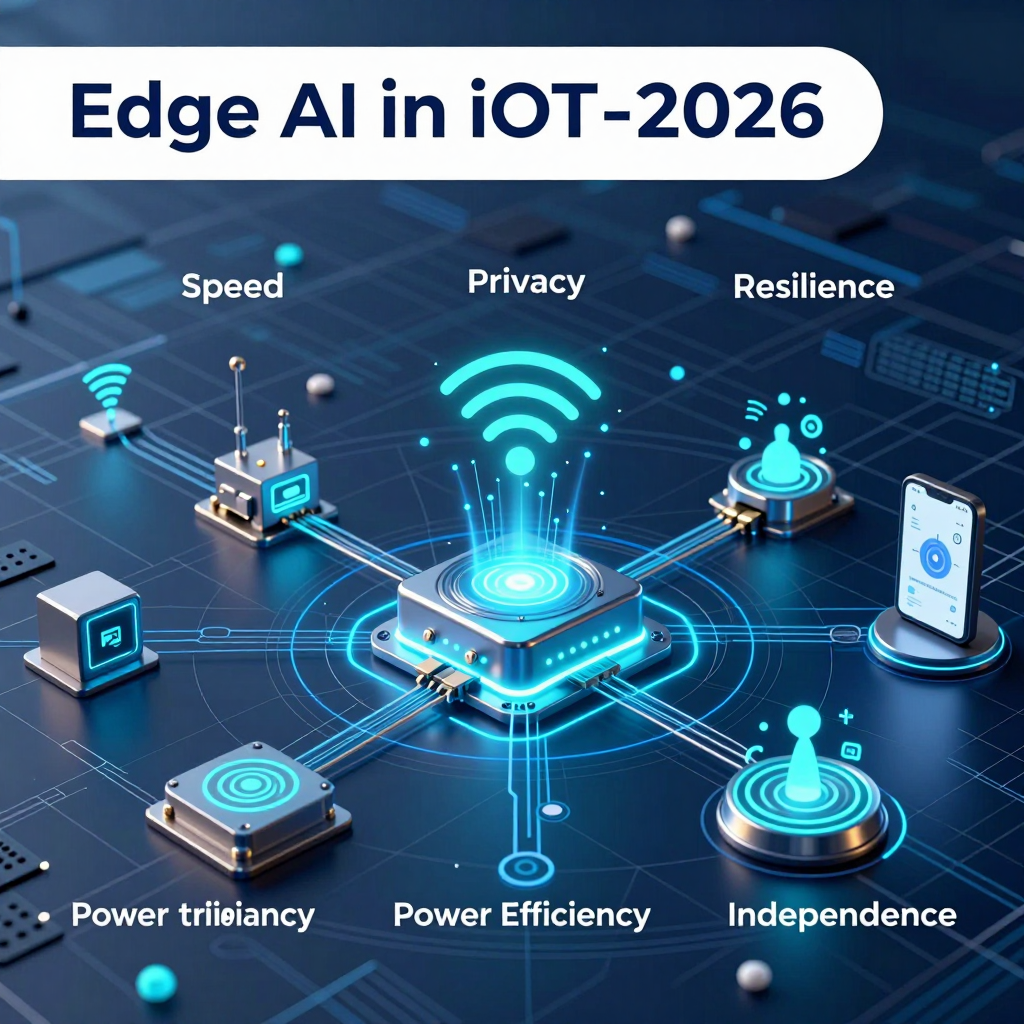
- Ultra-low latency decision-making: Devices infer instantly on-site without waiting for data transmission and analysis. This is decisive in scenarios like defect detection on production lines, medical alerts, and collision avoidance in robots.
- Enhanced data privacy protection: Original data is processed locally, reducing the exposure of sensitive information. Only “results” (such as anomaly flags, scores, events) need to be sent externally if required.
- Reduced network dependency and improved resilience: Devices maintain independent function even when connections are unstable or broken. This ensures system continuity in remote sites, moving vehicles, and disaster situations.
- Improved bandwidth and power efficiency: Since data isn’t constantly sent to the cloud, communication volume drops, cutting costs and battery consumption. This efficiency is especially noticeable in battery-powered sensors, wearables, and distributed equipment.
From an IoT Architecture Perspective: What Changes?
Implementing an Edge AI IoT platform is far more than just “adding AI models.” Real success hinges on architectural choices encompassing edge computing, wireless connectivity, and security.
- Edge compute design: Models must be lightweight (using quantization, pruning, etc.) to fit device CPU/NPU capabilities, memory, and power constraints, coupled with robust update strategies like OTA (over-the-air).
- Connectivity design: Communication frequency and data types vary by environment (Wi‑Fi, cellular, LPWAN). Rather than continuous “raw streaming,” many systems adopt event-driven transmission, sending alerts only when necessary.
- Security design: The edge becomes an attack surface in IoT. Fundamental principles include encrypted communication (TLS, etc.), device authentication, access control, and allowing data transmission only from trusted endpoints. Adding model tampering protection, secure boot, and key management ensures operational integrity.
Enterprise IoT Use Case: From “Data Collection” to “On-Site Execution”
Enterprise IoT is evolving beyond simple monitoring to intelligence that acts directly at the edge. Platforms that flexibly collect vast device data and provide ultra-low latency processing pipelines make scenarios like manufacturing optimization, predictive maintenance, and advanced emergency response a reality.
Ultimately, the true value of Edge AI IoT platforms isn’t “gathering more data” — it’s about making the right decisions on-site at the precise moment they're needed. This approach cuts operational costs while directly elevating safety, quality, and service experience.
Core Technologies and Astonishing Benefits of Edge AI IoT
Minimizing latency, extending battery life, and handling network failures with ease? If this sounds exaggerated, now is the moment to pay attention. Edge AI IoT breaks away from the traditional IoT method of “sending data to the cloud for processing” by executing AI inference directly on the device (the edge) where the data is generated. This subtle shift in architecture revolutionizes performance, cost, security, and operational reliability all at once.
How Edge AI Reduces Latency in IoT
In traditional IoT, sensor data travels through the network to the cloud → is analyzed by servers → and the results descend back to the device. During this, delays accumulate due to factors like wireless link quality, backhaul congestion, and cloud processing queues, becoming a bottleneck in scenarios requiring “immediate decisions.”
Edge AI, on the other hand, adopts the following structure:
- Local Inference: Inputs from cameras, sensors, microphones, etc., are immediately processed within the device’s NPU/TPU/MCU
- Event-driven Transmission: Instead of uploading all raw data, only meaningful results like “anomalies” are sent to the cloud
- Local Closed Loop Control: Judgement and control form a closed loop on the device or site, enabling instant reactions without network round trips
As a result, IoT applications that demand responses within a few to several tens of milliseconds—such as smart factory safety detection, medical device alarms, and robot control—experience dramatically improved perceived performance.
Why IoT Device Battery Life Extends
Many IoT devices need to last months or years on battery power. One of the biggest power drains is wireless communication. The more frequently and heavily data is transmitted, the faster battery drains.
Edge AI plays a crucial role in extending battery life.
- Reduced Communication Frequency: Transmission occurs only when locally determined necessary
- Smaller Data Size: Instead of sending raw data (images, audio, high-frequency sensors), only lightweight results like labels, scores, or summaries are transmitted
- Optimized Sleep Strategies: Combined with event-triggered wake-up methods, idle power consumption can also be minimized
In short, Edge AI isn’t just “adding AI,” it represents a structural design that drastically lowers IoT operational costs—power and communication expenses—at their core.
IoT That Keeps Running Even When Network Fails: The Secret of Resilience
Field IoT experiences communication disruptions more often than you might think—in elevator shafts, underground parking lots, factories with radio interference, or disaster situations. The higher the cloud dependency, the more severe the functionality degradation during outages.
Edge AI IoT creates a system that “keeps going even when disconnected” by these principles:
- Offline Inference: Models reside locally, enabling decision-making without network connectivity
- Store & Forward: Event logs and summary data are stored and transmitted sequentially once connection is restored
- Local-first Policy: Critical functions such as safety, control, and alerts are executed locally first
This resilience is not mere convenience but translates directly into reduced downtime in industrial sites, enhanced safety in healthcare, and service continuity in smart cities.
‘Intelligent’ Processing That Works Even with Limited IoT Bandwidth
Workloads like video analysis, voice recognition, and vibration analysis involve large, continuous raw data streams that easily saturate networks. Edge AI doesn’t just “avoid” bandwidth constraints—it strategically leverages them.
- Filtering and summarizing at the edge before transmission: Only selected clips or extracted features are uploaded
- Distributed processing across multiple local devices: Various IoT nodes share roles for processing, while the cloud handles integration, learning, and management
- Clear cloud-edge role separation: The cloud focuses on model training, deployment, and policy management, whereas the edge performs real-time inference and control
In essence, Edge AI IoT evolves beyond “upload everything because the cloud is powerful” to a design philosophy centered on uploading only what’s worth uploading for maximum efficiency.
Why IoT Security and Privacy Are Structurally Enhanced
Uploading all data to the cloud increases risks of personal and industrial confidential data leaks. Edge AI improves security and privacy by fundamentally changing data flows.
- Local processing of sensitive data: Raw data such as faces, voices, and patient information stay on site for judgement
- Minimal data transmission: Less data means a smaller attack surface
- Standard encryption and authentication-based transmission: When data must be sent, trusted endpoints communicate via TLS and access controls
Of course, shifting functions to the edge increases the importance of device-level security measures like firmware integrity, key management, and secure updates. But when properly designed, Edge AI IoT becomes a rare solution that simultaneously enhances performance and security.
The Evolution of IoT Architecture: Enabling a Smart World
From smart appliances to medical devices and industrial platforms… IoT devices cannot rely on mere “connectivity” alone. Each faces unique constraints such as power, latency, security, network quality, and operational lifespan. Thus, the central question today converges on one key issue: How can we design the optimal edge AI architecture tailored to each environment? Let’s explore this technological evolution step by step.
How the Shift to IoT Edge-Centric Design Has Changed Architectural Criteria
In the past, IoT commonly followed a “sensor → cloud” model, where data was uploaded and analyzed in the cloud before issuing commands back. However, this approach frequently ran into limitations such as:
- Latency: Delayed alarms, controls, and safety-related decisions
- Bandwidth costs: Heavy burden transmitting raw data like high-resolution video, vibration, and audio
- Connectivity instability: Systems halt when networks drop
- Privacy and sensitive data: Burden of sending sensitive information externally
With the rise of edge AI, the architectural focus has shifted from “Where should data be sent?” to “Where should decisions be made?” In other words, performing AI inference directly on devices aims to deliver real-time decision making, enhanced privacy, reduced network dependency, and improved resilience—all simultaneously.
Core Components of IoT Edge AI Architecture: What to Combine
Modern IoT deployment hinges on a combination of three major pillars.
IoT Edge Compute: Where to perform inference and how to operate models
- On-device inference: Decision-making right next to cameras, microphones, and sensors (lowest latency, highest privacy)
- Gateway inference: Aggregating and inferring data from multiple devices nearby (site-level optimization)
- Cloud/data center training: Training centrally, inference at the edge (model updates delivered via pipelines)
A crucial insight here is that “doing everything at the edge” is not the goal; the most practical approach is a hybrid model where inference happens as close to the edge as possible, while training and long-term analytics are centralized.
IoT Connectivity: Network quality equals system quality
The stronger edge AI becomes, the more the network evolves from being an “essential infrastructure” to a selective synchronization channel—
- Uploading only events, summaries, or logs when connectivity is good to save bandwidth
- Continuing local operations when the connection is poor to maintain service continuity
IoT Security: From ‘transmission encryption’ to ‘endpoint trust’
In enterprise environments, device data collection and processing mandates standard protocol encryption like TLS, authentication, and access control throughout. As edge AI expands, attack surfaces extend to devices themselves, so beyond “protecting data in transit,” it becomes vital to build architectures where only trusted endpoints can exchange data and commands.
How Deployment Constraints Shape IoT Architecture Differently
Even within IoT, the "right" answer shifts dramatically depending on deployment context.
- Smart appliances/home automation: High demands for low power, low cost, and privacy → local inference + summary uploads work best
- Medical devices: High safety, regulatory demands, and data sensitivity → on-device decision making (alarm/anomaly detection) + strong authentication and logging
- Industrial platforms/robots/manufacturing: High downtime costs and unstable connectivity → site gateways/edge servers for ultra-low latency processing + predictive maintenance pipelines
In short, IoT architecture has evolved from “one-size-fits-all templates” to a design challenge that optimizes based on specific constraints as inputs.
The ‘Real-time Pipeline’ Aim of IoT Enterprise Architecture
From an enterprise perspective, IoT platforms are no longer mere storage layers but evolving into systems that provide massive real-time device data ingestion → elastic pipelines → low-latency processing. With such a structure in place, tasks demanding instant judgment—such as manufacturing optimization, predictive maintenance, or emergency response—can integrate generative AI and analytics in real time.
The key takeaway is clear: Decide quickly at the edge, learn extensively at the center, and connect safely across the entire chain. This is the practical conclusion toward which contemporary IoT architecture is evolving.
IoT Enterprise Innovation: A New Standard for Real-Time Data Processing and Security
If you can handle data emitted by countless devices in real time and securely, the rules of competition in enterprise IoT change completely. Solutions like Oracle OCI IoT Platform stand out not simply by providing “connections,” but by uniting massive device data ingestion → elastic pipeline processing → low-latency analytics and decision-making into a single operating system. As a result, manufacturing floors become faster, and emergency response systems become more accurate.
IoT Real-Time Pipelines: From ‘Collecting’ to ‘Instant Processing’
In traditional IoT architectures, device data was often gathered in the cloud and processed in batches, with significant delays before analysis results were sent back to the field. In contrast, enterprise-grade platforms are designed with the following requirements in mind:
- Massive Concurrent Ingestion: Thousands to tens of thousands of endpoints such as factory line sensors, robots, vision cameras, and energy meters generate events simultaneously.
- Elastic Scalability: Pipelines automatically expand during traffic surges (peak hours, alarm floods during failures) to reduce bottlenecks.
- Low-Latency Processing: Collected streams are immediately refined, aggregated, and connected to rule-based detection or model-based inference, dramatically shortening decision times.
This “instant processing” is crucial because events like manufacturing defects, equipment anomalies, or logistic temperature deviations lead to exponentially rising costs the longer detection is delayed.
IoT Security Design: TLS Encryption and ‘Trusted Endpoints’ Only
In enterprise IoT, security is not a feature but a fundamental premise. As data volume grows, the attack surface expands, requiring platforms to systematically manage transmission, authentication, and access control.
- Encrypted Transmission: Data moving from devices to the platform is encrypted using industry-standard protocols like TLS to minimize risks of eavesdropping and tampering.
- Authentication and Authorization: Only registered and verified devices are permitted to send data, with access scopes to data and APIs limited according to permissions.
- Endpoint Trust Assurance: Data from unknown sources not only diminishes analytic value but endangers operations, making a chain of trust indispensable.
In other words, for real-time IoT success, just as important as rapid pipelines is the architecture that ensures only data from verified endpoints flows through.
IoT Manufacturing Innovation: Predictive Maintenance and Process Optimization Become ‘Operational Norms’
With environments equipped for real-time ingestion and low-latency processing like Oracle OCI IoT Platform, manufacturing innovation transforms from a “project” into an “operational standard.”
- Predictive Maintenance (PdM): Continuously collecting signals such as vibration, current, temperature, and noise to detect anomalies early and minimize downtime through planned maintenance.
- Process Quality Enhancement: Detecting real-time signs of defects (dimensional deviation, pressure anomalies, temperature drift) to immediately adjust line conditions.
- Accelerated On-site Decision-Making: Bypassing dashboard waits by linking event-based work orders, alerts, and automated controls.
The key is not just “gathering data” but enabling operations to move as soon as the data arrives.
Evolution of IoT Emergency Response: Faster Detection, More Accurate Dispatch
In emergency scenarios (fire, equipment accidents, patient monitoring, infrastructure failures), 1 to 2 minutes of delay drastically influences damage extent. Real-time IoT platforms deliver value by:
- Instant Event Capture: Collecting sensor events without delay to trigger alerts immediately upon threshold breaches or anomalous patterns.
- Precision in Situational Awareness: Combining multiple data streams rather than relying on single sensors to reduce false alarms and automatically prioritize incidents.
- Trust-Based Automation: Running workflows only on data from authenticated devices to minimize chaos from erroneous signals.
Ultimately, the next stage of enterprise IoT is not “more devices,” but automated decision-making built on faster processing and stronger security. Approaches like Oracle OCI IoT Platform satisfy these two pillars (real time and security) simultaneously, elevating manufacturing innovation and emergency response to the next level.
Challenges and Opportunities of Edge AI IoT Platforms Toward 2030 from an IoT Perspective
From smart cities to healthcare and Industry 4.0, the story of new innovations unfolding within the future markets shaped by Edge AI IoT platforms has already begun. As we approach 2030, IoT differentiation will no longer rely on mere “connectivity,” but on the intelligence that makes autonomous decisions on-site (Edge AI), which will determine competitive advantage. However, this transition comes with distinct technical challenges as significant as the opportunities.
IoT Market Opportunity: From “Connected Data” to “On-site Decision Making”
The core transformation driven by Edge AI IoT platforms is simple yet profound. The focus shifts from sending data to the cloud to devices performing instant inference and sharing only the necessary results. This structure leads to 2030-era value creation such as:
- Smart City IoT: Traffic cameras and environmental sensors detect events (signs of accidents, sudden congestion spikes, rapid increase in fine dust) instantly at the edge, enabling control centers and signaling systems to respond without delay. Bandwidth usage shifts from streaming “full video” to transmitting only “meaningful alerts,” reducing operational costs simultaneously.
- Healthcare IoT: Wearables and hospital equipment analyze biometric signals in real time to identify risk patterns early. Highly sensitive personal data are processed locally, with only anonymized and summarized indicators transmitted, a method likely to become widespread.
- Industry 4.0 IoT: Equipment vibration, current, and temperature data are inferred at the edge to immediately identify anomalies and reduce downtime through predictive maintenance. Especially in sites with unstable networks, independent operation lowers production risks.
In summary, by 2030, the expansion of Edge AI IoT platforms will redefine IoT’s role from “large-scale collection” to “large-scale on-site decision-making.”
IoT Technology Challenges: The Wall of Making Edge AI a ‘Deployable Product’
While on-site inference is enticing, complex constraints simultaneously come into play during actual productization. The representative challenges companies will face include:
- The Power-Heat-Performance Triangular Constraint: IoT devices have limited battery life, heat dissipation, and form factor. Even the same model’s inference performance can fluctuate depending on on-site temperature, vibration, and power quality. Choosing hardware accelerators (NPU/TPU/GPU/MCU), model optimization (quantization, pruning), and scheduling become critical design factors.
- Connectivity Uncertainty and Data Consistency: The edge must operate offline as well. Deciding when, with what priority, and under what quality assurances to synchronize local inference results (store-and-forward, event-driven transmission, latency tolerance design) is essential.
- Expanded Attack Surface for Security: It is no longer enough to defend the cloud solely; countless endpoints become the security boundary. Transmission encryption (TLS) is just the baseline. Device authentication, key management, secure boot, firmware integrity, and OTA (over-the-air) update systems must be established for “operable IoT.”
- Model Lifecycle Operation (MLOps/EdgeOps): On-site data distributions drift over time. Platforms must take responsibility for monitoring models, detecting performance degradation, and securely redeploying. In other words, IoT operations must now see device management + data pipeline + model management as one integrated entity.
IoT Platform Opportunity: The Intersection of ‘Low Latency, Large Scale, Reliability’ Desired by Enterprises
As 2030 approaches, enterprises seek not “edge or cloud,” but a hybrid architecture. The edge handles real-time inference and immediate control, while the cloud manages large-scale aggregation, long-term analysis, model training, and policy/authorization management. When this structure takes hold, the opportunities grow as follows:
- Standardization of Real-Time Pipelines: Demand for IoT platforms capable of simultaneously collecting massive device data and offering low-latency processing rises. End-to-end pipelines connecting on-site events to “immediate decision-making” become a competitive edge.
- Industry-Specific Reference Architectures: Smart city, healthcare, and manufacturing face diverse regulatory and safety requirements, making generic solutions insufficient. Platforms offering validated industry-specific templates for security, data governance, and model operations are poised to lead.
- New Revenue Models: Shifting from device sales to service-oriented IoT businesses through “inference function (model) subscriptions,” “performance-guaranteed maintenance,” and “event-based billing” has huge expansion potential.
A Realistic Conclusion for IoT by 2030
Edge AI IoT platforms are poised to become one of the most powerful catalysts in growing the IoT market by 2030. Yet the game will not be determined by “model accuracy,” but by architectures resilient to on-site constraints (power, connectivity, security, operations) and large-scale deployment capabilities. The one question we must ask now:
Will our IoT stop at data collection, or will it evolve into an intelligent system that creates value on-site?
Comments
Post a Comment