 \n
\n
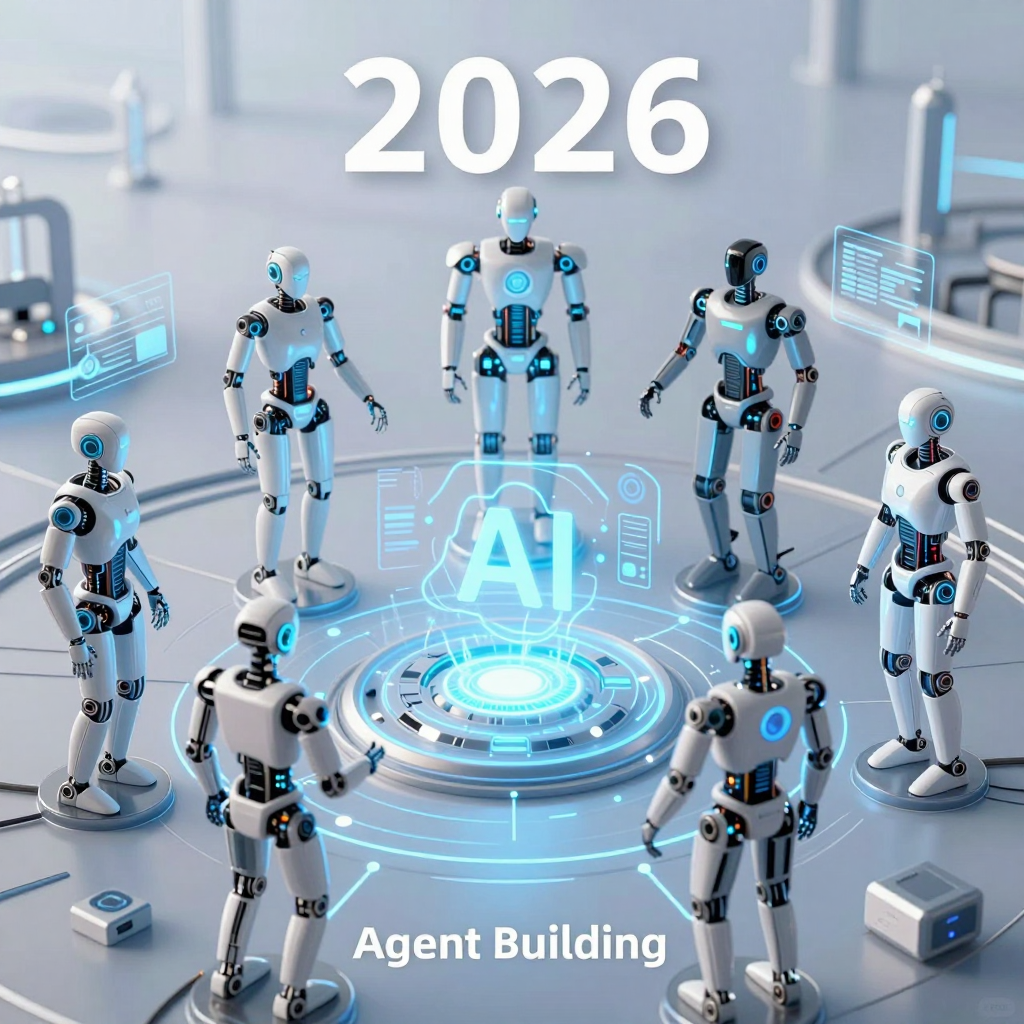
Revolutionizing AI Agent Development: The Rise of the Agent-Building Agent
Can you believe that AI could create agents automatically without you having to develop them yourself? In 2026, this vision is becoming reality, completely changing the rules of AI agent development. The focus is no longer on “how to craft good prompts” but has shifted to how an organization defines and communicates its operational knowledge.
From Manual Development to Automated Construction: A Shift in Agent Development
Traditional agent development was much more like “software development” than many realized. It involved designing customer journeys, defining exception cases at each step, integrating external systems, running repeated simulations and tests, and manually categorizing and fixing bugs and issues.
This process wasn’t just time-consuming—it often resulted in loss of domain expertise during the translation of frontline knowledge into code.
In contrast, the Agent-Building Agent flips this process on its head. AI takes over the painstaking design and implementation tasks, allowing users to focus solely on what they want the agent to do. In other words, the burden of coding diminishes while the quality of knowledge definition becomes the key driver of success.
Ghostwriter by Sierra: A Tangible Example of Agent-Building Agents in Action
The clearest real-world example of this shift is Sierra’s Ghostwriter. Its approach is simple yet revolutionary.
- Users upload SOPs, customer support call transcripts, process documents, photos of whiteboard sketches, voice recordings, or
- Simply describe in natural language the goals of “what kind of agent should do what.”
Ghostwriter then internally performs the following:
- Extracts Core Actions (Normal Flows): Structures the main stages and decision points of the consultation or workflow
- Identifies Edge Cases: Categorizes frequent exceptions, branches, and error scenarios encountered on the ground
- Transforms into Production-Ready Form: Packages the agent to handle voice, chat, and email channels while supporting over 30 languages
In short, instead of “coding an agent,” the concept is better viewed as uploading operational knowledge to be ‘compiled’ into an agent. Here, Agent-Building Agents are not just simple automation—they represent a fundamental shift in the development paradigm itself.
Why Is This Technology Spreading Now? Signs of Market Maturity
This momentum isn’t just hype—the reality is shown by actual deployments. Sierra, just three years after its founding, collaborates with 40% of Fortune 50 companies, delivering Agents as a Service across industries including ADT, Chime, Cigna, Nordstrom, Rocket Mortgage, and SiriusXM.
This signifies two key points:
- The technology has reached “operational maturity”: It meets not only accuracy but also reliability, scalability, and maintainability standards
- The value proposition is crystal clear for enterprises: Shortened development times, cost savings, and removal of AI adoption barriers for non-technical teams
Ultimately, the defining change in 2026 is not just that agents are smarter—it’s that the method of creating agents has been automated. This automation shifts focus from “developer-centric” to “domain knowledge-centric,” accelerating AI adoption to an entirely new level.
Ghostwriter Agent: Fully Automating the Tedious Agent-Building Process
Say goodbye to manual coding and needless repetition! Sierra’s Ghostwriter flips the agent-building process on its head, enabling “just define what you want in one sentence, and the Agent delivers.” Previously, endless cycles of journey tweaks, integrated coding, simulation, and issue classification fell on human shoulders, but Ghostwriter automates the entire workflow—from design → implementation → verification/improvement.
How Ghostwriter Agent Transformed Development: The Era of ‘Definition’ Instead of ‘Coding’
Traditional agent development typically hits these bottlenecks:
- Scattered requirements across documents and field knowledge: SOPs, call records, operation guides, personal know-how, and more.
- Infinite edge cases: The more exceptions you handle, the more complex rules and states become.
- Lengthy testing and fixes: Repeated loops of simulation → failure analysis → prompt/logic tweaking → redeployment.
Ghostwriter changes the very input itself. Instead of complex design docs or code, users simply provide real-world data such as:
- SOPs and process documents
- Customer support call recordings
- Whiteboard sketch photos
- Voice records, email/chat logs
- Or a natural language explanation of “our desired business goals”
From these inputs, Ghostwriter extracts the core actions (behavioral rules) and edge cases (exceptions/branches), structuring them into an immediately executable Agent.
Ghostwriter Agent’s Core Technology: Automatically Detecting Edge Cases
Agents usually fail in production not due to “normal flows,” but because of “exceptional scenarios.” Ghostwriter excels by systematizing exception handling—traditionally imagined by humans—through this process:
- Identify recurring intent/situation patterns from uploaded materials.
- Outline necessary information-gathering questions and policy/regulation-based constraints for each scenario.
- Locate potential failure points (ambiguities, data gaps, permission issues, etc.) and implement branch handling.
- Refine the dialogue flow from a user experience perspective and lock it into an operational format.
In short, Ghostwriter doesn’t create “chatbots that just sound plausible,” but focuses on building procedure-compliant Agents essential for real-world operations.
Production-Grade Ghostwriter Agent: Multi-Channel and Multilingual from the Start
Ghostwriter aims to deliver not just demos, but production-ready agents. Therefore, output formats go beyond simple chat:
- Multi-channel support across voice, chat, email, etc.
- Support for 30+ languages ideal for global operations
- Designed with production stability in mind (consistent policy adherence, handling exception flows)
Ultimately, users gain access not to “a model running in a chat UI” but to Agents ready to engage with actual customer touchpoints and business processes—faster.
The Shift Ghostwriter Represents: Domain Experts Building Agents Themselves
The biggest change Ghostwriter brings? The AI adoption driver shifts from development teams to domain experts. It’s no longer about who writes the best code but who knows the process best—uploading materials and defining goals to instantly create Agents.
- Reduced development time: fewer repetitive integration and correction cycles
- Cost savings: less dependence on specialized personnel for agent building
- Accelerated scaling: swift replication and deployment of tailored agents per team
In summary, Ghostwriter isn’t just “technology to build agents” but a prime example of technology that enables building agents (Agent-Building Agent)—automating tedious setup work and opening new paths for enterprises to scale Agents in operational form.
Explosive Growth and Real-World Adoption: The Moment Agents Moved from "Experimentation" to "Operation"
Did you know 40% of Fortune 50 companies are already using them? The real reason giants like ADT, Chime, and Cigna chose Agent-Building Agents isn’t just because “AI is smart.” It’s because they can immediately save money and time, control risks, and standardize quality on the ground.
Why Agents Spread So Quickly: The Bottleneck to Production Deployment Has Disappeared
Traditionally, building agents for customer centers meant revising journey designs, coding integrations with CRM/payment/authentication systems, running simulations, and manually classifying issues. Two major bottlenecks slowed this down.
- The cost of translating domain knowledge into development outputs: It took a long time to convert SOPs and consulting know-how into code, rules, and flows.
- The explosion of edge cases: “Exceptions” existed only in the field and weren’t documented, resulting in mass discovery only after launch.
Agent-Building Agents like Ghostwriter tackle these bottlenecks head-on. By ingesting SOPs, customer support call records, process documents, and even photos of whiteboard sketches as input, they identify core actions and edge cases and automatically assemble them into production-level agents that operate via voice, chat, and email. In other words, the process shifts from “development” to an operational model focused on Define → Verify → Deploy.
Three Practical Reasons Why ADT, Chime, and Cigna Chose Agent-Building Agents
When large enterprises adopt new technologies, operability takes priority over mere “possibility.” Their real drivers usually boil down to:
1) Consistency in large-scale operations (quality standardization)
In thousands-strong support teams, response quality varies by person. Agents standardize responses based on SOPs and instantly apply updates across all channels. For industries like insurance (Cigna), where regulations and disclosure obligations are critical, this very consistency is risk management.
2) Dramatic reduction in costs for multi-channel, multi-language expansion
Agents supporting voice, chat, and email simultaneously in 30+ languages turn new region or channel expansions from “recruit and train” to “configure and verify.” The broader the customer touchpoints—as in retail, finance, healthcare—the more this transforms cost structures.
3) Structural simplification of integration and maintenance
In enterprise environments, “continuous fixing” beats “one-time building” in terms of cost. Agent-Building Agents absorb change requests (policy shifts, promotions, product updates) through natural language requirements and internal document updates, then recompose flows and behaviors accordingly. The result? Shorter release cycles and fewer bottlenecks between operations and development teams.
How “Agents as a Service” Is Spreading: From Pilots to Platform Adoption
The market isn’t about one-off PoCs anymore but platform-level adoption. The fact that 40% of Fortune 50 work with these agents speaks volumes. Large enterprises don’t settle for a single agent. They expand horizontally across customer service, payments, memberships, order changes, refunds, account recovery—and demand the following capabilities:
- Auditability (tracking why an answer was given)
- Quality control (automated, repetitive testing, simulation, and issue classification)
- Organizational scalability (operational processes hold even as teams grow)
Agent-Building Agents meet these demands not through isolated development, but via a loop of generation, verification, and improvement. Consequently, the market now sees agents not as “new features” but as productivity infrastructure that transforms operating systems—fueling their explosive proliferation.
Multi-Agent Agent Systems: Revolutionizing AI Quality through Division of Labor
How far can the quality of outcomes improve if multiple specialized AI agents collaboratively solve complex tasks? Multi-agent systems move away from entrusting everything to a “single all-purpose agent” and instead adopt an approach that divides roles and implements mutual verification structures to reduce failure rates. The design principles proposed by AWS distill this idea into a production-ready form, serving as a practical guide that dramatically elevates AI quality.
Why Multi-Agent Agents Are Needed: Context Overload and Single Points of Failure
A single agent attempting to hold vast information and handle everything from “planning → execution → verification → reporting” often encounters these problems:
- Context Overload: Requirements, policies, domain knowledge, and exceptions mix, diffusing focus.
- Single Point of Failure (SPOF): If the plan is flawed, execution and results cascade into failure.
- Limitations of Self-Verification: Confirming outcomes from the same model’s perspective tends to leave errors unnoticed.
Multi-agent systems tackle this through division of labor and cross-verification. Each agent specializes within a narrow scope of responsibility, while other agents review the work, creating a structure where “AI monitors AI.”
AWS-Based Multi-Agent Architecture: Layering Creates Quality
AWS’s approach breaks down complex work into a hierarchical role system. The key is separating the “planning agent” from the “execution agent” and placing an “oversight and coordination agent” above them to secure stability.
Step 1: Coordinator → Planner → Plan Reviewer
- Coordinator: Defines the scope of requests and success criteria (clarifying what counts as ‘done’).
- Planner: Breaks down tasks step-by-step and creates execution plans encompassing tools, data, and constraints.
- Plan Reviewer: Detects omissions (edge cases, policy breaches, risks) and requests corrections.
→ This stage functions as a quality gate that “reduces failure before execution.”
Step 2: Supervisor (Orchestration Agent)
- Calls specialized agents according to the plan, managing task sequences and dependencies.
- Applies operational policies like retries, fallback routes, and escalation to humans upon failure.
→ In production, the Supervisor is the central axis maintaining both stability and cost efficiency.
Step 3: Coder / Validator / Reporter / Tracker (Specialized Execution Agents)
- Coder: Handles “creation,” including coding, integration, and modification.
- Validator: Takes charge of “verification,” such as testing, consistency checks, and policy compliance.
- Reporter: Focuses on “communication,” summarizing results, organizing evidence/logs, and user interaction.
- Tracker: Manages “operations,” recording progress, categorizing issues, and gathering reproducibility data.
→ Separating creation and verification shifts results from “plausible” to “trustworthy.”
How Multi-Agent Systems Boost Quality: Division, Verification, and Resilience
Multi-agent systems don’t simply increase the number of agents—they structurally enhance quality by the interplay of three core mechanisms:
- Role Separation for Expert Focus: Planners optimize plans, Validators concentrate on error detection. This specialization improves the completeness of each phase compared to a single agent doing all tasks.
- Cross-Verification to Reduce Hallucinations and Omissions: The explicit presence of “critics” like Plan Reviewers and Validators makes passing errors difficult.
- Built-in Resilience: The Supervisor executes retries, detours, and partial rollbacks, minimizing operational interruptions—a critical factor in real-world services.
Practical Tips for Productionizing Multi-Agent Systems: A Checklist
When technically implementing, success hinges on these points:
- Clear Interfaces: Document each agent’s input/output formats (e.g., JSON schemas), scope of responsibility, and prohibited behaviors.
- Minimize Shared Memory: Sharing all information among all agents leads back to overload. Design so each receives only “necessary information” efficiently.
- Quantify Verification Criteria: Validators must have pass/fail criteria beyond “looks good,” such as test passing, policy checklists, and evidence links.
- Essential Logging and Tracking: To reduce operational costs, multi-agent systems need traceability for bug identification.
Ultimately, multi-agent systems raise AI quality and operability simultaneously through division of labor. Acknowledging the limits of single agents and embedding roles and verification into the architecture transforms AI from a “demo” into a genuine “service.”
The Future of AI Agent Democratization: Making AI Accessible to Everyone
AI is no longer the exclusive domain of technical experts. The biggest shift in 2026 is that the focus has moved from "developing" Agents to "defining" Agents. Agent-Building Agents automatically transform scattered unstructured knowledge within organizations—such as SOPs, consultation logs, process documents, and even whiteboard sketches—into production-level Agents. As a result, the bottleneck of "technical implementation" in AI adoption has significantly decreased, opening the door for frontline workers to drive innovation directly.
How Agent-Building Agents Are Changing the Development Paradigm
Traditional Agent development typically required the following steps:
- Designing and revising customer journeys
- Writing code for system integration
- Creating simulations and test cases
- Operating failure/issue classification and retraining loops
The most costly part wasn’t just model usage fees but the human and time costs of repeatedly designing, implementing, and validating. In contrast, Agent-Building Agents (e.g., the Ghostwriter family) take a different approach:
- Users provide the “desired outcomes” and “field materials”
- The system extracts core actions and edge cases from the materials
- It assembles deployable Agents considering channels like voice/chat/email and multilingual operations
In other words, the focus shifts from heavy coding to precise explanation of tasks and providing evidence-based design.
Why the Barrier to Agent Adoption Crumbles in Non-Technical Organizations
The core of Agent democratization is less about "who can create" and more about "what knowledge gets productized." Agent-Building Agents transform the strengths of non-technical organizations directly into productivity.
- Domain knowledge becomes the specification: Customer service scripts, operation manuals, and policy documents convert into the Agent's behavioral rules.
- Unstructured data becomes a development asset: Accumulated data such as call records and chat logs become training materials that elevate quality.
- Production requirements become defaults: Critical elements like multilingual support, channel integration, and exception handling start as the design baseline—not optional add-ons.
Consequently, typical AI adoption obstacles (ambiguous planning, lack of engineering resources, operational complexity) turn into definable problems, enabling frontline professionals to accelerate development themselves.
Technical Principles That Reduce Cost and Time: ‘Automated Design’ + ‘Validation Loop’
The reason Agent-Building Agents reduce cost and time is not merely automatic generation but the automation of design and systematized validation.
Knowledge Extraction (Understanding Layer)
Structures intents, policies, prohibitions, and exceptions from uploaded documents and logs. It models both “what should be done” and “what should not be done.”Behavior Modeling (Policy & Action Layer)
Constructs action graphs for conversation flow, tool invocation, approval, and escalation conditions aimed at achieving the customer’s goals. This replaces manual human design.Simulation-Based Validation (Evaluation Loop)
Automatically runs various scenarios (normal/edge/malicious inputs), classifies failure patterns, and iteratively improves prompts, policies, and tool configurations. It automates what used to be done by manual QA.
This architecture reduces not only “build time” but also operational quality maintenance costs, speeding initial deployment and simplifying updates and changes.
Multi-Agent Production Realizes Democratization
Agent democratization is not about one all-in-one Agent solving everything but is realized through a multi-agent structure dividing roles. Breaking down complex tasks with Coordinators/Planners/Reviewers planning, Supervisors orchestrating specialized Agents, and execution Agents like Coders, Validators, Reporters, and Trackers owning outcomes brings clear advantages:
- Prevents context overload: No single Agent bears all information, reducing errors and hallucination risks.
- Ensures reproducible quality: Clear role responsibilities make testing and validation easier and enable operational standardization.
- Scalable automation: As demands grow department by department, scaling by “adding Agents” keeps the overall system stable.
In short, while Agent-Building Agents make creation “easy,” multi-agent production makes operation “safe and reliable.”
The Future Shift: From ‘Should We Adopt AI?’ to ‘Who Defines It First?’
The competition now moves away from choosing models to how clearly and thoroughly business processes are defined and documented. Organizations that standardize their documents and logs, clarify exception rules, and formalize approval structures will expand Agents more rapidly. Ultimately, the future of AI Agent democratization goes beyond “anyone can build without coding” to anyone can automate their work as a product.
Comments
Post a Comment