 \n
\n
A 50-Year Challenge Begins: The Launch of Artemis 2
Humanity is heading back to the moon for the first time since 1972. What are the hidden stories behind this historic mission with four astronauts onboard? Artemis 2 isn’t about “landing on the moon” but about precisely proving the feat of “traveling to the moon and returning.” This journey, returning to Earth within 10 days, serves as the most realistic and critical rehearsal for the next step: a manned lunar landing.
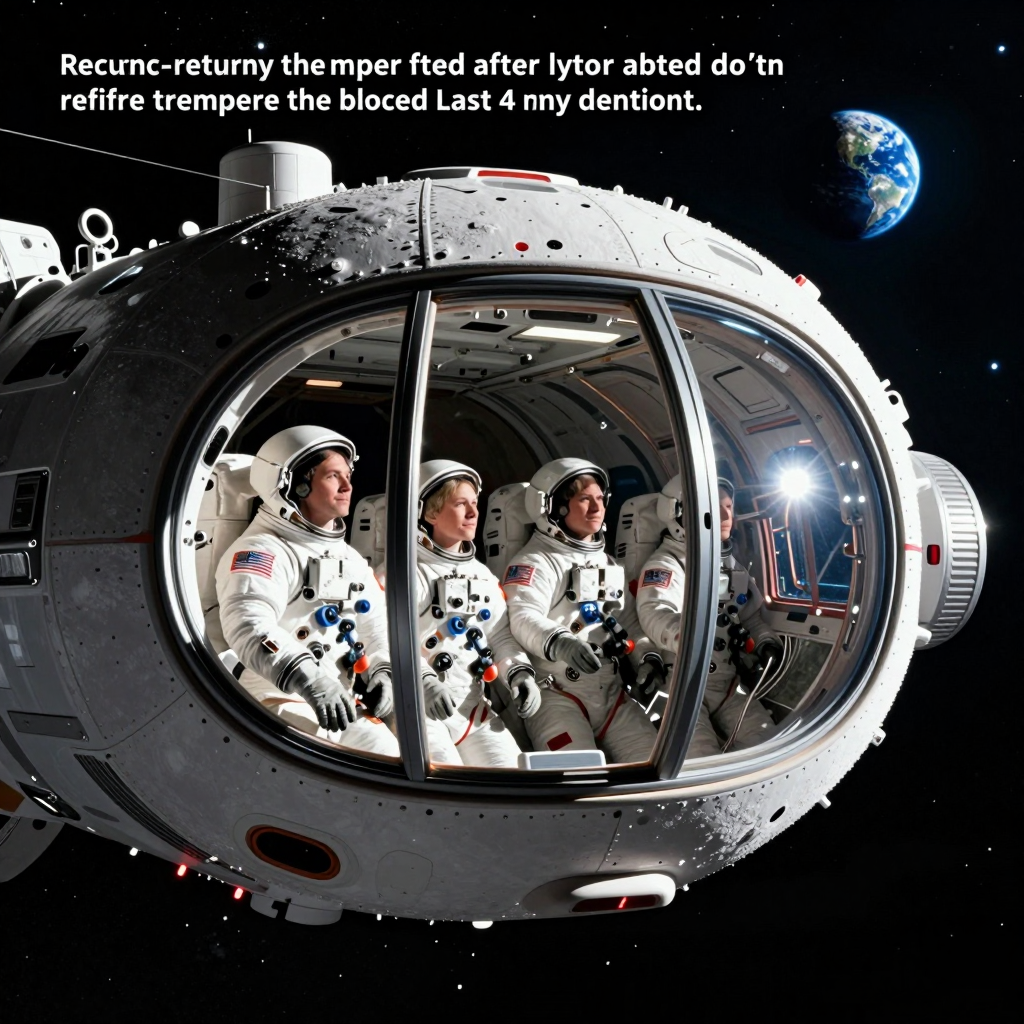
At the heart of this mission are four astronauts. Commander Reid Wiseman, pilot Victor Glover, mission specialist Christina Koch, and Canadian astronaut Jeremy Hansen will fly the Orion spacecraft on a fly-around mission around the moon. Their goal is not just a simple “visit” but to complete, with both humans and spacecraft, the full spectrum of lunar exploration necessities—crew operations, communication, navigation, life support, and safe return.
What makes Artemis 2 extraordinary also emerges in the ‘distance’ it will cover. On the sixth day of flight, Orion will travel beyond the moon to a point approximately 4,000 miles (6,400 km) farther from Earth, surpassing the Apollo 13 record. This means the four on board become the farthest-traveling humans in history. The phrase “going back to the moon” isn’t just symbolic; it marks the dawn of a new era in both numbers and records.
The early phase of the journey is equally fascinating. In the first 25 hours after liftoff, the crew maneuvers Orion to dock with the upper stage, which has separated into Earth’s high and irregular orbit, training the crucial docking skills needed for future missions. They judge distances visually rather than with rangefinders, maintaining a safe distance of at least 10 meters—demonstrating that the human ability of astronauts still plays a vital role in mission safety.
The trajectory toward the moon employs the famous free-return trajectory. This path leverages the gravitational forces of the moon and Earth, reducing fuel consumption while providing a relatively safe route back to Earth in emergencies. Beyond flashy new technology, artemis 2’s design is backed by time-tested orbital mechanics and risk management.
Ultimately, the core takeaway of this mission is clear. Artemis 2 is not just “a story of returning to the moon” but the first manned gateway humanity must pass through to stay on the moon again. Now, the next question remains: at this gateway to the moon, what data and experiences will Orion and the crew bring back to Earth?
The Journey of Astronauts and Record-Breaking: Artemis 2’s Tale of the ‘Longest Distance’
Circling the Moon—about 390,000 kilometers from Earth—without landing is a far more dramatic journey than you might imagine. The Orion spacecraft of Artemis 2 will fly around the Moon and return within roughly 10 days, but within that brief mission lies a moment where humanity will travel a distance never before reached, shattering records along the way.
Four Crew Members Take Charge of the First Crewed Lunar Flight in 50 Years (Artemis 2)
The mission’s crew includes Commander Reid Wiseman, Victor Glover, Christina Koch, and Jeremy Hansen. Though they won’t land on the Moon’s surface, these astronauts will rigorously test Orion’s capabilities and crew operations throughout the entire journey to the lunar vicinity. In essence, they will perform the human “final rehearsal” before a lunar landing.
Beyond the Moon, Up to 6,400 km Further… Artemis 2 Surpasses Apollo 13’s Distance Record
The highlight of the journey arrives on day six of the flight. After passing the Moon, Orion will reach approximately 4,000 miles (6,400 kilometers) beyond it, surpassing the crewed flight distance record set by Apollo 13 in 1970.
At this moment, the crew will be more than just travelers to the Moon—they will become the furthest voyagers in human history.
Returning on a ‘Free-Return Trajectory’: Artemis 2’s Safety Design Even at the Farthest Distance
Artemis 2 will utilize the free-return trajectory, famously known from Apollo 13. This flight path skillfully exploits the gravitational forces of the Earth and Moon, minimizing the need for heavy engine burns while ensuring that if anything goes wrong, the spacecraft can safely return to Earth.
This daring record-breaking mission is not a mere adventure but rather a “longest distance flight” designed with safety as the foundation, making the story of Artemis 2 even more thrilling.
Artemis 2: The Pinnacle of Cutting-Edge Technology and International Collaboration
From the European Service Module embodying German and European engineering to radiation detectors and mini satellites, what secrets of groundbreaking science will Artemis II unveil? The mission's essence goes beyond merely “going to the Moon”—it aims to realize a system where humans can safely travel near the Moon while gathering valuable data.
The Vital Role of the European Service Module (ESM) Supporting Artemis 2
The European Service Module (ESM) is the lifeline of the Orion spacecraft. It integrates essential functions for crewed flight such as propulsion, power, and thermal control, significantly boosting mission reliability. Especially during Artemis 2’s journey around the Moon and back to Earth, long-distance navigation and system dependability directly impact crew safety. The fact that European technology handles this “invisible core” makes this mission a shining example of international cooperation.
Artemis 2’s Precision Data Collection on Space Radiation
One of the most tangible dangers en route to the Moon is space radiation. Artemis 2 carries four M-42 EXT radiation detectors developed by the German Aerospace Center (DLR), which will measure the radiation environment between Earth and the Moon. This is not mere observation—it aims to secure high-resolution data critical for future long-term lunar missions, shaping shielding designs, mission operation standards, and crew exposure management.
The Ride-Along Mini Satellite, TACHELES CubeSat, on Artemis 2
Artemis 2’s technological advancements extend beyond the Orion spacecraft. The German small satellite demonstration project, TACHELES CubeSat, will also venture into lunar orbit. This dynamic where a large crewed spacecraft paves the way and small satellites swiftly conduct scientific and technological demonstrations illustrates how future lunar exploration is evolving into a modular, distributed ecosystem.
Ultimately, Artemis 2 will be remembered not just for “the distance to the Moon,” but for the density of its technology and the maturity of its collaboration that makes that distance traversable. With European and German hardware integrated, humanity’s return to the Moon is entering a more sophisticated and tangible phase than ever before.
The Mystery of Artemis 2’s Lunar Orbit Flight and Free-Return Trajectory
The path to the moon is designed not by “going straight and fast,” but by borrowing gravity for maximum efficiency. This is the core of Artemis 2’s mission. The Orion spacecraft utilizes a low-fuel, high-efficiency free-return trajectory, leveraging the combined gravitational forces of the moon and Earth like a colossal ‘space slingshot.’ Through precise navigation, it completes the round trip in just 10 days. On the surface, it might seem like a simple “flight around the moon,” but in reality, it is a meticulously calculated and safety-driven strategy.
Artemis 2’s Free-Return Trajectory: Saving Fuel While Ensuring Safety
A free-return trajectory is a route in which a spacecraft flying towards the moon bends its path by using lunar gravity and naturally returns to Earth with minimal additional propulsion. The appeal of this method is clear:
- Minimal Fuel Consumption: Instead of forcing major course corrections with engines, the route is shaped by using the Earth-moon gravitational fields.
- Safety in Emergencies: Even if the engine or critical systems fail, the trajectory itself works as a safety net by steering the craft back, significantly reducing mission risk.
- Rehearsal for Future Lunar Landings: It allows the verification of complex deep-space navigation, communications, and crew operations in an actual lunar environment, serving as a vital stepping stone to the next phase of missions.
This concept, famously proven by Apollo 13, reemerges in Artemis 2 as a core strategy, now combined with advanced navigation, communication, and thermal protection designs.
Artemis 2’s Lunar Orbit ‘Flight’: Why It’s Challenging Without Landing
While Artemis 2 skips lunar landing and instead performs a fly-around, this is far from a mere sightseeing tour. Near the moon, even slight deviations in speed, angle, or timing can alter the return trajectory and re-entry conditions dramatically. In other words, the fleeting moment of “just brushing past the moon” is actually the mission’s critical battleground.
Furthermore, on the 6th day of flight, Orion travels 4,000 miles (6,400 km) beyond the moon, setting a new distance record for human spaceflight. The farther it ventures, the greater the challenges from communication delays, radiation exposure, and navigation errors. This makes lunar orbit flight the most crucial technical proving ground.
Artemis 2’s Navigation ‘Strategic Secret’: Return is Determined Not by the Moon, But by Earth
The true mystery of the free-return trajectory is that the “way back from the moon” is not the key — instead, the return conditions are set from the moment the spacecraft leaves Earth. Initial trajectory adjustments, attitude control, and lunar approach angle together essentially predefine the speed, angle, and heat load of Earth re-entry.
NASA’s refinement to minimize atmospheric descent time and limit heat exposure during re-entry reflects this as well. Although lunar orbit flight appears to be a “moon-centered” event, the mission’s success hinges on the entire trajectory design that ensures the final crucial minutes back at Earth will be safe. Artemis 2 will demonstrate this intricate brilliance most dramatically—without even landing.
Artemis 2: The End of the Journey to the Moon, a New Beginning
Until the final moment of safely splashing down in the Pacific Ocean, Artemis 2 demonstrates how intricately engineered the mission to “go to the Moon and return safely” truly is. Although there is no lunar landing, this return scene becomes the decisive proof that makes the next era of manned lunar exploration a reality.
The Reentry Gamble: Building Confidence Through Heat Shield Improvements
The core of a spacecraft's return lies in its heat shield, which must endure the extreme heat generated during atmospheric reentry. Based on heat shield damage issues observed in a 2022 test flight, NASA chose to redesign Artemis 2’s heat shield while maintaining the fundamental design philosophy.
In addition, to reduce heat exposure during reentry, the mission adopts an approach that shortens atmospheric descent time, refining the “return process” itself to be more conservative and safer. As much as the technology to reach the Moon matters, the technology to accurately return to Earth from the Moon becomes the starting point for the next mission.
Splashdown Is Not the End but a Checkpoint: Mission Includes Recovery Operations
The moment a spaceflight is deemed successful is not just when the lander’s legs touch down. The entire process—from Orion’s splashdown in the Pacific to the deployment of Navy recovery ships safely retrieving the crew and capsule—is a complete system test.
The smoother this “endgame” is executed, the clearer the operational standards for future, more ambitious goals become—longer stays, more complex missions, and manned explorations that carry higher risks.
Evolution of Live Broadcast: An Era Where the Public ‘Joins’ the Moon Mission
One particularly impressive development in this mission is the real-time video broadcast. Artemis 2 transmits footage from inside Orion and throughout the mission with more advanced technology—from launch to just before splashdown—making the exploration feel like an unbroken, “live adventure.”
This is not mere promotion but a mechanism to transform space exploration into a social project. The public can witness astronauts’ decisions in real time, verify system stability with their own eyes, and gain solid reasons to support future investments and collaboration.
What the Return to the Moon Leaves Behind: Proof That Opens Doors for Future Exploration
Flying around the Moon and back may seem simple on the surface. But the true significance of Artemis 2 lies not in “going to the Moon,” but in standardizing the entire process of returning from the Moon.
Heat shield improvements, reentry profile adjustments, splashdown and recovery systems, and real-time broadcasting—all these factors working together turn the next lunar landing mission and plans for a long-term Moon base from mere ideas into an actionable roadmap.
Comments
Post a Comment