 \n
\n
The Brain: The Mysterious Organ That Governs Our Lives
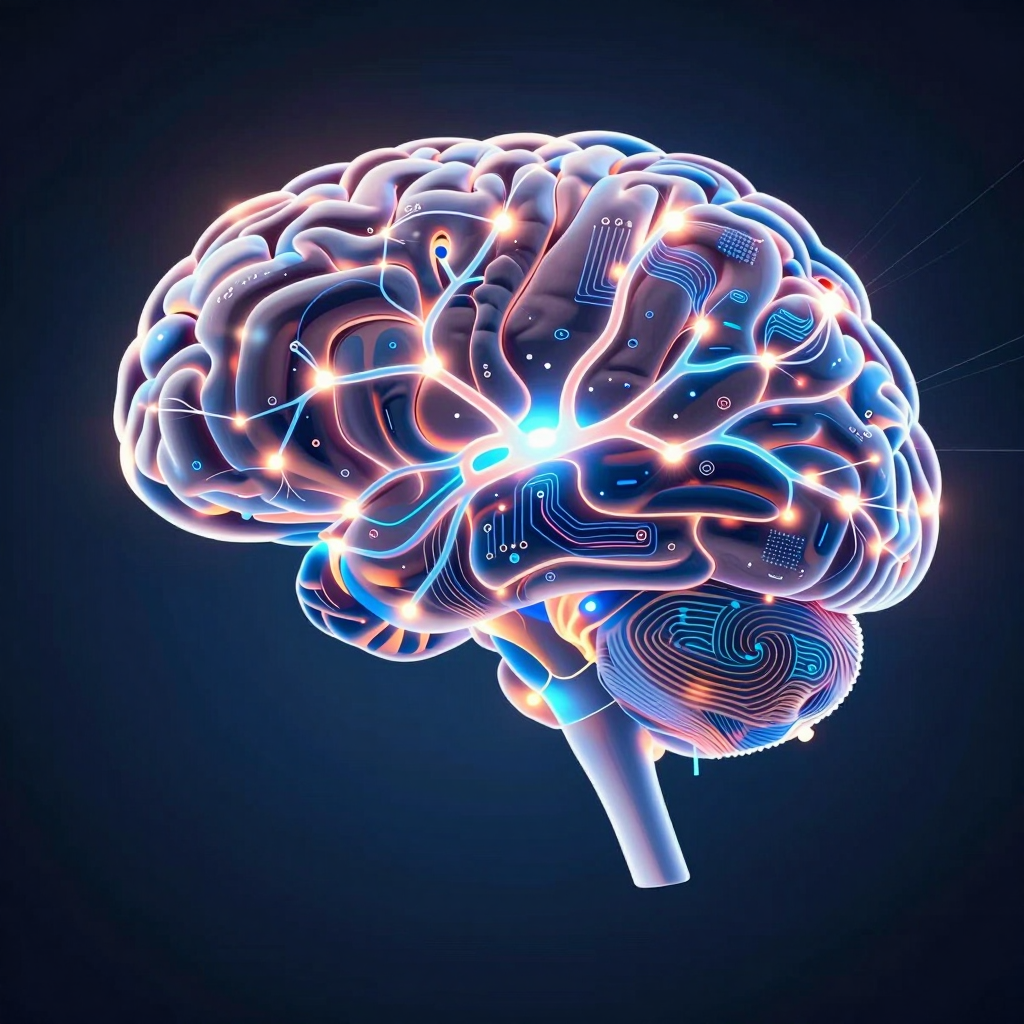
The brain is not just a simple organ. Did you know that every sensation we see, hear, and feel is determined by the brain’s remarkable neural activity? Even when viewing the same scene, why some days it appears vivid while other days it passes by unnoticed ultimately depends on how the brain chooses and interprets stimuli.
At the core are the brain’s neurons. Neurons transmit information through electrical signals called action potentials, and these signals combine to create sensory perception and behavior. Especially when we pay “attention” to a specific stimulus, the sensory cortex in the brain doesn’t just respond as one mass—it operates differently across each layer. Thanks to advanced technologies like ultra-high-field fMRI, we can now observe these layer-specific responses in the human brain with greater precision than ever before.
In this way, the brain acts like a “control center” that filters the vast influx of information every moment, assigns meaning, and decides the next move. In the upcoming sections, we will carefully explore how this intricate system wavers when faced with diseases and injuries, and how rehabilitation and technological advances expand the brain’s potential.
Waves of Neural Activity Cascading Through Layers of the Sensory Cortex: The Secret to Sensory Processing
The moment we focus on a sound or consciously observe an object before our eyes, the brain doesn’t just respond “more strongly”—it rearranges its responses in a far more sophisticated way. Ultra-high-field fMRI breaks down these changes into layer-specific reactions in the sensory cortex, offering clues on how the cognitive switch called ‘attention’ operates within the brain.
The Brain is Not a Single Mass, but a Stage with Layered Roles
The sensory cortex consists of multiple layers, each designed with distinct input and output flows. When sensory stimuli arrive, information from the outside world enters the cortex and spreads across layers for interpretation. When we pay attention, the brain amplifies responses in certain layers or strengthens connections in others, adjusting processing so that even the same stimulus is handled in a “more meaningful” way.
Ultra-High-Field fMRI Captures How Brain Responses Change Across Layers
Traditional imaging often treated the sensory cortex as a single zone. However, ultra-high-field fMRI’s superior resolution helps distinguish signal differences within cortical layers. As a result, researchers can more precisely observe that when we attend to a stimulus, the sensory cortex does not activate uniformly—instead, different layers respond with distinct patterns. This insight moves beyond the notion that “attention simply increases activation” toward the interpretation that attention reorganizes the very flow of information through brain circuits.
Subtle Neural Movements Create a ‘Wave-Like’ Processing Flow
The brain’s basic language begins with neuronal action potentials. Individual neuronal firings accumulate, circuits connect, and sensory information doesn’t stay static but flows layer by layer in a cascading movement. The key isn’t “how much” activity there is, but “which pathways” it follows. When we focus our attention, the brain performs fine-tuned adjustments—decomposing sensory input more precisely and prioritizing essential information along these specific routes.
Why This Discovery Matters: A Sharper Resolution for Understanding the Brain
Seeing layer-specific responses means understanding the brain not just by regions but through the deep structural organization of circuits. This foundation will enable future high-resolution brain imaging research to clarify exactly how cognitive functions like attention, perception, and learning emerge from the interactions between layers. Ultimately, it brings us closer to explaining what truly happens inside the brain the very moment we “notice something.”
Why Are Brain Disorders Sudden and Fatal? The Critical Moments of Rehabilitation
Stroke (ischemic and hemorrhagic) is known as the “sudden collapse disease,” but the true danger lies in how quickly specific brain circuits stop working all at once from the moment of onset. The brain finds it extremely difficult to immediately compensate for functions (such as movement, speech, swallowing, balance) governed by the damaged area. That’s why daily functions collapse drastically as soon as symptoms appear, and the later the treatment, the narrower the scope of recovery.
After Brain Injury, It’s Not Time But “Training” That Drives Recovery
Many people think, “It will get better if I just rest a bit,” but recovery after brain disorders is not a simple matter of waiting it out. Functional recovery is more like a process of reactivating neural functions through repetitive training.
For example, if your arm won’t lift well, leaving it alone leads the brain to “learn not to use this function anymore” and reduce circuit activity. Conversely, when you repeatedly use the function within a safe range, the brain recruits and reorganizes remaining circuits, gradually adapting to work more efficiently.
The Golden Time Window in Brain Rehabilitation: Early Steps Unlock Great Opportunity
The sooner rehabilitation begins, the better. Right after a brain disorder, neural plasticity is heightened, prompting active changes aimed at recovery. Starting rehab at this time offers significant benefits:
- Prevention of muscle weakness and joint stiffness: Reduced movement can slow down the recovery process.
- Increased potential for walking and upper limb function recovery: Training can be designed to increase “movements you can do.”
- Building the foundation for daily living: Key functions like moving to the bathroom, eating, and dressing are often shaped early on.
Brain Rehabilitation Changes More Than Just Strength
The core of rehabilitation is not simply building muscle but helping the brain regain control over movements. Even for the same action, repetitive training refines posture, balance, and sensory feedback, enabling the brain to learn strategies to perform “with less effort and more precision.”
In other words, rehabilitation is not a declaration that damaged brain function is gone forever, but a process of transforming remaining potential into actual ability.
The reason sudden brain disorders are fatal is because the “damage” happens swiftly, and rehabilitation is crucial because “recovery doesn’t happen on its own.” Rather than waiting for time to pass, the moments when repetitive training helps brain circuits come back to life—that is when the prognosis changes.
The Brain and Everyday Risks: The Truth About the Impact of Soccer Heading on the Brain
It sounds quite counterintuitive that the impact of a light soccer ball can burden the brain comparable to an explosive shock. However, researchers have pointed out that the feeling of “no pain” does not always equate to “safety.” The real issue isn’t a single strong hit, but rather the pattern of small, rapid impacts accumulating repeatedly.
The Impact Delivered to the Brain: It’s Not the “Moment of Contact” but the “Way It’s Transmitted” That Matters
Heading may seem like a simple contact of the ball hitting the forehead, but in reality, the impact energy can be transmitted as a wave to the frontal lobe of the brain. Research from Loughborough University analyzed this process and suggested that these brief impacts can repeatedly cause the brain tissue to ‘shake’ and undergo ‘microscopic deformation.’
In other words, the risk of heading increases not only with the size of the impact but also with the shape (wave form), speed, and frequency of the impacts.
Warning Signs for Brain Health: The Accumulated Burden Created by Repeated Exposure
The most uncomfortable question the research raises is this: “One time might seem okay, but is it really safe after hundreds of times?”
Repeated heading can accumulate as a continual burden on the brain and potentially link to long-term risks of neurodegenerative diseases. In fact, some reports note that the incidence of neurodegenerative diseases in soccer players is 3.5 times higher than that of the general population, arousing concerns about the connection to repeated impact exposure.
Practical Solutions to Protect the Brain: “Reduction” and “Improvement” Over “Ban”
This is not a call to give up soccer. The key lies in designing and adopting habits that minimize unnecessary risk.
- Improving air pressure and materials: Adjusting the ball’s elasticity, surface materials, and internal structure could reduce the impact transmitted to the head.
- Modifying training methods: Unlike game situations, training often involves more frequent heading, so managing the frequency and intensity is crucial.
- Age-specific safety standards: Since the brain and nervous system are still developing during growth, it’s necessary to reconsider whether applying adult standards is appropriate.
While heading is seen as a “routine sports skill,” from the brain’s perspective, it can be repeated exposure to impacts. The future challenge is not to amplify fear but to transform the soccer environment by accurately measuring and reducing risks based on scientific evidence.
The Future of Brain Research Technologies: The Brain-Computer Interface (BCI) Revolution
What happens when AI interprets signals inside the brain? This is no longer a question from science fiction. Brain-Computer Interface (BCI) technology is rapidly evolving to measure the electrical signals generated by neurons and interpret their meaning through machine learning, connecting intents (thoughts and commands) directly to device control. With cutting-edge research like KAIST’s neural field-based AI technology added to this trend, the very accessibility of “intracranial information once visible only through expensive equipment” is poised for a radical transformation.
The Core of Brain Signal Interpretation: From “Measurement” to “Meaning Understanding”
The starting point of BCI is simple. Neurons in the brain communicate via action potentials, and these changes can be captured through non-invasive methods like EEG or more direct approaches. But the real innovation lies not just in reading signals but in estimating what these signals mean.
Recent AI advancements can detect patterns within noisy brain signals to classify and predict user intent. As this process becomes more sophisticated, the following breakthroughs become possible:
- Control of assistive devices, cursors, or robotic arms for patients who have difficulty moving their hands or arms
- Communication assistance for individuals with speech difficulties via intent-based input
- Advancement of customized interfaces that reflect individual differences in brain signals
The Significance of KAIST’s Neural Field-Based AI in Lowering the Barriers to Brain Observation
The neural field-based AI algorithms proposed by KAIST researchers have the potential to reshape the cost and accessibility of brain observation and analysis, which traditionally relied on high-end equipment. The key lies in a method that reconstructs clearer internal brain structures and signal patterns from limited observed data.
When combined with BCI, such technology can drive progress beyond mere improved control performance toward:
- Field-deployable BCI systems that reliably utilize brain signals in a variety of real-world environments
- Quantitative evaluations that monitor brain responses to repetitive training in rehabilitation settings
- Expansion of brain-based healthcare services from labs into everyday life
How Brain-Computer Interfaces Will Transform Daily Life: Treatment, Rehabilitation, and Enhanced Abilities
The most practical impact of BCI lies in medicine and rehabilitation. For conditions like stroke, where function is impaired, repeatedly activating neural functions through training is vital. BCI can provide real-time feedback on brain responses during training, boosting the efficiency and motivation of rehabilitation.
In the long term, “input methods that do not require hand use” could become commonplace, fundamentally changing work environments and user experiences. Interfaces might autonomously adjust difficulty based on concentration and attention, or proactively assist by predicting user intent in specific tasks.
Growing Brain Technologies Demand Growing Attention to Safety and Trust
Brain signals reflect sensitive personal information, including health status and cognitive traits. Therefore, as the technology advances, issues such as data protection, interpretation accuracy, accountability for malfunctions, and bias must be addressed simultaneously. It is crucial to maintain transparency regarding the scope and limitations of “reading the brain,” ensuring this expression is not exaggerated.
Brain research is now shifting from technologies that “observe” to those that “interpret and connect.” As neural field-based AI and BCI integrations mature, we may well rewrite not only the methods of treatment and rehabilitation but also the fundamental rules of human-machine interaction.
Comments
Post a Comment