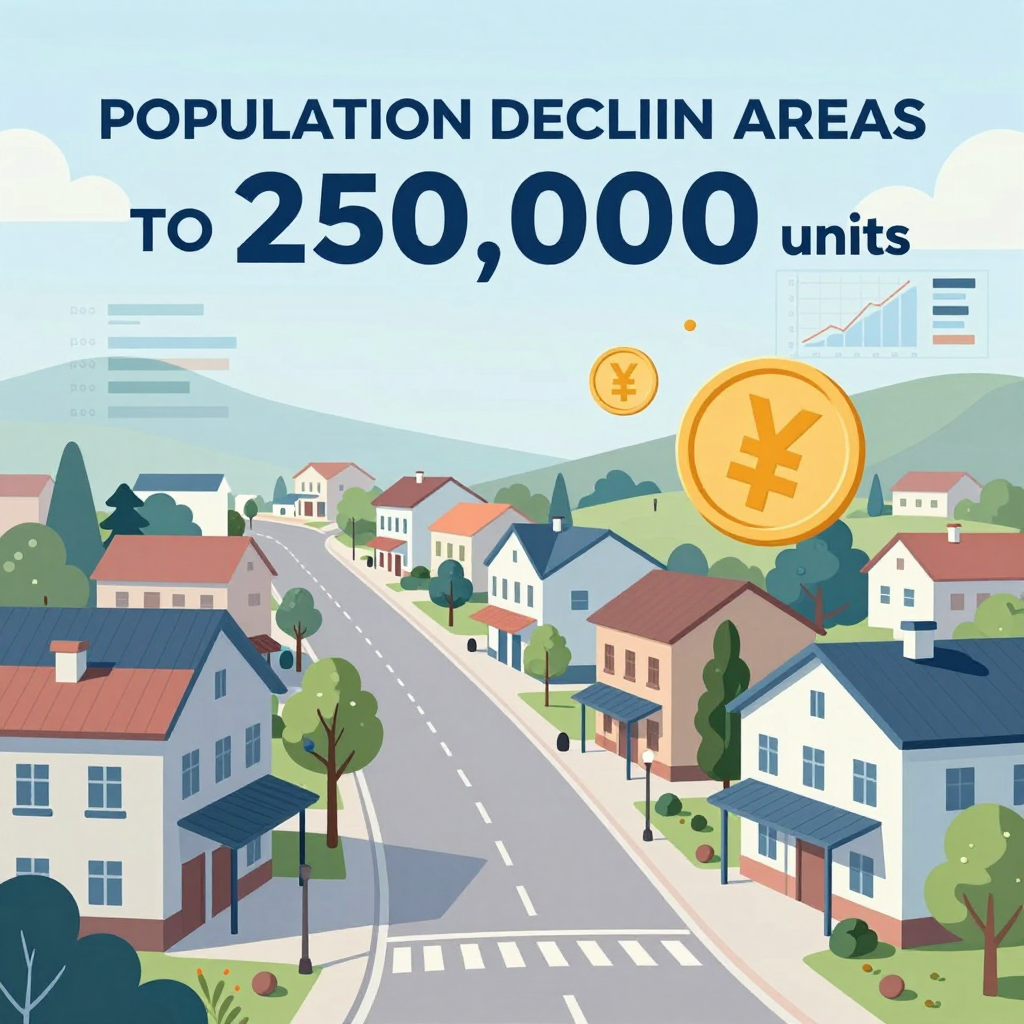
Support Fund for Declining Population Areas: Up to 250,000 Won – How Much Will Our Neighborhood Receive?
 \n
\n
South Korea Facing Population Extinction Crisis in Declining Regions: The Real Issue You Don’t Know
How much do you really know about the fact that many areas in South Korea are facing a threat to their very existence due to rapid population decline? This is far beyond just “a quieter countryside.” In several regions, the simultaneous weakening of essential living foundations—such as schools, hospitals, commercial districts, and transportation—is pushing them into an irreversible downward spiral once collapse begins.
The core issue is less about the ‘result’ of population loss and more about the ‘structure’ that forces people to leave. When youth jobs disappear, young people move away; as the population drops, consumption shrinks; with less consumption, stores close; as businesses shutter, even more people leave. This vicious cycle repeatedly shrinks local economic activity, eventually turning these places into spots where people can live but no longer want to.
In response, the government has designated population-declining areas to focus policy support. Depending on the support intensity, these are classified as priority support areas and special support areas. The former includes hubs near major cities, while the latter centers on more severely impacted regions like mountainous or island areas. In other words, even within population-declining zones, the depth of crisis and policy prescriptions differ greatly.
Recently, support designed to ease the shock of surging oil prices has been more generously structured for these population-declining areas. Even within the same income brackets, priority and special support areas receive higher aid than general regions, revealing a policy approach that differentiates “harder-to-survive regions” and aims to reinforce them. Still, while this kind of direct cash assistance can lessen immediate burdens, it does little to reverse population decline in the long run.
Here lies the true issue. The crisis in these regions isn’t simply a matter of ‘headcount’—it’s about the rate at which vital local functions disappear. People stay only if jobs, education, housing, transportation, caregiving, and healthcare withstand these pressures simultaneously. Ultimately, the real battle to prevent population extinction isn’t about the size of subsidies but how quickly communities can restore the conditions to plan and build their futures.
The Hidden Secret Behind Population Declining Areas, Preferred Support Areas, and Special Support Areas
Why has the government divided population declining areas into two categories? Simply grouping them together under “population decline” misses the vastly different conditions and recovery potential each area faces. Even with the same population decrease, some regions still have the resilience to hold on, while others have entered a stage where their very living foundations are shaking. Reflecting this crucial difference in policy design led to the classification of Preferred Support Areas and Special Support Areas.
The Key to Population Declining Area Classification: Different “Depths of Crisis”
- Preferred Support Areas typically include regions near large cities or key hubs. These places often retain relatively good transportation and living infrastructure or have potential to create recovery momentum through industries or tourism.
- Special Support Areas are mostly mountainous or island regions where residential conditions are tougher, and the speed and impact of population decline is more severe. Basic infrastructure like schools, healthcare, and jobs are weak, making it easy to fall into a vicious cycle where population decline fuels further decline.
In short, the two categories are not a “stamp of shame” but a policy tool to adjust support priorities and intensity.
Where the Support Difference is Felt: Cash Support Amounts Vary
Even when nationwide support programs like recent compensation for high oil prices are designed, additional weight is applied to population declining areas. For example, looking at households in the bottom 70% income bracket:
- Non-metropolitan areas: 150,000 KRW
- Population Declining Preferred Support Areas: 200,000 KRW
- Population Declining Special Support Areas: 250,000 KRW
Because the support amount varies according to regional classification, even households in the same condition experience different levels of aid. This classification thus goes beyond an administrative label—it becomes a real criterion affecting local households.
The “Hidden Effects” of Population Declining Area Classification on Local Economies
1) More money coming in changes consumption
No matter the scale, support funds immediately impact local businesses. Especially in smaller population bases like Special Support Areas, the perceived ripple effect of the same policy can be much larger.
2) Policy experiments prioritize differently
Preferred Support Areas, assuming “recovery potential,” are more likely to receive investment and inflow policies, while Special Support Areas tend to focus more on “preventing collapse”—maintaining basic living infrastructure such as healthcare, caregiving, and transportation. This explains why policy direction can differ even within the same population declining category.
3) Housing and real estate policies are linked
When local governments implement policies like acquisition tax reductions, being designated a population declining area boosts both the “legitimacy” and “speed” of such measures. For instance, Gangwon Province is pushing to ease acquisition tax reductions for unsold apartments specifically in its population declining counties and cities to reduce vacancies and stimulate transactions. While such policies may revive sentiment in the short term, long-term sustained effects require simultaneous support for jobs, education, and healthcare.
The Real Challenge for Population Declining Areas: ‘Structure’ Matters More Than ‘Classification’
The division between Preferred and Special Support Areas is a tool to increase support efficiency, but cash assistance alone won’t reverse population trends. Ultimately, the core challenge is to restore both the economic structure that allows people to earn a living (jobs and industry) and the living conditions that make staying feasible (education, healthcare, housing) simultaneously.
Understanding this classification helps clarify whether your area truly needs “additional support funds” or a “transition in industry and improvement in living conditions.”
High Oil Price Relief Fund for Population Declining Areas: Regional Differential Support Status and Its Significance
Why do some regions receive more from the same high oil price relief fund? The key lies in the assessment that the “oil price shock” does not impact every area equally. Especially in population declining areas, rising living costs are more likely to trigger outward migration, so the government treats the same damage as a “greater risk” and has designed supplementary measures accordingly.
A Quick Look at Differential Support by Region, Including Population Declining Areas
Below is a summary of the regional differential payment structure based on the first supplementary budget bill of 2026. Even within the same income bracket, support increases in order from metropolitan areas → non-metropolitan areas → population decline priority support areas → population decline special support areas.
| Region Classification | Basic Livelihood Beneficiaries | Lower Income & Single Parents | Bottom 70% Income Bracket |
|---|---|---|---|
| Metropolitan Areas | 550,000 KRW | 450,000 KRW | 100,000 KRW |
| Non-Metropolitan Areas | 600,000 KRW | 500,000 KRW | 150,000 KRW |
| Population Decline Priority Support Areas | 600,000 KRW | 500,000 KRW | 200,000 KRW |
| Population Decline Special Support Areas | 600,000 KRW | 500,000 KRW | 250,000 KRW |
Two points stand out:
- Vulnerable groups (basic livelihood beneficiaries, lower income & single parents) receive relatively uniform support across regions, prioritizing a ‘basic safety net.’
- Meanwhile, general households in the bottom 70% income bracket see clear regional differences, with additional incentives offered specifically to population declining areas.
Why Population Declining Areas Receive More: To Protect “Settlement,” Not Just “Living Costs”
Population declining areas face overlapping challenges of youth outflow and weakening economic bases. External shocks (rising oil and living costs) can quickly translate into migration, business closures, and reduced consumption. Therefore, differential support means more than simple compensation:
- A buffer to prevent further outflow: As financial pressure mounts, choosing to leave becomes easier; support helps delay that choice
- Maintaining minimum consumption in the local economy: Funds are likely to be spent locally, easing immediate economic strain
- A policy priority signal: It sends a message that population declining areas are not “regions under identical conditions” but ones requiring “additional management”
In other words, even with the same relief funds, population declining areas effectively receive added ‘crisis management costs.’
Questions Raised by Differential Support: Is Cash Assistance Alone Enough?
However, simply providing more funds to these areas does not resolve the structural causes of population decline right away. While short-term livelihood cushioning is possible, lasting effects depend on improving settlement conditions such as jobs, education, housing, and transportation. This differential support is less about “why more was given” and more a starting signal for the next discussion on “what needs to change next.”
Local Government’s On-Site Response: How Far Do Policies in Population Decline Areas Really Work?
How are local governments fighting back against population decline, like Gangwon Province’s apartment acquisition tax reduction policy? While tangible responses are clearly taking place on the ground, whether these efforts actually lead to “population inflow” is another story altogether. Let’s break down the typical strategies used in population decline areas and what they reveal.
What Actually Works in Population Decline Areas: Local Governments’ Response Tactics
Local governments, realizing that cash support from the central government alone isn’t enough, deploy policies that change living, housing, and economic conditions.
- Alleviating Housing Burdens (Settlement Inducement Type): Gangwon Province is implementing a 50% acquisition tax reduction on unsold apartments across 12 cities and counties classified as population decline areas, expanding eligibility from homes valued under 300 million KRW to up to 1.2 billion KRW. This approach aims to reduce vacant and unsold housing, rejuvenating the local community.
- Defending the Local Economy (Core Hub Maintenance Type): Even amid population decreases, budgets are put toward sustaining essential services like hospitals, education, and transportation to maintain “livable conditions.”
- Linking Short-Term Livelihood Support (Consumption Shock Cushioning Type): When central government aid like high oil price relief funds is applied variably across regions, local governments design campaigns, local currencies, and additional support to channel this aid back into local consumption.
Housing Support Expectations in Population Decline Areas: Strong at Reducing Vacancies
Gangwon’s tax reduction case illustrates a domain where local governments can relatively quickly produce results.
- Direct impact on unsold and vacant properties: Lowering tax burdens reduces transaction barriers and increases the likelihood that neglected homes re-enter the market.
- Short-term economic stimulus: Moving, remodeling, and everyday consumption triggered by these policies can boost sales for local small businesses.
- Creating an entry point for settlement: Even if full population inflow doesn’t occur, this policy can attract various demands like rural migration or second-home purchases, acting as a catalyst.
The Limits of Population Decline Area Policies: Houses Alone Can’t Keep People
However, these policies have clear limitations as solutions to actually slow down population decline rates.
- Without job opportunities, stable residency is hard to secure: Reduced acquisition taxes won’t translate into long-term settlement without stable jobs, education, and childcare infrastructure.
- Risk of demand concentrating on second homes or investments: Even if transactions rise, if permanent residents don’t increase, core issues like maintaining schools and commercial zones remain unresolved.
- Differences in local government financial capacity: Tax cuts and support require fiscal backing—declining populations shrink tax revenues, undermining policy sustainability.
The Next Step Needed in Population Decline Areas: Bundling Settlement Conditions as a Package
For on-the-ground responses to be truly effective, it’s not just housing but a full set of reasons for people to stay that must be created.
- Link housing support with local jobs or remote work infrastructure
- Improve accessibility of education and childcare to encourage family settlement
- Redistribute core services to strengthen livable hubs rather than maintain every location
- Design short-term cash support to lead not just to consumption but to actual settlement
Ultimately, while local government policies in population decline areas can “help the region hold on,” creating a “structure where people start to come back” requires a bigger plan that moves housing, employment, and living infrastructure together.
Beyond Cash Support in Population Declining Areas: Fundamental Challenges for the Future
Short-term cash support provides relief, but it does not eliminate the "root causes" of the population extinction crisis. In reality, even if population-declining areas receive more generous support like high oil price relief funds, if youth outflow, job scarcity, and weakening living infrastructure continue, the same problems recur. The challenge now for policymakers and politicians is not how much more to give, but why people leave and what makes them stay.
The Limits of Cash Support in Population-Declining Areas
- Sustainability Issues: One-time or short-term aid temporarily boosts consumption, but without growth in the local income base, the effect quickly vanishes.
- The Core Factor of Population Is “Work and Life”: Factors that determine settlement are more about stable jobs, access to education and healthcare, housing quality, and care systems than cash alone.
- Risk of Eroded Trust in Policy: Repeated handouts can increase anxiety that “things will get hard again if support stops,” potentially delaying decisions to settle long-term.
Structural Challenges Shaping the Future of Population-Declining Areas
- Industrial Strategy to Improve the Quality of Local Jobs: Instead of competing to attract simple industries, design anchor industries and related job ecosystems based on local strengths — such as energy, advanced agriculture, tourism/content, bio/healthcare.
- Designing for Youth ‘Settlement’ Rather Than Just ‘Inflow’: A package including not only settlement support but also initial housing (rental or purchase), career-type jobs (linking local firms, public sectors, universities), and safety nets for startup failures lengthens stays.
- Securing Minimum Standards for Living Infrastructure: Healthcare, caregiving, education, and public transportation are not optional—they are settlement conditions. Especially in rapidly aging population-declining areas, caregiving and mobility underpin the local economy.
- Transforming Empty and Unsold Homes into ‘Assets’: Approaches like acquisition tax reductions are just starting points. Efforts must connect empty house maintenance, remodeling, conversion to public or youth housing, and integration with living SOC to create “homes people can live in.”
Governance Issues That Must Be Addressed in Population-Declining Area Policies
If administrative and political structures remain unchanged despite population decline, fiscal efficiency deteriorates and policy priorities can become distorted. As institutional issues like the recent “vote parity” controversy emerge, discussions to revise representation, administrative districts, and fiscal distribution principles must proceed simultaneously. Ultimately, what matters is accurately reflecting local realities and reallocating resources into a “performance-based structure.”
Conclusion: The Solution for Population-Declining Areas Is Not ‘Cash Support’ but ‘Conditions for Settlement’
The key question for revitalizing population-declining areas is clear: Have we created jobs and living environments that make people want to stay? Cash support is necessary but must not be the end. The next step is a long-term strategy linking industry, housing, living infrastructure, and institutional reform into one roadmap to build “regions where people don’t have to leave.”
Comments
Post a Comment