 \n
\n
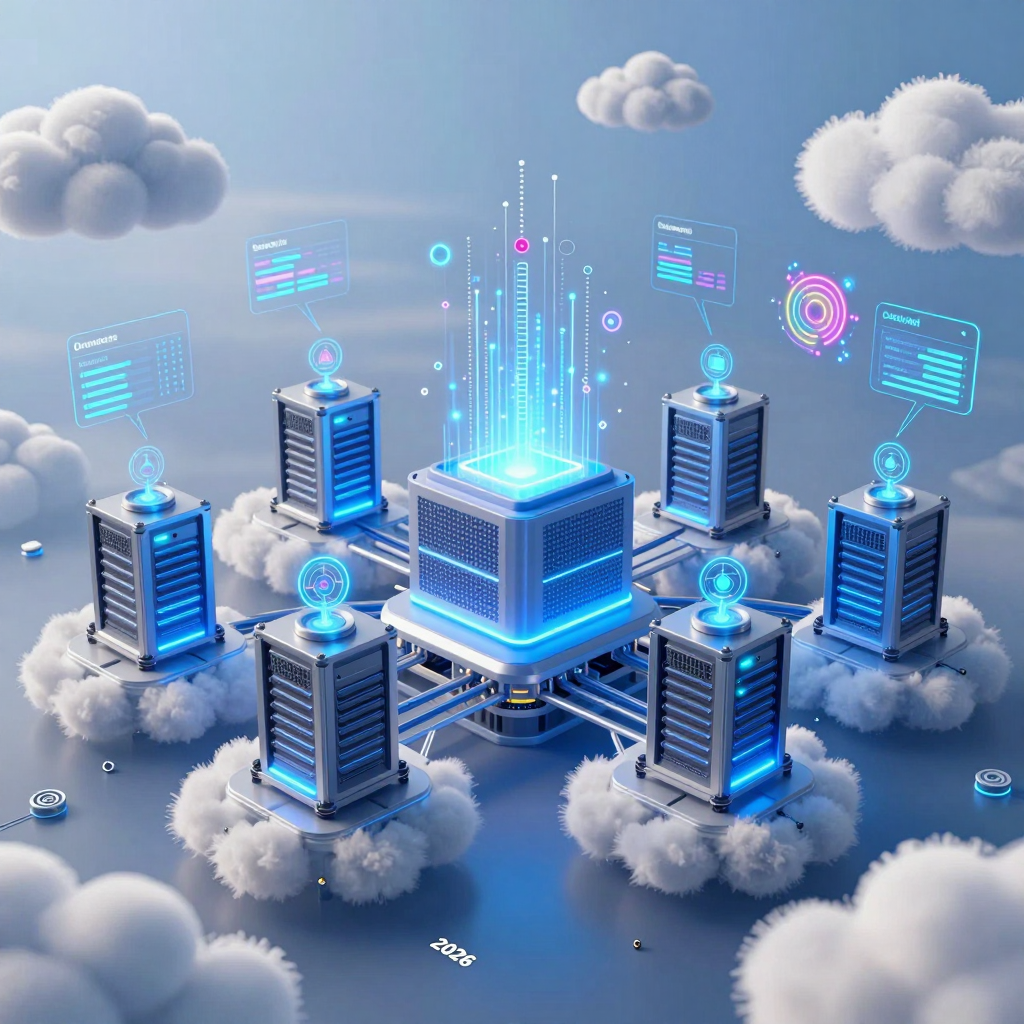
Cloud: The Dawn of the Cloud Revolution in 2026 – The Rise of AI Agents
What future awaits us when over 70% of cloud spending is devoted to AI workloads? The answer is clear. Cloud infrastructure is no longer just a place to host apps; it is transforming into an execution platform that understands goals and autonomously operates AI agents at scale. This shift isn’t a mere trend—it’s a revolution reshaping cloud spending structures and architecture selection criteria across the industry.
Why AI Agents Become the ‘Stars of the Workload’ in Cloud
AI agents are software systems that set goals on behalf of users (planning), remember necessary information (memory), and make context-aware decisions (reasoning) to complete tasks from start to finish. While traditional automation “repeated fixed rules,” agents “interpret situations and choose the next action.”
This difference drives a profound change in computing usage patterns.
- Traditional applications: always-on + predictable traffic
- AI agents: run only when needed (event-driven) + explosive demand per task
In an agent-centric world, paying for idle time becomes inefficient, shifting cloud operations to focus on the ability to “scale up quickly when needed and scale down immediately when done.”
Why Serverless is the Deployment Standard for AI Agents in Cloud
AI agents are often invoked intermittently—only triggered by events such as customer inquiries, specific data changes, or batch jobs starting. This makes serverless container platforms (e.g., Cloud Run-like services) particularly advantageous.
Key technical highlights include:
- Auto scaling: Containers automatically multiply under heavy load to handle peaks, meaning no manual intervention is needed when agents perform many tasks simultaneously.
- Scale to zero: When traffic ceases, instances shrink to zero, effectively stopping costs—a perfect match for “work-then-pause” workloads like agents.
- Container-based deployment: The agent’s runtime environment (libraries, model calling logic, security settings) is encapsulated in fixed images for consistent, repeatable deployment—essential for iterative AI experimentation and operation.
Consequently, businesses no longer compete on “how many always-on servers to maintain,” but on “how fast they can create, scale, and retire agents” in the cloud.
What Changes When Cloud Spending Shifts to AI-Centric Workloads
As AI workloads drive cloud spending growth, priorities in technology choices shift dramatically:
- Cost optimization metrics evolve: Per-task/request cost surpasses fixed monthly infrastructure fees in importance.
- Architectural units shift: Designs move from “always-on services” toward “on-demand agents.”
- Operational focus broadens: Beyond basic availability monitoring, key metrics now include the quality of agent decision-making (reasoning, planning, memory) and execution stability (retries, timeouts, isolation).
In summary, the cloud revolution of 2026 isn’t about “simply adding AI to the cloud,” but rather redesigning the cloud around how AI agents operate. The next standard in cloud is poised to become “intelligent execution units” that appear when needed, accomplish their goals, and vanish.
What Is a Cloud AI Agent: The Secret Behind Smart Software
The reason why AI agents that make complex decisions are gaining attention beyond simple automation is that they are not just “tools that execute fixed rules” but “software that understands goals and finds ways to achieve them on its own.” So how do AI agents actually work, and how smart can they get?
Core Concepts Defining AI Agents in the Cloud Environment
An AI agent is a software system that pursues goals and completes tasks on behalf of the user. While typical chatbots or RPAs often stay at the level of “input → response,” agents combine the following capabilities to fully accomplish tasks from start to finish:
- Reasoning: Interpreting the situation and judging what matters
- Planning: Designing steps and sequences to achieve goals
- Memory: Utilizing previous context, user preferences, and task history
This combination is crucial because it enables agents to operate not as one-time responders but as stateful executors that remember and act based on the situation.
How Do Cloud AI Agents Make “Decisions”?
AI agent decision-making typically follows this flow:
- Receiving the goal: The user requests a result-focused task like “Create this week’s sales report.”
- Understanding the context: Checking data sources, permissions, deadlines, formats, etc.
- Making a plan: Breaking down tasks such as “collect data → clean → analyze → visualize → summarize.”
- Executing tools: Performing API calls, database queries, document creation, notification sending, etc.
- Verifying and revising: Inspecting quality and refining the output as needed
- Delivering the result: Providing the final product + suggesting next actions (e.g., “Shall I set up automatic generation from next week?”)
The key point here is that this is not an AI that just thinks—it’s a practical AI that actually drives systems to produce outcomes. This execution becomes increasingly powerful when integrated with cloud infrastructure (data, applications, permissions, events, monitoring).
Why Cloud-Based Architecture Makes Agents Smarter
For AI agents to be useful in enterprise environments, processing tasks safely and efficiently matters more than just “talking well.” Deploying on the cloud enables:
- Elastic scaling: Automatically increasing capacity during demand spikes and scaling down when idle
- Cost optimization: Running only when needed, adapting to intermittent workloads
- Easy integration: Combining with logs, monitoring, IAM, secrets management, API gateways, etc.
- Operational stability: Standardizing operational patterns like failure detection, rollback, and retries
Especially for goal-oriented agent workloads, which often run as “on-demand tasks” rather than “always-on apps,” the cloud’s serverless operational model is a perfect match.
The Decisive Difference Between Cloud AI Agents and Traditional Automation
In summary, while traditional automation excels at repeating predefined workflows, AI agents shine at choosing the best next action amid many variables. Automation reacts to “procedures,” whereas agents respond to “goals.”
This fundamental difference suggests that future software is likely to shift beyond function-centric apps toward intelligent agents that get the job done.
Cloud Serverless Platforms: The Secret Weapon for Infinite Scaling
Can you believe that AI agents in a serverless environment can “wake up only when needed” to work, then fall back asleep to cut costs? The key lies in Cloud serverless platforms—especially container-based ones like Cloud Run—with their powerful automatic scale-out and scale-in capabilities. Understanding this “hidden power” instantly explains why AI workloads will explode cloud spending by 2026—and why companies are changing how they deploy their agents.
Why Cloud Run Is Perfect for AI Agents: An Event-Driven Execution Model
Unlike traditional web apps that must always remain online, AI agents often focus computation only when a task arises. For example, workloads like “report summarization,” “root-cause analysis,” or “customer inquiry classification” tend to spike only when requests come in. Cloud Run is designed precisely for such workloads by:
- Instantly spinning up containers when an HTTP request or event arrives
- Automatically increasing the number of instances to process traffic in parallel
- Scaling instances down to zero when idle to minimize costs
This lets AI agents operate not in “always-on” mode, but “activate only when needed,” completely changing the infrastructure cost model.
How Cloud Auto-Scaling Really Works: Container Instances and Concurrency
Cloud serverless scaling isn’t just about “turning on more servers”; it’s about elastic adjustments at the container instance level.
- Concurrency: The number of requests a single instance can handle concurrently sets the threshold for scaling.
- Lower concurrency means less response delay but more instances—and higher costs.
- Higher concurrency improves cost efficiency but may increase latency for heavy tasks like LLM inference, requiring careful tuning.
- Automatic instance provisioning: When demand spikes, Cloud Run horizontally scales by adding instances.
- Scale to zero: Once requests stop, instances shut down, eliminating “always-on VM” costs.
From an AI agent perspective, this means reducing “state retention costs” and shifting to a cost model focused purely on runtime.
Key to Cloud Cost Optimization: Design for “Only When Needed,” Not “Always Running”
The recipe for maximum cost savings in serverless is crystal clear: the more intermittent or bursty the workload, the greater the benefit. For AI agents, these design strategies make or break costs:
- Break tasks into short units: Splitting long batch jobs into multiple stages allows resources to be released after each stage, avoiding unnecessary usage.
- Switch to asynchronous processing: For tasks that don’t require immediate response, hand off work to queues or event streams for robust peak-time handling.
- Profile memory and CPU needs: Different resource demands across inference, preprocessing, and postprocessing phases mean cutting overprovisioning can slash expenses dramatically.
In short, Cloud serverless is more than just a convenience for deployment—it’s a platform that forces AI agents into a model of elastic execution. This very enforcement is one of the most practical reasons cloud architectures are pivoting to AI-centric designs by 2026.
The Transformation of the Cloud Industry: A New Paradigm Brought by AI Agents
For a long time, long-running applications—servers always on, backends always waiting—were the fundamental premise of enterprise systems. But now the question is changing. “Do they really need to be running all the time?” With the emergence of AI agents, digital transformation in enterprises is shifting its focus from ‘how we build systems’ to ‘how work gets done.’
Why Cloud Is Shifting from ‘Always On’ to ‘On-Demand Execution’
AI agents are software that achieve goals based on reasoning, planning, and memory. Their nature differs significantly from traditional applications and operational models.
- Event-driven operation: Agents activate in response to triggers like user requests, work events, or data changes.
- Executed per task and then terminated: Once a goal is achieved, the agent stops, only to be reactivated when a new request comes in.
- Optimized for intermittent and variable workloads: Particularly in Cloud environments supporting scale-to-zero, such as container-based serverless platforms, cost efficiency is maximized through automatic scaling and shrinking to zero during idle periods.
In other words, instead of maintaining “always-on systems,” companies are redesigning workflows around agents that run intelligently only when needed.
How Cloud-based AI Agents Are Changing Enterprise Operations
The spread of AI agents goes beyond simple automation—it transforms how operations are conducted.
Shift from ‘app-centric’ workflows to ‘goal-oriented’ workflows
Where once processes were built by patching together function-based applications, now you input a goal like “generate and share a sales report” or “detect customer churn risks and suggest countermeasures.” The agent then selects the necessary tools and data to execute it.Digital transformation focuses move from ‘system adoption’ to ‘automation quality’
The competitive edge lies less in which solutions have been installed and more in how accurately the agents reason, the order in which they handle tasks (planning), and how well they maintain context (memory). Cloud acts as the flexible foundation enabling model execution, tool integrations, observability (logs/tracing), and security policy synthesis.Redefining cost structure and performance strategy
Charging shifts from always-on server costs to billing based on actual execution time and invocation volume. The ability to sharply scale up during peak times and scale down to zero when idle is especially effective for workloads like AI agents that “spike when busy and vanish when idle.”
Emerging Technical Challenges in the Cloud Era (What Enterprises Need to Prepare For)
As AI agents reshape paradigms, there are clear technical demands companies must meet.
- State management (memory) and reliability: Even with short serverless executions, an agent’s memory and task context must be securely preserved in external storage.
- Tool orchestration: Integrations with CRM, ERP, ticketing systems, data warehouses, and a control framework including permission and audit logs are crucial.
- Observability and governance: It must be traceable on what basis the agent made decisions and what actions it took—essential not only for incident response but also for compliance.
Ultimately, Cloud-based AI agents represent not just a “new capability” but an operational paradigm that changes how enterprises design work. The era of long-running applications is giving way to a new age of intelligent execution units that appear and disappear dynamically according to goals.
Future Outlook and Strategy for Cloud: The Imperative of AI and Cloud Integration
What strategies are necessary for companies to secure a competitive edge by leveraging AI agents? After 2026, the cloud industry will rapidly transform from being “long-running application-centric” to “goal-oriented agent-centric,” operating only when needed. In other words, AI workloads will fundamentally drive cloud spending and architectural choices.
Cloud Blueprint: Design “Agent Fleets” Instead of Just “Applications”
Going beyond merely breaking down functions into services, leading companies will design bundles of agents (fleets) that achieve business objectives such as generating quotes, responding to customer service, or risk assessment. Critical elements to enable this include:
- Redefining processes based on agents with Reasoning, Planning, and Memory capabilities
- Shifting work units from “request-response” to “goal-completion,” making state management and retry strategies essential
- Since agents invoke multiple systems (APIs, databases, SaaS), permissions, auditing, and policies become central to architecture
Cloud Operational Strategy: Standardize a Cost Model That Scales Down to Zero Using Serverless
Agent workloads in 2026 will be intermittent and highly bursty. Deploying via serverless (e.g., container-based serverless) enables automatic scaling of instances and scale-to-zero when idle, drastically improving cost-efficiency. Strategic points include:
- Designing a hybrid approach mixing “always-on” and “scale-to-zero” based on latency objectives (SLOs)
- Separating GPU/accelerator resources into dedicated pools while absorbing the rest into serverless
- Managing costs not just by infrastructure but as the total agent cost, including inference calls, tokens, and external API usage
Cloud Security and Governance: Control Even the “Tools” Called by Agents
The risk of AI agents is determined more by what tools they can access than by the models themselves. Security must therefore shift from network perimeters to behavioral boundaries.
- Applying the principle of least privilege at the tool level (API/DB/file/email) and logging all calls for auditing
- Enforcing Policy-as-Code to prevent prompt injection, data leaks, and privilege escalation
- Separating sensitive data across learning, inference, and storage paths with layered encryption, tokenization, and DLP
Cloud Technology Roadmap: “Observability” Accounts for Half of Performance
Agents involve multi-step reasoning and external calls, creating numerous failure points. Thus, the ability to quickly detect errors becomes a competitive advantage.
- Implementing trace-based agent observability that tracks step-by-step execution (planning → tool call → result)
- Designing resilience with retries, fallback paths, and human handoffs upon failure
- Shifting testing from answer correctness to agent quality metrics based on goal achievement rate, cost, latency, and safety
Cloud Organizational Strategy: Build “AI Agent Product Teams” and Experiment Rapidly
As the technology matures, speed of execution will decide success. Beyond small proofs of concept, post-2026 demands agent product operations that continuously iterate and improve.
- Combining business process experts, platform engineers, and security staff in unified teams operating on goal-driven KPIs
- Starting short-term with “work hour reduction,” expanding mid-to-long-term into new revenue models (agent-based service commercialization)
- Focusing core competencies not on model selection but on operational capabilities for safely deploying, observing, and improving agents on Cloud (including MLOps/LLMOps)
In conclusion, winners after 2026 will not simply be “companies that adopt AI” but those that standardize AI agents as operational units on Cloud, optimizing cost, security, and quality simultaneously. What’s needed now isn’t more pilots, but architectures and operational systems that enable agents to fully carry out real business tasks.
Comments
Post a Comment