 \n
\n
A New Revolution in AI Development: The Emergence of 'gstack'
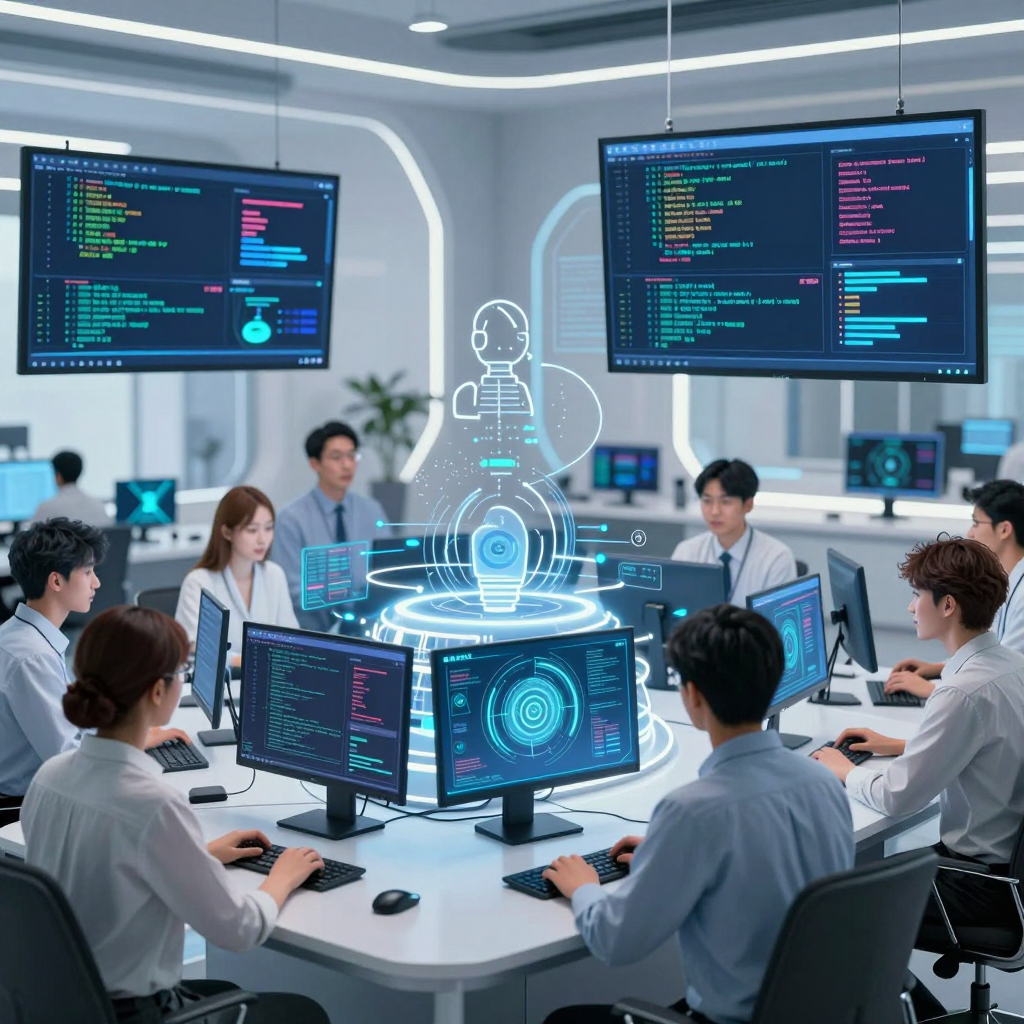
In just two weeks on the 2026 AI development tool market, ‘gstack’ soared past an astonishing 56,000 GitHub stars. But what exactly is gstack? It’s not merely an AI that “codes better”; it stands at the epicenter of innovation by restructuring the entire team’s development workflow through AI agents.
gstack Redefined as an AI Agent Workflow
Unlike a single all-purpose model handling every task, gstack is a toolkit designed for collaboration among specialized AI agents with distinct roles. Mirroring real software teams, these agents divide the pipeline into clear responsibilities:
- CEO/PM Perspective Agent: Defines goals, adjusts priorities, organizes requirements
- Designer Agent: Directs UX approach, proposes screen layouts and flows
- Engineering Manager Agent: Breaks down tasks, manages schedules and risks
- Release/Doc/QA Agent: Prepares releases, documents, and manages testing strategies and verification
In essence, gstack transcends being just a “tool to help development.” It aims to standardize the decision-making and execution phases of development organizations into an automated agent system. This structure is powerful because it tackles common development bottlenecks—unclear requirements, missed testing, lack of documentation, skipped deployment checklists—by allocating these responsibilities based on roles and thus minimizing omissions.
The Significance of the AI Cross-Platform Open Standard, Agent Skill (SKILL.md)
The secret behind gstack’s surge is not just the buzz created by the Y Combinator CEO unveiling it, but the fact that its specification, Agent Skill (SKILL.md), has been released as a cross-platform open standard. This standard prevents tool lock-in by structuring the tasks agents perform into:
- The roles and scopes of responsibility for each agent
- Definitions of inputs (context) and outputs (deliverables)
- Procedures (checklists and protocols) for tasks
- Quality criteria and validation methods
Thanks to this, SKILL.md acts as an “agent work specification” reusable not only with Claude Code but also across various AI ecosystems like Claude, Codex, Gemini, Cursor, Copilot, and more. It empowers companies and developers to avoid being tied to a specific model or IDE, opening the door to mix-and-match the optimal AI tools depending on the situation.
How gstack Transforms AI Development Workflows
What gstack signals is crystal clear: the future competitive edge won’t be about “who uses the best model” but how AI agents’ collaboration can be standardized and interconnected. When development processes are organized around role-based agents, teams can expect:
- Faster speeds through automation of repetitive tasks (documentation, releases, testing)
- Quality stability via checklist-driven verification
- Reduced collaboration costs by clarifying roles and deliverables
- Increased flexibility in tooling chains by combining multiple AI models
Ultimately, gstack offers more than just “faster coding with AI.” It pioneers a whole new way to transform the team’s operating system through AI. This is precisely why gstack has exploded in popularity.
Deep Dive into gstack: When AI Agents Become a Team
From CEOs to QA engineers, the idea of a development workflow toolkit where diverse AI agents gather in one place might sound unfamiliar. But the core of gstack is simple. Instead of “a single coding AI,” it restructures the development scene by breaking the entire team’s workflow into role-based automation.
How Role-Based AI Agents Transform the Development Flow
Traditional development relies on humans dividing roles to collaborate. Tasks flowing from planning → design → implementation → testing → documentation → release require different expertise, with high communication costs in between. gstack rebuilds this process as a pipeline of role-specialized AI agents.
- CEO/PM-style AI: Organizes requirements into goals and metrics, suggests priorities
- Designer AI: Structures UI components and screen flow (close to design deliverables)
- Engineering Manager AI: Breaks down tasks into tickets, manages schedules and risks
- Engineer AI: Handles actual code changes, refactoring, and test code writing
- QA AI: Designs scenario-based tests, checks edge cases, documents reproduction steps
- Doc Engineer AI: Organizes documentation like README, changelogs, and usage examples
- Release Engineer AI: Automates deployment checklists, version policies, and release notes
The beauty of this structure? It doesn’t wait for a “jack-of-all-trades” single model. Each AI delivers outputs from its role’s perspective, then the next AI takes these as inputs to verify and improve quality collectively. As a result, developers spend less time on repetitive tasks (organizing, documenting, checklisting, test scenario writing) and focus more on core decisions and architecture.
Agent Skill (SKILL.md): The Blueprint Standardizing AI Collaboration
gstack isn’t just a toolkit; it stands out as a “standard” thanks to Agent Skill (SKILL.md). This specification clearly documents each agent’s capabilities and workflows (input/output formats, responsibility scopes, handoff rules) without being tied to any specific model or IDE.
Technically, SKILL.md enables:
Consistent Hand-offs
Example: Engineer AI leaves PR summaries and test results in a set format, so QA AI reads the same format and seamlessly continues automated verification.Reproducible Workflows
“What order to review, by what criteria, and under which conditions to release” is encoded in the agent skill, ensuring smooth operations even if the team changes.Cross-platform Scalability
Not limited to Claude but reusable across Codex, Gemini, Cursor, Copilot, etc., reducing AI stack lock-in by maintaining uniform role definitions everywhere.
Transformation in the Development Field: It’s Not Speed, It’s Flow That Accelerates
The shift gstack drives isn’t about typing code faster—it’s about eliminating development bottlenecks to smooth out the overall workflow.
- Less back-and-forth between planning, development, and testing: Requirements become clear as tickets with acceptance criteria, cutting down on follow-up questions.
- Elevated, standardized PR quality: Code changes come bundled with impact scope, test plans, and rollback strategies, simplifying reviews.
- Documentation created “in parallel,” not “later”: Doc Engineer AI updates docs alongside changes, preventing knowledge debt accumulation.
- QA shifts from post-verification to pre-design: QA AI proposes test scenarios upfront, encouraging testability from the implementation stage.
In short, gstack organizes AI agents like a team, automating development as a connected process—not isolated tasks. The real game is no longer single-model performance battles, but how to design roles and rules to operate AI collaboration as a manageable system.
The Power That Transcends AI Boundaries: Cross-Platform Open Standard ‘Agent Skill’
How is this open standard, supported by more than 32 AI agents from Claude to Copilot, enabling innovation without being tied to a single platform? The key lies in Agent Skill (SKILL.md) at the heart of gstack — it’s not just a “plugin for a specific model,” but rather a common contract that defines what an agent should do. Simply put, it’s a standard designed so that even if the model changes, the definition of work and the specifications of deliverables remain consistent.
The Structure of SKILL.md That Standardizes AI Development Workflows
Agent Skill declares the capabilities an agent should have in a document while clearly specifying the rules the agent must follow during execution. Implementations (Claude, Codex, Gemini, Cursor, Copilot, and others) read this document and attempt to act in the same way. Technically, the following elements are crucial:
- Separation of Role and Responsibilities: Breaks down “what needs to be done” into discrete tasks and clearly defines responsibility boundaries by agent.
- Input/Output Specifications (I/O Spec): Defines what type of input is received and the format of expected output. For example: PR description templates, release note formats, test report structures.
- Definition of Done (Quality Criteria): Specifies completion criteria to ensure results can be verified despite changes in the model. Examples: passing tests, updating documentation, inclusion of edge cases.
- Operational Constraints and Safeguards: Includes access boundaries (files/folders), prohibited tasks, sensitive data handling, and logging rules—making it ideal for team-level operations.
Thanks to this design, Agent Skill absorbs performance differences among AI models. Whether a model excels at code generation or documentation, as long as the “deliverable specifications” are consistent, the workflow remains stable.
The ‘Language of Work’ Stays the Same Even If the AI Agent Changes
The true value of this cross-platform standard is replaceability. Being tied to a specific vendor or IDE turns changes in model policies, price hikes, or quality fluctuations into productivity risks. In contrast, with an Agent Skill-based workflow:
- Even if the agent execution environment switches from Claude Code to another tool,
- As long as there is an implementation capable of interpreting the same SKILL.md,
- The development flow can be maintained with the same task units and deliverable standards.
As a result, teams focus less on “which AI to use” and more on “what tasks to automate and by what criteria.” This is a critical factor for moving AI adoption from experimental stages to operational maturity.
The Ecosystem Effects Created by AI Open Standards: Sharing, Reuse, Validation
When Agent Skill spreads as an open standard, individual prompt know-how transforms into a team asset.
- Sharing: Teams and communities share skills for repetitive tasks like QA, releases, and documentation.
- Reuse: The same skills can be applied across projects, reducing onboarding costs.
- Validation: With defined output formats and completion criteria, results are easier to automatically verify.
In summary, the essence of gstack’s cross-platform strategy is not about “making AI smarter,” but about standardizing AI so it integrates reliably into team processes. Agent Skill stands at the center of that standardization, effectively breaking down platform boundaries.
Disrupting Software Development: The Industrial Significance of AI and ‘gstack’
The productivity of corporate development teams is no longer defined by “how well individual developers use AI,” but rather by how much AI agents automate team-based collaboration. This is precisely why gstack is gaining attention. By dividing roles such as CEO, designer, QA, documentation, and release into specialized agents and fixing their collaboration process as a workflow, thus creating a repeatable development system, gstack sparks an industrial transformation that goes far beyond being a simple coding assistant.
How AI-Driven Team Collaboration Automation Is Transforming Development Operations
The core value of gstack lies not in ‘code generation’ but in process automation. In traditional development organizations, the most time-consuming phases typically include:
- Gathering requirements → Design agreement → Implementation → Testing/QA → Release → Documentation
- Plus the countless communications in between (review comments, issue tickets, meetings, handoffs)
In the gstack model, each phase is broken down into the responsibility domain of specialized AI agents, with defined formats for deliverables and handover protocols. For example, a Release Engineer agent generates release notes, a Doc Engineer agent updates changes in document templates, and a QA agent refreshes test scenarios and regression checklists.
This structure automates “organizing, transferring, and verifying” tasks, which often become bottlenecks when handled by humans, enabling teams to focus more on decision-making and core implementation.
Integrating the AI Model Ecosystem: From Vendor Lock-In to ‘Open Standards’
An industrially crucial point is that gstack is not tied to any single model or tool. With Agent Skill (SKILL.md) spreading as an open standard, companies gain options such as:
- Mixing models according to work needs (e.g., a model strong in design/documentation + another excelling in coding/refactoring)
- Seamless replacement anytime to meet cost, security, and performance demands (mitigating vendor lock-in)
- Reusing the same agent skills within teams and partners (internal standardization and reduced collaboration costs)
In other words, competitiveness hinges less on “which AI you use” and more on “which skills and workflows you standardize.” For companies, this shifts AI adoption from a one-off proof of concept to an operational development framework.
The Future of Corporate Development Productivity: Not ‘Humans + AI’ but ‘Organization Design Inclusive of AI’
The future that gstack points to is clear. Productivity breakthroughs will come not from individual AI proficiency, but by redesigning organizational role distribution to include AI agents. The anticipated transformations include:
- Shortened lead times through automation of repetitive tasks (accelerating the planning-to-deployment cycle)
- Enhanced consistency in documentation, testing, and release quality (based on standardized deliverables)
- Process internalization resilient to personnel changes (reducing onboarding costs)
- Cost optimization and risk diversification via freedom of model choice
Ultimately, gstack promises to make “adding AI as a tool” obsolete, establishing AI as a fundamental unit of collaboration in development operations. Corporate development teams that seize this wave can achieve a structural advantage—improving products faster, more reliably, and with fewer resources.
gstack Opening the Future of AI: The Technical Theory Behind Specialized Agents and Collaborative Automation
From the specialization of AI agents and collaborative automation technology to the implications of the open standard Agent Skill—once you grasp the technical depth, the true power of gstack reveals itself not as a mere “tool,” but as a way to fundamentally restructure the development process itself. Rather than simply boosting the coding capability of a single model, gstack faithfully mirrors real-world role divisions within teams and realizes them through organizational collaboration among agents.
Why AI Agent Specialization Enhances Performance: Role-based Reasoning (Division of Cognition)
Traditional AI coding attempts to have one model handle planning, implementation, review, and testing all at once, leading to recurring issues:
- Context Overload: Trying to satisfy too many objectives simultaneously (functionality, quality, documentation, release) dilutes focus.
- Lack of Validation: When “author = reviewer,” errors tend to remain hidden.
- Inconsistent Quality Standards: Requirements, tests, and documentation blend with one voice, blurring acceptance criteria.
gstack’s solution is to split responsibilities like a team. For example, agents acting as CEO (requirements/prioritization), Engineering Manager (task decomposition), QA (test strategy), Release Engineer (deployment/versioning), and Documentation Engineer (docs/examples) each hold clear success criteria and cross-validate one another. This setup transfers core software engineering principles—separation of concerns, independent verification, clear accountability—to the level of AI agents.
The Core Mechanism of AI Collaborative Automation: Orchestration + Contracts
For gstack to operate like an “automated team,” it requires more than simple multi-agent calls; the interactions among agents must be proceduralized. Technically, two pillars stand out:
- Orchestration: Deciding the order, assigning tasks to whom, and determining when to retry or escalate.
- Contracts: Explicitly defining what input an agent takes, what output it produces, and the criteria for completion.
For example, “feature implementation” doesn’t end at code generation. In gstack’s approach, the typical cycle unfolds naturally as:
1) Fix requirements into a specification (CEO/PM role)
2) Break work down into tickets/stages (EM role)
3) Implement (Engineer role)
4) Design tests and add failure cases (QA role)
5) Create documentation and usage examples (Doc role)
6) Update release notes and versions (Release role)
7) Review entirely and, if standards are not met, regress to step 2) or 3)
The key point: “completion” is defined not as conversation termination but as the accumulation of validated deliverables. Automating collaboration via AI means cost-efficient reiteration of this validation loop.
The Implication of the AI Open Standard Agent Skill: A ‘Skill Interface’ Breaking Platform Dependence
A particularly industrially significant point of gstack is that Agent Skill (SKILL.md) is a cross-platform open standard not tied to any specific model (e.g., Claude Code). Viewing this standard as a “specification for what an agent can perform” makes it easy to grasp.
- Defining a task as a skill means you can maintain consistent invocation, output, and validation regardless of the underlying model.
- Teams become less locked into a specific vendor’s UI or agent runtime, and can choose the most suitable model by role.
- The agent ecosystem can expand like an “app store”: modular skills enable easier sharing and reuse.
Technically, this is reminiscent of how API standardization fueled software markets. While OS/browser/cloud interface standards previously unlocked ecosystems, now the AI agent skill standard is opening the gates to new development workflows.
AI Agent Outlook: Shifting from ‘Coding Assistance’ to ‘Process Operation’
The future gstack points to is crystal clear. AI no longer remains merely a “tool for writing code,” but evolves into a system executing the procedural workflows (design-implement-verify-deploy) operated by development organizations. This shift predicts changes such as:
- Automated quality as integral: Testing, reviewing, and documenting are no longer afterthoughts but built-in loops.
- Role-based model mixes: Employing inference-strong models for design, execution/accuracy-focused models for coding, counterexample-hunting models for QA, etc., for optimal combinations.
- Formatted organizational knowledge: “Our team’s development method” is not just documentation but stored as skills and contracts for reproducibility.
Ultimately, gstack’s potential hinges not on “which AI is smarter,” but on whether collaboration can be systematized. As standards like Agent Skill proliferate, enterprises can build more sophisticated automated teams without locking into any single toolchain—this is gstack’s most tangible competitive advantage.
Comments
Post a Comment