 \n
\n
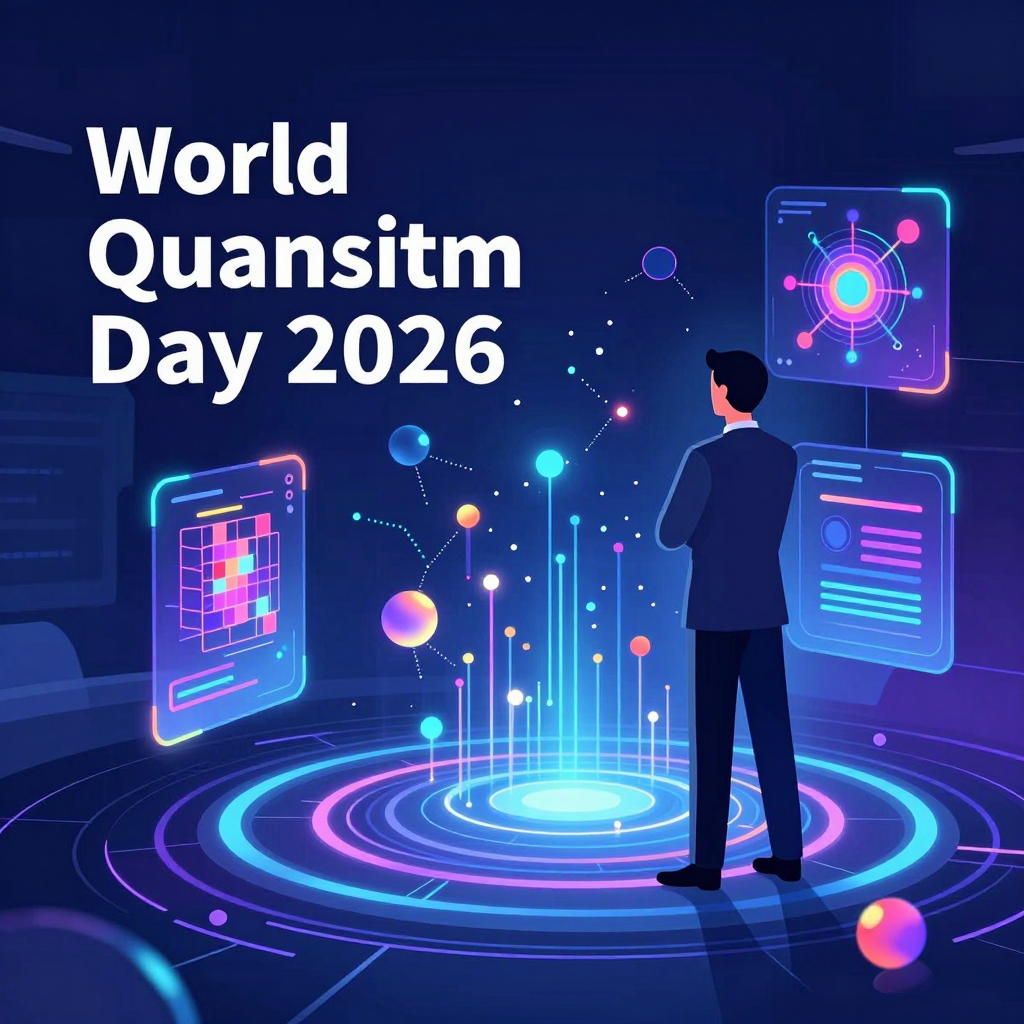
World Quantum Day: A Day When the World Turns Its Eyes to Quantum Science, 2026
Are you aware of how quantum science is poised to transform our daily lives and future? World Quantum Day, celebrated across 65 countries worldwide, takes place annually around April 14th. This international event, led by quantum scientists, broadens public understanding and showcases how quantum technologies are expanding beyond laboratories into industries and society at large.
What makes World Quantum Day 2026 particularly special is the clearer shift from ‘possibility’ to ‘impact.’ Quantum computing holds the potential to solve highly complex problems faster—ranging from drug discovery and climate modeling to secure communications—while simultaneously introducing new challenges like data privacy and job market changes. In other words, quantum science is no longer just a recurring topic in scientific news; it has become a tangible factor reshaping our security systems and industrial decision-making processes.
The focus of this day goes beyond mere technology promotion. Throughout the event, wide-ranging discussions take place—from quantum computer safeguards (guardrails) and post-quantum encryption (the transition to quantum-era cryptography) to intersections where quantum physics meets humanities, arts, and philosophy. The message is clear: just as technology accelerates, so too must social consensus and preparedness—a truth that fuels the global growth of World Quantum Day.
Exploring Quantum Innovation at the University of Rhode Island Through World Quantum Day
At an event where government, industry, and academia gathered to discuss the future of quantum technology, how is the United States solidifying its quantum leadership? The answer unfolded at the University of Rhode Island (URI). URI hosted its fifth annual World Quantum Day on the Kingston campus, creating a ‘collaborative stage’ that connects theoretical breakthroughs inside the lab to the language of society and industry.
The standout theme of the event was partnership. U.S. Senator Jack Reed emphasized that quantum computing and information science are directly linked to economic competitiveness and national security, asserting that a coalition of government, industry, and academia is essential. With participation from companies like AWS, IBM, and SiC Systems, the focus shifted from “who is researching the technology” to “who is bringing technology to reality.”
What makes URI’s approach particularly impressive is that quantum technology was not treated merely as a pure engineering challenge. The event extensively covered topics such as quantum computer guardrails, post-quantum encryption, and even the intersection of quantum physics with humanities and the arts. The clear message was that beyond performance battles, trust, ethics, and societal acceptance must be designed hand in hand.
The U.S. strategy to strengthen its leadership extends beyond events and into infrastructure. URI is constructing a next-generation quantum computing laboratory within the Fascitelli Center for Advanced Engineering, scheduled to open in 2028. This facility will feature low-temperature quantum computing environments, cleanrooms, and unclassified information review areas, establishing an integrated base bridging research, security, and manufacturing. This stands as a prime example of how a university can serve as a regional innovation hub and a national strategic asset.
Finally, URI’s announcement of a quantum-humanities mini-grant program marks an effort to transform how technology diffuses. By actively encouraging participation from non-STEM majors, the program is designed to examine the social impact of quantum technology—on jobs, privacy, and governance—from diverse perspectives. Ultimately, the question raised by World Quantum Day converges into one crucial inquiry: it’s not “Who will create quantum technology first?” but rather “On what social consensus and responsibilities will its adoption be based?”
World Quantum Day: The Meeting of Cutting-Edge Quantum Research Facilities and the Humanities Preparing for the Future
What significance lies in the state-of-the-art quantum computing laboratory aiming to open in 2028, alongside an innovative program supporting the fusion of humanities and quantum science? If World Quantum Day serves not just as a commemorative event but as a platform to ask, “How can quantum technology be safely and beneficially integrated into society?” then the two initiatives at the University of Rhode Island (URI) offer a highly pragmatic answer to that question.
First, the next-generation quantum computing lab being constructed at URI’s Fascitelli Center for Advanced Engineering symbolizes a decisive investment in transforming research from mere ‘ideas’ into tangible ‘infrastructure.’ Its design—including ultra-low temperature quantum computing facilities, cleanrooms for fabricating environmentally sensitive computational components, and controlled areas for handling classified information—represents a declaration to turn “the potential within academic papers” into “operational systems.” In other words, quantum technology leadership is not solely about talent or funding; it is completed through meticulously designed experimental environments and security and operational frameworks.
Complementing this, URI’s quantum-humanities mini-grant program, launched in collaboration with AWS and internal research institutes, further broadens the focus of quantum discourse. The program’s active encouragement of student participation beyond STEM fields is particularly vital. If quantum computing evolves solely as the language of industry and national security, social acceptance and normative frameworks will lag behind, escalating conflicts and costs. Conversely, a humanities-centered approach can anticipate pivotal questions such as:
- What new standards of privacy and trust are shaped by quantum computing?
- Who is protected, and who is marginalized during the transition to post-quantum encryption?
- Where does accountability in decision-making go when “faster optimization” is introduced?
Ultimately, URI’s strategy gains strength when these two pillars align. One is the hardware- and facility-centric experimental foundation being constructed toward 2028; the other is the interdisciplinary research ecosystem culminating in shared results by the 2027 event. The future illuminated by World Quantum Day is not one achieved through mere performance competition in technology. When society co-designs the pace and rules of adoption, quantum technology can move beyond being a ‘possible innovation’ to become a ‘sustainable innovation.’
Industrial Commercialization Illuminated by World Quantum Day: The Transformation Driven by D-Wave and HPE
The notion that "quantum computing is still a distant future" is rapidly becoming outdated. Global companies like D-Wave and HPE are shifting their focus from ‘research’ to ‘real-world application,’ integrating quantum technologies into actual workflows. So, what changes might this movement bring to our daily lives?
D-Wave: Quantum Computing as a Decision-Making Tool, Not Just an Experiment
D-Wave emphasizes that quantum computing is already being used to solve optimization problems in fields such as logistics, manufacturing, life sciences, defense, and emergency response. The key isn’t simply “faster calculations,” but rather a method to efficiently sort through complex daily choices on-site, aiding better decision-making.
- Logistics & Supply Chain: Quickly recalculating complex variables like delivery routes, loading, and warehouse operations to reduce delays and costs
- Manufacturing: Minimizing waste through optimized production scheduling and equipment operation planning
- Emergency Response: Swiftly allocating limited resources (personnel, equipment, time) to improve response efficiency
In other words, quantum computing is establishing itself in select industries as a “practical tool to make better decisions within realistic timeframes.”
HPE: The Shortcut to Industry Use — Combining Supercomputing with Quantum Accelerators
Rather than viewing quantum computing as a standalone solution, HPE is moving forward with the vision of quantum accelerators integrated into supercomputing (HPC) environments. This approach is pragmatic for businesses: instead of overhauling existing simulation and data analysis pipelines, quantum can be applied selectively where it boosts performance.
This trend is sparking several industry-wide changes:
- Lower Investment and Adoption Barriers: Easier integration with existing infrastructure accelerates the transition from PoC (proof of concept) to real-world deployment
- Faster Standardization Competition: Intensified battles for ecosystem leadership surrounding hardware, software, and operating environments
- Realization of Quantum Advantage: Shifting from “someday” to “achieving tangible results in specific tasks first”
Changes Touching Our Lives: Faster Innovation Alongside Growing Challenges
This commercialization wave holds the potential to accelerate breakthroughs in drug discovery, climate modeling, and secure communications. At the same time, businesses and society face pressing questions:
- Speed of Security Transition: Delays in adopting post-quantum encryption could create gaps in data protection for the quantum era
- Responsible Use: As high-performance decision-making tools grow, it becomes crucial to scrutinize the ethical standards and criteria guiding those models’ decisions
- Job and Skill Restructuring: It’s not just automation—business processes must be redesigned, changing the workforce skills needed
Ultimately, the message World Quantum Day sends is clear. Quantum technology is no longer a possibility confined to labs; it is rapidly becoming a “technology of execution,” validated and combined on industrial fronts, steadily weaving into our everyday lives.
World Quantum Day: The Future Society Painted by Quantum Technology and What We Must Prepare For
From drug development to privacy protection, how should we respond to the opportunities and challenges posed by quantum technology? The reason World Quantum Day is gaining attention is not simply the emergence of a "new computer," but because a transformation capable of changing the rules and competitive landscape of society is becoming a reality.
Opportunities: Faster Discoveries and More Refined Predictions
Quantum computing handles complex scenarios that are difficult for classical computing to explore, showing particularly high expectations in the following areas:
- Drug discovery and new material development: It holds the potential to shorten the search time for candidate substances by precisely simulating molecular-level interactions.
- Climate and disaster modeling: It can improve the accuracy of complex system predictions and contribute to designing more detailed response scenarios.
- Logistics and manufacturing optimization: Some organizations are already attempting to improve decision-making speed and efficiency through quantum-based optimization.
The key is not merely “faster computation” itself, but the fact that new problem-solving methods can change industrial cost structures and innovation speeds.
Challenges: Security Collapse, Privacy, and the Reshaping of Work
As the technology grows more powerful, societal costs and risks grow alongside it.
- Pressure to shift to post-quantum encryption: Concerns that quantum computers may threaten existing cryptographic systems have made data protection an urgent agenda starting “now,” not “someday.” Preemptive migration is especially critical for long-term stored data such as medical, financial, and national records.
- Personal data and data governance: Enhanced analytical capabilities facilitate data integration and inference, potentially undermining the effectiveness of anonymization. As technology advances, system designs that clearly define data minimization, access controls, and accountability are essential.
- Job and skill gaps: Quantum technology is not limited to researchers; it is likely to transform workflows and restructure jobs across industries. Without retraining and support for transitions, disparities could widen.
What We Must Prepare: ‘Guardrails’ and Interdisciplinary Consensus
What is needed now is neither optimism nor fear, but the ability to introduce technology at a pace society can manage.
- Establishing safety guardrails: Guidelines clarifying the scope of technology application, verification standards, and responsibility frameworks are necessary.
- Expanding interdisciplinary participation: The impact of quantum technology extends beyond economy and security to ethics, philosophy, arts, and education. Incorporating perspectives outside STEM into policymaking and product design increases social acceptance and sustainability.
- Realistic transition roadmaps: Companies and institutions must assess their ‘quantum readiness’ and implement prioritized security upgrades and talent acquisition in stages.
World Quantum Day ultimately leaves us with one question: Will we迎 the quantum-driven tomorrow “as determined by the technology,” or will we set the standards and choose the direction ourselves? Preparation is most advantageous when it starts now, not after the technology is perfected.
Comments
Post a Comment