 \n
\n
World Quantum Day: The Mysteries of Quantum Science, An Invitation to World Quantum Day
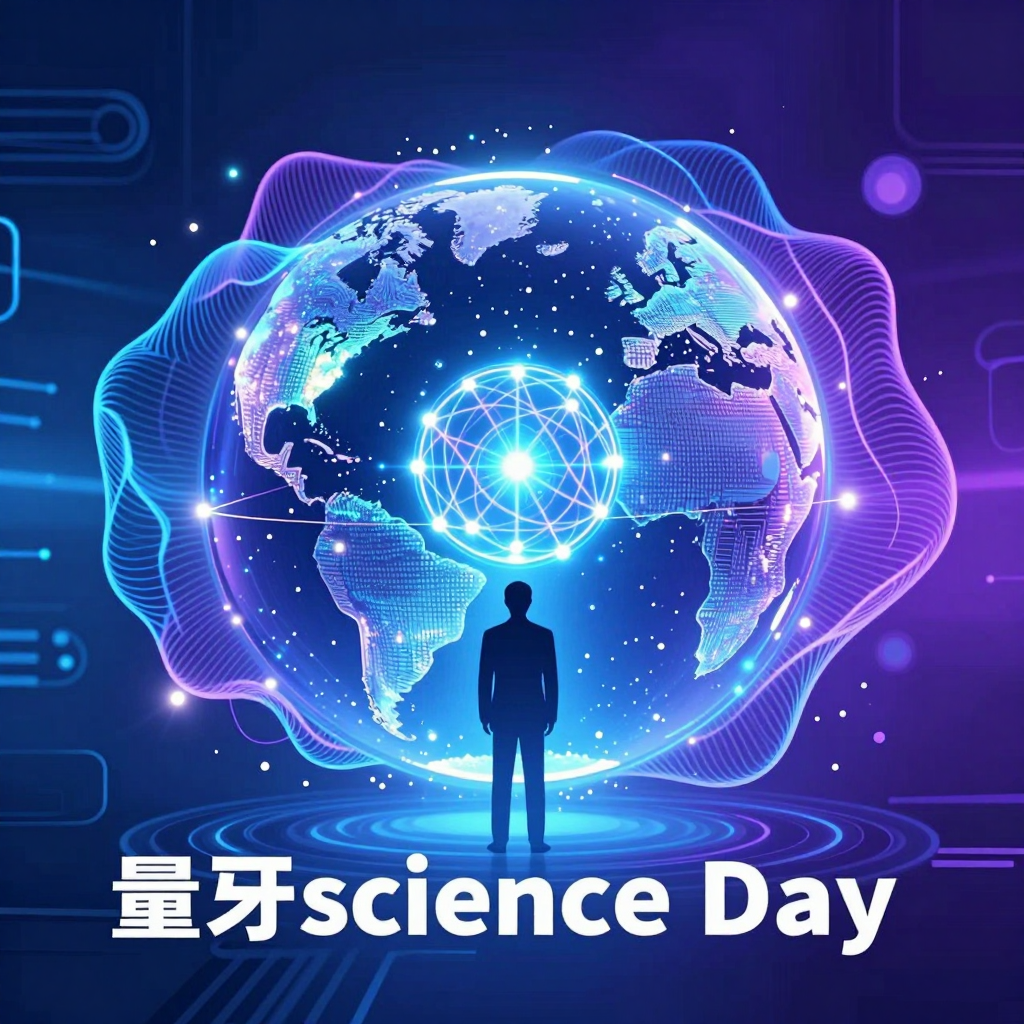
April 14th marks a special day that captures the attention of the world. Why is this day so crucial for the future of quantum science? The answer goes beyond a simple “commemoration”—it is the day when quantum technology is translated into the language of the public. This is World Quantum Day.
World Quantum Day is an international movement designed to help more people understand the core concepts of quantum science and to bridge the gap between breakthroughs in the lab and their applications in industry and education. Events such as lectures, workshops, lab tours, and live demonstrations take place around the globe, transforming the once complex world of quantum mechanics into a technology that feels connected to our daily lives.
The choice of April 14th is no coincidence—it is symbolic. The date is inspired by the first digits 4.14 of Planck’s constant, the fundamental constant of quantum physics. In other words, April 14th celebrates the very foundation on which quantum science stands.
Another key point is that quantum science is far from a distant future. We already use technologies grounded in quantum principles every day—GPS, medical imaging, lasers, to name a few. Now, attention is swiftly turning to quantum computing, a field expected to revolutionize cybersecurity and unlock solutions to complex challenges like drug discovery.
Thus, World Quantum Day is not just a festival for science enthusiasts. It is a convergence point for future technological competitiveness, education, and industrial innovation. It marks the moment when the word “quantum” leaps off news headlines and becomes a real agenda for society.
World Quantum Day: Planck’s Constant and 4.14 — The Key to Unlocking the Secrets of Quantum Mechanics
Have you ever wondered how the invisible world of quantum particles is transforming our lives, from the GPS we rely on to medical imaging technologies? At the heart of this question lies the number 4.14 and the essential key to quantum mechanics: Planck’s constant (h).
Simply put, Planck’s constant is the fundamental constant that mathematically confirms the fact that energy is exchanged not continuously, but in discrete “packets” (quanta). When light and matter interact, energy does not flow in arbitrary amounts—it is transferred in fixed units. The most intuitive expression of this principle is the equation:
- E = hν
(Energy E is proportional to Planck’s constant h and the frequency ν)
This simple formula carries profound significance. As the color (frequency) of light changes, so does the unit of energy exchange. This revelation laid the foundation for modern technologies like semiconductors, lasers, sensors, and medical diagnostic devices.
But why April 14? The reason World Quantum Day is celebrated on April 14 is inspired by the symbolic number 4.14, derived from Planck’s constant. Scientists use this date to make the somewhat abstract concept of “quantum” more accessible to the public and to highlight how quantum technology is already deeply woven into our everyday lives.
Planck’s constant is far from just a theoretical number—it’s clearly reflected in applied technologies:
- GPS: Quantum-based technologies (accurate frequency/time standards) underpin precise satellite signal timing and physical modeling.
- Medical Imaging: Tools like MRI harness the subtle quantum properties of matter to non-invasively “read” inside the human body.
- Lasers: Using transitions between quantum energy levels, lasers are widely applied from everyday barcode scanners to industrial and medical fields.
Ultimately, 4.14 is not merely a commemorative date but a symbol of the quantum mindset that made modern technological civilization possible. By truly grasping the meaning of Planck’s constant on World Quantum Day, we begin to see how the sophisticated science behind our daily technologies is more remarkable than ever.
America’s Challenge Through World Quantum Day: Quantum Computing and Advanced Technology Investment
From cybersecurity to new drug development, how will America’s massive investment in quantum technology ripple through global tech supremacy? World Quantum Day serves as a symbolic occasion to bring this question to the forefront. Beyond celebration and education, it vividly reveals the real-world race of ‘who will first unlock commercialization.’
The U.S. investment can be understood in two major streams. First is securing quantum computing capabilities. As qubit-based computation matures, problems that are nearly impossible for classical computers—complex optimization, high-precision simulations, massive data pattern detection—may be solved at unprecedented speeds. This power promises to transform productivity and the very methods of research and development across industries.
Second is investment from the perspective of national security and economic security. Cybersecurity, in particular, is the domain where the ‘rules change’ first in the quantum era. With growing concerns that quantum computing could threaten certain encryption systems, the U.S. is accelerating public-private efforts in transitioning to post-quantum cryptography (PQC), protecting critical infrastructure, and leading standardization battles. The nation that gains the edge here will effectively set the benchmarks for digital trust—transactions, communications, finance—globally.
Meanwhile, the impact on new drug discovery and advanced materials is also profound. The ability to precisely model molecular interactions can dramatically reduce trial and error before clinical stages and speed up candidate material searches. America’s aggressive capital and talent investment in this arena is not just about ‘faster calculations’ but leveraging a technological edge poised to reshape the bio-healthcare value chain.
Ultimately, the message World Quantum Day conveys is clear. Quantum technology is no longer just a scientific headline—it has evolved into a national project tied to standards, security, and industrial leadership. The pace and choices of U.S. investment will be a critical barometer, indicating where the global technological balance of power will lean next.
World Quantum Day Google Doodle and the Bloch Sphere: Visualizing the Invisible Quantum World
What story lies behind the mesmerizing movements of qubits captured in the Bloch Sphere animation, something never seen before? This year’s World Quantum Day Google Doodle offers the most intuitive “beginner’s answer” to that very question. Instead of complex equations, it illustrates the essence of quantum states through the motion of a single point moving on a sphere.
Why the Bloch Sphere is the ‘Map of Quantum States’
The Bloch Sphere is the standard tool for visualizing the state of a qubit. Unlike classical computer bits fixed as either 0 or 1, qubits can hold both properties simultaneously thanks to superposition. Rather than abstractly explaining this “simultaneous possibility,” the Bloch Sphere represents all possible states as coordinates on the sphere’s surface, making it instantly comprehensible.
- The sphere’s north and south poles represent the reference states akin to 0 and 1
- Any point on the sphere’s surface corresponds to a superposition state mixing 0 and 1
- The rotation (movement) of the point intuitively expresses quantum gate operations or state changes over time
In other words, the “movement of the point” seen in the Doodle isn’t just graphics—it is a visual language that compresses how quantum computations transform states.
The Hidden Message in the Animation: ‘Invisible, But Controllable’
The quantum world cannot be seen with the naked eye, yet technology is entering a phase where this realm can be designed and controlled. The Bloch Sphere symbolizes this turning point. Quantum states, once shrouded in “mysteries beyond understanding,” are now tangible through standardized models and tools.
Thus, this year’s World Quantum Day Doodle goes beyond mere commemoration.
For the general public, it offers the least intimidating introduction to “what quantum computing is,” while for industry and researchers, it serves as an emblematic reminder of “the language we use to engage with quantum.”
Why This Visualization Matters
Quantum computing connects to high-impact fields such as cybersecurity and drug discovery, yet its entry barriers remain high. Visual tools like the Bloch Sphere lower these hurdles. The faster people grasp the concepts, the easier education and talent influx become, ultimately accelerating the growth of the technology ecosystem.
Google’s choice of the Bloch Sphere is clear.
When discussing the future of quantum technology, the first essential ingredient isn’t just “excitement”—it’s the foundational step toward understanding.
Preparing for the Future with World Quantum Day: The Choices of the United States and All of Us
Quantum technology has become a core driver of national competitiveness beyond just science education. Why and how is the United States striving to gain an edge in this cutting-edge race? World Quantum Day serves as a window that brings this question into everyday language and reveals the moment when national strategies extend “beyond the laboratory.”
The reason the U.S. is determined not to miss out on quantum technology is clear. Quantum computing is set to change the rules of cybersecurity and break down the time and cost barriers in fields with explosive computational demands, like new drug development. With quantum science already woven into daily life through GPS, medical imaging, and lasers, the nation that leads the next wave is likely to dominate industrial standards, supply chains, and talent flows.
So, how does it create this advantage? The key lies in three pillars:
- Raising Awareness → Expanding Talent: By familiarizing the public with concepts like the Bloch Sphere and qubits—much like Google Doodles do—quantum technology shifts from being the domain of a few researchers to a recognized skill for future careers. This, in turn, fuels growing education demand and broadens the talent pool.
- Simultaneous Government-Private Investment → Ecosystem Building: When funding flows seamlessly from fundamental research through application to commercialization, laboratory breakthroughs connect directly to industry. It’s not about a “one-time breakthrough” but a “sustainable pipeline” that creates competitiveness.
- National Agenda Setting → Securing Standards and Trust: The country that first establishes rules for quantum-era security (especially cryptographic transitions), technology ethics, and international cooperation will win market confidence.
Ultimately, the message World Quantum Day delivers is simple. Quantum technology is not a “some-day-in-the-future” dream but a competition unfolding right now—where education, industry, and security intersect simultaneously. If the U.S. approach is strategy, our approach must be even more practical. When public interest in understanding quantum grows, companies experiment boldly, and curricula evolve in classrooms—a future that’s more than a spectacle becomes a result of preparation.
Comments
Post a Comment