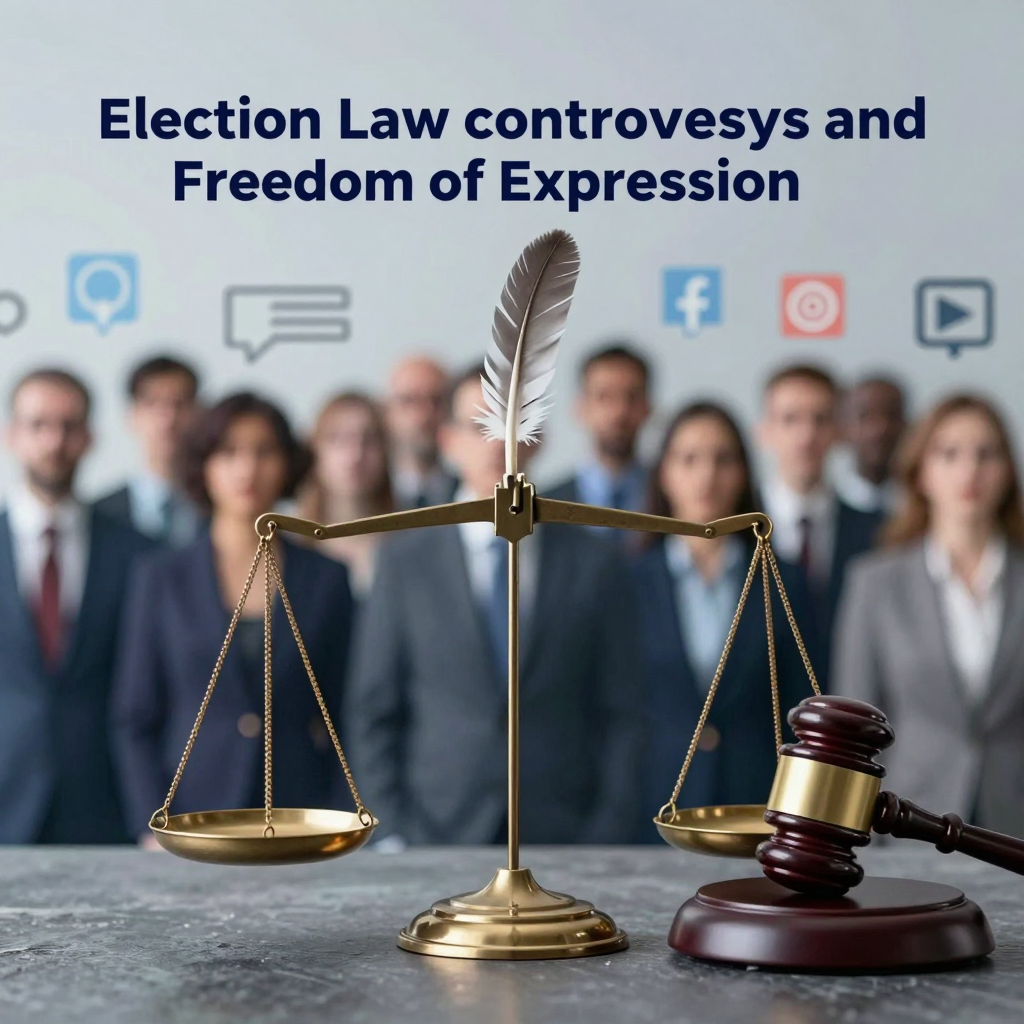
Controversy Over Election Law Violations: How Far Can We Go Between False Facts and Freedom of Expression?
 \n
\n
Election Law Meets the Rule Set of Democracy: Why Has Election Law Become a ‘Game Changer’?
Why is the recent debate over South Korea’s election law heating up so intensely? From allegations of false residency to election campaign content on social media, the headlines overwhelmingly boil down to “violation of the Public Official Election Act.” Here’s the key point: election law is not just a set of procedural rules—it is a ‘rule set’ that defines the rules of political competition and can even shift the direction of the game.
A common pattern emerges from recent controversies:
- False residency and actual residence allegations strike at sensitive issues of “candidacy qualifications” and “voter deception” simultaneously. Even the slightest factual dispute can shake the entire election landscape.
- Disputes over the spread of false information directly challenge how far election law permits freedom of expression. Whether a statement is considered an ‘opinion’ or a ‘factual claim’ can lead to drastically different legal outcomes for the exact same sentence.
- The controversy around social media election campaigns is even more complex. One single card news image, a map, or a short caption can imprint a specific “impression” on voters—and when that impression conflicts with the facts, it lands on the election law’s judgment bench.
Ultimately, the reason election law is so charged is that it acts as a direct bridge between the political content (words, images, frames) and the democratic outcome (voter choice).
For some, election law appears as a “safeguard against fake news,” yet for others, it feels like a “blade that stifles expression.” And as this tension intensifies, election law ceases to be just a background rule and emerges as a central variable in the political arena.
The Core of the Public Official Election Act: The Delicate Balance Between Fairness and Freedom of Expression
It is absolutely essential to prevent money and power from unfairly interfering in elections. However, if the speech of politicians and the criticism of voters are excessively restricted, elections become not a "forum for debate" but a "chamber of silence." So how does the Public Official Election Act capture these two values—fair elections and freedom of expression—within one framework?
The Two Pillars That the Election Law Protects
The Public Official Election Act is not merely a procedural law that says, "Conduct elections this way." At its core, two major goals operate simultaneously:
- Ensuring Fairness: It suppresses acts that break the "rules of the game," such as money-driven elections, organizational mobilization, and the spread of false information.
- Guaranteeing Freedom of Expression: Fundamentally, elections are a competition of ideas. Candidates and voters must have the freedom to debate policies, personalities, and controversies for elections to function properly.
The problem is these two often clash. Strong regulations may increase fairness but can also stifle speech itself. On the other hand, broad freedom of expression encourages lively debate but raises the risk of falsehoods and distortions polluting the elections.
Where to Draw the Line: The Hardest Question for Election Law
The recurring debates around the Public Official Election Act stem from the fact that what the law addresses are not just numbers or documents but words, impressions, and contexts. Especially during election periods, these gray areas frequently emerge:
- Factual Claims vs. Opinions/Evaluations: Saying someone is “incompetent” is more an evaluation, but if the facts cited to support this are false, it becomes problematic.
- Criticism vs. Defamation: Distinguishing whether a statement is public-interest scrutiny or a personal attack depends on the situation.
- Accurate Sentences vs. Overall Impression: Even if part of a statement is factual, the overall impression might mislead voters.
A particularly notable trend in recent rulings is the growing tendency not to judge falsehoods purely on a sentence-by-sentence basis but to consider the “overall impression” received by voters. While this approach is effective in catching subtle distortions, it also raises fears that political rhetoric and messaging could be vulnerable to punishment.
Ultimately, Election Law Is About Designing the Rules of Democracy
In conclusion, the Public Official Election Act does not offer perfect answers but rather forces us to repeatedly ask the same question for every election: "To what extent should expression be permitted for democracy to thrive, and from which distortions must we protect elections to keep them fair?"
Thus, election law cannot be fully understood by reading statute alone. In reality, the decisions of election commissions, choices of investigative agencies, and judicial interpretations overlap and shift the point of balance continuously. And that very balance reveals the democratic temperature a society chooses to uphold.
Election Law and the Supreme Court’s ‘Overall Impression of the Average Voter’ Standard: Where Is the Boundary of False Information Disclosure?
What if the measure of a "lie" is not the truthfulness of each individual sentence, but the overall impression the voter receives from the entire statement? The Supreme Court’s introduction of the ‘overall impression of the average voter’ standard directly challenges this point. This criterion changes how the crime of disseminating false information under election law (Public Official Election Act) is judged, effectively redesigning the permissible scope of political debate itself.
When the Issue Is Not Each ‘Sentence’ but the ‘Impression’
The conventional intuition is simple:
- If it’s true, it’s OK; if it’s false, it’s OUT.
However, language in election campaigns usually combines fact + interpretation + implication + framing. The Supreme Court’s ‘overall impression’ acknowledges that even if each sentence can be defended as “not strictly false,” if the end result creates an impression that distorts the voter’s fair judgment, it can be deemed dissemination of false information.
In other words, the focus within election law now shifts:
- Truth or falsehood by sentence → Truth or falsehood of the image created by the entire statement
- Formal accuracy → Potential for substantial misleading
The Question Raised by the Lee Jae-myung Case: How Far Does the Shield of ‘Political Expression’ Extend?
The Supreme Court’s decision in the Lee Jae-myung presidential case caused a major ripple because it placed the ‘overall impression of the average voter’ front and center in determining falsehood. This holds a dual message:
1) Political expression deserves wide latitude, but
2) The greater the expression’s impact on voter judgment, the narrower its allowable limits may become.
This reasoning sends a warning to prior practices that protected political speech up to points that might conflict with the election law’s goal of fair elections:
“However, manipulating impressions that cloud voter judgment is a separate matter.”
The Expansiveness of the ‘Overall Impression’ Standard Viewed Through the Controversy Over Candidate Han Dong-hoon
This standard is more controversial because it is not confined to a single case. Indeed, in the debates around Candidate Han Dong-hoon’s statements, questions arise: “If we apply the Lee Jae-myung precedent logic, could this be considered dissemination of false information?” The key is not whether a single fact was incorrect, but that multiple factors can be weighed together, including:
- The circumstances and context in which the statement was made (campaign site, flow of confrontation)
- The core message conveyed (the gist voters remember)
- The emotional conclusion created (“This is the kind of person after all” impression)
- Patterns of dissemination: rebuttal possibilities, corrections, repetition, etc.
Ultimately, the ‘overall impression’ standard makes it difficult to dismiss frequently used campaign rhetoric such as implication, metaphor, and framing as mere “political rhetoric.” This explains why the election law’s risk zone is said to be expanding.
The Boundary Is Likely to Be Drawn as Follows
Translating the ‘overall impression’ standard into practical election law terms emphasizes these boundaries:
Areas likely to be permitted:
- Expressions centered on policy criticism, value judgments, or opinion that are not primarily claims of verifiable fact
- Clearly presented opinions supported by evidence, framed as “It appears that ~”
Areas with greater risk:
- Statements framed to sound factual but that structurally induce misunderstandings overall
- Edited claims that selectively combine facts to strongly imply a different conclusion
- Fixing impressions by simplifying complex facts into images, slogans, or short phrases
In short, the key question election law is increasingly asking is becoming clearer. It no longer just asks:
“Is the statement true?” but moves toward,
“What conclusion did the statement lead voters to believe as fact?”
On the Ground of Election Law Enforcement: Who Judges What from the Election Commission to the Prosecutors and Courts?
Who ensures the fairness of elections, and who decides whether there’s a violation of the law? In the news, the phrase “accused of election law violation” often passes quickly, but in reality, a multilayered process unfolds: report → investigation → accusation → prosecution → trial. Throughout this process, there are plenty of legal interpretations at play—and just as much political tension.
The First Gatekeeper of Election Law, the Election Commission: Both “Watcher” and “Operator”
The Election Commission is the first institution to spring into action at election sites. Its role can be divided into two main functions:
- Creating a fair election environment: arranging candidate debates and forums, and helping voters compare information.
- Detecting and responding to potential violations: receiving reports and tips to verify facts, and if suspicion is high, referring the case to investigative agencies.
Here’s the key point. A referral from the Election Commission does not mean a “guilty verdict” but rather a judgment that “further investigation is needed.” Despite this, during election seasons, even just being “accused” can create powerful political frames, making the election law a frequent tool for political battles.
The Crossroad of Election Law Cases, the Prosecutors: Choosing Between “Investigation” and “Dismissal”
After reports from the Election Commission or rival candidates are received, the next phase is usually investigation by prosecutors (or police). From here, cases typically go in two directions:
- Prosecution (leading to trial): when charges are supported and violation is likely recognized.
- Dismissal or Non-prosecution (case closure): when evidence is insufficient, legal elements are missing, or investigation is deemed unnecessary—ending without a substantive ruling.
In other words, the “real game” in election law issues begins after the accusation. Even identical cases can result in prosecution or dismissal depending on the quality of evidence, context of statements, and spread of communication (like social media propagation)—and this decision itself influences election strategies and public opinion.
The Final Arbiter of Election Law, the Courts: Precedents Redefine the ‘Rules’
Election law contains many abstract concepts. In particular, with cases like false information disclosures, the debate always centers on “where political rhetoric ends and legal punishment begins.” The final standards come from the courts, especially Supreme Court precedents.
Recently, the Supreme Court emphasized the “overall impression received by an ordinary voter” when judging falsehoods, moving beyond checking the truth of each sentence to considering the comprehensive image and impact voters perceive. This shift sends a powerful message to practitioners:
- The old idea that “as long as one fact is correct, you’re safe” may no longer hold.
- Not only speech but also editing, images, and framing (such as SNS card news, thumbnails, maps, etc.) can fall under legal scrutiny.
Ultimately, court rulings don’t merely conclude individual cases—they redraw the communication rules everyone must follow in the next election.
Why Election Law Is Challenging: Legal Interpretation Meets Political Complexity
To sum up, election law enforcement is not a straight procedural path but a series of stages each guided by different logic:
- The Election Commission focuses on maintaining fairness and preemptively blocking suspicious violations.
- The Prosecutors sift cases based on evidence and legal criteria.
- The Courts balance freedom of expression and voter protection through precedent.
Because of this structure, election periods see repetitive conflicts: “accusation vs false accusation,” “freedom of speech vs smear campaigns.” For readers, here’s one crucial takeaway: an accusation is not a conclusion, but the start of the process—and to truly understand election law news, you must always look for “which stage it’s at” to grasp its real meaning.
How Election Laws and Case Law Are Changing the Election Battlefield – 5 Practical Points Candidates and Voters Must Remember
We live in an era where a ‘complaint’ does not automatically mean ‘guilty.’ At the same time, even images and frames (thumbnails, card news, catchy phrases) are subject to legal scrutiny. As elections approach, election law shifts from a question of “Do you know it or not?” to “Are you prepared or negligent?” Here are five practical points that candidates, their teams, and voters alike will genuinely feel on the ground.
Election Law Practical Point 1: Separate ‘Reported News’ from ‘Guilty Verdicts’
The most common phrase in election season news is “reported to the election commission” or “filed a complaint with the police.” But a report is merely the start of a process, not the conclusion.
- Reporting to the election commission → investigation by authorities (possible dismissal or non-prosecution) → trial → final verdict takes time.
- Because competing camps often use reports as “political weapons,” taking headlines at face value can distort judgment.
Voters should get into the habit of treating “reported” as a fact and “guilty” as a claim to be verified.
Election Law Practical Point 2: The ‘Overall Impression’ Is More Dangerous Than a Single Sentence
Recent case law emphasizes not isolated statements but the overall impression formed in the voter’s mind. In other words,
- Even if individual sentences cleverly seem factual,
- If putting the statements together creates a structure that leads to “this is what is really meant” misunderstandings,
legal risks increase significantly.
Campaigns and candidates must review not only “precise word choice” but also the frame created by the combination of sentences in debates, rallies, and interviews.
Election Law Practical Point 3: Mixing ‘Facts’ and ‘Evaluations’ Greatly Increases Legal Risk
Strong criticism is normal in politics, but election law disputes usually balloon the moment opinions are passed off as facts.
- Saying “incompetent/irresponsible” may be an opinion (evaluation), but
- If the numbers, statements, or incidents cited as evidence (facts) are wrong, the issue quickly turns into false information.
The foundation of safe communication is simple: - Present facts clearly and briefly with sources attached
- Make sure evaluations are clearly expressed as opinions, emphatically
Election Law Practical Point 4: SNS Images, Memes, and Thumbnails Are Also Viewed as ‘Election Statements’
The main weapon in today’s elections isn’t text but images. Card news, infographic maps, short videos, and provocative thumbnails spread much faster. The problem is these also fall under the scope of election law scrutiny.
- Defenses like “it’s just an image” may not hold, and
- If the composition strongly shapes voters’ impressions,
it can lead to accusations of false information or defamation.
In practice, even when creating one post, a system is needed to examine not only the “factual accuracy of the text” but also the meaning implied by the design.
Election Law Practical Point 5: ‘Verifiable Evidence’ Beats Attacks in Winning Elections
In elections, it’s tempting to target opponents’ weaknesses with sharp words. But in the environment shaped by election laws, the ability to “speak aggressively” is outmatched in the long run by the ability to “build solid evidence.”
- Securing reliable sources like court rulings, official documents, government statistics, original videos, etc., and
- Ensuring tight links between claims and evidence gives you defensive strength even when disputes arise.
On the other hand, relying on rumors or fragmented screenshots turns the election from a policy contest into a game of legal risks instantly.
While elections are a celebration of democracy, they are a competition possible only within the rules. Ultimately, the strongest strategy in the era of election laws is not to “talk a lot” but to persuade with verified facts and win with evidence, not impressions.
Comments
Post a Comment