 \n
\n
A New Horizon for Edge AI: The Arrival of the Fully Offline LLM Era
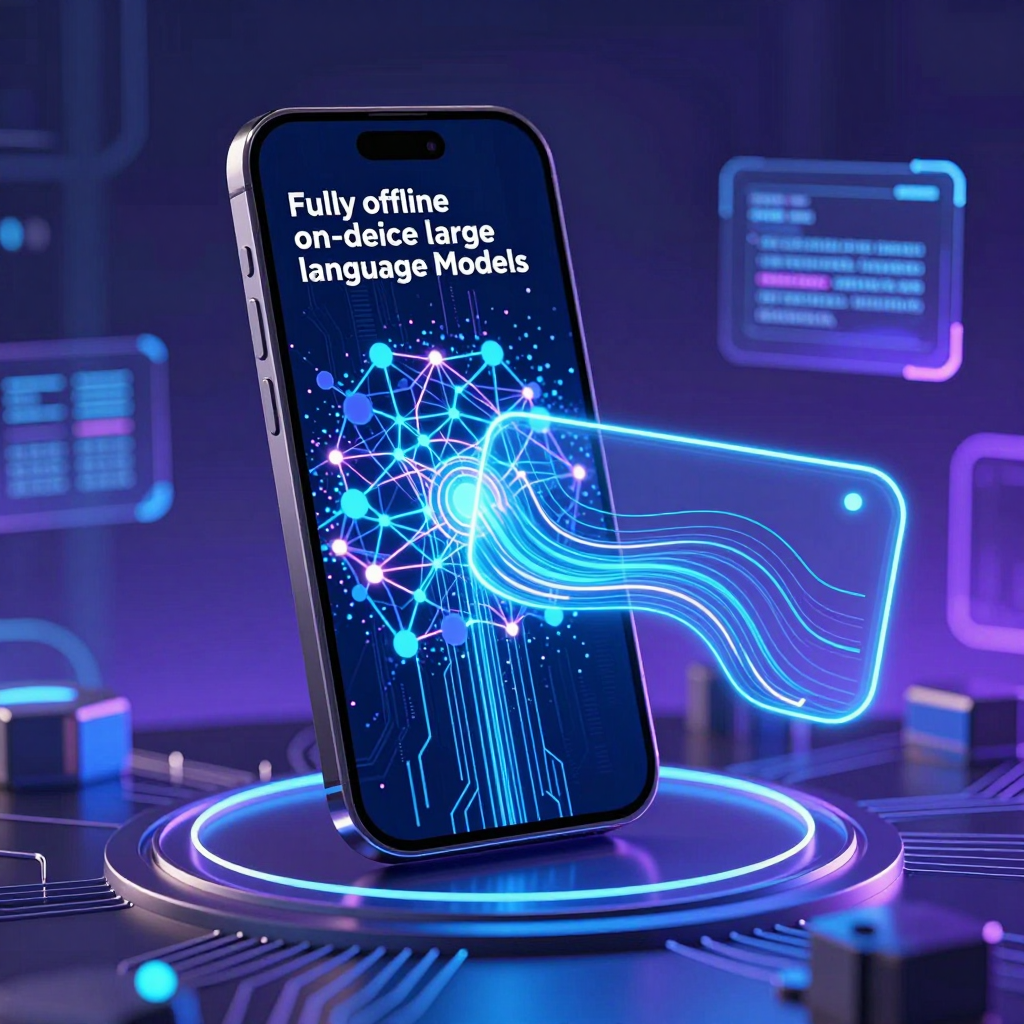
What if you could run the latest large language models (LLMs) entirely on your smartphone without any cloud assistance? Google’s AI Edge Gallery transforms this question into a reality by bringing fully offline LLMs down to the level of everyday mobile devices. Notably, their recent update officially supports the on-device LLM ‘Gemma 4’ family, signaling that Edge AI is no longer just a lab experiment but an immediate, practical execution platform right in the field.
Edge AI Breaks the Old Paradigm: The Fall of “You Must Ask the Cloud” as Common Sense
The classic LLM experience rested on a simple premise:
- Send your input (text, voice, image) to the cloud,
- Run inference on the server,
- Download the results back to your device.
Edge AI upends this flow. By running models directly on the device where data originates (the edge) rather than the cloud, it confronts the core bottlenecks that have long challenged generative AI head-on.
- Latency: With no network round trip, responses are instantaneous.
- Bandwidth: Continuous uploads of voice, video, or text are no longer needed, reducing traffic.
- Privacy: Sensitive inputs never leave the device, creating a truly private architecture.
This is why AI Edge Gallery proudly declares its service as “fully offline, private, and lightning-fast.” Running offline means more than just working without internet—it signals that the design paradigm for LLM experience is shifting from the server to the device.
What On-Device Gemma 4 Means in Edge AI: A Technological Shift
Running LLMs on constrained environments like smartphones demands technology beyond “just running an app.” AI Edge Gallery’s support for Gemma 4 on-device means its stack meets critical edge inference requirements at minimum:
- Model Compression and Optimization
Large models demand significant memory and computation. To run them on mobile devices, techniques like quantization reduce weight precision (e.g., 8bit/4bit), decreasing both memory footprint and computational load. - Exploiting Hardware Accelerators
CPUs alone struggle with efficient LLM execution on smartphones. Leveraging accelerators such as GPUs or NPUs for inference is standard. Success in Edge AI ultimately depends on how well hardware capabilities are harnessed in addition to raw model performance. - Decoding Optimizations for Perceived Speed
Users judge speed not by final answers but by how quickly the first token appears. Thus, on-device LLMs typically employ streaming output token by token, along with optimized decoding pipelines to boost responsiveness.
In short, AI Edge Gallery’s Gemma 4 support is not just a new model addition—it marks the arrival of real-world optimization, acceleration, and runtime operation capabilities for running LLMs in mobile environments.
Who AI Edge Gallery Targets as an Edge AI Platform
AI Edge Gallery is less a chat app for casual users and more an open-source experimental and deployment platform for developers and the AI community. This distinction is vital. Broad adoption of on-device LLMs hinges less on who builds bigger models and more on who can provide an execution environment that enables rapid testing and safe deployment.
Edge AI’s value shines immediately in scenarios like:
- Privacy-Sensitive Tasks: Handling personal notes or summarizing/classifying medical and financial records entirely on-device.
- Network-Limited Environments: Conducting offline Q&A and translation during fieldwork, travel, or in areas with unstable connections.
- PoC and Prototyping: Redesigning user experiences around the premise “no cloud needed” from the ground up.
Ultimately, AI Edge Gallery aims beyond “LLMs on mobile” — it positions itself as the essential toolkit for development and experimentation in the Edge AI era. Supporting Gemma 4 is the clearest proof that this toolkit is evolving in lockstep with the latest open-source LLM trends.
Edge AI On-Device LLM: A Revolutionary Evolution
Why insist on running AI directly on the device rather than in the cloud? Ironically, as large language models (LLMs) become more powerful, where they run matters more than ever. The reason Edge AI is gaining attention now is simple: it boldly tackles the cloud’s structural limitations—network latency, bandwidth costs, and privacy risks—by shifting execution to the “edge” (the device itself).
Google’s AI Edge Gallery update adding Gemma 4 on-device support symbolically illustrates this trend. With the ability to run the latest open-source LLMs completely offline on personal devices like smartphones and wearables, Edge AI is expanding beyond “simple sensor inference” to the domain of generative AI.
How Edge AI Solves Cloud’s Three Major Bottlenecks
On-device LLMs are less a ‘replacement’ and more a ‘solution.’ The differences become clear especially in these three areas:
1) Latency: Erasing Round Trip Delays
Cloud LLMs require sending queries to the server and waiting for the response—a network round trip. Even slight network degradation can make response times feel sluggish.
By contrast, Edge AI runs inference entirely on the device, delivering consistent responses regardless of network conditions. This “instant responsiveness” is critical for voice assistants, real-time translation, and on-site operational support.
2) Bandwidth: Designed to Avoid Uploads
Generative AI handles more than just text—it includes voice, images, documents, and more, making uploads a significant burden.
On-device LLMs eliminate the need to send data to the cloud, drastically reducing network traffic and making cost forecasting easier in enterprise settings. Especially for services with many simultaneous users or devices, this creates a structure that naturally scales with device capabilities instead of cloud expansion costs.
3) Privacy: Sensitive Data Stays Local
The AI Edge Gallery’s emphasis on “fully offline, private” usage is no coincidence. Sensitive text—medical notes, personal schedules, financial records, internal company documents—loses control the moment it’s transmitted.
By processing locally, Edge AI minimizes data movement and reduces the attack surface. The strongest protection isn’t “security after transmission,” but rather “never transmitting data in the first place.”
The Significance of Gemma 4 in the Edge AI On-Device LLM Landscape
Gemma 4 isn’t just another “new model.” The key is that the choice of cutting-edge LLMs runnable on devices has expanded. AI Edge Gallery now enables developers to:
- Run open-source LLMs directly on mobile, testing performance, latency, heat generation, and battery life under real-world conditions
- Rapidly prototype local chatbots, summarization, classification, and Q&A that work offline
- Experiment with privacy-first app architectures with reduced cloud dependence
Technically, running Gemma 4-class models on devices requires essential optimizations like quantization (e.g., 8bit/4bit), leveraging on-device accelerators such as GPUs/NPUs, and employing token-level streaming decoding. Offering this “on-device LLM execution stack” as an app, AI Edge Gallery is far from a simple demo—it’s a true platform for Edge AI experimentation and deployment.
Summary: Edge AI is an Evolution That Changes the ‘Structure,’ Not Just the ‘Speed’
On-device LLMs don’t aim to completely replace the cloud but shift AI’s focus to solving cloud weaknesses (latency, bandwidth, privacy) at the edge. The AI Edge Gallery’s push—including adding Gemma 4 support—signals that LLM competition is expanding beyond “who has the most powerful server” to “who runs LLMs best on the device.”
The Heart of Edge AI Technology: Gemma 4 and the Secrets of On-Device Inference
Running the latest open-source LLM, Gemma 4, on a smartphone quickly and securely involves a surprisingly intricate tech stack hidden beneath the surface of “just install one app and you’re done.” The fully offline, private, lightning-fast experience that AI Edge Gallery aims for becomes reality only when three pillars—quantization, hardware acceleration, and customized runtime architecture—work in harmony. Here, we’ll dissect each of these from the Edge AI perspective.
1) Quantization: The Most Practical Way to Break Through the “Mobile Memory Wall” Enabling Edge AI Inference
When running an LLM on a smartphone, the biggest hurdle is not so much the amount of computation but the memory and bandwidth constraints. LLMs have huge weights (parameters), and they continuously accumulate activations (intermediate results) during token generation. The secret weapon here is quantization.
- What changes?
Instead of storing and computing model weights in typical high-precision formats (e.g., FP16/FP32), they are converted into low-precision integer formats like 8-bit or 4-bit. - Why is this so effective?
- It drastically reduces memory usage of the weights, making it feasible to load the model on mobile devices with limited RAM.
- It cuts memory bandwidth demands, often resulting in noticeably improved real-world speeds.
- Trade-offs?
Lower precision can hurt output quality (accuracy/consistency), so methods that minimize quality loss through smart quantization or selectively keep higher precision on some layers are typically employed.
In summary, quantization in Edge AI isn’t just an option; it’s a prerequisite for making LLMs viable on mobile.
2) Hardware Acceleration: Why CPU Alone Can’t Deliver ‘Offline High-Speed’ Performance
To give the impression that an on-device LLM is truly fast, you must take full advantage of the device’s internal accelerators. Mobile SoCs don’t just have CPUs—they also include GPUs, NPUs (or TPU variants), DSPs, and other compute units. How you leverage these critically affects perceived performance in Edge AI inference.
- GPU Acceleration
Powerful in matrix computations and often used for LLM inference, though power consumption and heat management are important concerns. - NPU (Neural Processing Unit) Acceleration
Outstanding power efficiency that favors sustained inference for continuous AI features, albeit with constraints on supported operators/precisions that increase the difficulty of model conversion and optimization. - Why hardware acceleration matters
- Token generation is a chain of repetitive computations, so accelerators directly impact tokens processed per second.
- In offline settings, there’s zero network lag, thus local computation speed fully dictates user experience.
Ultimately, the lightning-fast promise of AI Edge Gallery isn’t just about “no cloud latency”—it’s grounded in Edge AI inference designs that actively harness device compute units.
3) Customized Runtime Architecture: The Execution Layer That Makes a “Model Gallery” Possible
AI Edge Gallery is more than just a demo—it’s closer to a platform that runs various open-source LLMs on devices. To enable this, the key isn’t just the “model files” but the runtime: the execution layer responsible for loading the model, connecting accelerators, generating tokens, and streaming output.
Key runtime components include:
- Model Loader and Memory Planner
Efficiently allocating weights and caches (KV cache) within tight mobile memory limits. Longer conversations mean larger caches, so smart memory management equals stability. - Computation Graph Optimization
Fusion or ordering of operations affects speed and heat generation—even with the same model. - Streaming Decoding (Token-by-Token Output)
LLMs don’t answer all at once but generate tokens sequentially. To improve user experience, managing time to first token (TTFT) and token generation speed is crucial.
Effective streaming minimizes the “thinking…” stalling feel. - Offline/Privacy Design
The strength of Edge AI lies in data never leaving the device. To do this right,- Network calls are minimized or completely blocked, and
- Logging, caching, permission handling are all coordinated to maintain a fully contained data flow on-device.
In other words, “running Gemma 4 on mobile” is not just about a model, but a system combining quantized models + accelerators + optimized runtime + streaming UX. This complexity is exactly what makes Edge AI fascinating yet challenging.
On-device LLMs have moved beyond “possible” to a battle of how to run faster, longer, and more securely. AI Edge Gallery, supporting Gemma 4, boldly brings this battleground to mobile—offering a platform where anyone can test and enhance Edge AI inference firsthand. This shift marks a meaningful milestone in Edge AI’s exciting journey.
Who Uses Edge AI and Where? Exploring Real-World Possibilities
On-device LLMs, once seeming like mere toys for developers and researchers, take on a whole new meaning the moment they enter environments where network stability is shaky or privacy is paramount. In places where cloud connectivity isn’t just a “nice-to-have” but a “must-work-without”, Edge AI isn’t just about optimization—it’s a critical prerequisite for the product itself. Let’s take a closer look at real scenarios unlocked by platforms like AI Edge Gallery, where offline execution is the default for LLMs.
How Edge AI Is Transforming User Landscapes: From ‘Developer Tools’ to ‘On-Site Tools’
On-device LLMs become incredibly valuable when three conditions intersect:
- Tasks where latency translates directly to quality: eliminating round-trip network delays means instant responses
- Environments where bandwidth is costly or limited: no need to upload videos, audio, or documents to the cloud
- Domains where data leakage poses risks: sensitive information remains on the device
In essence, the benefit of Edge AI shines brightest not because “the cloud is weaker,” but where operational constraints simply don’t allow cloud dependence.
Edge AI in Privacy-Sensitive Fields: Local Processing Innovations in Healthcare, Finance, and Personal Records
The core change on-device LLMs bring to privacy-critical domains is simple yet profound: providing generative capabilities without transmitting data.
- Medical/healthcare notes: locally generating summaries of patient records, symptom-based Q&A, medication scheduling
- Finance/business documents: extracting and summarizing crucial parts of transactions, contracts, and consultation logs without external transmission
- Personal journaling/lifelogging: organizing sensitive emotional entries, schedules, family details with “AI that never leaves the cloud”
Technically, because inference happens on-device, the original text/audio/image data never travels to servers. This shifts security design from relying mainly on “encryption in transit” to emphasizing non-exfiltration, creating more robust regulatory compliance and audit-friendliness.
Edge AI for Network-Restricted Environments: When Offline Is the Norm, Not the Exception
In places like airplanes, ships, construction and farming sites, or international business trips—with unstable connectivity—cloud-based LLMs offer a patchy user experience. On-device LLMs, by contrast, deliver consistent inference quality regardless of network conditions.
- On-site manual Q&A: instantly searching and explaining equipment check procedures, error codes, safety rules offline
- Translation/communication: enabling smooth multilingual collaboration even with poor connectivity
- Automated task instructions/checklists: transforming voice/text inputs into structured report drafts on site
Since these are offline scenarios, models must infer directly on the device, and performance experience largely depends on:
- Memory/storage: local storage of LLM weights demands capacity and fast loading
- Compute acceleration (NPU/GPU use): governs token generation speed and battery efficiency
- Streaming responses: immediate token-level output reinforces a “fast” impression, avoiding waits for full sentences
When these elements align, Edge AI shifts from a “cloud-dependent convenience” to an essential on-site infrastructure.
Experimenting with Edge AI Products/Services: Accelerating Decisions from PoC to Deployment
Platforms like AI Edge Gallery radically speed up prototyping (PoC). Instead of “deploying to the cloud and testing APIs,” developers can instantly validate on the actual target device:
- Model selection: identifying which open-source LLM fits task demands
- Performance limits: token speed, heat generation, battery drain, memory usage
- UX design: caching offline, on-device search (local RAG), graceful failure handling (e.g., storage shortages)
In Edge AI, satisfying resource constraints is just as critical as accuracy. A product fails if the device can’t handle it—so starting on-device tests early slashes costs dramatically.
Edge AI Education & Research: Moving from ‘Running Models’ to ‘Mastering Systems’
For research and education, on-device LLMs aren’t just demos—they’re textbooks of system optimization:
- shrinking models through quantization
- leveraging hardware acceleration (NPU/GPU)
- balancing real-world constraints on latency, power, and heat
- all while achieving the desired quality and responsiveness
This highlights that Edge AI isn’t simply about “how to use AI” but how to make AI actually work in the real world.
Ultimately, on-device LLMs change the question from “How big a model can we run?” to “What can we enable when there’s no connection, no data leakage, and immediate response is critical?” And the first real proving ground for that answer is, unmistakably, Edge AI.
A New Axis in the Edge-First LLM Race Reshaped by Edge AI, and Future Outlook
The era when cloud meant AI is rapidly fading away. The core question in the competition now is simple: it’s no longer about “who can run bigger models on more expensive servers,” but “who can run them more securely and faster on more devices.” At the heart of this shift is Edge AI, and Google’s AI Edge Gallery (with Gemma 4 supporting on-device) offers a ‘ready-to-grab’ developer-friendly option that pushes this trend forward.
Limits of Cloud-Centric Competition: LLMs Hit Bottlenecks in Speed, Cost, and Data
While cloud LLMs are undeniably powerful, as they move closer to products and real-world industry use cases, the following issues quickly emerge:
- Latency: As soon as network round-trips are involved, interactive UX, real-time control, and on-site decision-making suffer sharply in perceived responsiveness.
- Cost structure: As usage scales, server and traffic costs increase linearly.
- Privacy/Regulations: In healthcare, finance, and industrial data, simply “sending data out” poses risks. Once data leaves the premises, audit, security, and compliance costs escalate.
- Dependency on connectivity: Service quality fluctuates in unstable network environments such as field sites, mobile situations, overseas locations, or disaster zones.
The direct answer to these bottlenecks is Edge AI, meaning inference is performed on the device where the data originates, not in the cloud. Ironically, the larger LLMs grow, the clearer the need to “move inference to the edge” becomes.
Apple and Qualcomm’s On-Device AI Strategy vs. Google’s Edge AI Platform Approach
Many players promote on-device AI, but their approaches vary widely.
- Apple: Designs on-device AI experiences deeply integrated into its OS, hardware, and app ecosystem. Its strengths lie in smooth UX and controlled quality, but it’s more about optimizing its own ecosystem than serving as a universal development or experimental platform.
- Qualcomm (and chip vendors): Prove “AI running on devices” primarily through NPU/DSP/GPU performance and SDKs. This approach centers on hardware capability-driven proliferation.
- Google AI Edge Gallery: The distinguishing factor here is that beyond “specific device experiences” or “chip performance showcases,” it aims to be a universal Edge AI experimentation and deployment starting point—where developers can run open-source LLMs fully offline, swap models, and validate them. Support for Gemma 4 means this platform now extends to the latest model lineup.
In summary, the competition axis is expanding from device features (integrated UX) and chip performance (accelerated hardware) to a platform/runtime that empowers developers to run LLMs at the edge, and AI Edge Gallery reads as a strategic move to seize this emerging center.
What “Universal Edge AI Platform” Technically Means
To run LLMs effectively on mobile, simply uploading model files won’t suffice — the entire inference stack needs optimization. For the AI Edge Gallery’s promise of “fully offline, private, lightning-fast” to hold (from a typical on-device LLM deployment view), the following are crucial:
- Model lightweighting/quantization: Reducing LLM weights to 8bit/4bit dramatically cuts memory and compute requirements. This is the key premise to simply “make it run” on mobile devices.
- Utilizing hardware acceleration: Properly leveraging device accelerators like GPU/NPU is essential for token generation speed and power efficiency — factors that directly impact perceived Edge AI performance.
- Streaming decoding and latency optimization: User experience hinges less on “final answer time” and more on “how quickly the first token appears.” Token streaming and cache optimizations are indispensable.
- Model swapping and reproducibility: Edge PoCs are a quick “works on this model, or not” verification game. A platform’s value lies in enabling easy replacement of open-source LLMs to compare performance, memory, heat, and battery impact.
Put simply, AI Edge Gallery’s role is to provide an app-like runtime environment to realistically run on-device LLMs, which embodies the heart of the universal Edge AI platform vision.
Future Outlook: Edge-First LLMs Expanding Beyond Mobile to Robotics and Industrial IoT
Edge-first LLMs don’t stop at smartphones. Instead, smartphones serve as the most popular edge node and a beachhead for industrial expansion. The next frontier naturally extends into the physical world:
- Robotics/Autonomous Driving (Physical AI): The field prioritizes latency and safety above all. Local inference without dependency on networks becomes not an option but a fundamental design principle.
- Industrial IoT and on-site work assistance: Tasks like manual lookups, inspection report summarization, and on-site Q&A about equipment anomalies are prime examples of “data that’s hard to send out.” Edge AI simultaneously cuts costs and risks.
- Privacy-centric consumer apps: In sensitive areas such as personal notes, health data, and financial records, on-device LLMs are not merely differentiators, but foundations of trust.
Ultimately, the market is likely to be elegantly reshaped into a combination of cloud LLMs (centralized) + Edge AI (local inference) + cloud calls only when necessary (hybrid). Approaches like AI Edge Gallery will lay the groundwork for “running LLMs at the edge as standard developer practice,” acting as a catalyst that shifts competition criteria from model performance to real-world feasibility (deployment, cost, privacy, latency).
Comments
Post a Comment