 \n
\n
The Tech War of ‘AI Phones and AI PCs’ Begins: Why Is On-Device Generative AI Exploding in Popularity?
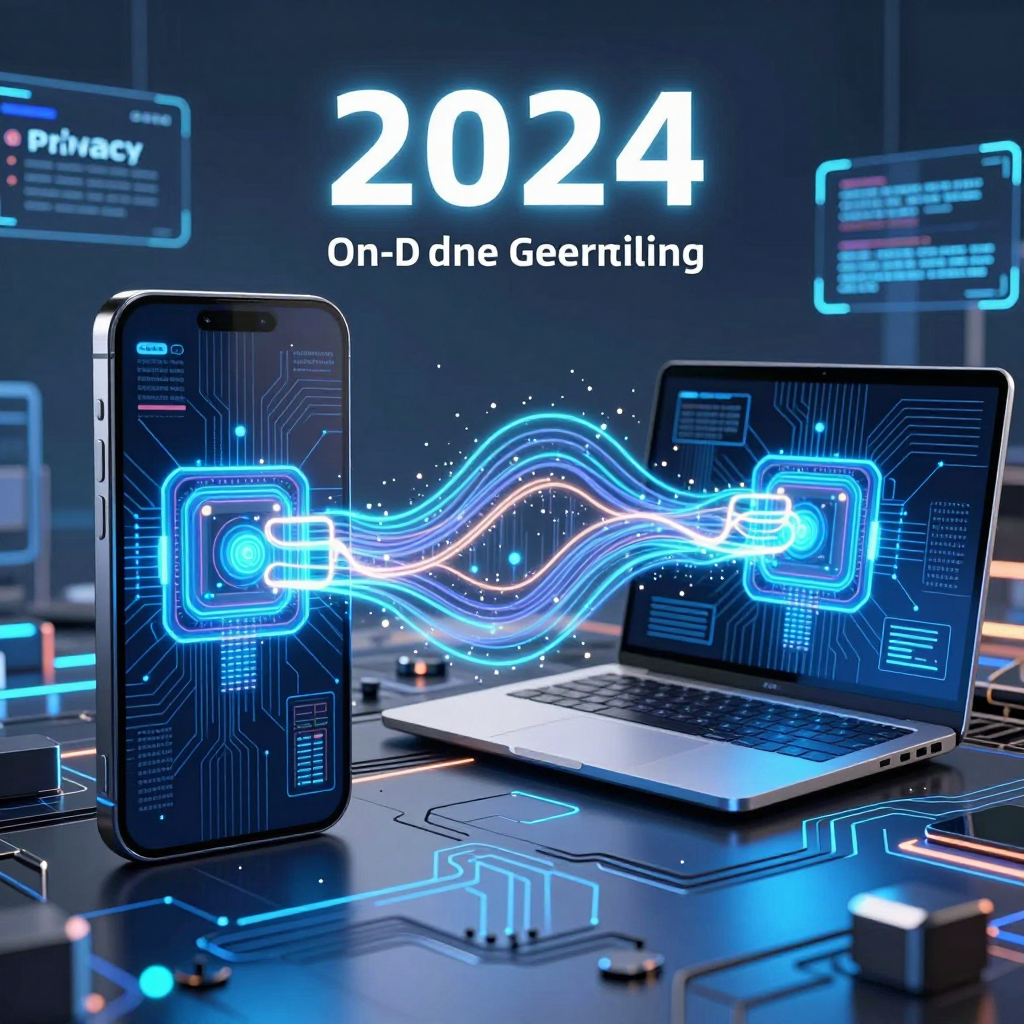
Until just a few months ago, generative AI meant nothing more than “asking questions and receiving answers from the cloud.” But today, the battlefield in the tech industry is swiftly shifting inside smartphones and PCs. The key is simple: to overcome the latency, cost, and privacy limitations of cloud AI, dedicated AI chips like NPUs (Neural Processing Units) embedded in devices have begun running generative AI locally. Why has this trend suddenly become so explosive now?
The Three Major Limits of Cloud AI from a Tech Perspective (Latency, Cost, Privacy)
As generative AI becomes widespread, structural bottlenecks in relying solely on the cloud become glaring.
Latency: “Round-trip communication” destroys real-time experiences
Cloud AI requires sending requests (uploading) → the server performs inference → receiving results (downloading). This round-trip latency fluctuates from hundreds of milliseconds to several seconds depending on the environment.
But features like real-time translation, keyboard autocomplete, copilot functionalities explaining while you look at the screen, AR/wearables break the moment users feel even a slight “thinking delay.” On-device AI solves this bottleneck by eliminating communication altogether.
Cost: As user numbers grow, cloud bills explode
Large models consume GPU resources, power, cooling, and data center operations continuously. When hundreds of millions of users access AI as a native feature on phones/PCs, costs explode—not linearly but exponentially.
On-device AI handles “frequently used basic tasks (summarization, classification, simple generation)” right on the device, reshuffling cloud resources to focus on high-complexity tasks—dramatically optimizing cost structures.
Privacy/Regulation: Sensitive data becomes problematic the moment it leaves the device
For generative AI to truly be useful, it must access core personal information—camera, microphone, messages, photos, calendar, health data. Sending this data to the cloud immediately raises user anxiety and regulatory risk.
On-device AI can process sensitive data entirely inside the device and share only minimal results as needed, enabling simultaneous “personalization” and “security” in its design.
The Tech Core: NPU Turns ‘AI Phones and AI PCs’ into a Performance Battle
The engine powering on-device generative AI is usually neither CPU nor GPU, but an NPU. NPUs, dedicated circuits optimized for matrix operations critical in deep learning inference, boost performance per watt (efficiency) tremendously.
- Smartphones: Latest chipsets flaunt NPUs with tens of TOPS power, defining the “AI phone.”
- PCs: The Windows ecosystem has set “NPU performance standards” to create the AI PC category, with Intel, AMD, and Qualcomm restructuring competition around this benchmark.
The key point: On-device AI is not just about “faster AI”—it marks a moment when hardware specs themselves become central to product value. Just as camera quality once was, “how well AI runs on my device” is now a decisive purchase factor.
The Tech Puzzle Solver: ‘Model Compression’ Made On-Device Generative AI Possible
“How can huge models run on phones or laptops?” The answer lies in model compression techniques. Three core methods:
Quantization
Reducing model weights from 16/32 bits to 8 or 4 bits drastically cuts memory and computation needs. This slashes resource demands while minimizing performance loss, making device integration feasible.Knowledge Distillation
Compressing and transferring the capabilities of large models into smaller ones creates usable quality within limited compute/memory. “Nano”-scale models optimized for on-device deployment emerged from this trend.Hybrid Architecture (On-Device + Cloud)
Lightweight models on the device perform first-pass tasks (summarizing, organizing, filtering), passing only the hardest queries to massive cloud models. This pragmatic solution keeps user experience fast while reducing cost and compliance burdens.
Conclusion from a Tech Standpoint: The Moment AI Becomes a Platform Feature, Not Just an App
On-device generative AI is hot not because of adding another feature—it integrates AI as a fundamental layer of OS, chips, and devices, transforming the very axis of competition between smartphones and PCs.
The future question shifts from “Which apps do I install?” to “What kind of AI, and how much local processing, does my device handle?” This shift marks the dawn of the ‘AI Phone and AI PC’ war.
Tech Core Technology Analysis: How NPUs and Model Compression Drive AI Innovation
Instead of cloud computing boasting hundreds of trillions of operations, how can an NPU embedded inside a device run massive AI models on a “small” scale? The simple answer is by making computations cheap and fast through dedicated hardware (NPU) and reducing memory and computing demands via model compression to fit the model into a “realistically deployable size.” This combination is the very engine that makes today’s tech industry competition in AI phones and AI PCs truly possible.
Tech Perspective on NPUs: Why Not CPU/GPU?
Generative AI (especially LLMs) inherently performs intense matrix multiply operations repeatedly. CPUs can handle this but are inefficient for parallel processing; GPUs are fast but consume a lot of power. Enter the Neural Processing Unit (NPU).
- NPU’s Role: Handles matrix operations essential for AI inference using dedicated circuits
- Key Objective: Process the same workload with less power and shorter time (= better performance per watt)
- Performance Metric (TOPS): While TOPS (Tera Operations Per Second) often gets highlighted, actual perceived performance heavily depends on memory bandwidth, cache architecture, computational precision (INT8/INT4), and software stacks.
In other words, rather than “higher NPU TOPS = absolutely faster,” the smooth operation of on-device generative AI requires a holistic optimization of NPU + memory + compiler/runtime as a complete set.
Tech Core: The ‘Model Compression’ Trio That Packs Large Models Into Devices
The biggest constraints on-device are RAM (memory capacity), power/thermal limits, and inference latency. Rather than deploying huge models as-is, these techniques combine to make models “smaller.”
Tech 1) Quantization: Compressing 32-bit Down to 4-bit
Quantization lowers model weights and activations from floating-point precision to fixed-point integers (e.g., INT8, INT4) for storage and computation.
- Why it works?
- Much of the model’s performance is not significantly hurt by losing “high-precision floats.”
- Lower bit-width linearly reduces memory usage and lightens compute loads.
- Typical changes:
- FP16 (16-bit) → INT8 (8-bit): Dramatically cuts memory and bandwidth demands with minor quality loss
- INT8 → INT4 (4-bit): Further shrinks size for easier mobile deployment but demands advanced techniques to maintain accuracy and stability
- Practical notes:
- Going beyond simple quantization by employing Quantization-Aware Training (QAT), group/channel-wise quantization, and mixed precision minimizes degradation.
Quantization is the number-one key to making on-device AI deployment viable, especially on RAM-limited smartphones.
Tech 2) Knowledge Distillation: Transferring the ‘Wisdom’ of Large Models to Small Ones
Distillation teaches a small model (Student) to mimic the output distributions, intermediate representations, and decision processes of a large model (Teacher), enabling the small model to “behave like the big one.”
- Why it’s needed:
- Quantization reduces model size but struggles to preserve intelligence fully.
- Distillation allows smaller architectures to achieve high performance targeted for specific tasks.
- Benefits:
- Enables creation of on-device specialized models fine-tuned for summarization, classification, or lightweight Q&A
- Cuts both latency and costs simultaneously
Ultimately, on-device models evolve from “all-round massive models” toward practical models focused on efficiently handling frequently used device tasks.
Tech 3) Structural Optimization & Hybrid Approaches: Activate Only What’s Needed, Offload the Rest to Cloud
Rather than trying to run everything locally, on-device AI often adopts a hybrid architecture (on-device + cloud) to optimize user experience.
- Structural optimizations:
- Attention optimizations, KV cache management, token generation pipeline tweaks to reduce latency
- Selective activation of experts (like MoE) to save compute
- Hybrid usage patterns:
- Local: text summarization, keyboard suggestions, voice dictation, light translation/classification (fast and privacy-friendly)
- Cloud: complex inference, long-form generation, challenging multimodal tasks (quality prioritized)
This approach offers a realistic solution balancing latency, cost, and privacy, and is likely to become the “default” in future tech product designs.
Tech Conclusion: NPU Is the Engine, Compression the Fuel… Together They Power ‘AI Phones and AI PCs’
In summary, the on-device generative AI revolution does not rely on a single technology but emerges from the synergy of NPUs (dedicated inference engines) and quantization, distillation, and optimization (model deployment enablers). Even the fastest NPU struggles if the model is heavy due to battery and heat constraints; conversely, squeezing the model without hardware and runtime optimizations collapses performance via latency.
The current platform battle ultimately centers on who sets the standard for running AI on-device faster and quieter (= low power) first.
Comparing Major Tech Players’ Strategies: Apple, Google, Qualcomm, and Microsoft’s Visions for the Future of AI Devices
Peering into the strategies of the big tech giants at the heart of the on-device AI war, it all boils down to one question: Will they build trust by prioritizing privacy above all, or seize standards by expanding their ecosystems? Though racing toward the era of NPUs, each camp crafts fundamentally different user experiences (UX) and revenue models.
Apple: On-Device AI Where “Privacy Is Not Just a Feature, But a Philosophy”
Apple’s strength isn’t merely chip performance, but its vertically integrated OS-chip-app permission architecture held by one company. Thanks to this structure, even when AI accesses personal data (photos, messages, calendars, health records), Apple can most convincingly push the message of “processing as much as possible on device.”
Core weapons: Neural Engine + OS permission controls
- Continuously boosting the A/M series Neural Engine (NPU) performance every generation to push model inference locally.
- Controlling sensitive data access at the OS level to reinforce the rationale for on-device processing: privacy.
Service strategy: Local functions based on personal context
- Photo/file search: excels at meaningful searches rooted in personal history, e.g., “Photos from last summer’s Jeju beach.”
- Writing/summarizing: delivers personalized recommendations by understanding mail, notes, and keyboard context.
- Wearables/spatial computing: extends real-time captions and assistive features across peripherals like AirPods and Vision Pro.
Winning point
- Apple aims to win trust through “how far AI handles my data” over “how smart AI is.” As on-device AI becomes mainstream, this privacy-first frame will only grow stronger.
Google: Leveraging Android’s Scale + Gemini Hybrid to Aim for “Standard API”
Unlike Apple, Google can’t dominate a single hardware platform but owns the immense distribution power of Android. Its strategy is clear: prove on-device experience first with Pixel, then spread Gemini Nano and related APIs across the ecosystem.
Core weapons: Android extensibility + cloud Gemini integration
- Showcases functionality like summarization, replies, and transcription on Pixel with on-device Gemini Nano, creating a reference point.
- Designs a seamless hybrid system (on-device + cloud) that offloads complex tasks to the cloud naturally.
Technical strength: platform favorable to ‘model routing’
- A structure where local first-pass summarization/classification triggers calls to large cloud models as needed.
- The more Google services involved—Search, Gmail, Docs, Maps—the stronger it becomes. From the user perspective, it’s “the same assistant everywhere.”
Winning point
- Google bets less on privacy and more on ‘diffusion speed’ including developers and manufacturers as partners. If on-device AI features become standardized Android APIs, the market inevitably flows Google’s way.
Qualcomm: The Hardware Battle Where “AI Phones/PCs Are Ultimately Decided by Chips”
Rather than running AI services themselves, Qualcomm is the player behind most Android flagships and Windows ARM PCs’ foundational chips. Their goal isn’t “which brand’s phone wins,” but to set the standard that on-device generative AI runs best on Snapdragon.
Core weapons: NPU TOPS + power efficiency (Perf/W)
- The quality of on-device generative AI hinges not just on raw compute but on performance per watt.
- Pushes demos processing heavy workloads like text and image generation/editing (e.g., Stable Diffusion lineage) “within seconds on device.”
Ecosystem strategy: provide OEMs (Samsung, Xiaomi, etc.) with ‘AI recipes’
- Supplies chips + SDKs + reference implementations as a set to fast-track manufacturers making AI functionality a product differentiation point.
- Consequently, AI features defaulting to “Snapdragon-optimized” becomes entrenched.
Winning point
- Qualcomm is the classic “platform below platforms” in tech. Users may not notice Qualcomm, yet the actual pace of on-device AI adoption heavily depends on Qualcomm’s chip/toolchain maturity.
Microsoft: Defining the “AI PC Standard” to Regain Windows’ Dominance
Having missed the mobile wave, Microsoft’s approach on PC is to bake AI as a fundamental OS-level feature. The flagship is Copilot+ PC, with the crucial aspect being the hardware minimum standard set (NPU 40+ TOPS).
Core weapons: embedding AI as ‘built-in apps’ in Windows
- Integrates Copilot into the OS experience and links it with productivity apps (Office) to lock in usage time.
- On-device inference reduces latency and cost by running supported functions locally.
Technical significance: when NPUs shift from optional to mandatory
- Standards like Copilot+ PC effectively force OEMs/chipmakers to include “this level of NPU as baseline.”
- Competition in the PC market shifts focus from CPU/GPU to NPU performance + local AI functionality.
Winning point
- Microsoft’s bet is not on “the best model” but creating a state where “not using AI on Windows is more inconvenient.” However, OS-level features (e.g., those based on user activity logs) could spark backlash amid growing privacy debates.
Key Spectator Point: How Will ‘Privacy First’ vs ‘Ecosystem Expansion’ End?
- Apple digs deep on trust through “personal data stays on device.”
- Google targets “standardization of on-device AI” leveraging Android scale and APIs.
- Qualcomm raises ecosystem-wide performance ceilings through chips and optimization tools.
- Microsoft reshapes the market defining “minimum specs for the AI PC era” with Copilot+ PC.
In the end, there might not be a single winner. Smartphones lean toward Apple’s privacy-centric frame, Android favors the Google/Qualcomm alliance for rapid diffusion, and PCs tilt toward Microsoft controlling standards. The fiercer this competition becomes, the more on-device AI moves from a trend to a fundamental device feature.
Changes in Everyday Tech: How On-Device AI Will Unlock New User Experiences
Real-time translation and subtitles, automatic extraction of information from photos, even local code assistants. On-device AI is transforming “AI that asks the cloud and makes us wait” into “AI that reacts instantly right in your hand.” The key lies in the Neural Processing Unit (NPU) embedded in smartphones and PCs, which handles text, voice, and image inference directly on the device—reducing latency (immediacy) and keeping sensitive data inside the device to protect privacy.
Real-time Translation and Subtitles: Conversations Less Dependent on Connectivity
The first tangible change brought by on-device AI is real-time voice processing. Previously, voice data had to be sent back and forth to servers for recognition (ASR), translation, and subtitle generation, causing delays especially when the network was poor.
By contrast, on-device models swiftly run the following pipeline locally:
- Voice signal preprocessing (noise suppression, speech segment detection)
- On-device ASR (voice to text)
- Lightweight translation/summarization models (text to multilingual conversion or compression of key points)
- Subtitle rendering (displayed instantly over call or screen UI)
What this means is clear: translation and subtitles are no longer just “features within an app,” but can seamlessly integrate as OS-level experiences in calls, meetings, video viewing, and more. Especially when on the move, roaming abroad, or underground where connections falter, “uninterrupted conversation” becomes a real possibility.
Automatic Information Extraction from Photos: Cameras Evolve from ‘Recording’ to ‘Organizing’
The second change reshapes the role of cameras and galleries. Photos aren’t just memories but rich information repositories, increasing the “cost” of finding and organizing. On-device AI tackles this with these technologies:
- OCR (Optical Character Recognition): Extracting text from receipts, documents, whiteboard notes
- Layout understanding: Identifying tables and item structures to separate fields like “amounts, dates, business names”
- Semantic search: Searching naturally with phrases like “Jeju beach last summer” or “whiteboard in the conference room”
- Personalized classification: Learning user patterns to automatically generate albums/tags, while processing everything locally to ease privacy concerns
Technically, this combines image encoders (vision models) and text models to create multimodal embeddings stored in a local index for lightning-fast searches. In other words, your phone “understands your photos” without sending data to servers.
Keyboard, Messaging, Email: UX Focused More on ‘Decision-Making’ Than ‘Typing’
On-device generative AI shines strongest in commonly used input interfaces like keyboards, messaging apps, and email. The reason is simple. Instead of the user “typing every prompt,” AI can read the current context locally and proactively suggest next steps—making interaction more efficient.
- Context-based reply drafts (short responses matching the tone of received messages)
- Email and document summaries (condensing long texts into 3 key lines)
- Extracting events and tasks (turning “meeting next Tuesday at 3 PM” into calendar entries)
Here, the advantage of on-device AI is not just convenience, but data boundaries. Sensitive personal conversations and work emails don’t leave the device, lowering the psychological barrier for users to accept AI suggestions more frequently.
Local Code Assistants: Development Help That ‘Doesn’t Leak’ Outside Company PCs
In the PC domain, a major shift comes with local code assistants. Many organizations hesitate to transmit code or design documentation externally, making cloud-based LLM integration difficult for critical tasks. On-device (or on-premises) LLMs fill this gap by enabling:
- Code completions and refactoring suggestions operating locally in the IDE
- Local indexing and natural language search of internal repositories and documents
- e.g., “Summarize the cause of last quarter’s payment module failure”
- Maintaining developer productivity even in air-gapped or offline environments
Technically, this involves running lightweight (quantized) models locally and combining embedding-based search (a local version of Retrieval Augmented Generation) tailored to the “codebase inside my PC.” Crucially, on-device AI designs user experience not by merely shrinking models but through NPU acceleration + local indexing + hybrid cloud fallback when needed.
In Summary: It’s Not Just ‘Apps’ Changing, But the ‘Device Experience’
The essence of new user experiences unlocked by on-device AI isn’t just adding a few features. It’s about AI that responds instantly, personalizes itself, and guards privacy becoming fundamental behaviors of smartphones and PCs. We are shifting from “search to solve” toward a flow where “the device organizes first.” This promises a future tech competition not just in model performance but in how naturally on-device inference integrates into everyday UX.
Future Outlook of Tech and Korea’s Opportunity: At the Heart of AI Ecosystem Innovation Unfolding Within 2–3 Years
The on-device generative AI battle is not about simply “adding features,” but rather a shift in the fundamental locus where AI operates—from the cloud to the device itself. The essence of this transformation is clear: ‘local-first’ app design, Korean language–specialized on-device models, and privacy-guaranteeing solutions. These three are the fastest routes for Korean companies and startups to seize opportunities over the next 2–3 years.
How the On-Device AI Ecosystem Will Evolve Within 2–3 Years (Core Tech Scenario)
“Hybrid” becomes the default mode.
Users won’t consciously choose between “local or cloud” usage; the system will automatically decide. For example, offline or low-latency tasks and sensitive data will run locally, while complex inference and large-scale generation will be offloaded to the cloud—setting the standard UX.NPU performance (e.g., 40+ TOPS) becomes both a design constraint and a competitive opportunity.
In the past, CPU/GPU performance defined the bar; now, whether a feature can run in real-time on the NPU determines product competitiveness. Apps will be designed from launch around model size, quantization (4bit/8bit), caching strategies, and streaming inference.On-device always-on AI grows, making ‘personalization’ the core of products.
A local model continuously summarizes and indexes the user’s context (files, calendar, messages, work logs), evolving AI from “search/assistant” into a layer that reconstructs personal workflow.
Korea’s Especially Advantageous Opportunity 1: ‘Local-First’ App Design
The Korean market features long mobile usage times and a high density of daily-life apps—payments, messengers, maps, delivery, finance. In this environment, local-first design immediately becomes a major differentiator.
Why local-first is powerful
- Minimizing latency: Translation, speech subtitles, camera-based recognition demand sub-second responses to ensure perceived quality.
- Cost structure improvement: Running summarization/classification/simple generation locally flattens server costs despite user growth.
- Offline UX: In subways, overseas travel, and field work, “AI that works even when disconnected” fosters product trust.
Key technical points for implementing local-first apps
- Primary inference on-device: classification, keyword extraction, short summarization, OCR post-processing, etc.
- Secondary inference upgraded via cloud: legal review, long document generation, large-scale image synthesis, etc.
- Minimal data transfer principle: sending only summaries/embeddings/anonymized features instead of raw texts to servers becomes a competitive edge.
Korea’s Especially Advantageous Opportunity 2: Korean Language–Specialized On-Device AI Models
On-device AI derives value by becoming sharper in specific languages/domains as models shrink. Korean presents a significant opportunity here because its particles, verb endings, spacing variations, neologisms, and mixed expressions make general English-centered models unable to deliver high quality locally right away.
Why Korean on-device models are essential
- Handling conversational, meaning-dense short sentences (messenger/chat comments)
- Unique expressions and formats in public, finance, medical documents (abbreviations, tables, idiomatic phrases)
- Korean-specific data structures in local service contexts (e.g., receipts, card statements, delivery messages)
Technical keys
- Lightweight pipelines: 8bit → 4bit quantization, knowledge distillation to keep models compact yet performant in Korean
- Domain adaptation: fine-tuning not on “general Korean” but on industry-specific corpora (call centers, hospitals, finance, commerce)
- Evaluation framework: since benchmarks directly correlate with product quality, building evaluation sets focusing on real user utterances (short requests, typos, colloquial speech) is crucial.
Korea’s Especially Advantageous Opportunity 3: Privacy-Guaranteed Solutions (B2B, Regulated Industries)
The most practical driver of on-device AI growth is privacy and regulation. Korea’s finance, medical, and public sectors are extremely conservative about data exfiltration and often operate with isolated internal networks. This means that AI running within devices or intranet environments is far more likely to be purchased than “just uploading to the cloud.”
Required components for privacy-guaranteed solutions
- On-device or on-premises inference: running LLMs on employee PCs or internal servers
- Policy-based routing: automatic decisions allowing only “local” or also “cloud” usage, based on sensitivity classification
- Audit and logging: traceable systems to track who performed what inference on which data (mandatory for compliance)
- Model/data protection: preventing model file leaks (encryption, integrity verification), secure storage of prompts/responses
Market entry strategy (realistic monetization)
Regulated industries prioritize security evidence and operational convenience over features when deciding purchases.
Startups will benefit more by offering packages including deployment, updates, policy control, and audit reporting—rather than competing solely on the model itself.
Conclusion: ‘On-Device AI = The New Basic Infrastructure,’ and Korea Can Win with Speed of Execution (Tech Perspective)
The next 2–3 years will see on-device AI become the foundation layer of mobile and PC functionality, upon which apps and services will be reorganized. Korea’s advantage lies not in battling huge model scale but in rapidly building market-leading products focused on local-first UX, Korean-specialized lightweight models, and B2B privacy-guaranteed solutions. This is not merely a tech trend—it’s a frontline competition likely to reshape revenues and industrial structures immediately.
Comments
Post a Comment