Opportunities and Barriers in Licensing: Mastering Licenses in Korean Society from Driver's Licenses to Professional Credentials
 \n
\n
Licenses: More Than Just a Piece of Paper—The Authority and Trust Granted by the State
Why is a license not merely a certificate but a powerful tool through which the state grants authority and trust? The key lies in understanding that a license is not a badge praising an individual's ability, but rather an official state decision to exceptionally permit a restricted activity. In other words, a license isn’t just saying “you may do this”; it’s society declaring, “we trust you to handle this responsibility.”
The Essence of a License: Not ‘Permission’ but a Key to Exceptions
In daily life, we may think of a license as “a piece of paper verifying qualifications,” but legally and administratively, its structure is different. Socially risky or public-interest-related activities are basically restricted from anyone freely undertaking them, and a license serves as a device to open the door exceptionally for those who meet specific conditions.
This is why licenses carry greater weight in fields like driving, medical practice, or specialized professions where mistakes directly impact others’ lives, property, or rights.
The Change a License Brings: Redefining the Boundary Between “Possible” and “Legal”
The greatest power of a license is not merely expanding options but shifting the boundary between legal and illegal. The same action becomes legal if you have a license, illegal if you don’t.
Therefore, a license is not just personal achievement but a pathway to becoming a responsible participant within society’s established rules. Moreover, management measures such as penalty points, suspensions, cancellations, and renewals come along because a license’s nature is to “bind responsibility to the authority granted.”
How a License Produces Trust: The State’s Guarantee of Minimum Standards
A license doesn’t simply say “we trust you,” but rather signals publicly that you’ve met a certain standard. Because the state confirms minimum requirements like completing education, passing exams, and complying with laws and ethics, others can confidently use licensed services or entrust licensed tasks.
Ultimately, a license operates as a trust infrastructure that provides opportunities for individuals and safeguards for society.
The Paradox of a License: One Piece of Paper Does Not Equal Competence
One vital fact to remember is that a license is a starting line, not a finish line. Holding a license doesn’t guarantee immediate proficiency, and it’s common to find “closet licenses” — licenses obtained but rarely utilized or practiced.
That’s why a practical strategy when preparing for a license goes beyond “just getting it” to include planning how to maintain, apply, and connect that license to real experience after acquisition.
The Hidden Structure of Licensing Systems: A Regulatory Network Beyond Driver’s Licenses
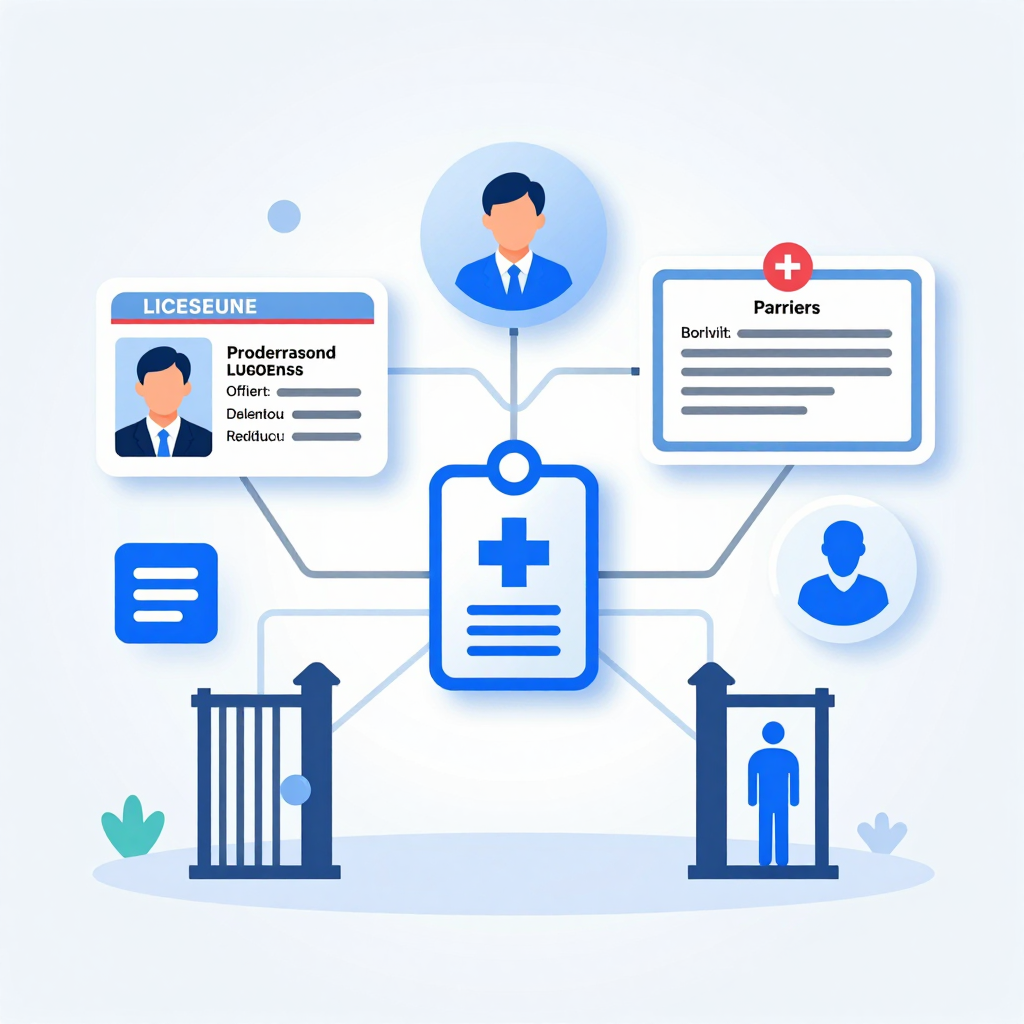
Are you ready to peer behind the driver’s license testing sites and explore the intricate web of licensing systems that extend into professional credentials and even hobbies? When we casually say “getting a license,” we often think only of passing a test, but in reality, a tightly connected system of government agencies, institutions, and practical fields operates behind the scenes. Understanding this structure reveals why licenses serve not merely as credentials but as mechanisms that simultaneously design societal trust and opportunities.
How Licenses Work: Not “Permission” but “Exceptional Authorization”
The core of licensing is simple: it exceptionally permits restricted activities only to individuals who meet specific requirements.
In other words, licenses are less about praising ability and more about granting controlled access for public safety and order.
From this angle, a driver’s license is not just a right to drive a car but an official pass granting entry into public spaces like roads.
The License Operation Network Behind Driver’s License Testing: Police Agency – Road Traffic Authority – Field Sites
A driver’s license isn’t achieved by personal effort alone. Behind it is a differentiated operational network:
- National Police Agency: The legal authority and supervisory center of the system
- Korea Road Traffic Authority: Entrusted with practical operations such as testing, issuance, and renewals
- Driver’s License Testing Centers: Local hubs where core procedures including written exams are conducted
- Driving Specialty Academies: Private partners responsible for education and some testing tasks
The key point here is that a driver’s license is not “a one-time achievement.” Post-issuance regulations like renewals, training, suspension, and cancellation turn the license into both a right and an object of ongoing management. For this reason, driver’s license testing centers function not as mere exam venues but as frontline bases where state regulations are actively enforced.
The Weight of Professional Licenses: “You Can’t Without It” Rather Than “You Can If You Do”
If driver’s licenses expand mobility and career choices, professional licenses are even more direct. In fields like medicine, law, and welfare—where others’ lives and rights are impacted—a license determines the legitimacy of one’s work.
For example, in professions such as radiology where a license is explicitly required for hiring, possessing the ability without the license still bars one from entering the field. Here, licenses are not just credentials but the gateway to the market, as well as mechanisms by which the state clarifies responsibility.
There is also a practical reality called the “dormant license.” Even if one holds a license, lack of practical experience leaves them unfamiliar with the field despite passing the system. This highlights that licenses establish minimum standards but do not guarantee ongoing proficiency.
Licensing Expands into Hobbies and Leisure: Rules to Preserve Freedom
Licenses do not stop at professional worlds. As activities like fishing, drones, water and air leisure sports become more popular, governments increasingly require permits, registration, and completion of training for safety and resource protection.
Abroad, there are exceptions such as “Free Fishing Days,” permitting fishing without a license for a limited time. Paradoxically, this illustrates a fundamental truth: licenses are the default, and regulations are adjusted only as necessary to encourage public participation.
Ultimately, leisure licenses are less devices to restrict freedom and more designs of conditions that sustain freedom.
A driver’s license is only the most familiar starting point. The essence of licensing lies not in personal test-passing experiences but in the complex network through which society manages risk and builds trust. Next time you wonder “Which license should I get?” you’ll also consider, “Within what structure does this license operate, and what responsibilities and opportunities does it bring?”
The Dual Nature of Licenses Revealed by ‘Dormant Licenses’
The phenomenon of a “dormant license” — possessing a license but not actually using it — is not simply a matter of individual choice to “not utilize” it. It simultaneously exposes the power of a license (opportunities and trust) and its limitations (gaps in experience and skills), posing crucial questions about society and career planning.
Having a License Is Different from Being Competent
To summarize dormant licenses in one sentence:
A license is an entry pass, but it does not automatically guarantee skill or experience.
- Even with a driver’s license, if you haven’t driven for a long time, you become a novice on the road again.
- Similarly, even if you have obtained specific certifications such as a social worker license, your competitiveness in the job market sharply declines if practical experience is lacking.
In other words, a license opens the door to possibility, but continuously walking through that door is a separate challenge.
The Structure Behind Dormant Licenses: A Signal from the System, Not Just a Personal Issue
Dormant licenses cannot be simply blamed on individual laziness. Rather, they result from accumulating structural issues such as:
- Lack of pathways after entry: While guidance is provided up to obtaining the license, there is often weak linkage to real-world work through internships, practicums, or mentoring.
- Penalties for career gaps: If you leave the field for some time, evaluations focus on “licensed but inexperienced,” making reentry difficult.
- Temptation of over-acquisition: A culture of “better to have it just in case” encourages license accumulation without assessing true necessity.
This phenomenon ultimately signals to society that increasing the number of licenses alone cannot solve workforce or career development problems.
The Two Sides of a License: A Certificate of Trust but a Liability if Neglected
A license is undeniably a powerful public certification. However, if unused over time, its value becomes ambiguous.
- Positive side: The minimum condition that opens opportunities when needed (application eligibility, starting point of trust)
- Negative side: It invites questions like “Why obtain but never use it?” or loses up-to-date relevance and practical insight, potentially becoming a disadvantage
Thus, dormant licenses clearly teach us one thing: the key is not just acquiring a license but maintaining and utilizing it.
A Practical Checklist to Avoid Dormant Licenses
If you are planning to obtain a license or already have one, simply asking these questions can greatly reduce the risk of letting it go dormant:
- Is this license legally required for my target job, or is it merely advantageous to have?
- Do I have a concrete plan to gain hands-on experience within 3 to 6 months after obtaining it? (such as driving, practicums, short-term projects)
- Have I researched retraining or reentry programs (including those supported by local governments or institutions) in case I have a career gap?
A license grows stronger the longer you actively use it after acquisition. Dormant licenses serve as a very practical warning about how easily the opposite can happen.
Licenses: Personal Freedom or Social Regulation? — The Expansion of Licenses in Leisure and Hobbies
Fishing may seem like the most “free” way to enjoy nature, yet in some areas, a license is fundamentally required. As activities move toward drones, leisure boats, and high-risk sports, “conditions to follow” begin to take precedence over “ways to enjoy.” The growing presence of licenses in leisure and hobbies ultimately comes down to one crucial question: Where should the balance between freedom and safety be struck?
When a License Attaches to Leisure: Turning “Personal Hobbies” into a “Public Domain”
Hobbies may appear to be individual choices, but the moment these conditions overlap, they become subject to public regulation:
- When risks extend to others: Incidents like drone crashes, boat collisions, or mountain rescue requests that affect others and lead to public costs
- When resources are limited: Overfishing certain species or areas impacts ecosystems and local economies
- When spaces are shared: The sky (flight), water surfaces (navigation), parks and beaches (public spaces) are not exclusive territories for “my hobby”
Here, a license doesn’t mean “don’t enjoy,” but acts as a social agreement device that says, you may enjoy this, but do so responsibly.
Not an Outright Ban, but “Conditional Permission”: The Fundamental Logic of Licenses
Administratively, licenses are essentially a form of conditional permission. That is, activities usually restricted are exceptionally allowed to those who meet certain criteria. The structure is the same in leisure:
- Fishing licenses serve as tools for protecting and managing natural resources
- Drone-related training, registration, and flight restrictions are mechanisms to enhance airspace safety and reduce privacy infringements
The key is not “regulation for the sake of regulation,” but the question of who bears responsibility and how if an accident occurs. Licenses function as a clear link assigning that responsibility to individuals.
The Balance is Not ‘Freedom vs. Regulation’ But ‘Benefit vs. Risk’
Debates surrounding leisure licenses often become emotional, but the practical decision-making framework is relatively straightforward:
- Benefit: The easier the access, the more leisure expands and industries grow
- Risk: The easier the access, the more inexperienced participants enter, increasing the chance of accidents
Thus, balance should not be framed as “abolish/increase licenses” but should be designed around questions like:
- Are minimum licenses and training requirements demanded only for high-risk activities?
- Is there a tiered system (beginner-intermediate-advanced) enabling novices to enter safely?
- Are regulations actually improving safety, or simply adding bureaucracy that needs measurement and improvement?
Ultimately, licenses in the leisure domain are most persuasive when designed not as walls restricting personal freedom, but as safeguards that sustain freedom over time.
Licenses in the Era of Digital Transformation and Your Strategic Choices
As mobile licenses and evolving qualification requirements in the AI age reshape everything, one question stands out: How will you not just 'obtain and be done with' a license, but how will you ‘maintain and leverage’ it? Digital transformation does more than change the form of licenses (from cards to apps); it revolutionizes the very methods of verification, required competencies, and career planning.
What Mobile and Digital Licenses Are Changing: From “Possession” to “Instant Verification”
With the spread of mobile-based identity and qualification checks, licenses are becoming not just items to hold, but connected data.
- The speed of qualification verification accelerates: In hiring, field deployment, and subcontracting, “submitting documents” is increasingly replaced by “instant lookup and verification.”
- The risk of counterfeiting and forgery decreases: As electronic verification becomes widespread, trust hinges more on integration with official certification systems than on simple paperwork.
- Renewal and training history gain importance: Licenses become a career safeguard through maintenance (renewal, continuing education, managing disqualifications) rather than mere acquisition.
Simply put, in the near future, having a license will matter less than “having a valid license with up-to-date records being actively managed.” This is the stronger signal.
Changing License Requirements in the AI Era: From Knowledge Tests to “Responsibility and Capability”
As AI and automation expand, licensing systems are likely to shift focus from simple knowledge checks to judgment, ethics, and accountability.
- While parts of the job become automated, final responsibility for accidents and disputes rests with humans.
- Accordingly, license assessments evolve from “memorization” to on-site decision-making, risk management, legal compliance, and ethical standards.
- Simultaneously, AI literacy becomes a de facto additional requirement in many professions. If a license grants legal authority, AI skills secure practical competitiveness.
In short, a license will still denote “permission to act,” but the market will increasingly scrutinize whether you are prepared to bear the responsibility that comes with it.
Your License Strategy: Design in 3 Steps—“Essential, Expand, Maintain”
The faster things change, the simpler your strategy must be to execute. Check your approach with these three steps:
1) Lock down your essential licenses (block illegal/unqualified areas)
First, verify whether your desired role is outright impossible without the license. Fields like driving, healthcare, welfare, and law, where the law bars entry without proper licenses, make them not a choice but a prerequisite.
2) Create an expanded combination (license + supplementary qualifications/experience)
If a license is your “ticket in,” your performance depends on added skills and experience.
- Attach experience-based proof such as internships, projects, and portfolios
- Add modern capabilities such as digital tool use (document automation, data processing, AI applications)
Position yourself as a “ready-to-deploy professional,” not merely a “license holder.”
3) Design a maintenance and utilization routine (avoid letting licenses gather dust)
Licenses can lose value over time.
- Organize a calendar for renewals and refresher courses
- Commit to at least monthly practical routines (driving, consulting, tool usage)
- Explore “return paths” like local government or institutional programs if gaps arise
By following these three, the odds of your license becoming a “forgotten certificate” drop dramatically.
In the digital transformation era, licenses remain powerful opportunities, but it’s the management and active use after acquisition—not just the moment of obtaining—that determine your competitiveness. Those who ask not only “Which license should I get?” but also “How can I amplify my career with this license?” will lead the way.
Comments
Post a Comment