2026 AI DevOps Innovation Strategy: The 4 Core Technologies of GenAI-Based Platforms and Implementation Guide
 \n
\n
DevOps: How AI Will Revolutionize DevOps in 2026
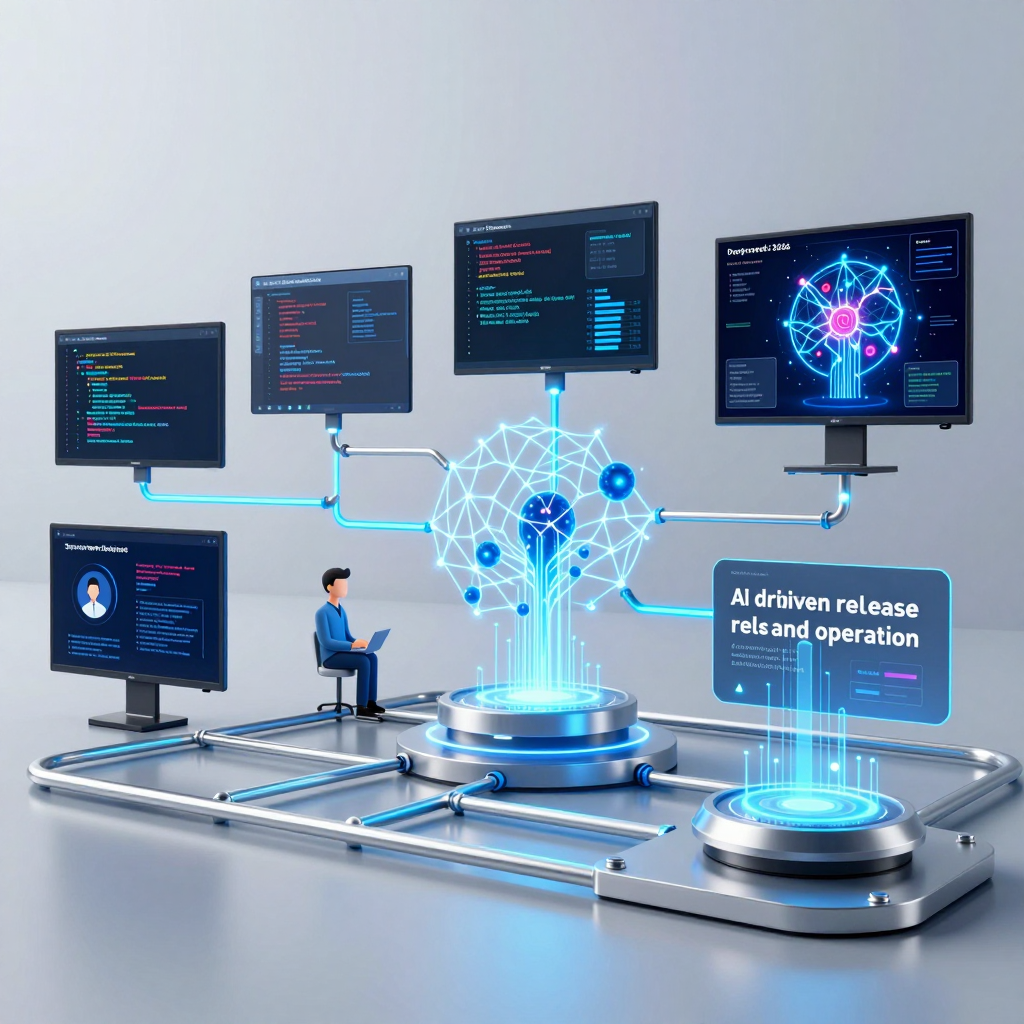
Curious why AI-powered DevOps platforms—which go far beyond simple autocomplete to revolutionize the entire software delivery process—are set to be the fastest-growing technology in 2026? The core is simple. AI is no longer just a “tool to assist developers”; it’s becoming an automation layer that collaborates on deployment and operational decisions, deeply embedded within DevOps pipelines.
The Next Step in DevOps: What Is an AI-powered DevOps Platform?
AI DevOps in 2026 doesn’t refer to a single product. Instead, it means a structure where AI reads data, makes judgments, and assists (or even automates) execution across the full flow—from code writing → testing → building → deployment → monitoring → incident response. Typically, this experience bundles the following features into a single platform:
- Code & Infrastructure as Code (IaC) generation/refactoring: Creating and modifying not only application code but also IaC templates like Terraform and Helm
- Decision support within CI/CD: Analyzing change impact, automatically selecting necessary tests, recommending deployment approvals or halts, and deciding on rollbacks
- Operations automation based on observability data: Detecting anomalies by analyzing logs, metrics, and traces, then responding according to runbook playbooks
- ChatOps/Agent interfaces: Interactive pipeline issue analysis and action execution right from Slack, Teams, or IDEs
In other words, while traditional DevOps resembled “automated pipelines,” AI DevOps evolves into an “intelligent pipeline” that continuously learns, infers, and optimizes itself.
Why DevOps Trends Explode in 2026: From ‘Task Automation’ to ‘Decision Automation’
The explosive growth of AI DevOps is straightforward. The bottleneck in DevOps has shifted from “not being able to write scripts” to making faster and safer decisions amid complex systems.
- As deployment frequency increases, it becomes impossible for humans to track “What will this change affect?” on every release.
- In microservices, Kubernetes, and multicloud environments, causes of failure don’t reside in one place—they’re scattered throughout observability data.
- While more testing is generally better, running all tests every time lengthens lead time, ultimately slowing delivery speed.
Here, AI addresses core DevOps questions based on data:
- “What if we only run the tests needed for this change?”
- “Are there patterns of failures from similar past changes?”
- “Since the risk of SLO violations is rising, should we lower the canary deployment percentage?”
In essence, AI DevOps in 2026 gains value by catching signals humans might miss early and making release and operational decisions safer.
DevOps Architecture Perspective: Where the AI Agent Fits In
When enterprises realistically adopt AI DevOps, AI is typically “inserted” across these four layers:
1) Source & IaC Layer
- Assist with PR creation, code review, and propose IaC template edits
- Agents understanding repository context (existing rules/structures) absorb repetitive tasks
2) CI/CD & Testing Layer
- From change impact analysis → prioritized testing → flaky test detection → failure log summarization
- AI functions plug in alongside existing toolchains like Jenkins, GitHub Actions, and GitLab CI
3) Observability & Operations Layer
- Integrate logs, metrics, traces, and events to detect anomalies
- During on-call incidents, summarize “likely causes/relevant commits/recommended actions” to shorten response times
4) Platform/Developer Portal (IDP) Layer
- On portals like Backstage, when requesting “service creation,” AI auto-configures templates including basic CI/CD, monitoring, and policy setup
- Expanding DevOps from “central ops team support” to a “self-service platform”
The key shift here is that AI becomes not a one-off tool but a common layer permeating the entire DevOps toolchain.
The Most Powerful Real-World DevOps Use Cases: Release Gates and Incident Copilots
The biggest impact of AI DevOps is seen where “immediately actionable decisions” are necessary:
- AI-assisted Release Gate: After PR merge, AI analyzes changes and recommends required tests plus deployment strategies (canary, blue/green, rollback criteria)
- Incident Copilot: When an incident happens, it aggregates recent deployment history plus logs/metrics, summarizes root cause candidates and remediation plans, then links to ChatOps for execution
Here, the effect isn’t merely “work gets faster.” It’s about simultaneously boosting release quality and operational stability. Deliver faster without breaking more—this is why the AI-powered DevOps platform of 2026 commands attention.
DevOps AI DevOps Platform: The Core Technology and How It Works
How can AI provide comprehensive assistance from writing code to testing, deployment, and monitoring? The key lies in AI stepping beyond a mere “development assistant tool” to becoming a layer that reads data throughout the entire DevOps pipeline (code, IaC, build logs, deployment history, metrics, traces) and participates in “decision-making.” Here, we dissect the internal workings of an AI DevOps platform by breaking it down into stages.
The 4-Layer Structure of AI DevOps from a DevOps Perspective
AI DevOps usually operates through the following four interconnected layers:
1) Source & IaC Layer: Git-based code and infrastructure definitions (Terraform, Helm, Kustomize, etc.)
2) CI/CD & Testing Layer: Execution engines like Jenkins, GitHub Actions, GitLab CI, Azure DevOps
3) Observability & Operations Layer: Logs, metrics, traces, events, SLOs, incident timelines
4) Platform & Interface Layer: ChatOps (Slack/Teams), IDE, developer portals (IDP)
AI doesn’t just excel at one point in this chain—it links contexts across layers for chained optimization. For example, judging “how a PR change impacts a particular SLO” requires viewing not only the code diff but also past failures, deployments, and metric patterns together.
DevOps Code & IaC Phase: Creating “Verifiable Changes,” Not Just Generation
What AI DevOps does in code creation goes far beyond simple autocomplete. It is evolving toward reading the entire repository context and designing changes at the PR level.
- Code/Refactoring: Restructures function and module boundaries aligned with the change intent and estimates impact scope.
- IaC Creation/Modification: Automatically proposes changes even in high-risk operations like Terraform/Helm value updates—but produces pull requests in a “verifiable” form.
- Policy Compliance Guardrails: Crucially, mechanisms prevent AI from making arbitrary changes. Items like opening security groups, excessive permissions, or namespace policy violations must be preemptively blocked via Policy-as-Code tools (OPA, Kyverno, etc.).
Technically, AI’s “code generation” must pass static analysis (SAST), IaC scanners, and policy checks before advancing. In other words, the AI output is a draft, with DevOps quality gates serving as the final safety net.
DevOps CI/CD & Testing Phase: AI Decides “What to Run”
Traditional CI/CD often runs all tests or lets humans preset rules. AI DevOps takes it one step further with impact-based decision-making grounded on change analysis.
- Change Impact Analysis: Recommends which tests to prioritize using code diffs, dependency graphs, and historical failure records.
- Flaky Test Detection: Learns failure log patterns to distinguish between code defects and test instability.
- Failure Cause Summaries: As CI logs grow lengthy, AI links failure segments with related commits and config changes to produce concise summaries.
The core mechanism here is (1) accumulating pipeline execution data → (2) labeling failures and successes → (3) feeding back into recommendation and prioritization models. Thus, to truly leverage AI DevOps, a short-term PoC is insufficient; test/build/deploy histories must accumulate in a “learnable” format.
DevOps Deployment & Release Phase: How the AI-assisted Release Gate Works
The “real transformation” with AI DevOps emerges at release time. Since deployments always entail risks, AI is usually introduced as an intelligence layer enhancing the “release gate” rather than just pressing an auto-deploy button.
- Release Risk Scoring: Calculates risk by combining change size, failure rates of similar past changes, number of affected services, and SLO sensitivity.
- Deployment Strategy Recommendations: Suggests policies like “Canary 5% → 25% → 100%,” “Blue/Green,” or “Immediate Rollback Conditions.”
- Approval/Blockage Rationales: The critical point is explainability. Simply labeling something as “risky” doesn’t convince operators. Links to metrics, past incidents, and changed files must substantiate AI’s advice for DevOps decision-making.
Implementation generally flows as follows:
1) PR or merge event triggers
2) AI queries change, test, and past incident data
3) Synthesizes “mandatory tests / extra verifications / deployment strategies”
4) Reflects these in pipeline gate comments/checks (approval assistance)
5) Continuously monitors post-deployment metrics to auto-scale or rollback as conditions dictate
In essence, AI does not replace deployment but becomes a co-pilot refining deployment decisions.
DevOps Monitoring & Operations Phase: “Compressing” Incidents Using Observability Data
AI DevOps shines in operations because it compresses scattered data (logs, metrics, traces, events, deployment history) into a single timeline, condensing the situation.
- Anomaly Detection: Detects anomalies not just by single metric thresholds but through multivariate patterns (simultaneous changes, leading signals).
- Correlation Analysis: Groups events like “error rate spike right after deployment + latency in a specific dependent service + impact limited to certain regions” to narrow down root cause candidates.
- Incident Copilot: Presents on-call engineers with “top 3 possible causes / related PRs / recommended actions (rollback, flag off, scaling),” and integrates execution via ChatOps.
Here, the quality determinant is not model size but observability data quality. If logs are unstructured (missing key-values), deployment events untracked, or cross-service tracing broken, AI resorts to unsupported guesses (hallucinations). Hence, operational automation in AI DevOps requires observability readiness as a prerequisite.
DevOps Platform Perspective: When the Agent Becomes a “Workflow” Instead of Just a “Tool”
AI DevOps is called a platform because it goes beyond integrating multiple tools to rebuild standard workflows centered around AI agents.
- Interface Integration: Connects IDE (development) ↔ CI/CD (validation) ↔ ChatOps (operations) ↔ developer portals (IDP, self-service) into one seamless flow.
- Agent-enabled CI/CD: Not only applications but the “AI agents themselves” must have versioning, testing, and deployment policies because changes in prompts, tool permissions, or plugin configurations affect operational results.
- Permission and Boundary Design: Agents have powerful capabilities (deploy, rollback, config changes). DevOps teams must solidify policies defining “which actions run automatically and which require human approval.”
In summary, the operating principle of AI DevOps platforms is straightforward: connect scattered data in the DevOps pipeline to build context, then recommend (or selectively automate) testing, deployment, and response decisions based on that context. All while ensuring safe operation through quality gates, policies, and observability—the foundational “basics of operations” underpinning AI.
AI DevOps in the DevOps Field: Cutting-Edge Tools and Scenarios
From GitHub Copilot agents to production-grade CI/CD blueprints, AI is no longer just a “helpful tool”—it’s beginning to act like a ‘specialist’ dedicated to specific tasks on the DevOps frontlines. The fundamental shift is this: AI is not just assisting with code writing anymore; it’s now deeply integrated throughout the pipeline—handling testing, deployment, and operational decisions—and impacting real outcomes such as release speed, stability, and cost.
What Are “Agent-type Specialists” in DevOps?
The latest trend in AI DevOps moves beyond simply using large language models (LLMs) standalone. Instead, it embeds agents within the toolchain to enhance sophistication.
- Input Data: PRs/commits, CI logs, test results, deployment history, metrics/logs/traces, alert events
- Actions: Beyond summarizing and recommending, these agents perform “actions” like ticket creation, PR generation, proposing pipeline configuration updates, and triggering rollbacks
- Control Mechanisms: Approval gates (human sign-off), policy-as-code, scoped permission tokens, audit logs
In other words, the core innovation is not just automating repetitive DevOps tasks but restructuring the pipeline so AI participates in the “decision-making loop” itself.
Latest DevOps Tool Trends: “Pipeline-Embedded AI,” Not “Single Products”
By early 2026, the category “AI DevOps tools 2026” naturally emerged to describe bundles of AI tools aligned with each DevOps stage. What they share is the approach of enhancing existing stacks (Jenkins, GitHub Actions, GitLab CI, Azure DevOps, etc.) rather than replacing them, layering these AI capabilities on top:
- CI Optimization: Running only selective tests based on impact analysis, detecting and isolating flaky tests
- Automated Failure Analysis: Summarizing build/deployment failure logs, suggesting root cause candidates, and auto-linking related commits/PRs
- Release Decision Assistance: Recommending canary rollout percentages and rollback criteria based on past incident patterns and SLO risks
- Operations & Observability Integration: Detecting anomalies → suggesting playbook actions → executing via ChatOps
A key design question is “Where to attach AI?” Most organizations start with low-risk, easily measurable segments (tests/failure analysis) and then expand into release gates and incident response.
Top 3 Immediately Applicable DevOps Scenarios
DevOps Release Gate: AI-assisted Release Gate
At the final pre-release checkpoint, AI doesn’t “replace” human judgment but rapidly and consistently provides evidence to support decision-making.
- After PR merge, AI analyzes change scope to identify affected services/modules
- Based on past similar changes’ incident history, it suggests risk signals (e.g., specific error rate spike patterns)
- It recommends necessary test suites and aggregates results to propose policies like:
- “Start this deployment with 5% canary”
- “Automatically rollback if certain metric thresholds are breached”
Technically, this usually involves reasoning over CI results (tests/static analysis), deployment strategies (Argo Rollouts, feature flags), and observability metrics (SLI/SLO) within a unified context.
DevOps Incident Response: Incident Copilot (On-Call Assistant)
In incidents, the highest cost is often not the recovery work itself but the time until root cause is identified (MTTA). Incident Copilot focuses on shrinking this gap.
- Narrow down anomaly windows by jointly querying logs, metrics, and traces
- Present “top 3 cause candidates” along with “ways to confirm” (dashboards/queries to check)
- Automatically track related PRs/commits linked to recent deployments
- Enable limited commands via ChatOps (Slack/Teams) to:
- Roll back
- Redeploy a specific version
- Apply scaling or circuit breakers
Permission control is critical here. Every operational action must be designed with approval gates + execution audit logs + least privilege access (RBAC).
DevOps Test Automation: Combining “Selective Execution + Automated Generation”
Testing is where AI DevOps’ ROI materializes fastest.
- Selectively run only necessary tests based on change impact, cutting the cost of full regression runs
- Detect and quarantine flaky tests or suggest root cause candidates
- Generate UI/E2E test scripts and analyze coverage gaps to recommend additional scenarios
Technically, it’s a combined approach of “test selection” and “test generation” evolving to simultaneously improve speed (lead time) and reliability (escape rate).
Key Focus in DevOps Practice: Copilot Agents and “Agent-centric CI/CD” Emerging
Expanding GitHub Copilot Agents for DevOps Tasks
Copilot’s roadmap goes beyond simple autocompletions to an “agent-type” that understands repository context and performs complex tasks like adding tests, refactoring, adjusting CI settings. The community already shares active scenarios where such agents serve as “DevOps specialists” responsible for
- Pipeline failure root cause analysis
- GitOps configuration tuning
- Deployment debugging
Next Stage for DevOps: Production-grade CI/CD for AI Agents Themselves
The most fascinating shift is the view of deploying “agents” themselves as the application target. Recently released production-grade CI/CD blueprints include:
- Agent versioning (managing models/prompts/tool call policies as artifacts)
- Testing strategies (regression, safety, policy/permission violation tests)
- Deployment policies (gradual rollout, rollback, approval gates)
- Interoperability (linking IDE, Copilot, AI platforms, and DevOps pipelines)
Ultimately, as DevOps’ standard operating practices (CI/CD, monitoring, governance) extend to AI components themselves, the primary question changes from “How do we develop AI?” to “How do we deploy AI as reliable, operable software?”
DevOps Adoption Checklist: Essential Preparations Before Implementation
- Observability Data Quality: Inconsistent logs/metrics/traces drastically reduce AI recommendation accuracy.
- Minimize Integration Points: Instead of replacing the entire pipeline upfront, inject AI into one segment (e.g., testing or failure analysis) to create measurable improvements first.
- Built-in Governance: Define clear boundaries for “what AI can do” using policy-as-code and approval gates to enable safe scaling.
AI DevOps is not a passing fad of flashy tools—it’s a transformative evolution of DevOps automation and decision workflows. Today, that transformation is concretely entering the field in the form of “specialist agents.”
Technical and Organizational Challenges to Overcome When Adopting DevOps
AI delivers astonishing efficiency across the entire process of code writing, testing, deployment, and monitoring, yet at the adoption stage, hidden pitfalls often play a bigger role. Especially if you push forward without designing for security, data quality, toolchain integration, and role redefinition, DevOps speed can slow down instead of speeding up, and incident responses may become more unstable. Here, we summarize the critical challenges that must be addressed for successful AI DevOps implementation.
DevOps Data Quality: AI Accuracy Depends on the Quality of Logs and History
AI DevOps doesn’t run on LLM performance alone. Operational data used for training and inference (logs, metrics, traces, deployment history, incident records) must be well-organized to yield “verifiable answers” rather than just plausible-sounding outputs.
- Standardizing observability data schemas
- If log formats differ across services, AI struggles to establish correlations.
- Fields like
trace_id,request_id,release_version,feature_flag, andtenantmust be consistently recorded.
- Linking release history with operational events
- Without connecting “an incident occurred” to “which deployment happened,” AI’s Root Cause Analysis (RCA) becomes guesswork.
- Deployment events (commit/PR/build artifacts/deployment time/target) should be queryable on the same timeline as observability stacks.
- Managing data drift and noise
- Differences in logging levels by environment (staging/production), sampling policy changes, and metric name revisions disrupt AI judgement.
- Metadata that records “the changes” (versioning, policy change logs) must also be managed together.
The key is simple: Poor data in AI DevOps results not in automation but in automated chaos.
DevOps Security and Governance: Agent Permissions Are Attack Surfaces
From the moment an agent can modify CI/CD settings, change infrastructure (IaC), and even execute rollbacks, security becomes a non-negotiable prerequisite. This is no longer just a “developer tool” — it’s another software entity wielding operational privileges.
- Least privilege and segregation of duties
- Granting agents broad cluster/repository permissions makes damage skyrocket during prompt injection or supply chain attacks.
- Separate permissions into “read (analysis)” and “write (modification),” with write operations governed by short TTLs and approval workflows.
- Policy-as-Code to verify AI-generated artifacts
- Human review alone can’t reliably audit AI-created Terraform, Helm charts, or pipeline YAMLs.
- Policy engines like OPA or Kyverno must automatically block issues involving network exposure, IAM over-permission, image tagging policies, and secret handling.
- Handling secrets and sensitive information
- If API keys, tokens, or customer data leak into logs, prompts, or conversation histories, the “help request” itself becomes an incident.
- DLP (data loss prevention), secret masking, prompt filtering, and encryption at storage are mandatory.
- Auditability
- “The AI recommended it” does not justify operational decisions.
- Verifiable audit logs must capture who (which agent), based on what evidence, proposed and executed what changes.
In sum, securing AI DevOps is not just about “model security” but an operational governance issue combining permissions, policies, auditing, and data protection.
DevOps Toolchain Integration: Don’t Overhaul Existing CI/CD—Find the ‘Insertion Points’
A common cause of AI DevOps failure is “it looks good, so let’s embed it across the entire pipeline at once.” In reality, DevOps stacks tangled with Jenkins, GitHub Actions, Argo CD, Kubernetes, and monitoring tools only grow more fragile when AI is blindly forced on top.
- Start with high-ROI, low-risk insertion points
- Examples: failure log summarization, flaky test detection, impact-driven test selection, automated release note generation.
- These stages focus on “recommendation/analysis,” carry low operational risk, and yield measurable effects.
- Release gates should start with ‘auto recommendation + approval’ rather than ‘auto execution’
- AI suggests canary ratios and rollback conditions, but humans review and approve early on for stability.
- Standardize agent runtimes
- Define first where agents run (internal networks, isolated workers, SaaS) and their access paths (proxies, outbound controls).
- Design the runtime to be “operationally manageable,” including network, permissions, log collection, and emergency kill switches.
Ultimately, the integration strategy’s essence is clear: Identify bottlenecks in DevOps and expand AI ‘step-by-step’ to reduce them.
DevOps Organizational and Role Changes: Clearer Responsibility as Automation Increases
While AI DevOps reduces repetitive work, it can blur responsibility boundaries within teams. If an agent raises a PR and deploys code, lack of accountability, approval, and verification processes heighten confusion in incidents.
- Redefine RACI (Responsibility, Approval, Collaboration)
- AI is a tool, not a responsible party.
- Clarify workflows as “Recommendation (Agent) – Approval (Owner) – Execution (Automation) – Verification (SRE/QA).”
- Provide guardrails from a platform engineering perspective
- Diverse prompts and scripts per team shake quality standards.
- Reduce variation with internal developer portals (IDP) or templates offering standard pipelines, monitoring, and policies.
- Shift skill sets
- Future core capabilities lie not in “direct configuration” but in validating AI outputs, designing automation boundaries, and managing data quality.
- DevOps fundamentals—policy, observability, and release strategy understanding—outweigh prompt-writing finesse.
DevOps Success Strategy Checklist: A Safe Rollout Sequence to ‘Prove Impact’
- Define and standardize minimum criteria for operational data (logs/metrics/traces/deployment history).
- Narrow AI application points to one or two for PoC, measuring accuracy, time savings, and incident reduction.
- Attach Policy-as-Code and audit logs early to systemically verify “AI-generated changes.”
- Gradually expand auto execution scope, always with rollback and kill switches ready.
- Document organizational approval and accountability structures to safeguard fast DevOps alongside safe operations.
The Future of DevOps: A New Operational Paradigm Completed by AI
What does the future of DevOps look like within the next 12–24 months when AI agents become “first-class citizens”? The key is not just “adding another tool,” but redesigning pipelines so that AI continuously handles parts of deployment and operational decision-making. DevOps is now entering a phase where it amplifies the ability to safely roll out changes with AI, going beyond merely the speed of code creation.
Three Axes of Change in DevOps: Automation → Decision-Making → Autonomous Operations
1) Advanced Automation
Whereas traditional automation focused on “executing predefined scripts,” AI-driven DevOps interprets situations and recommends or executes the next actions. For example, it selects tests based on impact analysis and summarizes failure logs to narrow down the “most likely root cause candidates.”
2) Embedded Decision-Making
The competitive edge will lie in how sophisticated AI-assisted Release Gates become at deciding whether to approve, hold, or roll back releases.
- By calculating change scope + past failure patterns + current SLO risks together,
- AI recommends policies such as canary ratios, monitoring metrics, and automatic rollback conditions, or
- Automates the approval process itself under certain conditions.
3) Expansion into Autonomous Operations
When an AI system integrating observations (logs, metrics, traces, events) detects anomalies, it semi-automatically or automatically executes responses like rollbacks, scaling, or feature flag adjustments based on standardized playbooks. The critical shift here is that AI agents become the primary actors in operations execution, with humans overseeing rather than directly manipulating tools.
Practical DevOps Roadmap: A 12–24 Month Step-by-Step Guide
Phase 1 (0–3 months): Establish DevOps Data Foundations — Creating “Trustworthy Inputs” for AI
AI DevOps performance depends more on input data quality than the model itself. Start by consolidating:
- Observability standardization: unify log formats, trace context, service/deployment version tagging rules
- Release history linkage: ensure traceability across commits/PRs ↔ builds ↔ deployments ↔ alarms/incidents
- Accumulate at least 6–12 months of data: retaining failure causes, responses, and outcomes enables AI to make “evidence-based recommendations.”
Checkpoint: If you cannot track “which deployment caused the latest failure” within 1 minute, AI’s accuracy will inevitably degrade more frequently.
Phase 2 (3–6 months): PoC in Low-Risk, High-ROI Areas — Test Summaries, Log Summaries, Root Cause Analysis
Target areas where automation yields immediate benefits in repetitive and costly tasks:
- Test optimization: run only tests impacted by changes (speed↑, cost↓) using impact analysis
- Flaky test detection: distinguish “code issues vs. test reliability problems” as failure causes
- CI failure analysis: summarize build/deployment failure logs and suggest reproduction steps
Define success not merely by “accuracy” but by DevOps metrics like reduced lead times, shorter MTTR, and lower unnecessary test costs.
Phase 3 (6–12 months): Integrate AI into DevOps Release Decision-Making — Implement Release Gates as “Policies”
Here AI moves beyond recommendations to automatically creating and validating deployment policies.
- Upon PR merges, AI scores change risks and recommends deployment strategies (canary/blue-green/rolling)
- Predicts SLO violation likelihood and suggests approval holds or canary ratio reductions
- Triggers automatic rollbacks on risk threshold breaches configured with policy-as-code
Technically reliable combinations for practice include:
- CI/CD: Maintain existing pipelines like GitHub Actions, Jenkins, or GitLab CI
- Deployment: Kubernetes + Argo CD (or equivalents) using GitOps
- Policy validation: Use OPA/Kyverno to preemptively block/validate AI-generated configurations
- Observability: Train AI clearly on “what to look for” based on defined SLOs/SLIs
Phase 4 (12–24 months): Redefine DevOps Operating Model — Designing Organizations Where Agents Are First-Class Citizens
From this stage, operational structure becomes the decisive factor more than technology.
- Agent CI/CD: Version control, test, deploy, and roll back not only applications but also the “AI agents themselves.”
- For example, manage agent prompts and tool access changes via PRs
- Include tests simulating agent behavior (preventing privilege abuse, blocking risky commands)
- Define Clear Boundaries of Authority and Responsibility:
- Areas where AI can only “suggest,”
- Areas where AI can execute with approval,
- Areas allowing fully automated execution,
— all logged for auditing.
- Integrate with Platform Engineering: Provide “standard service templates + AI DevOps policies” as self-service through IDPs like Backstage to reduce team variance and maintain operational consistency.
Core Conclusion from a DevOps Perspective: AI Agents Are Not Team Members but Platform Components
In the next 1–2 years, AI will evolve beyond “assistants” in DevOps to become platform components entrusted with parts of release and operational decisions.
The key to success lies not in choosing the latest model but in establishing an “operational system where AI can work safely” by focusing on data quality, policy validation, permission design, and observability integration.
Comments
Post a Comment