 \n
\n
Medical Waste: The Invisible Danger – What Is Medical Waste?
Often mistaken for mere hospital trash, medical waste is a high-risk special waste that simultaneously threatens infections, environmental pollution, and even human dignity. Usually out of sight and mind—simply assumed to be “properly handled”—the moment a single misstep occurs in its segregation, this danger seeps beyond hospital walls. So, what exactly is this hazardous waste we often overlook?
The Core Definition of Medical Waste: “Waste Generated from Medical Activities That Requires Separate Management”
In South Korea, medical waste is regulated under the Waste Management Act, and can be summarized in two key points:
- It is waste generated during medical activities such as diagnosis, treatment, prevention, and research.
- Due to risks like infection, injury, and toxicity, it must be managed under specialized standards, distinct from regular trash.
In other words, it’s not simply about whether it comes from a hospital. Even if generated in a healthcare facility, waste with low risk may fall under other categories, whereas anything posing harm to human health demands far stricter control.
Why Medical Waste Is Dangerous: A Tangled Issue of Infection, Environment, and Ethics
The risks tied to medical waste are far from one-dimensional.
- Infection Risk: Contaminants like blood, bodily fluids, and sharp objects such as needles can cause direct injury and expose workers to infections during handling.
- Environmental Risk: Large-scale incineration releases air pollutants and carbon emissions, while improper treatment or storage leads to soil and water contamination.
- Ethical and Social Trust: The moment human tissues are treated merely as “garbage,” patient rights and societal acceptance become contentious issues. Recent controversies highlight exactly these concerns.
Ultimately, medical waste is one of the most pressing real-world ESG (Environmental, Social, Governance) issues, intricately linking health, environment, and society.
Where Does the Problem Begin? The Starting Point Is “Precise Segregation and Disposal”
The success or failure of medical waste management is determined well before the incinerator—starting with on-site classification and segregation. Even waste originating from the same area must be sorted into dedicated containers under strict storage criteria; once mixed or misclassified, the entire downstream process becomes hazardous.
Therefore, the essence of medical waste is not just “fear,” but more realistically the need for a system that accurately identifies, separates, and safely channels this waste. In the next section, we will dive deeper into the categories of medical waste and explore why proper classification systems are so critical.
Types and Classification of Medical Waste: The Key to Safety Management
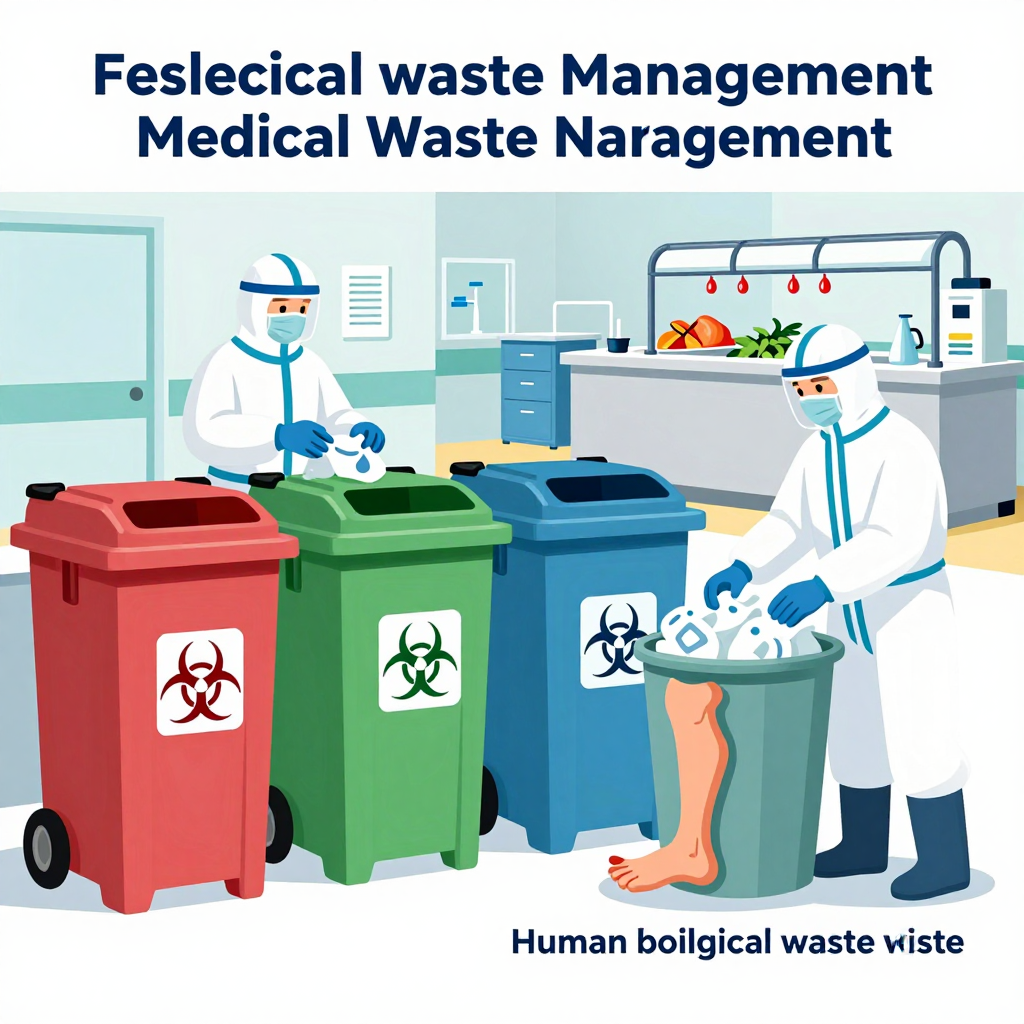
Misclassified medical waste is not just a “simple mistake.” The incident in Incheon, where a severed leg was found at a recycling facility, reveals that the moment pathological (tissue) waste is misidentified at the source, the entire process of transportation, sorting, and disposal becomes jeopardized. Ultimately, the starting point of safety management is not grand equipment, but correct classification at the very moment of disposal.
Why Medical Waste Classification Matters: Because ‘Disposal Methods’ Differ
Medical waste requires specific storage containers, transportation conditions, and final disposal methods (such as incineration or sterilization) based on its type. Therefore, classification errors quickly lead to further complications.
- Increased risk of infection and injury: Workers on recycling lines may be exposed to blood, bodily fluids, or sharp objects
- Expanded environmental risks: Improper disposal can cause contaminants to leak into the environment
- Erosion of ethics and trust: The social shock and distrust caused when human tissues are treated as ordinary trash
If pathological waste is mixed with regular recyclables, as in the Incheon case, it immediately enters sites (collection, sorting) where protective gear and procedures differ, heightening the chances of secondary accidents.
Representative Types of Medical Waste: Confusing Points on the Ground
Based on commonly used classification systems at medical sites, here is a concise summary of key types.
Infectious Medical Waste
Gauze or dressings contaminated with blood or bodily fluids, tubes and IV sets with high infection risk
→ Though they may look like ordinary trash, contamination status is the key criterion.Pathological (Tissue) Medical Waste
Organs, tissues, severed limbs, placentas, and other solid human-derived materials removed during surgery or procedures
→ The Incheon ‘severed leg’ incident falls into this category. Human tissue classification itself is the boundary between safety and ethics.Sharps Medical Waste
Needles, surgical blades, other sharp instruments
→ Even small mistakes can cause puncture injuries, increasing bloodborne infection risks, making dedicated containers essential.Chemical and Pharmaceutical Medical Waste
Expired medicines, anticancer drugs, certain disinfectants
→ The primary risk here is not infection, but toxicity and persistence.General Medical Waste (Low Infection Risk Medical Waste)
Waste with relatively low infection risk but still requires separate management from regular household trash
→ Rather than “when in doubt throw it in regular trash,” it’s safest to verify based on criteria before disposal.
Practical Principles for Medical Waste Classification: Systems That Minimize ‘Ambiguity’
Medical waste incidents often start because “someone didn’t know.” To reduce uncertainty on-site, the following principles are effective.
- Separate and dispose immediately after treatment or procedure (delays cause fading memory)
- Fix visible color and label standards clearly (posters, checklists per department)
- Provide uniform, repeated training to new and outsourced personnel (classification depends on ‘standardization’ not skill)
Managing medical waste hinges not on vast policies but on whether everyone on-site can uniformly answer the question: “Which bin does this go into?”
Where, How Much, and How Is Medical Waste Generated?
What lies behind the skyrocketing medical waste? To get straight to the point, it’s not because “hospitals suddenly got dirtier,” but rather because the very structure of medical usage has changed and the way we respond to infectious diseases has evolved, naturally leading to an increase in the volume of medical waste.
What Are the ‘Primary Origins’ of Medical Waste Generation?
Medical waste isn’t produced in just a few specific places—it arises virtually everywhere medical activities take place. However, the actual volume varies greatly depending on these categories:
- Large medical institutions (tertiary and general hospitals): High numbers of surgeries, procedures, and tests generate a vast absolute amount of waste.
- Small and medium-sized clinics and long-term care hospitals: The higher the proportion of inpatients, the more waste tends to be produced per patient.
- Testing and research facilities, veterinary and animal hospitals: Specialized waste consistently arises from diagnostic testing and research processes.
In other words, “where” waste is generated isn’t simply about “hospitals,” but more accurately at intense points of medical activity like operating rooms, wards, testing labs, treatment rooms, and research labs.
Why Has the Structure Led to an Increase in Medical Waste?
The surge in medical waste can be explained mainly by two major trends:
Aging population → rise in chronic diseases, hospitalizations, and surgeries
As the elderly population grows, medical use increases, which means more consumables like dressings, syringes, and IV sets are used. Especially as hospital stays and treatments rise, waste accumulates not just per event but on a daily, ongoing basis.Strengthened infectious disease response → explosive growth in PPE and diagnostic kit use
After COVID-19, medical sites saw an explosive surge in PPE (personal protective equipment) use—masks, gowns, gloves, and more. The higher infection control standards go, the more disposable items are used, directly driving up medical waste volume.
Adding to this, medical institutions face rising processing fees and labor costs, creating a cycle of “more waste → higher costs” happening in tandem.
How Does Medical Waste ‘Actually’ Occur? The Key Lies in Single-Use Items and Segregated Disposal
Medical waste typically follows this flow:
- Single-use consumables are used during treatment and care, then immediately discarded
- Waste is segregated and disposed of according to risk levels like infectivity or sharps hazard
- When classification is unclear or inconsistent, problems arise—either waste is unnecessarily categorized as medical waste (over-classification), or hazardous waste is mixed into general garbage (misclassification).
Ultimately, the real key isn’t just acknowledging “medical waste has increased,” but understanding why it has increased (aging, infectious disease control, medical usage) and at which moments it’s generated (single-use usage, segregation points). Only by grasping this structure can hospitals, local governments, and tech companies pinpoint where reduction efforts can actually succeed.
The ‘Severed Leg’ Medical Waste Incident and the Blind Spots in Medical Waste Management
The discovery of a severed limb suspected to be a human leg at a recycling facility in Incheon brutally highlights that medical waste is far from mere ‘hospital trash.’ A single failure in managing medical waste can unleash both infection risks and ethical issues simultaneously, exposing the system’s vulnerabilities in full detail.
The Terror of “On-site Exposure” Created by Medical Waste Misclassification
Pathological medical waste like severed limbs must, in principle, be managed through dedicated containers and separate procedures. However, once such waste flows into the general recycling stream, as in this case, the danger escalates rapidly outside the hospital.
- Worker Safety Concerns: During sorting, compressing, and transportation, workers can be exposed to residual blood and bodily fluids. The risk multiplies in poorly equipped environments lacking adequate protective gear.
- Secondary Contamination Risks: If the contents break or leak, surrounding waste and facility surfaces may become contaminated, expanding the circle of exposure.
- From ‘One Mistake’ to ‘Multiple Exposures’: When hospital-controlled risks spill into the recycling process, management responsibilities fragment and response speeds slow dramatically.
The key is simple: Medical waste management wins or loses at the classification (separate disposal) stage, even before treatment technology comes into play.
Medical Waste and Human Rights: It’s a Matter of “Dignity,” Not Just “Trash”
The deep anger and disgust stirred by this incident go beyond infection risks alone. The very fact that a patient’s body parts were treated like recyclable garbage delivers a profound ethical shock.
- Violation of Patient Dignity: Human tissues are part of a person deserving societal respect, not merely ‘waste to be disposed of.’
- Collapse of Trust in Medical Institutions: Medical waste management is invisible to the public eye, so a single incident easily breeds suspicion that “similar things might have happened before.”
- Secondary Harm to Bereaved Families and Patients: The moment such an incident becomes public, the affected individuals and their families suffer indescribable humiliation and psychological trauma.
Ultimately, managing medical waste is not just a hygiene regulation—it serves as the final safeguard that upholds medical ethics and public trust.
The Blind Spots in Medical Waste Management Systems: The Rules Exist, So Why Does Leakage Happen?
This incident reveals not a lack of regulations but rather where the system breaks down first when regulations fail on the ground.
- Misjudgment by Humans: Cases like “mistaking a human leg for a mannequin” are not mere accidents but signal that the classification system hasn’t been internalized in the workers’ everyday language.
- Training Blind Spots: If employees with high contact to medical waste—such as cleaning, contract, or shift workers—are left out of training, accidents occur at the system’s weakest links.
- Lack of Checks and Audits: Separate disposal is a repetitive daily routine, prone to “skimming over with inertia.” Without regular inspections and feedback, errors accumulate.
- Limits of Tracking Systems: Even if tracking at collection and transport stages improves, waste not classified as medical from the start will slip outside the system entirely.
The clear message from this incident: Medical waste management is not completed at incineration plants or transport vehicles; it’s a system that can fail right at the hospital’s ‘initial sorting’ stage. Thus, solutions must go beyond stricter penalties and start by thoroughly redesigning basics such as on-site training, standardized procedures, and a culture of regular inspections.
Strategies for the Future of Medical Waste: Beyond Incineration to Recycling and Ethical Management
Can “medical waste” be transformed from mere disposal into a valuable resource? Recent legal reforms are cracking the long-held formula of “incinerate everything without exception.” The key lies in managing high-risk waste more strictly while redesigning the system to resource certain proven reusable materials.
Why Recycling Medical Waste Is Now on the Table
Until now, human tissue has been strictly prohibited from recycling and disposed of mainly by incineration. However, with ethics and safety validations in place, the door is beginning to open legally to reuse materials like human-derived fat in research, regenerative medicine, and pharmaceutical development.
This shift signals not just an expansion of recycling but a new approach to risk-based management of medical waste.
Preconditions for Medical Waste Resource Utilization: Safety, Ethics, and Traceability
Before technology, the creation of trust mechanisms is essential to turning medical waste into a resource.
- Safety: Highly infectious or tissue-based hazardous waste must continue to be tightly controlled. Resource recovery applies only to ‘low-risk’ waste or processes that have passed stringent verification.
- Ethics: Human-derived materials are not mere raw materials—they involve patients’ rights and dignity. Consent, transparency of use, and prevention of misuse must be central pillars of oversight.
- Traceability: A system tracking waste from generation → storage → transport → treatment/utilization is crucial to preventing “legal resourcing” from becoming “illegal distribution.”
Roles for Sustainable Medical Waste Management (Hospitals, Local Governments, Companies)
Sustainability cannot be achieved by one party alone; roles must be clearly divided among stakeholders.
- Hospitals (Waste Generators): Accurate segregation is the foundation for all processes. Especially for high-risk, infectious, or fragile tissues prone to accidents, a combination of education + on-site inspections + Standard Operating Procedures (SOPs) must be implemented.
- Local Governments and Regulators: Expanding resource utilization requires not only "authorization" but also verification standards, penalties for violations, and data transparency. Building community trust through communication about treatment facilities is essential.
- Companies (Collection, Treatment, and Technology Providers): Alongside advanced sterilization, low-emission incineration, and heat recovery tech, operational capabilities grounded in electronic handover and tracking systems become competitive advantages by minimizing risks.
Conclusion of Medical Waste Strategy: Resource Utilization Is a System Challenge, Not Just a Tech One
Recycling some medical waste goes beyond “reducing incineration”—it poses a societal challenge to uphold safety, ethics, and transparency simultaneously. The future direction is clear:
Stricter controls for high-risk waste, greater transparency for reusable resources—only by advancing these two hand in hand can medical waste shift from being a “problem” to becoming a “manageable resource.”
Comments
Post a Comment