 \n
\n
The Dawn of AI-Driven Filmmaking Innovation: DeepMind and A24’s $75 Million Project
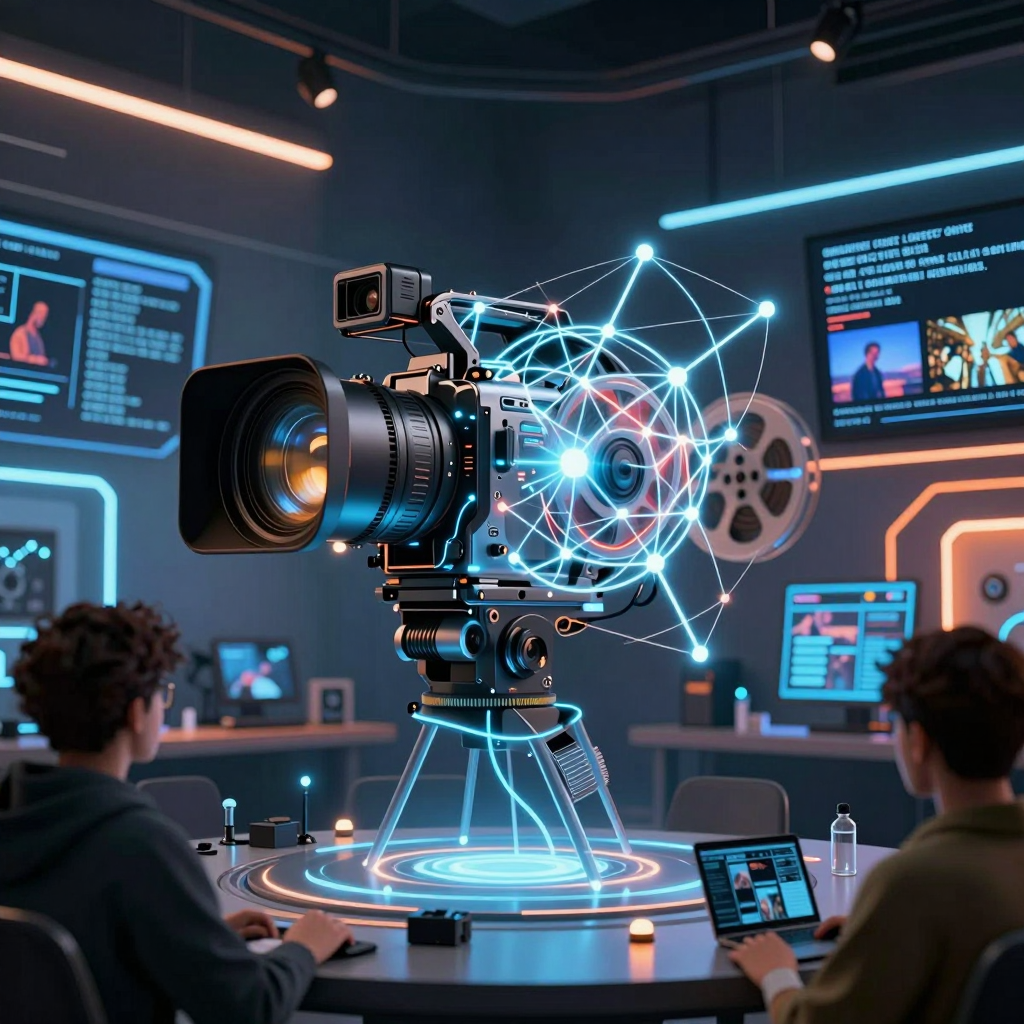
What if AI could go beyond being a mere assistant and completely rethink the entire filmmaking process? How would that transform the future of creativity? The most direct answer to this question lies in the $75 million, multi-year R&D partnership between Google DeepMind and film studio A24. The focus is not on technology that generates a few seconds of footage but rather on a bold declaration to build a ‘filmmaking AI’ that redesigns the entire filmmaking workflow.
The Core of AI Investment and Partnership: “Studio-Embedded R&D” Has Begun
What makes this collaboration remarkable is not just its scale. DeepMind partnering with a specific studio—A24—for long-term research signifies a groundbreaking structure where AI research teams embed themselves directly within the filmmaking workflow. In other words, rather than delivering AI models simply as tools developed in labs, they will co-design technology alongside creative decision-making processes from development and pre-production through editing and marketing.
This approach signals the following transformative shifts:
- AI evolves to propose ‘practically executable creative options’ after learning on-site constraints such as budgets, schedules, and shooting risks
- The studio’s accumulated production expertise informs model design, quickly refining domain-specific AI pipelines
- Ultimately, the system moves beyond “impressive demos” toward becoming a production system that proves strong ROI (return on investment)
What Changes Technically in AI: Multimodal Pipelines and Agent-Based Workflows
Though the published details do not reveal specific architectures, the broad scope targeting “the entire filmmaking process” suggests a hierarchical multimodal system rather than a single monolithic model. The key is a foundational model that processes text, images, video, and audio as one, augmented by stage-specific AI agents (tools).
Mapped onto filmmaking stages, this might look like:
- Scenario/Development: Transforming loglines and synopses, verifying character arcs, ensuring tonal consistency in dialogue, and generating massive explorations of alternate endings
- Previsualization (Previs) and Shot Design: Generating storyboard and shot list candidates from textual scene intents, proposing camera angles, lenses, and movements
- Virtual Production Simulation: Checking spatial, lighting, and physical consistency while virtually rehearsing risky stunts and complex blocking in advance
- Editing (Post-production): Suggesting rough cut structures, analyzing rhythm and information flow between scenes, recommending alternative cuts based on audience comprehension and immersion
- Marketing: Automatically generating multiple versions of trailers, posters, and copy for A/B testing
The essential point is that AI does not replace creativity but exponentially expands the option space that directors and producers can rapidly explore, verify, and select from. As a result, filmmaking bottlenecks may shift from “idea generation” to “precision in choice and direction.”
How AI Is Changing the Economics of Production: Risk-Reducing Technology as a Box Office Strategy
Film production is inherently an industry riddled with uncertainty. Failures during development and pre-production are costly and hard to recover from. The ideal early target for Filmmaking AI lies precisely here.
- Reducing development risk: Instead of committing to a single draft, rapidly experiment with dozens of structural/character/ending variants to find promising designs faster
- Lowering shooting risk: Virtually verify mise-en-scène and blocking before going on location to reduce chances of reshoots and schedule delays
- Enhancing marketing efficiency: Automate iteration of trailers and promotional materials to measure audience responses across segments and optimize messages through data
Put simply, the success of this project will likely be judged not by how convincingly “AI-generated footage” looks but by how much it improves decision-making quality while cutting costs, time, and uncertainties for a film’s entire lifecycle.
Why A24 in the AI Era: Signals from a ‘Auteur Studio’ Partnership
Unlike mass-franchise studios, A24 is known for its auteur-driven, experimental films. Collaborating with such a studio suggests that Filmmaking AI aims to be more than simple automation—it aspires to be a director- and writer-friendly tool, a true ‘creative partner’.
In summary, DeepMind and A24’s $75 million project is less about “making films with AI” and more about rebooting the entire operating system (OS) of filmmaking with AI. How this experiment concretizes into workflows over the next few years may well reshape the future of creativity—not as replacement, but as reassembly.
AI Filmmaking: What Technologies Make This Project Possible?
When multimodal AI combines with virtual world simulation, the “perfect assistant for directors” becomes more than just a metaphor. DeepMind × A24’s Filmmaking AI aims not merely to ‘generate’ a single scene but to technically realize an end-to-end pipeline that supports decision-making throughout the entire filmmaking process. Technically dissected, this can be explained in three main layers.
Multimodal AI Foundation Model: The Core That Understands Script, Images, Video, and Audio at Once
Filmmaking is inherently a multimodal task. It begins with a script (text), moves through concept art (images), filmed footage (video), and dialogues and music (audio), all influencing one another. At the heart of Filmmaking AI is likely a multimodal foundation model that handles these four inputs within the same semantic space.
- Text Understanding/Generation: Grasping the script’s structure (three-act format, rising conflicts, character arcs), tone (black comedy, suspense), and dialogue rhythm to rapidly propose “narrative experiments” such as alternate scenes, altered endings, and reconfigured character relationships.
- Image/Video Understanding: Extracting mise-en-scène rules (color, texture, composition) from concept art and analyzing reference shots to learn the “visual language of the work.” It’s not just about pretty frames but the ability to link directorial intent with the function of shots (conveying information, emphasizing emotion, building tension).
- Audio Understanding: Considering factors like dialogue clarity, emotional trajectory, and sound design at scene transitions to make “editing suggestions” genuinely useful in production. In other words, it evolves beyond mere video generation into decisions involving editing, sound, and rhythm as a unified whole.
The key is not “one model does it all” but a structure where production-stage-specific tools sit atop a core model with shared understanding abilities.
Agent-Based AI Workflow: A Pipeline Where ‘Specialist Assistants’ Collaborate for Each Production Stage
What’s needed on set is not a general chatbot but functionalities embedded within the production workflow. Filmmaking AI is likely a network of agents (tools) specialized for each phase, connected through the multimodal core.
- Development: Mass-producing logline, synopsis, and treatment variations while conducting risk exploration based on assumed audience segment reactions. The critical technology here is constraint-based exploration—not mere generation but factoring in constraints like budget, rating, runtime, and shootable locations.
- Pre-production: Breaking down the script into shots to automatically extract shot lists, shooting plans, and prop/set requirements, along with proposing scheduling options. This involves not only natural language processing but also structured information extraction and optimization of production data.
- Previsualization/Editorial: To suggest “how to adjust cut lengths to preserve emotional arcs” or “what visual/auditory match cuts to connect scene transitions,” the model must thoroughly understand the temporal dimension. It can evolve to read a scene’s purpose and rhythm, proposing multiple rough-cut editorial alternatives.
- Marketing: Automating multivariate testing (A/B/n) of trailers and posters, experimenting to see which tone or cut drives higher click and completion rates in target audience groups. However, this leans more toward message optimization than creativity, raising ethical and creative autonomy debates.
The crux of this layer is not AI that “makes tons of content,” but AI that preserves the director’s intent while reducing repetitive work. Ultimately, the UX depends on how short the loop is made from director’s notes → instant visualization/alternative proposals → director’s selection and revision.
Virtual World Simulation AI: Creating the ‘World’ Before the ‘Scene’
Where Filmmaking AI can diverge from conventional video generation lies in world simulation. Beyond crafting a convincing single clip, if technology can simulate a continuous world—maintaining character positions and movements, camera motion, physical consistency, and lighting changes—the production method transforms.
- Virtual Set/Blocking Simulation: When a director says, “The character moves to the window, looks outside, and the camera slowly follows from behind,” AI can construct the space and calculate collision-free paths, proposing multiple camera plans.
- Physics and Continuity Checks: Problems like inconsistent spatial relations in action scenes or mismatched lighting directions between cuts are notorious cost drains. World simulation acts as the foundation for automatic continuity verification.
- Integration with Virtual Production: Combined with LED volumes and real-time rendering pipelines, previs effectively becomes the shooting plan. This greatly accelerates directorial decision-making without test shooting.
In summary, the technology combination that makes this project viable is (1) multimodal understanding/generation core + (2) stage-specific agent workflow + (3) world simulation–based virtual production. When these three fuse effectively, Filmmaking AI evolves from a mere generator into a ‘production operating system’ that structures the director’s intent and accelerates iterative experimentation.
How AI Is Transforming the Creative Industry: The Game-Changing Partnership Between A24 and DeepMind
The news that A24, the titan of independent cinema, has teamed up with DeepMind, a cutting-edge AI research powerhouse, goes far beyond a mere “tech collaboration.” It boils down to one critical question: Can the fusion of indie film aesthetics with big-tech AI reduce filmmaking costs and risks while unlocking a new creative paradigm? This partnership is in the spotlight precisely because it’s boldly tackling that possibility through long-term R&D.
AI Reinvents the “Front End” of Filmmaking: Compressing Development and Pre-Production
The biggest waste in film often happens not after shooting, but before cameras roll. The cost of failure balloons as ideas solidify into scripts and then become shootable plans. The core target of filmmaking AI is to slash this front-end repetition and drastically cut exploration costs.
- Parallelizing Script Exploration: With a multimodal LLM-driven pipeline, a single project seed can swiftly generate and compare alternatives like “Ending A/B/C,” “Character motivation variations,” and “Scene rewrites across tones (dark comedy/thriller/human drama).” The key isn’t “AI writes instead of humans” but rather expanding the breadth and speed of choices humans can make.
- Automating Shot Design and Storyboards: By inputting scene intentions as text, AI can propose shot lists and storyboard/previsualization drafts. This slashes back-and-forth meeting times and clarifies “what exactly to shoot” before filming begins.
- De-risking Through Virtual Filming: If scene composition, actor blocking, and pacing can be pre-validated without costly test shoots, decision-making becomes more data-driven. Studios like A24, known for director-driven films, stand to gain massively from experimentation at the previs stage.
Technically, this revolves around multimodal foundation models that process text, images, video, and audio simultaneously, layered with agent-style tools linking stages—like “script agent → previs agent → editing suggestion agent”—to naturally build a seamless workflow.
When AI Meets “World Simulation”: Rules of Virtual Production Rewrite Themselves
The impact deepens when DeepMind’s interactive world simulation tech enters the picture. Beyond merely generating visuals, AI can simulate the scene’s world under consistent rules.
- Optimizing Camera Moves and Blocking: Feed in the director’s intent (tension, isolation, pace), and AI can suggest camera angles respecting physical and spatial constraints.
- Ensuring Action and Physics Continuity: AI helps minimize costly “continuity errors” in action sequences before shooting starts, saving post-production time and raising quality.
- Iterating Virtual Set Designs: Before location scouting and set construction, various spatial layouts can be virtually tested. Especially for mid- and low-budget projects, this lowers the cost of “trial and error,” enabling bolder directorial risks.
AI Breeds “AI-Native Studio” Models: Transforming Production Organizations
This collaboration is symbolic in forging a near “studio-embedded R&D” structure, where big-tech AI teams and studios operate closely together—transforming not just production methods but organizational dynamics.
- Continuous Workflow Integration: Instead of on-demand tools, “production partner AIs” actively participate full-time—from brainstorming to editing feedback.
- Role Reconfiguration: While some tasks of writers, concept artists, and edit assistants get automated, the crux shifts from mere replacement to from generation to curation and direction. The ability to decide what to create and articulate taste becomes paramount.
- Marketing as a Powerhouse: Rapid multivariate generation of trailers, posters, and copy for A/B testing could become standard. The line between production and distribution blurs, pushing launch strategies earlier into the production pipeline.
The AI Era’s Greatest Challenge: The Triangle of Data, Copyright, and Trust
With such industry-wide impact, success hinges not just on tech performance but on trust and norms.
- Data Pipeline Transparency: Industry standards will split over which films, images, and music are used for training—and whether opt-out and compensation mechanisms exist.
- Style Copying and Publicity Rights: Commercially appealing yet fraught with disputes, cloning a director’s or actor’s style, face, or voice pushes rapid evolution of contracts like “digital persona licenses.”
- Directors’ Trust Issues: Whether to adopt AI-suggested shots and edits depends on UX and explainability. Filmmakers must grasp “why this cut is recommended” and revert instantly on the timeline. In other words, the interface—not just the tech—could make or break adoption.
Ultimately, the DeepMind × A24 experiment sends a clear message: AI aims to become more than a tool for speeding up a few scenes—it strives to be a collaborative partner reshaping the entire decision-making fabric of filmmaking. If this effort proves both ROI-positive and ethically sound, the creative industry may swiftly evolve from “studios that use AI” into studios run by AI.
AI Creative Labor, Ethics, and Regulation: New Challenges in the AI Era
As AI encroaches on the realm of creation, how will the roles of writers and directors evolve, and how can laws and ethics keep pace? When systems like DeepMind–A24’s “filmmaking AI” dive deep into production pipelines, the debate shifts beyond simply “AI makes the video” to who created what, who is accountable, and who gets compensated.
Creative Labor Reorganized by AI: From ‘Generation’ to ‘Direction’
Film production has traditionally been highly segmented, but AI’s introduction redraws the very boundaries of this division. Especially in stages like pre-production (planning and development) and post-production (editing and marketing), where “creating many variations and selecting the optimal one” is key, changes are rapid.
Writers (Screenwriters)
- Past: Linear repetition from logline → synopsis → treatment → rough draft → rewrites
- Change: AI rapidly generates dozens of plot variants, dialogue tones, and endings; writers focus more on designing selection criteria (themes, character desires, rhythm) and spend more time on consistency checking.
- Ultimately, those who choose better and direct more precisely gain competitiveness over those who simply write more.
Directors, Cinematographers, Production Designers
- With faster generation of concept art, mood boards, and shot references, the director’s core strength shifts from the “idea” itself to the ability to define and maintain aesthetic rules in words.
- Moreover, combined with world simulation technologies, virtual production previsualization—validating camera moves, lighting, and blocking in virtual spaces through text prompts—could become widespread. This shifts key pre-shoot decisions from on-set to studios/offices.
Editors, Trailers, Marketing
- As AI automates rough cut options, rhythm (tempo) suggestions, and trailer version diversification (A/B testing), editors’ judgment becomes more important than manual “hands-on” work.
- Concurrently, if “audience response data-driven editing optimization” spreads, creative criteria risk shifting from completion quality toward metric optimization.
The crux is clear: as AI spreads, creators do not disappear; rather, the unit of creation elevates from ‘sentence/cut generation’ to ‘intention/rule/criteria design’. Yet, for this transition to be smooth, labor markets must realign with retraining, job redefinition, and credit norms.
AI Copyright, Style, and Publicity: The Blurring Line Between “Learning” and “Copying”
When filmmaking AI enters practical use, the first big hurdle is rights (copyright, moral rights, publicity rights). Technically, multimodal models handle text, image, video, and audio together; the problem is that it becomes difficult to distinguish whether the output is a “new creation” or a “replication of a specific creator’s style.”
Style Imitation
- The moment an AI convincingly reproduces a specific director’s cut patterns, a cinematographer’s lighting tone, or an editor’s rhythm, legal and ethical issues erupt.
- While technically one may claim the model merely learned distributions from certain creators, industrially, disputes arise when a “market substitution effect” occurs.
Actor Faces and Voices (Digital Personas)
- As AI audio/video generation advances, the line blurs between look-alikes and unmistakable reproductions of the person.
- Therefore, persona licenses (permissions to use faces, voices, acting styles) are likely to become standard contract terms.
Data Transparency
- Trust hinges on knowing what data was used for training and how rights holders are compensated or allowed opt-outs.
- Practically, even if “disclosure of training data sources” isn’t a perfect solution, at least the existence of rights management systems (licenses, compensation, exclusion requests) lowers barriers to adoption.
In summary, technology expands the realm of possibility, but industries don’t move without legitimacy. As AI-generated outputs improve in quality, rights design becomes a competitive advantage.
AI Accountability and Safety: When Creative Tools Become ‘High-Impact Systems’
Although AI for filmmaking appears as a creative tool, it can drive high-impact decisions. For example, casting image generation, biased character portrayals, amplification of violence or hate, or narratives based on falsehoods put production companies in a position where defending solely on “freedom of expression” becomes untenable.
Technically, the following safety measures gain importance:
- Content Safety Filtering (Text/Image/Video simultaneously)
- In a multimodal environment, text may be safe but images or video risky; thus, a cross-verified safety system—not modal-specific filters—is necessary.
- Provenance Tracking and Watermarking
- For internal review and dispute resolution, generation history logging—recording which prompts, models, and data lineages were used—becomes indispensable.
- Human in the Loop (HITL)
- Rather than “auto-generate → auto-publish,” workflows enforcing expert approval reduce risk. Especially for outputs with wide impact like trailers and promotional materials, review stages must be more rigorous.
AI Regulatory Framework: The Tug of War Between Innovation Promotion and Responsibility Enhancement
Following recent U.S. policies emphasizing “advanced AI innovation and security,” regulation trends favor strengthening accountability, security, and transparency rather than outright bans. Even if creative fields are not immediate regulatory targets, large-scale systems like filmmaking AI face regulatory influences in these areas:
- Model Safety and Security Requirements: Preventing misuse of high-performance models, access control, security audits
- Clarification of Responsibility: Determining whether studios, model providers, or users are liable when harms (defamation, image rights infringement, biased portrayals) occur
- De facto Industry Standards: Compliance items demanded by platforms, distributors, and insurers (watermarking, rights verification, log retention) may become the norm ahead of legislation
Ultimately, the battleground isn’t “AI that evades regulation” but rather AI workflows embedded with regulation, contracts, and ethics. While production sites crave speed, without trust, speed cannot endure. Creativity in the AI era isn’t a technology problem—it has transformed into a challenge of designing systems that generate trust.
Key Points to Watch in the Future of AI: Scenarios Unfolding as Filmmaking AI Comes to Life
If DeepMind × A24’s “filmmaking AI” truly materializes as a complete end-to-end pipeline, the real focus isn’t on flashy tech demos. The critical battleground lies in where trust between directors and AI is formed, how transparently data is managed, and how the AI-native studio organizational model redistributes industry power. Here are four essential perspectives that will shape the next several years.
AI Perspective 1: Director’s Trust Matters More Than “Model Performance”—Where Does Decision-Making Authority Remain?
The most precious resource in filmmaking isn’t GPUs but decisions. Once filmmaking AI steps onto the set, the key question boils down to: “When and on what basis does the director accept the AI’s suggestions?”
Trust isn’t built just because the outputs look good. Three technical conditions must be met:
- Explainable Suggestions: Rather than simply “this shot is better,” AI must back up its proposals with elements like emotion curves, character motivation, rhythm (cut length), and visual focus. For editing suggestions, it should explicitly state the intentions and trade-offs of alternative cuts on the timeline (e.g., tension ↑ vs. information ↓).
- Consistency Checking: When combined with world simulation, AI will not only generate “cool scenes” but also serve as a quality assurance (QA) system that automatically checks physical, spatial, blocking, and prop continuity. Directors tend to trust AI not just for creative flair but as a mistake-reducing assistant.
- Authority Separation: Humans retain core decisions like the final cut, casting, and acting tone, while AI floods the process with alternatives. Thus, the role will likely settle as a director-first tooling system designed to aid direction more than creation.
Ultimately, the competition isn’t “Is AI getting smarter?” but how much ‘decision-making burden’ the director delegates to AI.
AI Perspective 2: Data Transparency Is Infrastructure That Determines ‘Transaction Costs’—Not Just a Tech Spec
Filmmaking AI is likely a multimodal system spanning text, images, video, and audio. Alongside performance, the source and rights of training data become a sensitive, critical issue. If data transparency collapses, studios will face simultaneous lawsuit and boycott risks, halting tech adoption.
Key realistic watchpoints include:
- Provable Provenance: Auditable logs are essential to show when, under what license, and from where data entered the system. It’s not just documentation—the pipeline itself must enforce provenance.
- Built-in Opt-Out/Compensation Mechanisms: Rather than conflict over “Was this data used for training?”, embedding license options and compensation rules into the system lowers transaction costs. Particularly, disputes over actors’ faces/voices or specific directors/cinematographers’ styles may converge on publicity and digital persona licensing.
- Watermarking/Attribution of Outputs: Even for internal studio use, if metadata doesn’t mark which shots/dialogue/sound passed through AI, responsibility later becomes opaque.
The winner here isn’t “the best model” but the stack that raises productivity with the lowest legal and labor frictions.
AI Perspective 3: Creator-Friendly UX Decides Victory—It’s About “Workflow,” Not Just “Prompts”
Film professionals don’t produce movies from prompt boxes. For filmmaking AI to truly reshape the industry, it must be a tool system (workflow-native agents), not just generative models.
- Script Phase: Writers want not “one-shot script generation” but editable variant creation—like strengthening conflicts while preserving dialogue tone, branching the ending into three, or finding holes in character arcs.
- Previsualization & Shot Design: Taking a director’s notes, AI generates shot lists, blocking paths, lens/camera height candidates, quickly verifying spatial feasibility via world simulation.
- Editing/Post: Alternative cuts are proposed on the timeline, but to ensure adoption, AI must make non-destructive suggestions that don’t disrupt the editor’s rhythm.
- Marketing: Beyond mass-generating trailers/posters, the key is an operating layer that optimizes which version to show when, based on audience segment reaction data.
In summary, the success of filmmaking AI hinges not on model cards but on how AI ‘attaches’ to existing professional tools (editors, asset management, production schedule, review approvals).
AI Perspective 4: The AI-Native Studio Model Redistributes Power—Small Teams Move Like Big Studios
The DeepMind–A24 partnership is symbolic not for technology but for the organizational model. An in-house, continuous R&D studio changes the nature of production companies—from “makers of content” to “operators of models and pipelines.”
Likely scenarios unfolding include:
- Collapse of Scale Economies in Development: Planning and testing once requiring many personnel and time are compressed by AI, enabling small teams to explore as widely as major studios.
- Shift in IP Strategy: The franchise-dependent, hit-chasing structure could give way to a data-driven “cheap, heavy experimentation” approach. Rather than banking on one blockbuster, a diverse mid-budget portfolio may regain competitiveness.
- Triangular Reorganization of Platform-Studio-Tech: Which AI partner (or in-house model) a studio chooses will soon dictate production speed, cost, and rights structures. Success cases will trigger a cascade of similar R&D partnerships and the content ecosystem will be “blockchained” based on AI technology stacks.
When watching filmmaking AI, don’t just focus on headlines that “AI made a movie.” Instead, follow who holds decision-making power (trust/authority), what data it’s based on (data transparency), which tools define the workflow (UX), and what organizations emerge victorious (AI-native studios). When these four aspects align, the filmmaking industry’s competitive rules will quietly—but irreversibly—fundamentally transform.
Comments
Post a Comment