 \n
\n
Hanwha Aerospace: The Backbone of South Korea’s Defense and Space Industry—What Does This Company Do?
As a core defense and aerospace company within the Hanwha Group, Hanwha Aerospace spearheads South Korea’s national defense and space initiatives with cutting-edge technologies and businesses. From fighter jet engines to rocket and missile propulsion systems, this firm stands at the heart of technology-intensive industries that provide the “propelling force” behind national security and space development.
The Role Hanwha Aerospace Plays: A Key Supplier of Engines, Propulsion Systems, and Weapon Components
Hanwha Aerospace is introduced as a comprehensive platform company encompassing aerospace, defense, and space sectors. While it is commonly recognized primarily as a “defense company,” the real strength lies not just in weapon systems’ outer structures but in core technologies such as engines, propulsion mechanisms, and fuel systems.
- Aero Engines and Parts: Manufacturing parts for military and commercial aircraft engines, assembly, testing, maintenance (MRO), and performance enhancement
- Rocket and Missile Propulsion Systems: Developing and producing large propulsion engines, handling propellant systems and associated processes
- Defense System Development and Production: Expanding into ground weapon systems, guided weapons, launch systems, and related equipment
A Snapshot of Hanwha Aerospace’s Business Structure: Why Aerospace, Defense, and Space Are Intertwined
The company’s portfolio is broadly divided into aerospace (engines) – defense (weapon systems) – space/propulsion (rockets and missiles). While these sectors may look distinct, their technologies are tightly interlinked. For example, precision machining, heat-resistant materials, and testing capabilities honed in aircraft engine development directly connect to rocket and missile propulsion technologies.
In other words, a single technological foundation extends across multiple strategic national industries, a frequently cited strength of Hanwha Aerospace’s competitive edge.
What Hanwha Aerospace’s ‘Key Production Hub’ Really Means
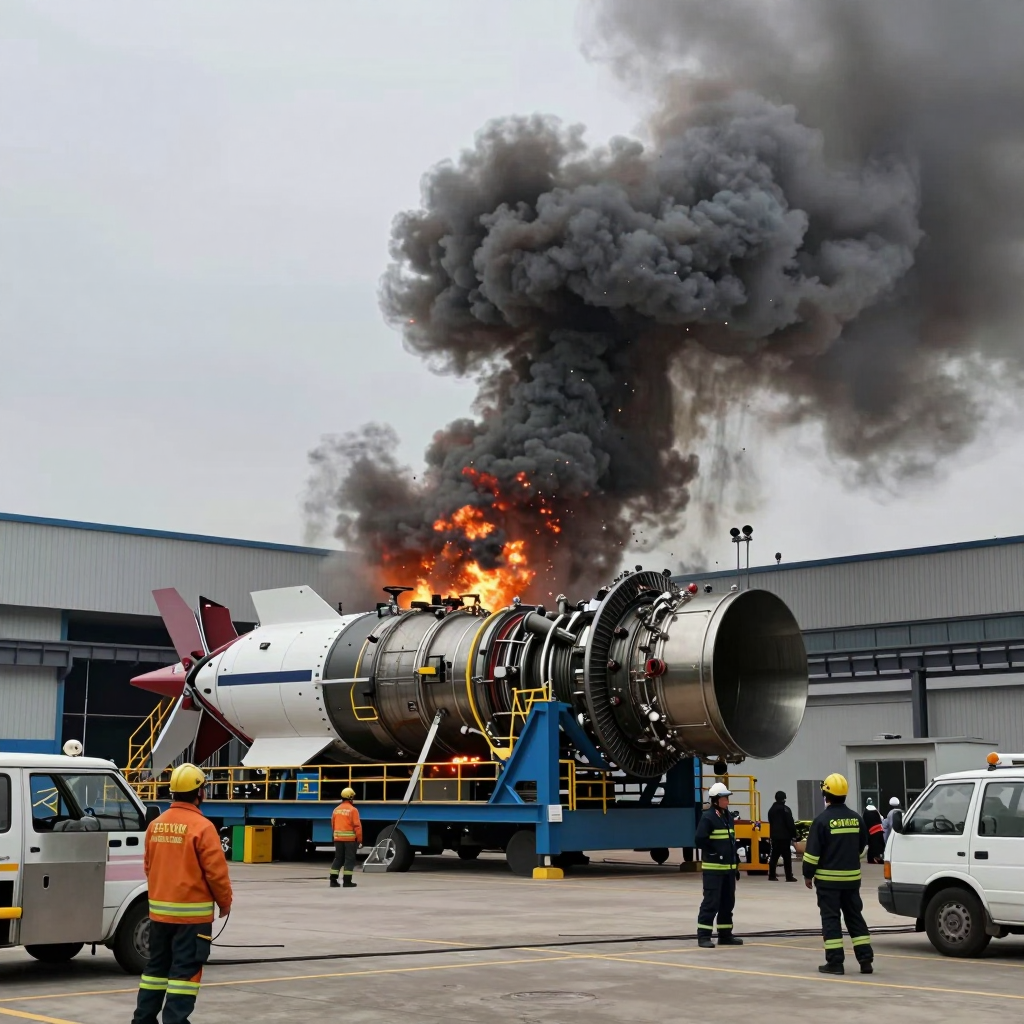
According to reports, the Daejeon plant is a core facility where high-risk processes involving explosive materials, such as rocket and missile engines and fuel systems, take place. Processes like propellant mixing, loading, and cleaning are so sensitive that even minor friction or static electricity can cause accidents. Therefore, alongside technical expertise, the completeness of safety management systems is crucial in earning corporate trust.
In this way, Hanwha Aerospace holds irreplaceable technologies within South Korea’s defense and space industries. At the same time, the company remains under constant spotlight for “what it makes” and “where and how those things are made.”
The Hidden Shadow Behind Hanwha Aerospace’s Remarkable Growth: Repeated Explosions at the Daejeon Plant
Over the past eight years, three deadly explosions have occurred—what dangerous processes are causing such tragedies to repeat? Hanwha Aerospace’s Daejeon Plant is known as a crucial hub handling “inherently explosive” processes like rocket and missile propulsion systems and fuel lines. The problem arises when such high-risk activities fail to be managed as controllable risks, shifting the consequences directly onto workers and the local community.
Why Do Accidents at Hanwha Aerospace’s Daejeon Plant Appear More Severe?
The Daejeon facility isn’t just a simple manufacturing site; it concentrates on processes that directly handle explosive materials, such as propellant mixing, charging, and cleaning. In such environments, even the smallest variable can escalate into a catastrophic incident. For example, propellants can react to micro-stimuli like friction or static electricity, meaning that any slight lapse in process design, equipment condition, operational procedures, or on-site control dramatically multiplies risk.
The Repeated Record of Accidents at Hanwha Aerospace Daejeon Plant: 2018, 2019, 2026
Media reports reveal a disturbing pattern of deadly accidents at the Daejeon plant over the past eight years:
- May 2018: An explosion and fire occurred during the charging of solid fuel into a rocket propulsion container, resulting in 5 deaths and 4 injuries.
- February 2019: An explosion and fire took place in a space linked to propellant molding processes, causing 3 fatalities.
- June 1, 2026: An explosion and fire erupted at Building 56’s missile cleaning area, leading to 5 deaths and 2 injuries.
The common denominator is clear: all three disasters involved explosions and fires in processes directly touching propellants or propellant systems, tragically leading to multiple fatalities. This pattern raises a crucial question—are these accidents mere coincidences, or does it point to a failure in how risk itself is managed?
The Core of High-Risk Processes at Hanwha Aerospace: Even ‘Cleaning’ Is No Safe Zone
The fact that the 2026 accident occurred in a “missile cleaning area” is especially telling. Cleaning may seem ancillary, but when variables like residual propellant, flammable substances, static electricity, and tool friction converge, the risk escalates sharply. In other words, at propellant-handling sites, not only primary processes but surrounding operations demand the same rigorous safety protocols.
Questions Raised by Hanwha Aerospace’s Accidents: Can They Be Blamed on Individual Error Alone?
Once a pattern of three major accidents emerges, it’s no longer just about individual mistakes. Structural questions inevitably arise:
- Did risk assessments and safety procedures fully incorporate the changing conditions on-site?
- Were fundamental control measures—equipment reliability, ventilation, explosion-proof designs, and static electricity management—continually verified?
- Were work pace, staffing, training, and education genuinely designed with ‘safety first’ as a core principle?
- After the accidents, were countermeasures aimed at preventing recurrence, or merely focused on resuming operations?
As Hanwha Aerospace grows in defense and space sectors, safety issues at the Daejeon plant evolve beyond routine industrial accidents to become a pivotal factor in corporate trust and sustainability. The repeated tragedies convey one clear message: Just as technology and acquisition speed advance, so too must the systems managing risk—at the same relentless pace.
Hanwha Aerospace’s High-Risk Processes and the Blind Spots of Safety: An ESG and Corporate Future at Stake
Are recurring major accidents simply bad luck? Or do they reveal fundamental flaws in the safety management system? The fact that deadly explosions have repeatedly struck Hanwha Aerospace’s Daejeon plant over recent years cannot be explained away by the notion that "high-risk industries are inherently dangerous." With every repeated accident, one question converges from both the market and society: Does the company have a system in place that understands the risks and can control them?
The ‘Structural Risk’ Facing Hanwha Aerospace: Why the Processes Themselves Invite Explosions
The Daejeon plant primarily handles explosive substances involved in rocket and missile propulsion systems and fuel lines. Such processes mean that even a minor variable can trigger a large-scale disaster.
- Everyday factors like static electricity, friction, and impact can become ignition sources
- Propellant mixing, charging, and cleaning inherently carry extremely high risk density, where even slight deviations in work standards can lead directly to accidents
- When equipment defects, process condition fluctuations, and declining skill levels compound, the accident becomes not a matter of chance but something close to an inevitability
In short, the root problem is not simply “doing dangerous work,” but rather how this dangerous work is managed by a system.
The Message Behind Hanwha Aerospace’s Repeated Accidents: Why It’s Not Just Individual Error
When fatal accidents repeatedly occur at the same facility, investigation naturally shifts from blaming individuals to scrutinizing the system as a whole. If the conclusion stops at “field carelessness,” the company faces unavoidable follow-up questions:
- Was the risk assessment truly reflective of reality (based on actual working conditions rather than just documentation)?
- Did work stop authority function effectively on-site, or was it powerless against deadline and performance pressures?
- Were fundamental improvements made to the repeated processes—such as equipment, workflow, isolation, and remote/automated operations?
- If post-accident measures were limited to “strengthening training,” recurrence becomes only a matter of time
An accident is a single event; recurrence is the system’s report card. This is why investors, clients, and local communities regard safety as a core ESG metric.
The Crucial ESG Issue for Hanwha Aerospace: Safety Is Not a Cost, But ‘Business Sustainability’
In the defense and aerospace industries, safety issues translate directly into business continuity risks.
- The longer regulation, supervision, and work stoppages drag on, the more project timelines and deliveries are jeopardized
- Major accidents negatively impact workforce recruitment and retention, creating the most critical gap in field expertise in these technology-intensive sectors
- Most importantly, corporate reputation moves independently of “technical prowess.” When safety trust falters, an invisible discount rate is applied to contracts and partnerships
Ultimately, Hanwha Aerospace’s challenge is clear: answer not just that “an accident happened,” but why it happened repeatedly. When that answer manifests concretely across equipment, processes, organizational culture, and accountability, ESG ceases to be mere promotional rhetoric and becomes an instrument that protects the company’s future.
Hanwha Aerospace: What Is the Solution for Both Communities and Corporations?
When a large apartment complex is located just 600 meters away from the city center, and nearby high-risk operations such as propellants and engines are underway, residents cannot help but perceive this not as mere “anxiety” but as a “constant risk.” At the same time, companies like Hanwha Aerospace, a key pillar of the nation’s defense and space industries, cannot realistically consider unconditional shutdowns as an option. Ultimately, the solution lies not in a binary choice between “operation vs. closure” but in a structural design that places residents’ safety and corporate social responsibility on the same scale.
The Minimum Principles Hanwha Aerospace Must Lead With
- Elevated Standards of Transparency: Rather than ending with just a “summary” of accident causes and recurrence prevention measures, the company must disclose risk factors (what, where, and how they are dangerous) and the timeline for improvement completion in terms understandable to residents.
- Physical and Procedural Separation of High-Risk Operations: Even within the same facility, processes with high explosion and fire risks must prioritize isolation, explosion-proof design, remote operation, and automation. Simply “enhancing training” cannot justify recurrent accidents.
- Independent Safety Governance: Internal reporting systems have substantial limitations. Institutionalizing an independent safety committee that includes external experts, along with regular audits and checks on improvement implementation (with deadlines), is essential.
The Framework for ‘Social Consensus’ from the Community Perspective
- Resident-Participatory Safety Council: There should be a formal channel where corporations, local governments, fire departments, labor authorities, and resident representatives regularly share updates on process changes, facility replacements, and training plans. Without resolving information asymmetry, conflicts will repeat.
- Operational Emergency Response System: Plans such as sirens, evacuation routes, text alerts, and shelter operations must be transformed from mere documents into a practically drillable system. The very sense that residents “know what to do” is a core component of safety.
- Reevaluation of Location Risks: If high-risk facilities are situated close to the city, long-term considerations must include process relocation (including moves), while reviewing costs, schedules, and viable alternative sites. This is not solely a corporate decision but also a matter of public policy.
The Balance Point Lies Not in ‘Industrial Necessity’ but in ‘Certainty of Prevention’
Hanwha Aerospace’s path to regaining community trust is not to ask for understanding because it is an “important industry.” It is to clearly demonstrate what risks have been mitigated through what designs, who verifies this, and by when it will be completed. Production without assured safety is unsustainable, and unsustainable production ultimately undermines both corporate and industrial competitiveness. In conclusion, what is needed is verifiable prevention over speed, and a system of shared responsibility operated jointly by corporations, governments, and communities.
The Reconstruction of Hanwha Aerospace’s Safety System Determines the Company’s Future: Mid- to Long-Term Outlook and Challenges
Hanwha Aerospace carries significant risks alongside its outstanding growth momentum. What path will this company choose going forward? To cut to the chase, the mid- to long-term corporate value will likely be determined not only by “orders and technological capabilities” but also by the ability to “rebuild its safety system.” The defense and aerospace industries operate on trust, and trust ultimately stems from accident-free operations and transparent improvements.
Hanwha Aerospace’s Mid- to Long-Term Growth Drivers: “There is demand, and there is capability”
Hanwha Aerospace’s foundation is solid. Few companies simultaneously hold positions in high-barrier sectors like aircraft engines and parts, defense platforms, and rocket and missile propulsion systems. Against the backdrop of expanding global defense demand and prolonged national space and missile projects, the company’s technical and production capabilities can serve as effective engines of growth over the mid to long term. The issue is not whether they “can do it,” but whether they can do it “safely and sustainably.”
Hanwha Aerospace’s Core Risk: Costs and Uncertainties Born from Repeated Accidents
The fatal accidents repeatedly occurring at the Daejeon plant are not mere one-off incidents; they fundamentally change the criteria by which the market and society judge the company. Risks multiply and cascade.
- Regulatory and Oversight Risk: As work stoppages, process redesigns, and equipment replacement demands intensify, production disruptions and cost burdens increase.
- Project Schedule Risk: Timeliness and trust are crucial in defense and space projects, so delays directly impact relationships with partners and clients.
- Reputation and Talent Risk: Whether “safety is guaranteed” in high-risk operations is directly tied to securing skilled personnel and organizational stability.
- Community Acceptance Risk: The presence of high-risk facilities near urban areas may escalate into demands for transparency, relocation discussions, and acceptance issues with local communities.
In other words, even if growth opportunities remain open in the mid to long term, if ‘operational continuity’ falters, growth itself can be delayed.
Challenges Hanwha Aerospace Must Solve: Proving “Prevention of Recurrence”
What the market will focus on from now on is not apologies but the concreteness of recurrence prevention. The following four points will be key checkpoints.
- Fundamental Improvements in Process Safety: Are reliability of equipment, control of static electricity and friction risks, explosion-proof standards, and the level of isolation and workflow in high-risk processes such as propellant handling, cleaning, and charging actually being strengthened?
- Investment in Automation and Remote Operations: Are investments being made toward reducing human exposure (automation, remote work, enhanced monitoring)?
- Elevation of Safety Governance: Are KPIs and accountability structures being redesigned at the executive and board level to ensure that field safety does not take a backseat to production goals?
- Transparent Disclosure and Stakeholder Management: To what extent and at what frequency are investigation results and improvement progress disclosed, and how is trust being rebuilt with local communities, partners, and personnel?
The bottom line is not “there are measures,” but whether those measures are executed and proven by ‘operations free from repeated accidents.’
Hanwha Aerospace’s Crossroads: From a Technology Company to a ‘Sustainable Enterprise’
Hanwha Aerospace holds strategic importance in Korea’s defense and aerospace industry. Therefore, this juncture could become a turning point defining the company’s character. If it can redefine its safety system as a competitive advantage rather than a cost and simultaneously elevate processes, organizations, investments, and communications, it can build a foundation of trust for mid- to long-term growth. On the other hand, if improvements are delayed or merely superficial, escalating regulations, delays, and reputational damage will accumulate, making it difficult to escape the “high-growth, high-risk” framework.
Comments
Post a Comment