How the U.S. Department of Defense’s Agent Network AI Will Revolutionize Battlefield Intelligence and Strike Management in 2026
 \n
\n
Agent Network: Heralding a Revolution on the Battlefield
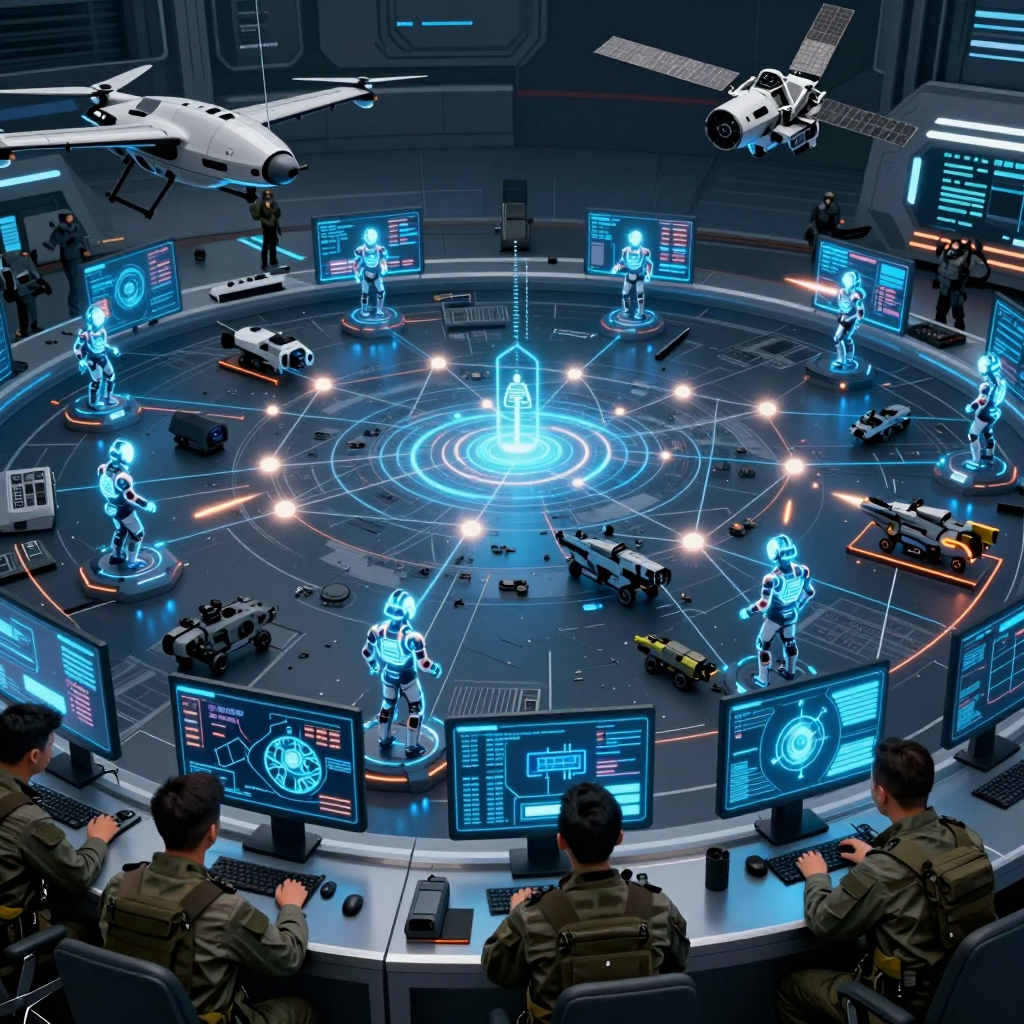
The U.S. Department of Defense’s Agent Network, unveiled in 2026, promises to transform the way combat information is gathered and strike decisions are made. Until now, the decisive factor on the battlefield wasn’t “who had more information,” but who could convert information into ‘operational decisions’ faster. Agent Network stands out as a prime example of an agentic AI system designed specifically for the battlefield, created to accelerate this critical transformation speed.
What Agent Network Aims to Change: Eliminating Bottlenecks in the Slow Kill Chain
Traditional strike preparation processes—commonly called the ‘kill chain’—have relied heavily on humans to organize, cross-verify, and prioritize vast amounts of incoming data. Inputs such as sensor data, ISR (Intelligence, Surveillance, Reconnaissance) reports, and satellite imagery are exploding, but analysts and commanders need time to turn them into “decision-ready packages.”
Agent Network has a clear mission:
- Speed up multi-source data integration: Quickly gather and organize diverse streams into formats commanders can immediately understand
- Delegate initial analyst tasks to Agents: Automate repetitive jobs like classification, summarization, tagging, event grouping, and importance assessment
- Link directly to strike package recommendations: Go beyond simple summaries to present executable options (Courses of Action, COAs) in a comparable format
In short, Agent Network strives to evolve “information systems” into decision-preparation systems.
The Heart of the Agentic Structure: A Role-Divided Agent Network, Not a Single Model
What makes Agent Network truly remarkable is that it doesn’t rely on one powerful model to do everything. Instead, it embraces a network of multiple Agents collaborating by dividing roles. This multi-agent approach is spreading beyond the military to civilian sectors, and on the battlefield, it’s likely realized in forms such as:
- Information gathering Agents: Automatically collect and normalize incoming sensor, report, and imagery data
- Situational awareness Agents: Organize events along a timeline, build context, and detect anomalies
- Threat assessment Agents: Prioritize enemy threats, calculate confidence levels, and refine alerts
- Target candidate generation Agents: Create target lists and filter them based on constraints, rules, and risks
- Operational options generation Agents: Produce multiple COAs, comparing pros, cons, and expected outcomes in comparable formats
Crucially, these Agents aren’t merely “chatting entities”; they are autonomous actors that invoke tools, maintain state, and perform continuous loops of reasoning and action. This capability is built atop an agentic AI operating system (the orchestration layer), which manages state, tool invocation, memory, and policy enforcement.
What Operational-Grade Deployment Demands: OS-Level Orchestration + Runtime Control
Agent Network’s emphasis on operational scale rather than mere proof-of-concept brings significant technical implications. For Agents to affect real-world missions, performance alone isn’t enough; the following are essential:
- State management: Seamlessly execute multi-step workflows rather than one-off responses
- Tool layer: Call databases, APIs, simulators, and external systems through standardized interfaces
- Memory tiers: Store and reuse information hierarchically, from short-term context to long-term knowledge
- Guardrails & governance: Enforce permissions, policies, and resource limits at runtime with auditability
Ultimately, the change Agent Network heralds isn’t just “making AI smarter,” but embedding a robust system for safely and reliably operating AI Agents on the battlefield.
Conclusion: Agent Network Attempts to Redefine the ‘Speed of War’
Agent Network seeks to transform not just a tactical maneuver but the entire rhythm of warfare. By slashing the time from data arrival to options presented to commanders, battlefield dominance will hinge as much on decision speed and operational frameworks as on sheer firepower. At the heart of this shift lies the collaborative Agent Network, dividing roles and working together to redefine how wars are fought.
The Technical Foundation of Agent Networks: Agentic AI Operating Systems and Collaborative Agent Structures
On an agentic AI Operating System like Lumbra, multiple AI Agents with different roles operate simultaneously to make a strategic decision as a “team.” The key point is that this structure is not simply multiple models stuck together; rather, it integrates State, Tools, Memory, Guardrails, and Observability at the operating system level to create a continuously runnable network. So, what exactly enables this kind of collaboration?
What an Agentic AI Operating System Does: The Layer That Turns “Reasoning Agents” Into “Actionable Systems”
Unlike typical chatbots that end with a question-and-answer exchange, complex domains such as battlefield intelligence or strike management cannot be resolved with a single response. When given a mission, an agent enters a loop of planning → tool invocation → result verification → next action, performing multiple branches and retries along the way.
At this point, the operating system level takes charge of:
- Task Decomposition and Orchestration: Breaking one goal into multiple subtasks and assigning which Agent handles what
- State Persistence: Saving and restoring workflow so nothing about “what’s done and what’s left” is lost
- Standardization of Tool Execution: Safely and reproducibly calling external systems (APIs, databases, simulators, etc.)
- Policy-Based Control: Enforcing at runtime what an Agent is allowed (permissions) or forbidden (prohibitions) to do
- Audit and Traceability: Logging which Agent took what action based on which grounds to enable retrospective verification
Ultimately, Lumbra resembles execution infrastructure that makes agents operational in the field.
How Multi-Agent Networks Work: Role Division + Consensus/Verification Pipelines
Agent Network architectures typically rely on role-specialized Agents. They can be categorized as follows:
- Collection Agents: Detect and normalize new signals from ISR/sensor/report streams
- Analysis Agents: Perform event association, pattern detection, and quality evaluation
- Targeting/Options Agents: Generate Courses of Action (COA) and assemble strike package candidates
- Verification Agents: Identify lack of evidence, conflicting data, collateral risks; rebut or request additional information
- Summary/Briefing Agents: Compress key insights for commanders to make rapid judgments
The crux is not that “multiple agents just talk simultaneously,” but that the operating system manages work queues, dependencies, and approval gates to form a verifiable pipeline. In other words, a conclusion by one Agent does not directly translate into execution; it must be subject to cross-validation by other Agents or runtime policy blocking.
Core Component 1) State Management: The Backbone of Uninterrupted Mission-Level Workflows
Battlefield intelligence flows in real time, and tasks are long and complex. Therefore, Agents must manage long-running states beyond just “dialog context.”
- Saving progress by stage: e.g., collection completed, primary analysis done, conflicting data under review
- Retry and rollback: Recovering without halting despite tool call failures or data delays
- Multi-Agent synchronization: Preventing version conflicts when different Agents address the same target/situation
Without State, Agents would re-infer from scratch each time, destabilizing results and making them unreliable in operational settings.
Core Component 2) Tool Layer (MCP-based): Standard Interfaces for Agents to “Read-Write-Execute”
The riskiest yet most critical point in an Agent Network is tool invocation. Actions impacting the real world—DB queries, calls to external APIs, simulation runs, report generation—happen here.
- Connecting systems via standardized tool interfaces lets Agents use domain tools consistently
- Coupled with a permission model, it tightly controls which Agent can use which tools and to what extent
- Structured execution results (formalized outputs) make it easier for subsequent Agents to verify and cross-check
In essence, the Tool Layer is the gateway turning Agents from “conversational models” into “task-executing operators.”
Core Component 3) Memory Tiers: Layering from Tactical Short-Term Memory to Organizational Knowledge
In mission environments, memory is not mere dialogue history but a determinant of both performance and safety. Modern agentic systems typically implement layers such as:
- Short-term Memory: Immediate context needed for the current mission/session
- Mid-term Memory: Useful preferences, operational rules, and frequently used procedures across repeated missions
- Long-term Memory (Knowledge Repository): Organization-wide doctrine, past cases, validated intel summaries, policy documents
Without this stratification, Agents either (1) forget crucial information or (2) pull in unnecessary data that increases cost and errors. Especially in military domains, the “accuracy and provenance of memory” are critical, so memory design must include source tracking and refresh policies.
Core Component 4) Guardrails & Governance: A Runtime Control System, Not Just Filters
In high-risk environments, guardrails go beyond mere keyword filters. At the operating system level, the necessities include:
- Permission-based tool execution controls: Some Agents have read-only access; others have change/trigger rights
- Just-In-Time (JIT) time-limited permissions: Grant and revoke privileges automatically per mission timeline
- Policy violation detection: Blocking sensitive data access, unauthorized targeting requests, and excessive resource use
- Pre- and post-action verifications: Reviewing conditions before execution and confirming results match intentions afterward
In short, the more “autonomous” an Agent is, the more it needs clear boundaries and accountability—a responsibility the OS absorbs.
Core Component 5) Observability: The Operational Bedrock That Makes Agent Actions “Explainable”
Systems like Agent Networks must operate in a way that enables post-hoc analysis.
- Which Agent arrived at conclusions based on what data or evidence (basis and provenance)
- What tools were invoked with which parameters (execution logs)
- What policies allowed or blocked actions (policy decision logs)
- How handoffs occurred between Agents (workflow tracing)
This observability enables red team assessments, simulation validations, incident investigations, and performance improvements. The reason it’s called an “Operating System” is precisely because Agent behavior must be measured, traced, and controlled reliably.
Summary: The “Operating System-Centric” Agent Paradigm Revealed by Agent Networks
The technical core of Agent Networks lies not in the power of any specific model but in how an agentic AI Operating System safely combines multiple Agents into real-world workflows. An OS layer like Lumbra enables role division and elevates Agents from “risky automation that just works” to controllable automation through state, tools, memory, guardrails, and observability. Understanding this architecture clarifies why Agents today are considered not the “next step for chatbots” but the “next step for operating systems.”
Agent-Based Battlefield Innovation: The Impact and Expected Benefits on Military Operations
Beyond the limitations of passive analysis, what difference does an Agent Network—capable of real-time threat detection and strike option generation—make on the actual battlefield? The key lies in the fact that in an “information-rich battlefield,” the bottleneck deciding victory or defeat is no longer sensors or communications but the speed at which humans process and conclude from information. The Agent Network compresses this bottleneck through a collaborative multi-agent structure, designed to shorten the entire kill chain timeline and enhance decision-making consistency.
Kill Chain Compression by Agents: Automating ‘Collection → Understanding → Decision’
Traditional strike mission preparation involves a long process where humans cross-verify vast ISR (Intelligence, Surveillance, Reconnaissance) data, reports, videos, and signal intelligence to transform them into “meaningful forms.” The Agent Network automates the following:
- Accelerated Collection/Integration: Agents receive inputs from various sensors, reports, and data links in real time, performing normalization, tagging, and duplication removal
- Assisted Understanding (Situational Awareness): Linking incidents, entities, and relationships (e.g., target candidates—air defense networks—civilian facilities) into a graph form, tracking change indicators, and elevating “what matters now”
- Decision Support: Summarizing an intelligence package at the commander’s needed level and organizing actionable options for presentation
Technically, this is not about a single model being “smart” at everything but rather about role-separated Agents sharing state and memory, splitting responsibilities step by step. This structure is critical because the battlefield environment constantly creates exceptions and variables, requiring a continuous reasoning + acting loop instead of a one-off answer.
Real-Time Threat Detection by Agents: Catching ‘Emerging Dangers’ rather than ‘Known Risks’
On the battlefield, decisive dangers often arise not from “already known threats” but from new indicators revealed by pattern changes. This is where the Agent Network raises expectations most:
- Streaming Anomaly Detection: Early alerts triggered by spotting deviations in time-based movement, communication volume changes, radar activation patterns, etc.
- Priority Reordering: Instead of flooding all alarms, adjusting the “order” of notifications delivered to commanders based on mission objectives and available assets
- Explainable Evidence Presentation: Bundling “why it is risky” with data evidence (observation timing, correlated events, confidence levels) to reduce human review time
In other words, Agents do not merely monitor but track the ‘formation process’ of threats, translating subtle changes easily missed by humans into tactical significance.
Strike Option Generation by Agents: From ‘Proposing’ COAs to ‘Comparing and Validating’ Them
Another impactful aspect of the Agent Network goes beyond finding target candidates to covering strike package composition and COA (Course of Action) comparison. The anticipated process is:
- Target Candidate Organization: Ranking candidates by confidence, camouflage likelihood, and time sensitivity
- Operation Option (COA) Generation: Forming multiple packages reflecting available forces, routes, support assets (SEAD/EA/ISR), and time windows
- Risk/Outcome Comparison: Quantifying and contrasting collateral damage potential, enemy air defense exposure, probability of success, and impact on follow-up missions
- Human Approval–Centered Design: Final execution decisions rest with commanders, with Agents transparently providing rationale, alternatives, and constraints
To enable this technically, a tool layer that lets Agents call external resources (databases, simulations, planning systems), state/memory management that preserves context through lengthy tasks, and runtime guardrails preventing policy violations must work in tandem. In short, a “great model” alone is insufficient—an operationally viable Agent runtime is essential.
Operational-Grade Application: Performance Demands Not Just Speed but ‘Controlled Speed’
On the battlefield, systems must deliver not just speed but controllable speed. The message that Agent Networks aim for operational-grade status—not just “experimental demos”—entails:
- Human-in-the-Loop: The deeper automation goes, the clearer the connections between approval, revocation, and accountability must be
- Auditability: It must be possible to trace which Agent used what data and tools to reach which conclusion
- Handling False Positives, Bias, and Disruption: Verification systems are necessary to counteract failure modes unique to LLM/Agents such as prompt injection, data corruption, and false correlations
In summary, the transformation Agent Networks will bring to the battlefield goes beyond “automating analysis.” They enable a continuous workflow linking real-time threat detection → option generation → evidence-based comparison to structurally reduce kill chain bottlenecks. And their performance will likely hinge less on model size and more on multi-Agent orchestration and the design of safe execution controls (guardrails).
The Boundary of Agent Safety and Control: Agent Identity and Governance
When agents move beyond merely “recommending” to wielding authority—such as querying databases, interrogating sensors, running simulations, and triggering events in command systems—the security model shifts drastically. Especially in battlefield environments, a single erroneous tool invocation by an agent can instantly escalate into risks of misjudgment, friendly fire, or full-scale conflict. Thus, the priority isn’t “perfect answers” but safe execution. How, then, can we design military-grade agent operations that enable real-time control and policy enforcement?
The Agent Identity Issue: “Who” Acts Comes First
Traditional security revolves around human users (user accounts). However, in agentic systems, workflows proceed as follows:
- Human commanders or analysts assign objectives
- The agent chains calls to various tools (APIs, data lakes, mission planning systems, etc.) to achieve these goals
- Based on call results, the agent autonomously decides its next actions (Reasoning + Acting loop)
The greatest danger here lies in organizations lumping agents together as “service accounts,” obscuring the identification and accountability of the actor. In high-risk environments, each agent must be treated as:
- A privileged non-human identity
- Explicitly documented with an owner (responsible party), purpose, and scope of authority
- Fully auditable with the ability to reconstruct which agent did what and why from audit logs
If identity is compromised, all subsequent access control, auditing, and post-incident analysis collapse.
Agent Runtime Governance: It’s Not Filtering, It’s “Execution Control”
Many teams misunderstand safety controls as “prompt/output filters.” But battlefield agents operate real systems, so governance must act not at the message level but at the runtime execution level. Key implementation components include:
- Authorization policies for tool invocation: Which agent can call which tool with what parameter ranges
- Just-in-time access: Grant and automatically revoke privileges only for specific missions or sessions rather than permanently
- Rate limiting and cost/resource guards: Instantly block excessive calls, runaway loops, or system overloads
- Pre/post execution validation checks:
- Pre-checks confirming that call parameters comply with policies, rules of engagement, and safety conditions
- Post-checks that trigger rollback, isolation, or re-approval flows if tool results deviate from expected ranges
- Observability: Tracking the reasoning process, tool call chains, data provenance, and policy decisions on a single dashboard
In short, the goal is not to make agents say “no bad words” but to ensure they cannot perform dangerous actions.
Agent Threat Model: LLM Vulnerabilities Become Operational Risks
Military agents ingest varied inputs—reports, sensor metadata, external data feeds. Here, familiar LLM vulnerabilities convert immediately into operational risks:
- Prompt injection/data poisoning: Enemies introduce deceptive info via input channels, distorting the agent’s decision loop
- Hallucination (false confidence): Agents present unsupported conclusions as “plausible summaries,” dangerously accelerating decision speed
- Tool misuse: Overreliance or misconfiguration leads to querying or analyzing incorrect targets or scopes
- Cascading errors among agents: In multi-agent setups, one agent’s mistake propagates as flawed input to others, amplifying errors
Hence, high-stakes systems require not just improved accuracy, but red teaming, simulation-based validation, and enforceable runtime policies.
Agent Safety Design Principles: Human Control is a “Process,” Not a Button
Military-grade safe agent operation is often summarized as “human-in-the-loop,” but practical design demands:
- Decision point separation: Automate info packaging, prioritization, and option generation—but require explicit human approval for lethal or critical actions (e.g., striking)
- Hierarchical privileges: Strictly separate read (query) from write/act (change/execute) permissions, with stronger authentication and approval for act commands
- Ownership mapping and auditability: Link each agent to an owner, policy version, used data/tools, and approvers to clarify post-event accountability
- Validate-then-deploy approach: Rigorously test for policy violations, malfunction, and cascading failures in simulations before live deployment
Ultimately, the boundary is simple: the moment you expand what agents “can do,” you must simultaneously narrow what they are “allowed to do” in real time. The true winning edge for operational agent networks isn’t model accuracy but governance engineering—covering identity, authority, auditing, and runtime control baked into the system.
Implications of Agent Networks: What Industries and Korean Society Must Prepare For
The transformation that began with military agent systems has already expanded into high-risk civilian sectors like telecommunications, finance, and healthcare. The message from Agent Networks is simple yet profound: AI has evolved beyond being just a “model that provides answers” to becoming Agents that invoke real-world systems, maintain state, and deliver outcomes. The capability to operate these Agents will determine both industrial competitiveness and social security.
Technical Patterns of ‘Military to Civilian’ Spread from an Agent Perspective
Military-grade agentic systems like Agent Networks share a common architecture when transferred to civilian uses:
- Multi-Agent Orchestration: Rather than a single model, multiple Agents collaborate by dividing roles such as data collection, analysis, verification, and recommendation. Here, performance depends not only on “model intelligence” but critically on the quality of orchestration (task allocation, dependency management, conflict resolution).
- Standardized Tool Invocation (e.g., MCP) + State Management: To enable Agents to call databases, APIs, simulators, and business systems and carry out long workflows, standardized invocation protocols and execution state management (context/checkpoints) are essential. Competition among firms is shifting from “chatbot adoption” toward designing Agent runtimes (operating systems).
- Simulation-Based Validation: Especially in high-risk tasks, immediate production deployment is replaced by testing Agents in simulation/sandbox environments, including checks for false positives, biases, prompt injections, and tool failures before release.
Ultimately, autonomous network operations in telecom, anomaly detection and response in finance, and automation of quality and equipment management in manufacturing are all likely to build upon a common foundation of “secure agent runtime + observability + simulation.”
How Agents Redefine Industry Competition: It’s Not Automation, It’s About Authority
The essence of agentic AI is not mere automation but the emergence of authorized acting entities. Korean companies should pay special attention to these changes:
Workflows Are Redesigned Around ‘Tool Invocation Capability’
Previously, people manually operated ERP/CRM/network consoles. Now, Agents read tickets, gather evidence, suggest changes, or even implement them. Hence, processes rely less on “documentation” and more on API integration, authority separation, and automated approval flows.Security Focus Shifts from ‘Accounts’ to ‘Non-Human IDs (Agent Identities)’
Agents log in, invoke tools, and leave audit trails just like humans. However, many organizations fail to clearly distinguish “actions taken by Agents” from “actions taken by people” in audit logs — a critical flaw in high-risk industries.
The necessary response is clear: Agents must be registered as privileged non-human IDs with fixed policies detailing owners, purposes, access scopes, and expiration conditions.Guardrails Become Runtime Control Systems, Not Just Filters
Guardrails go beyond blocking profanity or harmful answers. They become execution control layers that regulate which tools Agents can invoke, invocation frequency, cost limits, data export, and verification of actual effects (e.g., diffs before and after changes).
Korean Society’s Challenges in the Agent Era: Responsibility, Auditing, and Trust Infrastructure
As Agents spread across Korean society, convenience and efficiency come hand in hand with demands for accountability and trustworthy systems.
- Ownership Mapping: It’s imperative to clearly identify the organizational entities responsible for “Who created this Agent, who operates it, and with what authority and purpose?” This is the foundation for pinpointing causes and preventing recurrence when incidents occur.
- Auditability (Who, What, Why, How): Records must show whether an Agent merely proposed or actually executed actions, and under what policies and data grounds decisions were made. Especially in finance and public sectors, explainable logs (evidence, reasoning paths, tool invocation histories) become the minimum trust condition.
- Culture of ‘Verify-before-Deploy’: In high-risk domains, “fast adoption” costs more long-term than “safe operation.” Delayed adoption of simulation, red team testing, and observability leads to greater incident-related damages.
Agent Preparation Checklist: Four Immediate Steps for Korean Enterprises and Institutions
Applying the directions indicated by Agent Networks to civilian sectors reveals surprisingly concrete preparation tasks:
- Build an Agent Inventory: Register every Agent in the organization—internally developed, third-party SaaS, and shadow Agents—as assets
- Time-Bound Authorization (Minimize Standing Access): Design authorization issuance and automatic revocation at the unit of work (Just-in-time access)
- Standardize Observability & Audit Logs: Keep trackable records of tool invocations, data access, and decision justifications
- Simulation-Based Operational Verification: Deploy only after repeated testing of failure modes (false positives, malfunctions, policy violations) in environments mimicking production
In summary, the industrial takeaway from Agent Networks is not just “adopt Agents” but establish operational systems (security, governance, validation) that enable Agents to work safely. Only organizations prepared in this way can transform agentic AI from a “risk” into a true competitive advantage across telecommunications, finance, manufacturing, and public sectors.
Comments
Post a Comment