 \n
\n
Jesse Marsch: A ‘Missed Opportunity’ or a New Legend? Canada’s 2026 World Cup Miracle
For Korean football fans these days, two questions echo simultaneously in their hearts. “Why didn’t we choose him?” and “How did the team he leads carve their name into World Cup history?”
At the center of these questions lies the name Jesse Marsch.
Canada was not a team simply relying on the ‘host nation premium’ at the 2026 North American World Cup. After thrashing Qatar 6-0 in the group stage to shift momentum, they went on to defeat South Africa 1-0 in the knockout round, making history by reaching the Round of 16 for the first time ever. Stephen Eustáquio’s winning goal in stoppage time wasn’t just a goal—it became a moment that propelled Canadian football forward.
This achievement feels less like a coincidence and more a reflection of Jesse Marsch’s distinctive football philosophy. He implanted a 4-4-2 formation based high press system in the national team, transforming Canada from a side that once sat back and defended into an active team cutting off opponents’ build-up from the front and swiftly transitioning to attack. The game begins the moment they regain possession—and the results prove that system works.
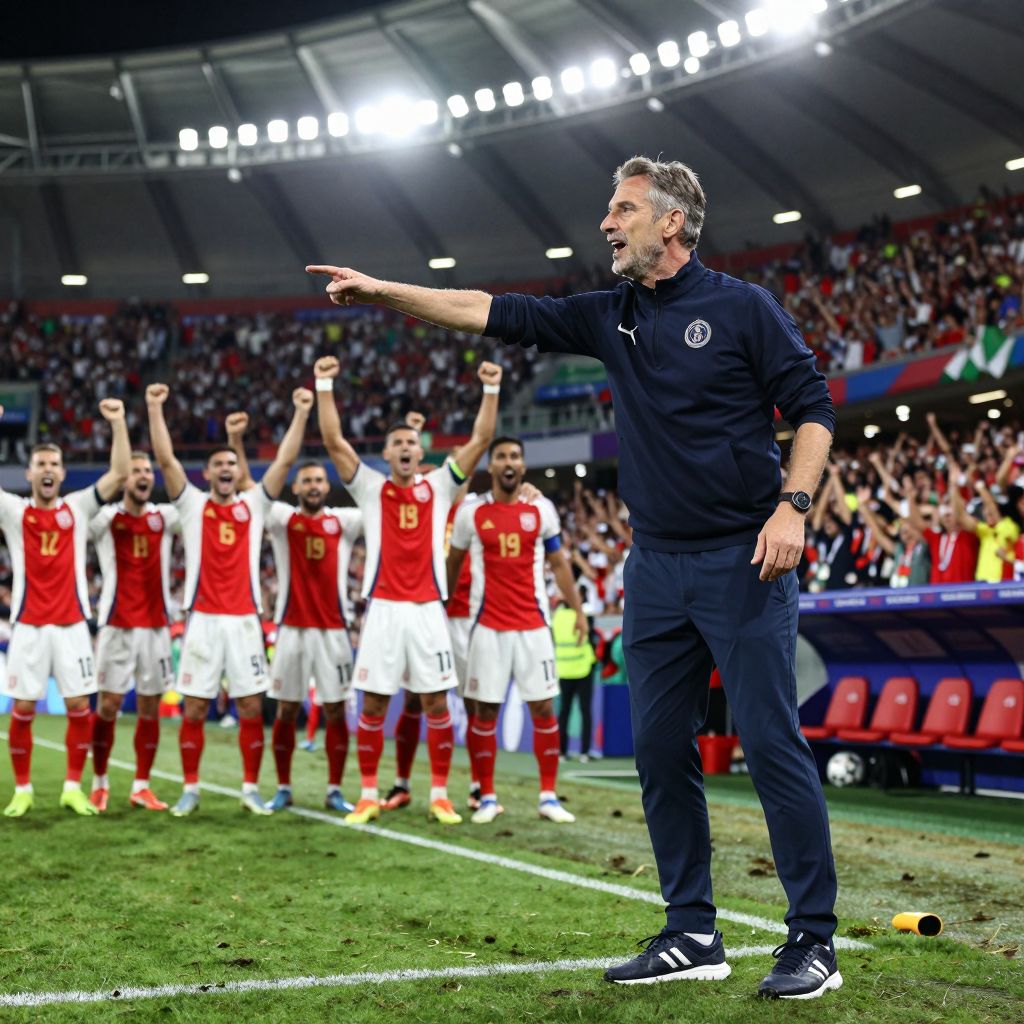
Adding to this narrative is Marsch’s leadership. The now-famous ‘locker room speech’ after the South Africa match showcased how he raised the team’s spirit before tactics even came into play—a moment that explains why locals call him a ‘hero’ in Canada.
However, for Korean fans, this story doesn’t end in awe alone. Jesse Marsch is well known as a man who once interviewed and negotiated to become South Korea’s national team coach. Ultimately, due to various factors including contract terms, the deal fell through. Naturally, the current Canadian surge stirs Korean football discourse: “Was the one we missed just a coach, or was it the very timing to embrace modern football?”
Who Canada will face in the Round of 16 and how far they advance remain unfolding stories. But one thing is certain—Jesse Marsch’s 2026 Canadian team has already proven a crucial fact: at the World Cup, history isn’t written solely by ‘strong teams,’ but also by those with a clear, defined football philosophy. And today, that philosophy bears a name: Jesse Marsch.
Jesse Marsch: Who is the American "Pressing Master"?
With his 4-4-2 formation, intense high pressing, and a connection to Korean player Hwang Hee-chan, a burning question naturally arises: "What kind of career path has this coach followed to transform Canada and stir debates among Korean fans?" At the heart of it all is Jesse Marsch.
Jesse Marsch Today: The "Modern Football" Coach Leading Canada’s National Team
Jesse Marsch, an American coach, is currently in the spotlight as the head coach of Canada’s national team for the 2026 North and Central America World Cup. He’s redefining Canada not merely as a host nation benefitting from home advantage, but as a team built on tactics and organization that generates real results.
The Core of Jesse Marsch’s Career: A High-Press DNA Proven in Europe’s Top Leagues
Jesse Marsch earned his reputation as a high-press specialist through his experience on the European stage.
Starting with Austria’s Red Bull Salzburg, moving on to Germany’s RB Leipzig, and then England’s Leeds United, he led teams playing trendy, pressing-and-transition-focused football in the intense environment of big leagues.
This career path clearly shows one thing: High pressing isn’t just a slogan—it’s a ‘system’ that requires repeated training and strategic design. Marsch is a coach who has implemented this system across various leagues.
The Hallmark of Jesse Marsch’s Tactics: 4-4-2 Plus Intense High Pressing
To summarize Marsch’s style in Canada simply: He uses a 4-4-2 base while applying strong pressure from the front.
His teams disrupt opponents’ buildup early on, swiftly regain possession, and quickly transition to create chances. It’s not passive defensive football but rather a proactive game that starts defending high up the pitch in the opponent’s half.
Jesse Marsch and Hwang Hee-chan: Why Korean Fans Find Him Familiar
Korean fans feel familiar with Jesse Marsch for a good reason. He shared a chapter with Korean forward Hwang Hee-chan during Marsch’s time at Salzburg.
Back then, Marsch coached Hwang as the Korean star proved his competitiveness on the European stage, leaving Korean football fans with the image of a coach who emphasized pressing and energetic football.
In the end, Jesse Marsch can be summed up in one sentence:
A coach who honed his pressing football in Europe’s top leagues and is now proving that philosophy through results at the national team level with Canada.
Jesse Marsch and Canada's World Cup Round of 16: The Stunning Upset Built by Innovative Football
The 6-0 blowout looked like an ‘upset,’ and the 1-0 winning goal felt like a ‘drama.’ But when these two moments are connected, the conclusion is clear. Canada’s first-ever World Cup Round of 16 appearance was not luck, but a structural transformation driven by tactics and teamwork. And at the heart of that transformation was Jesse Marsch.
6-0 Firepower, 1-0 Blueprint: The Team’s Evolution Told Through Results
The 6-0 victory against Qatar was Canada’s declaration that they were no longer a team relying on the "host nation boost." Such an overwhelming scoreline doesn’t come from the forwards’ form alone. It requires a repeated pattern of cutting the opponent’s buildup early, regaining possession, and rapidly creating goal-scoring chances.
Meanwhile, the 1-0 win against South Africa proved the opposite yet complementary point. Even without a large goal margin, Canada showed they could maintain concentration in a tight knockout match and convert a single chance in stoppage time into a winning goal. Linking these two matches reveals Canada as not just a team that’s strong on good days, but one that knows how to win according to the situation.
Jesse Marsch’s Key Prescription: Changing the Game’s Starting Point with 4-4-2 and High Pressing
The defining trait of Jesse Marsch’s Canada isn’t complex tactics but a fundamental shift in where the game is allowed to start.
- The base formation: 4-4-2
- The engine: high pressing
- The goal: simple — deny opponents the comfort of passing out from their defense, and push the ball-winning zone deep into the opponent’s half
Once this approach clicks, the game naturally flows to Canada’s desired rhythm. It’s not a defensive block sitting deep; it’s football that starts the attack the moment possession is won. In other words, it’s less about “winning by defending well” and more about “winning by making the opponent unable to attack.”
Organizational Mastery Behind the Upset: Why Canada Began to Look Like a Top Team
National teams don’t have the luxury of long training periods like clubs, so many play conservatively. Canada, however, simplified complexity with clear principles—pressure, spacing, and transition.
- Compressing the gap between the two lines to enhance pressing efficiency
- Winning second balls immediately after possession is regained
- Repeated transitions that quickly lead to shots within a short time frame
This structure builds not just the commonly mentioned “momentum,” but a persistent discomfort from pressure that opponents feel throughout the match. The explosive 6-0 win and the gritty 1-0 victory stem from the same root.
Canada’s breakthrough into the Round of 16 is fascinating not just as a historic milestone but because it proves that Jesse Marsch’s modern pressing football can work at the national team level. The big question now is: Will this energetic style continue to operate with the same precision on the Round of 16 stage?
The Twisted Fate of Jesse Marsch and Korean Football: The Spark of Controversy Ignited by “What If Marsch Had Taken Korea?”
“What if Jesse Marsch had taken charge of Korea?”
This question, currently heating up the Korean football discourse, is far from mere regret. As Jesse Marsch has proven his philosophy with tangible results (reaching the Round of 16) in Canada, the conditions are ripe for Korean fans to revisit past decisions.
Jesse Marsch Was Not Just a Rumor—He Was a Real Candidate Who Went Through Interviews for the Korean National Team
Here’s the crux: Jesse Marsch wasn’t just a name tossed around as a rumor. He was officially considered as the next head coach of Korea’s national team, with real negotiations and interviews taking place.
Yet, the final choice went in a different direction, and Marsch went on to achieve World Cup success with Canada. The timing couldn’t be more perfect, naturally funneling public opinion toward one conclusion:
- “Did we miss out on a modern coach who actually thrives at the World Cup right in front of us?”
Why the ‘Hong Myung-bo vs Jesse Marsch’ Frame Has Grown: A Clash of Tactical Philosophies
The increasing intensity of comparing these two coaches comes not from their personalities, but because their football philosophies starkly contrast each other.
The image Jesse Marsch projects is not “a team that adapts to the opponent,” but rather “a team that shakes up the opponent.” A high press, rapid transitions, and an attacking 4-4-2 base have become emblematic of his style.
On the other hand, what frustrates Korean fans usually boils down to familiar complaints:
- The team has a short time controlling possession during matches
- When facing stronger opponents, there is an unclear Plan B if the initial strategy fails
- When the direction wavers, the question “what exactly is this team trying to achieve?” becomes foggy
It is in this gap that the assumption “things would be different if Marsch were here” digs deep. Thus, the debate transcends the individual coach and turns into a question of what style Korean football should ultimately adopt.
The Trap of the Hypothetical: “Would Things Definitely Have Been Better if Marsch Had Come?”
But this “what if” scenario, as alluring as it is, carries dangers. Jesse Marsch’s high-press football is not a tactic that works by name alone.
- Pressing requires organizational cohesion,
- Cohesion depends on intense training and shared standards, and
- Maintaining those standards demands support from players’ stamina, squad composition, and the league environment.
In other words, the real core of the question “What if Marsch had led Korea?” is not about predicting results but probing deeper:
- Was Korean football ready to embrace high pressing as a core team identity?
- Even within the limited national team training periods, was there a structure capable of reproducing that intensity?
- Could the entire system—the association, league, and development pipeline—move in sync beyond just the head coach?
The Takeaway from Today’s Debate: It’s Not About the ‘Missed Coach’ but the ‘Missed Direction’
Ultimately, this debate doesn’t end as a simple showdown of “Hong Myung-bo or Jesse Marsch?”
Canada’s achievements send a powerful message to Korean fans: the formula for success in modern football increasingly leans on ‘philosophy paired with systemic execution.’
So, the Jesse Marsch issue resembles less a coach gossip and more a mirror forcibly reflecting Korean football’s choices.
And in front of that mirror, fans keep asking the same question:
- “What kind of football will we play at the next World Cup?”
The Future Message from Jesse March and the Canadian Model: Lessons Korean Football Must Learn and the Next Steps
Is Canada’s success, known as the ‘National Team Model of High Pressing,’ just a coincidence? The case of Jesse March, who led Canada to its first-ever Round of 16 in the 2026 World Cup, demonstrates that clear philosophy and execution create results far beyond the “host country boost.” This moment poses a sharper question for Korean football: What kind of football will we choose?
The Core Proven by Jesse March: ‘Style Is the System’
The essence of Canada’s transformation is not just a tactical formation (4-4-2). What Coach March created was a set of shared behavioral principles across the entire team.
- Applying intense pressing from the front to disrupt opponents’ build-up
- Immediately transitioning to create scoring opportunities upon regaining possession
- Repeating this pattern to control the rhythm of the game
Since national teams have limited training time, these simple yet powerful principles become a competitive edge. Canada’s results challenge the stereotype that “high pressing is only possible in club football.”
Lessons Korean Football Must Learn: Coach Selection is Strategy, Not Preference
The reason Jesse March’s candidacy for South Korea’s national team resurfaces is not just regret. The current instability in Korean football is less about results and more about lack of clear direction.
- Operations changing drastically depending on the opponent
- Repeated lapses in transitions between offense and defense
- Lack of alternatives revealed when the game plan fractures
Therefore, the lesson for Korea is not “who was missed” but what standards to apply. More important than a coach’s reputation is how concretely they have designed a feasible philosophy aligned with Korean players' makeup and the league environment.
The Next Step Jesse March Poses: Making High Pressing a ‘National Team Project’
If Korea wants to switch to proactive high-press football like Canada, it must become a project, not just a slogan. The following three conditions are minimum requirements:
- Standardization of Physical and Recovery Systems: High pressing isn’t just a tactic; it’s a model for managing physical fitness. Training during national team camps alone isn’t enough; shared standards with leagues and clubs are essential.
- Reprioritizing Training on Transition Phases: The first pass after a successful press, second ball retrieval, and re-pressing must be designed as a seamless set.
- Changing Player Selection Criteria: Pressing football can’t be completed with only technical players. Sprint repetition ability, coverage range, and tactical understanding need to be prioritized in player selection.
Canada’s Round of 16 is not the result of “just doing well,” but a reward earned by a team that knew exactly what it wanted to do. The path Korean football must choose now is not to follow an individual’s name but to establish the football principles that will define the next four years. The ongoing debate around Jesse March persists because, ultimately, that question remains valid.
Comments
Post a Comment