 \n
\n
Jordan vs Argentina: The First-Ever World Cup Encounter Between Jordan and Argentina
Underdogs Jordan, with zero points, face off against defending champions Argentina, who have already secured a spot in the round of 16 and top their group. On paper, the match might seem like a foregone conclusion, but what makes Jordan vs Argentina truly special is something else entirely. This game marks the very first time these two teams meet on the World Cup stage in history. It’s not just about the result, but about how that result comes to be—this is the real story behind the matchup.
This match is the final Group J showdown of the 2026 North America World Cup. Argentina enters comfortably, boasting two wins from two games (5 goals scored, none conceded), setting the stage for a smooth transition into the knockout rounds. Conversely, Jordan stands with two losses and zero points, facing the last match with nothing to lose but everything to prove. This stark contrast in circumstances actually adds layers of intrigue to the contest.
- For Argentina, this is a ‘Plan B test’—a chance to rotate players and experiment with tactics.
- For Jordan, it’s a ‘learning game’—a chance to gauge their limits and potential against the world’s elite.
In essence, this match transcends a simple win-or-lose scenario. It’s a stage where the smart rotation strategies of the powerhouse and the survival tactics of the underdog (risk management, counterattacks, set-piece focus) unfold simultaneously. More than the final scoreline, the narrative lies in how Jordan builds their defensive blocks, when they choose to push their lines forward, and how Argentina maintains control with any player combination—the very process that completes the story of their ‘first meeting.’
Jordan vs Argentina: Defending Champion Argentina’s ‘Confident Plan B’ Strategy
Having secured Group 1’s top spot early, is Argentina resting Messi on the bench? This question goes beyond simple star management—it signals how modern football has evolved to see “rest as a tactical tool.” Especially in a final group stage match like Jordan vs Argentina, where there’s a big gap in strength, this becomes a stage where the defending champion reveals just how meticulously they craft a Plan B for the knockout rounds rather than just chasing the result.
‘An Experimental 90 Minutes’ Made Possible by Early Qualification
Argentina has already secured a place in the Round of 16 and the top spot in their group. This means the last match is no longer a “must-win,” but rather a game they can afford to win, and more importantly, need to prepare for. Here, the coach’s objectives become crystal clear.
- Preserving key players’ stamina: In knockout stages, cumulative fatigue decides outcomes. Going all-out in the last group match can do more harm than good.
- Testing bench strength: As tournaments drag on, injuries and suspensions inevitably occur. Now is the perfect time to confirm whether “substitutes actually function in real game conditions.”
- Expanding tactical options (Plan B testing): It’s an opportunity to test tactical switches at match pace, such as facing a parked defense or recovering from an early deficit.
Messi Rotation Symbolizes the Era of ‘Smart Rotation’
A recurring question in previews is whether Messi will start. But the key is not simply “whether to rest Messi,” but whether the team can maintain control of the game while resting him. This is why modern powerhouse teams call rotation not just rest, but a strategy.
The features of smart rotation can be summarized as follows:
- Managing intensity: Rather than pressing full-throttle from the start, energy consumption is optimized through possession and positional discipline.
- Maintaining structure while swapping personnel: Even if players change, the team ensures that build-up routes, half-space infiltrations, and pressing triggers remain intact.
- Designing the ‘decisive 15 minutes’ in the second half: Tempo is only raised when necessary to close out the game—a method directly tied to knockout-stage management.
In a match like Jordan vs Argentina, the highest-level display from Argentina won’t be a blowout but rather the unshakable details of team management within rotation.
Why the Jordan Match Becomes a ‘Plan B’ Trial Ground
Jordan will likely adopt a low block and counterattack approach. From Argentina’s perspective, rather than focusing on a perfected Plan A, more important questions emerge.
- How to create numbers near the box against a deep defensive block
- Whether patterns that open up space through the central and half spaces work, instead of relying on wing crosses
- Whether a rotated midfield line-up can maintain pressing intensity and win second balls
In short, Jordan vs Argentina isn’t just a match where the strong team wins; it’s a game that reveals what the top team hides and what they test for the knockout rounds. More intriguing than the scoreline is the blueprint of this confident Plan B that Argentina’s composure creates.
Jordan vs. Argentina: Lessons from Zero Points — The Underdog’s Journey of Challenge and Growth
The more a loss seems inevitable, the clearer a team’s "current position" becomes. Jordan vs. Argentina serves as a test to see what the zero-point Jordan has prepared against the defending champions and what it must gain. More important than the result is one key question: What strategies reveal the state of Middle Eastern football through Jordan’s play, and which game aspects deserve focus despite the likely defeat?
What to Watch Beyond the Scoreline in Jordan vs. Argentina
Jordan is already on a losing streak in the group stage, struggling to build momentum. Their track record against South American teams also points to a disadvantage. So this match isn’t a “sure-loss” but rather a learning experience where a powerhouse sets the benchmark and Jordan diagnoses problems while compiling valuable data. What Jordan must take away isn’t points but a game structure capable of standing against tournament-level opponents.
Jordan vs. Argentina: A Realistic Match Plan for the Underdog
The most pragmatic approach Jordan can take is simple:
- Quality of the Defensive Block: Instead of blindly dropping the line, the key lies in how tightly they block spaces in front of the box, especially the half-spaces. It should not be a passive “park the bus” but a low block that maintains its shape.
- Speed of Transitions: If Jordan can't advance the ball within 3–5 seconds of winning possession, they'll be forced back into defense. Counterattacks aren’t just “fast attacks” but require rapid decision-making.
- Risk Management: Reckless buildup against a strong team spikes the chances of conceding. Jordan should minimize losses by distinguishing areas where they can relieve pressure from those where they cannot, rather than trying to exit neatly from the back.
Key Points to Track: Four Indicators to See if Jordan Has Grown
To turn this game into a ‘growth story,’ Jordan must produce the following moments:
Reduce Repeated Types of Goals Conceded
If goals keep coming from the same patterns (cutbacks, half-space penetrations, second balls), there’s no progress. If only “unavoidable goals” occur, it means the game plan worked.Defensive Discipline in the Center
Even with rotations, Argentina is likely to dominate the center. If Jordan holds the central zones, they can at least steer opponents toward the flanks, creating defenses with lower risk.A Threat from Set Pieces
The most realistic way for an underdog to unsettle a top team is through set pieces. If Jordan produces one or two “complete patterns” from corners or free kicks that lead to shots, they will gain valuable returns from this match.Maintaining Concentration Late in the Game
Strong teams often crack after the 60th minute. When a team collapses in the final 20 minutes, it’s less about stamina and more about defensive spacing and communication breaking down. If Jordan can hold their shape late, that is progress in itself.
In summary, Jordan vs. Argentina is a match to secure a benchmark, not points. The one thing Jordan must prove beyond the scoreboard is a team structure that functions even against elite opponents.
The True Tactical Duel Between Jordan and Argentina: Possession of the Strong vs. Resistance of the Underdog
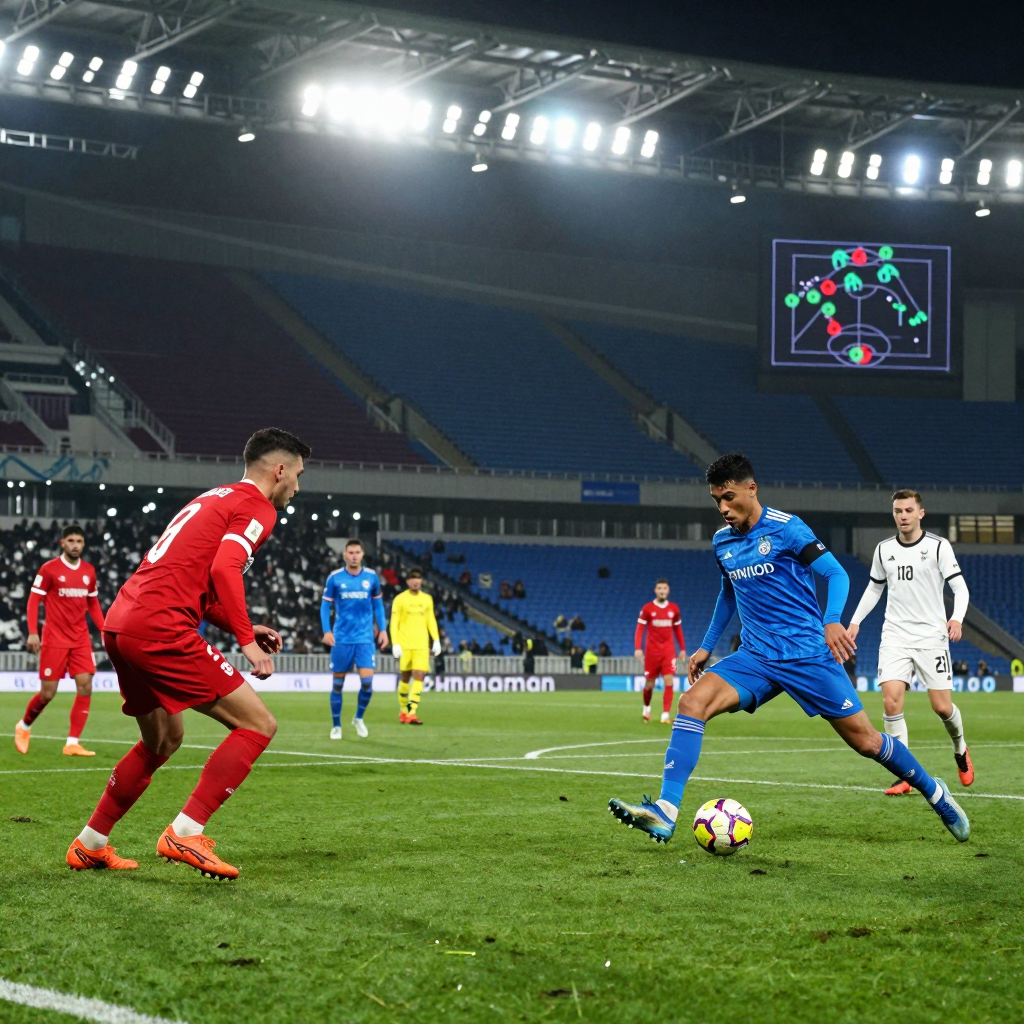
In the clash of contrasting strategies—Argentina’s dominant possession and Jordan’s low-block defense—the match between Jordan and Argentina vividly reveals how the team with the ball and the team defending without it unsettle each other in different ways. Despite the gap in strength, the game is filled with brief, intense moments that keep repeating.
Jordan vs. Argentina: The Fundamental Setup of Possession (Argentina) vs. Low Block (Jordan)
- Argentina, as the group stage frontrunner, effortlessly stretches the opponent side to side through build-up play and finishes with incisive runs into the half-spaces. Even with rotations, the overarching framework of “controlling the game through possession” is likely to remain intact.
- Jordan realistically manages risk by dropping into a low block around their penalty area, minimizing space and protecting against goals. After defensive success, they either escape with a few short passes or launch a long ball to buy time and create chances quickly.
In this setup, the key is not simply who holds the ball longer, but where the possession occurs and how each side destabilizes the opponent’s defensive block.
Jordan vs. Argentina: The Three Triggers that Ignite Intense Moments
Jordan’s First Pressing Window (The 10-Second Decision)
- If Jordan sits too deep, Argentina comfortably enters near the box.
- Conversely, applying pressure briefly around key zones (e.g., near the halfway line or wide touchlines) to disrupt Argentina’s forward passes can open counterattack opportunities.
In other words, Jordan’s “commitment pressure when stepping up” sets the game’s tension level.
Argentina’s Choice of Fixed Width vs. Half-Space Penetration
- When Jordan locks down the center tightly, Argentina faces the temptation to resolve attacks with crosses from wide areas.
- However, Jordan has more confidence in defending crosses through repetitive practice, while cutbacks and second-line runs triggered from half-spaces are far more dangerous if even the timing slips once.
Ultimately, the outcome hinges on whether Argentina settles for “circling on the outside” or pushes “sharp penetrations through the inside.”
The Second Ball Battle (How the Underdog Stays Alive)
- Low block teams don’t just hold out passively. The fight over who recovers the second ball after clearances is crucial for survival.
- If Argentina regains possession through their pressing, relentless attacks resume; if Jordan wins even a couple of second balls, they immediately launch counterattacks.
These quick exchanges accumulate, making the flow of the match surprisingly tight.
Jordan vs. Argentina: Unexpected Variables Born From Rotation
If Argentina has secured first place in the group, some rotation is a natural choice. The intriguing element here is not the rotation itself but the slight drop in cohesion and attention to detail that may grant Jordan “a single escape route.”
Jordan must translate that one opportunity into a set piece or a rapid transition to transform ‘resistance’ into a genuine ‘threat.’
In summary, the Jordan vs. Argentina matchup is not just about possession statistics but about how Argentina’s ball control morphs into “threatening possession” and how Jordan’s defense evolves from mere “resisting” into “counterattack-ready resilience.” This is a tactical showdown that reveals much more than meets the eye.
Jordan vs. Argentina: The Match Beyond Sports Content and the Future Trends of Football
Beyond just the final score, what messages does this game, showcasing data-driven tactical experiments and global media attention, convey to us? Jordan vs. Argentina is less about a single match with a clear power gap and more a condensed example of where modern football is heading.
The First Message from Jordan vs. Argentina: The Era Where “Rest is a Tactic”
Argentina, having already secured first place in their group, approaches this last match with a question far more important than winning or losing.
- Giving key players smart rest
- Deploying substitutes to pragmatically test Plan B in real-game situations
- Structuring ‘match management’ to maximize tournament performance
This approach is no longer a choice but has become the standard operational model for top teams. It’s no coincidence fans now analyze not just “who started,” but also “why a player was rested.”
The Second Message from Jordan vs. Argentina: Underdogs Survive Through Data
For Jordan, this match is less about winning or losing and more about what lessons they take from facing a powerhouse. The realistic solutions underdogs can choose in modern football are becoming clearer:
- A risk-managed defensive block to reduce scoring probabilities
- Optimizing low-probability chances from set-pieces and counter-attacks to maximize efficiency
- Focusing on tactical cost-effectiveness by targeting opponents’ least favored scenarios
In short, Jordan vs. Argentina highlights the importance of measurable goal-setting—deciding which metrics to minimize and which to maximize against strong teams—over mere narrative of “heart and soul.”
The Third Message from Jordan vs. Argentina: The Match as a Global Content Platform
The intrigue of this match goes beyond the 90 minutes of tactics. Global media uses this matchup to
- Observe the rotation experiments of the defending champions
- Record the learning curve of a Middle Eastern team facing a heavyweight
- Engage fans from other nations, reprocessing this into comparative and analytical content
Ultimately, the World Cup has evolved into an ecosystem where “match → highlights” expands into “match → data → analysis → content distribution.” Jordan vs. Argentina is perhaps the clearest example of this structure.
Conclusion: The Key Question Left by Jordan vs. Argentina
The core question this match poses is simple: How do top teams manage their ‘ways to win,’ and how do underdogs transform ‘losing games’ into assets?
No matter the scoreline, this game allows us to simultaneously read the future direction of football—strategic rotation, data-driven game plans, and the global media consumption framework.
Comments
Post a Comment