The 2026 Edge IoT Security Revolution: Key Agreement Technology for Intrusion Recovery Using Blockchain and Machine Learning
 \n
\n
A New Turning Point in IoT Edge Security: The Convergence of Blockchain and Machine Learning
By 2026, IoT security is no longer just about “adding one more strong encryption algorithm.” Especially in edge-based environments, authentication and data processing occur close to the source to minimize latency—making that exact spot the most enticing target for attackers. So, how can we implement security at the edge that operates swiftly yet remains unbroken even when breaches occur?
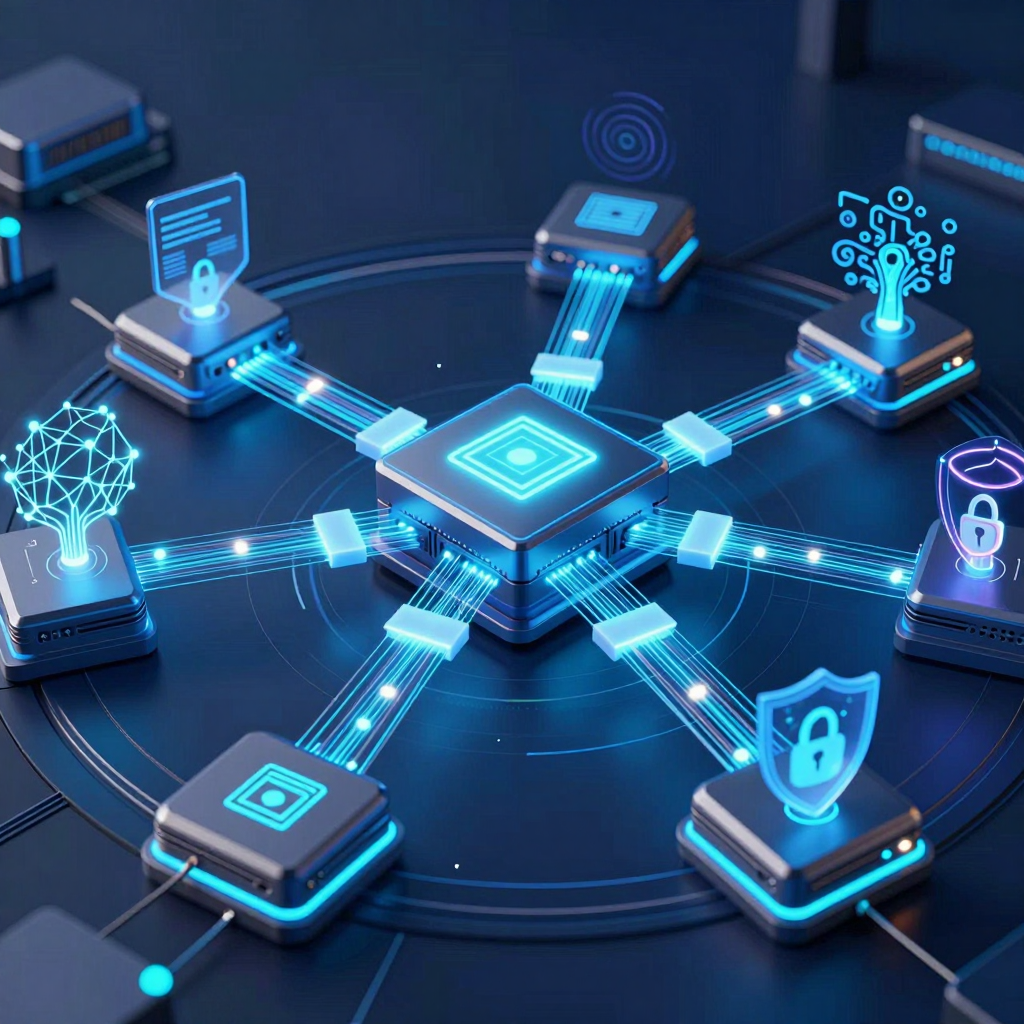
One emerging solution gaining attention is the integrated design of blockchain (decentralized trust) + machine learning (intelligent detection) + lightweight authentication and key agreement protocols, known as the “Intrusion-Resilient Authenticated Key Agreement Protocol.” The core idea is simple:
- Blockchain acts as a trust infrastructure, creating tamper-resistant audit logs recording who authenticated or agreed on keys, when, and how,
- Machine learning analyzes traffic and authentication failure patterns to detect anomalies early, and
- On top of these, a lightweight key agreement protocol securely establishes session keys between edge IoT devices and gateways (or device-to-device).
Why Is ‘Key Agreement’ the Critical Battleground in IoT Edge Environments?
Surprisingly, the most vulnerable aspect in edge IoT security is not data encryption itself but the process of mutual verification (authentication) and safely generating shared secret keys (key agreement). This challenge boils down to three reasons:
1) Resource Constraints: Many IoT sensors and actuators have limited CPU, memory, and battery capacity, making traditional heavyweight Public Key Infrastructure (PKI) unsuitable.
2) Edge-Centric Architecture Expansion: As edge servers and gateways act as hubs for authentication and analysis, the edge-to-device communication becomes a primary attack surface.
3) Attack Realities: Attacks like Man-in-the-Middle (MITM), replay, and impersonation via key theft are no longer theoretical—they are operational risks.
In essence, edge IoT security must design both the key establishment process and continuous operation under abnormal conditions.
The Triple Fusion Transforming IoT Security Architecture: Blockchain × ML × Key Agreement
The technological breakthrough here is not merely stitching these elements together but integrating the security operation flow into a unified system.
1) Building “Decentralized Trust + Immutable Audit” with Blockchain
Edge nodes (such as gateways) form a blockchain network that records summaries (hashes) of device registration data, authentication metadata, and key agreement events. This enables:
- Easy tracing of who opened which session,
- Drastically increased difficulty in forging or tampering with logs, and
- Reduced risk of a Single Point of Failure (SPoF) where the entire network halts due to a central authentication server outage.
2) Linking Machine Learning-Based “Intrusion Detection” to Protocol Operations
Machine learning-powered anomaly detection assesses network traffic, spikes in authentication failures, and abnormal retry patterns to determine attack likelihood. Crucially, detection results immediately trigger next-step actions such as:
- Session key revocation for suspicious sessions,
- Device quarantine,
- Enforced re-authentication or key re-agreement, and
- Recording risky events on the blockchain to bolster post-incident audits.
Hence, detection doesn’t stand alone but automatically drives key management and session control.
3) Creating Session Keys “Quickly and Securely at the Edge” with Lightweight Authentication and Key Agreement
The protocol performs mutual authentication, derives a session key, and protects all subsequent communication with that key. The design prioritizes the edge IoT context by minimizing computational and communication overhead while combining Nonce, timestamps, MAC, or lightweight public-key schemes to effectively prevent MITM and replay attacks.
What ‘Intrusion-Resilient’ Means: Preventing Total Collapse Even When Breached
Traditional security often focuses on “preventing intrusion.” But in industrial IoT settings, where downtime leads to substantial losses, the ability to maintain network integrity even if some nodes are compromised is vital. Intrusion-resilient key agreement aims to:
- Quickly terminate only the compromised session when intrusion signs appear,
- Keep unaffected parts running smoothly, and
- Restore a secure state through recovery procedures like re-keying or device re-registration.
Ultimately, by 2026, IoT edge security is shifting beyond just “encryption strength.” It embraces a new paradigm that combines decentralized trust (blockchain) and intelligent monitoring (machine learning) to achieve operational resilience even during attacks.
Why Are Key Agreement and Authentication the Biggest Weaknesses in IoT Security?
What happens when low-performance devices, a distributed edge architecture, and ever-evolving attacks collide in one place? Simply put, the first point of failure in IoT security is “key agreement and authentication.” No matter how strong the data encryption itself is, if the identity verification at the start of communication and the session key generation collapse, everything that follows becomes meaningless.
IoT 1) The “Realistic Limits of Cryptographic Protocols” Due to Low-Performance Devices
Many IoT sensors and actuators operate with extremely limited CPU, memory, and battery budgets. These constraints are fatal to key agreement and authentication.
- The burden of public-key operations: Traditional PKI-based mutual authentication (certificate validation, signature verification, chain verification, etc.) demands heavy computation and memory usage.
- Difficulty in generating secure random numbers: The quality of session key agreement heavily relies on randomness (Nonce/Seed), but low-cost IoT devices often struggle to secure sufficient entropy. Weak randomness greatly increases the real-world risk of breaking keys, even if the protocol is mathematically secure.
- Key storage vulnerabilities: Without secure elements (TEE/SE), keys stored in device flash memory can be easily exposed through physical attacks, firmware dumps, or exploiting vulnerabilities.
In other words, in the IoT environment, the bigger constraint is not a “theoretically secure protocol,” but a “protocol that devices can realistically implement within their resource limits.”
IoT 2) The Spread of Edge-Centric Architectures: Complicated Authentication Boundaries and Expanded Attack Surfaces
Due to latency and bandwidth issues, IoT systems are increasingly adopting structures where preliminary processing happens at edge gateways or edge servers instead of relying solely on the cloud. This shift drastically complicates authentication boundaries from a security perspective.
- Multi-layered communication paths: Key agreements are required for multiple segments—device to edge, edge to edge, edge to cloud—significantly increasing complexity.
- Explosion of session numbers: As devices multiply, the number of sessions created and renewed skyrockets, boosting the chance of key management mistakes such as reuse, expiration mishandling, or policy inconsistencies.
- Uncertain field environments: Edge nodes are often physically exposed in factories, roads, buildings, etc., allowing attackers to get closer to the network. Closer proximity makes onsite attacks like MITM, sniffing, and replay much easier.
Ultimately, IoT transforms the challenge from “securely sharing keys once” to an operational problem of continuously creating, maintaining, revoking, and reissuing secure sessions.
IoT 3) Sophistication of Attacks: It’s Not “Game Over” Once Breached—It Gets Worse After
Attacks on key agreement and authentication in IoT go far beyond simple eavesdropping. Commonly combined tactics include:
- MITM + downgrade/configuration error inducement: Forcing negotiation of weak cipher suites or bypassing authentication validation steps.
- Replay attacks: Loose verification of Nonce or timestamps allows reuse of old authentication messages to hijack sessions.
- Key compromise impersonation (KCI): Once keys leak, attackers can impersonate devices, set up fake edge nodes, and form botnets in a cascading manner.
- Large-scale automated attacks: Because many devices run the same firmware and configurations, a successful attack can rapidly propagate horizontally.
The key takeaway is that zero intrusion is nearly impossible in IoT, so designs must emphasize damage control even after breaches occur—through recovery, isolation, and forced re-key agreements.
IoT 4) Limitations of Centralized Authentication Servers: Single Points of Failure and Operational Risks
Many assume “authentication can be handled by a central server,” but this approach often hinders IoT systems.
- Single Point of Failure (SPoF): If the central authentication server fails or is attacked, the entire field site cannot establish new sessions, causing service outages—especially catastrophic for industrial IoT (smart factories, energy, transportation).
- Network segmentation/disconnection scenarios: In OT environments physically separated from the external network or with unstable onsite connectivity, central server dependence severely reduces availability.
- Scalability challenges: When tens of thousands to millions of devices simultaneously attempt re-authentication or re-keying, the server becomes a bottleneck. Performance problems can quickly become security vulnerabilities due to exceptions or bypasses.
- Difficulty in auditing and tracking: Centralized logs risk tampering or deletion; consistently reconstructing authentication events that span multiple edge segments is challenging.
Therefore, recent research and design trends are moving away from full centralization and toward distributed trust (e.g., blockchain-based auditing/consensus) and edge-level intelligent detection (ML-based anomaly analysis) to reduce “the moments when authentication and key agreement break” and enable “rapid recovery even when they do.”
The Secret Behind Strengthening IoT Security Schemes with Blockchain, Machine Learning, and Lightweight Key Agreement
How does this innovative protocol, combining distributed ledgers and AI-based intrusion detection, guarantee secure key agreement between edge IoT devices and even ensure “unstoppable” resilience after an intrusion? The key lies not in simply adding another layer of security, but in integrating trust (blockchain), surveillance (machine learning), and cryptographic protocols (lightweight authenticated key agreement) into a single system designed to defend before, during, and after an attack.
Why “Key Agreement” is the First to Fail in IoT
In edge-focused IoT environments, the number of devices like sensors and actuators explodes, and communication happens more frequently. If the process of agreeing on session keys falters, no matter how strong the encryption afterward is, it becomes meaningless.
- Devices face CPU, memory, and battery constraints that make heavy security procedures impractical.
- Because communication must minimize delays in edge-to-device and edge-to-edge links, authentication and key agreement occur often.
- Attackers repeatedly exploit the key agreement phase with classic but devastating attacks like man-in-the-middle (MITM), replay, and key compromise impersonation (KCI).
- Relying on a single central authentication server creates a single point of failure (SPoF), risking a complete halt once that node is compromised.
This scheme targets precisely this critical vulnerability by reimagining “key agreement” not just as a cryptographic step but as an operational security mechanism.
The IoT Security Trio: How Blockchain, Machine Learning, and Lightweight Key Agreement Divide the Tasks
The strength of this design lies in how each technology avoids redundant overlap by tackling distinct problems and compensating for each other’s weaknesses.
Blockchain: The “Auditable Trust Ledger” for IoT Authentication
Blockchain is not used here as a cryptocurrency mining tool but as foundational infrastructure for trust and audit management.
- It records device registration info (or its hash), authentication metadata, and events like session creation or failure in an immutable form.
- When multiple edge nodes share the same records through distributed consensus, even if one node is compromised, forging records becomes nearly impossible, and traceability is ensured.
- As a result, who opened which session and when remains logged, enabling post-incident analysis and accountability tracking.
Machine Learning: The Real-Time Watcher Detecting IoT Intrusions “by Patterns”
Machine learning (primarily anomaly and intrusion detection) addresses areas cryptography alone struggles with—detecting attacks disguised as normal traffic and behavioral deviations.
- It analyzes spikes in authentication failures, abnormal retries, changes in traffic patterns, and unusual device behaviors to classify signs of attacks.
- Crucially, detection triggers immediate recovery actions, such as forcibly terminating suspicious sessions, demanding key renegotiation, quarantining devices, or blacklisting offenders.
Lightweight Authenticated Key Agreement: The “Protocol Engine” IoT Devices Can Handle
Finally, the actual communication security rests on lightweight authenticated key agreement.
- Devices and edges (or device-to-device) exchange nonces, MACs, and signatures to perform mutual authentication.
- They derive session keys from the agreed secret values to encrypt subsequent data traffic.
- The core principle is “lightweight”: if the protocol is too heavy for edge IoT realities, security remains theoretical, never practical.
The Decisive Difference Making It “Intrusion-Resilient”: Linking Detection and Key Management
Most IoT security systems operate IDS/IPS and key management separately, a gap attackers exploit. This scheme reduces that divide by designing a seamless flow of detection → action → logging.
- Key agreement underway: Devices establish sessions with edges and agree on keys
- Anomaly detection: ML identifies abnormal behavior
- Recovery actions: Sessions terminate, reauthentication and key renegotiation enforce, affected devices quarantine
- Blockchain evidence logging: Events are recorded for prevention and audit
In other words, it’s not “once compromised, game over.” At the moment suspicion arises, the system reconstructs keys and sessions to minimize damage propagation. This is the essence of what the paper defines as intrusion-resilient.
Expected Benefits in IoT Deployment (and Realistic Checkpoints)
- Benefits: Distributed trust less prone to central server failures, rapid key resets triggered by attack signs, enhanced event traceability
- Checkpoints: Blockchain consensus and storage overhead, ML false positives/negatives costs, edge resource allocation, integration complexity with industrial protocols
Ultimately, this approach goes beyond “strengthening cryptographic algorithms” by weaving security into a system that embraces the edge IoT’s operational realities—availability, latency, and distribution. This is why it is gaining particular attention in IoT security design from 2026 onward.
Intrusion-Resilient Authentication Key Agreement Process Explored Through an IoT Operation Scenario
Let’s follow, in chronological order, what actually happens in an edge IoT environment from device registration → authentication & key agreement → intrusion detection → recovery (isolation & re-key agreement). The key point is that it’s designed not just to block attacks, but to keep the service running even if an intrusion occurs—making it resilient.
IoT Step 1) Device Registration: Anchoring “Who’s on Our Side” in the Blockchain
Goal: To create a tamper-resistant reference point so that newly introduced IoT devices can be trusted in future communications.
- When a new sensor or actuator (device D) is installed in the field, the gateway or edge node (E) carries out a registration process.
- The registered information typically includes:
- Device identifier (ID)
- Initial trust materials (e.g., initial shared secret, public key fingerprint, authentication metadata)
- Policy information (allowed functions, communication targets, update cycles, etc.)
- The crucial point is that instead of uploading the entire plaintext registration data, the blockchain usually records:
- The hash of the registration data,
- Metadata necessary for authentication,
- Event logs for future auditing
to ensure integrity (unchanged data) and traceability (when and who registered it).
Why is this linked to intrusion resilience?
Even if an attacker compromises a node, the “normal registration baseline” remains on the distributed ledger, making it easier to filter out forged identities during authentication and to quickly backtrack who was abnormal and when after an incident.
IoT Step 2) Mutual Authentication + Session Key Agreement: Creating a “Safe Secret Key at This Moment”
Goal: When device D and edge node E start communicating, they perform mutual authentication and agree on a session key to ensure security even if a third party tries to interfere.
Simplified operational flow:
Session Start Request
- D sends a connection request to E.
- Usually, D sends a nonce, timestamp, and its authentication value (MAC/signature, etc.) along with the request.
Mutual Authentication (Verifying Each Other)
- E consults the blockchain (or blockchain-stored verification data) to check whether “This device ID is registered” and “Metadata matches.”
- Simultaneously, E sends its own nonce/authentication value to D to prove that it genuinely is the edge node.
- The nonce and timestamp are core mechanisms against replay attacks—simply replaying old messages fails due to time/nonce mismatch.
Session Key Derivation
- Once authentication succeeds, both derive the session key K_session based on exchanged nonces and agreed secret values.
- This session key protects confidentiality and integrity of subsequent data traffic.
- The design favors lightweight key agreement schemes (e.g., ECC-based variants) to suit IoT’s resource constraints, acknowledging that heavy PKI is impractical.
Blockchain Logs a “Session Summary”
- Instead of logging all packets, summary events like the following are recorded:
- Session creation/termination
- Session identifier, time, participants
- Failure/error codes (policy violations, authentication failures, etc.)
- This enables audits that can reconstruct patterns—e.g., identifying periods with a surge in authentication failures.
- Instead of logging all packets, summary events like the following are recorded:
IoT Step 3) ML-Based Intrusion Detection: Catching Suspicious Behavior Even If Key Agreement Succeeds
Goal: Even if cryptographic protocols run perfectly, attackers might exploit other angles—so additional behavior-based anomaly detection is needed.
Machine learning observes patterns like:
- Sudden spikes in authentication failures or repeated retries by specific IDs
- Unusual traffic volume, frequency, or packet characteristics
- “Impossible movements” or simultaneous connections from the same device (depending on the environment)
- Abnormal session creation patterns across edges
In other words, this system monitors not only “Are the cryptographic messages valid?” but also suspicious operational flows. Even if attackers temporarily steal key material or insiders disguise as legitimate nodes, disrupted behavior patterns help reveal them.
IoT Step 4) Intrusion Resilience: Immediate “Partial Isolation + Re-Key Agreement” to Localize Damage Upon Detection
Goal: When an attack is detected, the entire network doesn’t halt—only the affected parts are rapidly blocked and recovered.
If ML flags a high intrusion probability, the system can carry out these recovery actions:
Session Key Revocation and Forced Re-Key Agreement
- Immediately discard the suspicious session’s K_session and initiate a fresh key agreement with new nonces.
- Even if attackers know old session keys, switching to a new session invalidates their access.
Device/Session Quarantine
- Isolate specific device IDs or edge ports to prevent spread.
- Crucially, this policy allows isolating only suspicious sections without shutting down the entire factory or city IoT.
Security Event Recording on the Blockchain
- Events like isolation, key renewal, or blacklist updates are logged, enabling:
- Instant sharing of causes among distributed edge nodes on-site
- Easier post-incident attack timeline reconstruction
- Thanks to the ledger’s consensus mechanisms, even if some nodes are compromised, it’s extremely hard to tamper with the entire record—forming the basis of “resilience.”
IoT Step 5) Why the Network Doesn’t Collapse Even If Attackers Get In
The secret this approach pursues is simple:
- Blockchain: Distributes trust criteria and security events to reduce single points of failure and manipulation.
- Machine Learning: Detects anomalies early from an operational pattern perspective, even when cryptographic checks pass.
- Key Agreement Protocol: Generates keys per session and is designed for rapid revocation and renewal whenever issues arise.
As a result, assuming intrusions can occur, the loop of detection (ML) → recording (blockchain) → blocking & re-keying (protocol) continuously runs, maintaining the IoT environment’s most critical goal: availability (no downtime).
Innovative Impact and Practical Challenges of IoT in Future Industrial Sites
In environments like smart factories, smart cities, and medical IoT—where “stopping means losing”—security is not simply about defense but about operational continuity (Resilience). This is why the Intrusion-Resilient Authenticated Key Agreement scheme that combines blockchain and machine learning (ML) is gaining attention. Instead of aiming to completely prevent intrusions, IoT security is redesigned to quickly terminate (invalidate) compromised sessions, enforce re-key agreements, and keep unaffected areas running even after an intrusion occurs.
How “Security Innovations” Differ by IoT Industry
Smart Factory (IIoT): Security Operations That Keep the Entire Line Running
Smart factories connect sensors, robots, PLCs, and edge gateways densely; a compromise at one point quickly causes production disruption. The industrial value of intrusion-resilient key agreements crystallizes as follows:
- Embedding intrusion detection → session invalidation → re-authentication/re-key agreement into security protocol workflows
Traditionally, IDS/IPS systems just “detect,” and key management is handled by separate systems. This structure directly links detection results to communication key renewal and isolation policies, significantly limiting damage spread. - Strengthening OT environment accountability through blockchain-based auditing
Key events like “who opened which session on what device and when” are recorded immutably, easing incident investigations and compliance responses. - Optimization for edge-centered operations
Many factory environments find cloud round-trip latency burdensome. Performing authentication, key agreements, and detection at the edge reduces delay while maintaining security control.
Smart City/Urban Infrastructure: Structures That Delay Trust Collapse in Distributed Environments
Smart cities resemble a “federation” connecting numerous IoT subsystems such as traffic, energy, and public safety. The dangerous points here are single points of failure (SPoF) like central authentication servers or sole control nodes.
- Reducing central dependency with decentralized trust (blockchain)
Even if some nodes are compromised, consensus-based records and shared logs can prevent total trust collapse. - Stronger surveillance systems against attacks like retransmission or session reuse targeting transportation and metering infrastructure
Session summary information is recorded, and abnormal patterns detected through ML allow operators to identify “quiet repeated” (slow) attacks faster.
Medical IoT: A Field Demanding Both Quarantine and Continuity
Medical environments face long device replacement cycles, limited patching, and above all, patient safety as a priority.
- Only devices showing intrusion signs have their sessions severed and isolated, while others continue operating uninterrupted.
- Blockchain-based event logs preserve change histories like “who blocked communication on which device when,” aiding post-incident verification during response.
Practical Limitations Faced When Implementing IoT Security: What Is the Hardest?
1) Resource Constraints: Who Bears the “Operational Costs” of Blockchain and ML?
Many real-world IoT devices are ultra-small and low-power, making direct blockchain maintenance or ML inference difficult. Designs typically include these layers:
- Devices (Sensors/Actuators): Perform lightweight authentication and key agreement (minimizing computing and memory)
- Edge/Gateways: Conduct ML-based anomaly detection, enforce policies (isolation/re-keying), interface with blockchain
- Blockchain nodes: Mostly edge/server-level equipment running private chains or consortium chains
The core challenge is not “every node runs blockchain,” but rather concentrating blockchain and ML burdens at the edge while controlling bottlenecks.
2) ML Reliability: False Positives/Negatives Translate Directly Into Operational Risks
Within intrusion-resilient structures, ML triggers potent actions like session termination and isolation, not just monitoring, raising immediate practical concerns:
- False Positives: Isolating legitimate devices could halt production, medical treatment, or services
- False Negatives: Undetected attacks prevent the “recovery” logic from activating, sharply reducing security effectiveness
Thus, ML models must be paired with policy design reflecting field operations (e.g., staged blocking, re-authentication priority, risk score-based actions), not just accuracy.
3) Blockchain Design Choices: Consensus Algorithms Bring Delays and Costs
In edge environments, heavy consensus protocols like public blockchains are impractical—typically, private or consortium chains with lightweight consensus (PBFT variants, PoA, etc.) are considered. The trade-offs are clear:
- Stronger consensus improves tamper resistance but increases latency and operation costs
- Lighter consensus boosts performance but may weaken the trust model
Hence, record-keeping strategies (on-chain vs. off-chain data separation)—deciding which events to store on-chain and which off-chain—become key variables in practical implementations.
Strategies to Overcome Challenges in Practical IoT Deployment: “Start Small and Prove via Operation”
- Edge-first architecture: Keep lightweight key agreement at devices; place ML and blockchain burden on edges to separate loads
- Standardize policy-based recovery scenarios: Prioritize and automate measures like isolation, re-key agreement, re-registration, and blacklisting
- Do not rely solely on ML as a decision-maker: Combine risk scoring with rule-based checks (e.g., authentication failure rate, nonce reuse, timestamp anomalies) to reduce false positive costs
- Minimize on-chain data: Record only hashed summaries of personal or large-volume logs to manage performance and regulatory risks simultaneously
Ultimately, the message from this scheme is clear. The battleground for future industrial IoT security is not just “strong cryptography,” but the realistic, cost-effective realization of key management and operational frameworks that keep systems running despite intrusions.
Comments
Post a Comment