The Greatest Reformist Intellectual of Joseon: Yeonam Park Ji-won - From Nuknang Diary to Northern Learning Thought
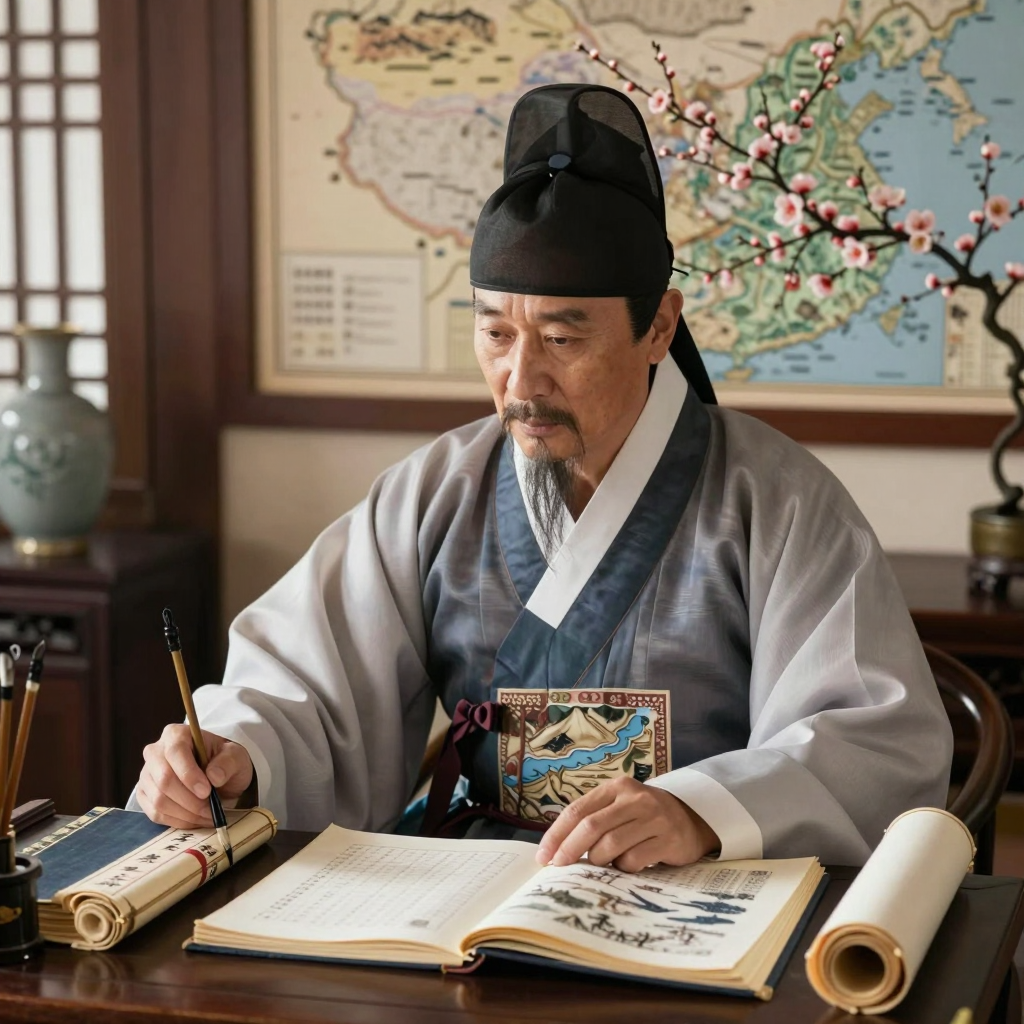 \n
\n
Park Ji-won: The Hidden Story of Yeonam Park Ji-won, an Innovator of Late Joseon
In 18th-century Joseon, amid a rapidly changing society, how did a scholar who repeatedly failed the civil service exams transform into a thinker who reshaped Joseon’s future? The answer lies in the choice of Yeonam (燕巖) Park Ji-won. He turned his “failure in officialdom” not into life’s downfall but into the very starting point of a deeper and clearer understanding of reality.
At that time, Joseon seemed outwardly entrenched in the Confucian order, yet internally, changes like the growth of commerce, the expansion of distribution networks, and cracks in the class system were already underway. Nonetheless, many in the ruling class clung to the disdainful notion of Qing (淸), refusing to properly recognize new civilizations and technologies. It is precisely here that Park Ji-won posed a unique question: “Setting aside emotions and ideologies for a moment, what must Joseon learn to survive?”
What made Park unique was that he did not stop at mere “criticism.” His embrace of Buk-hak (北學), the study of the North, involved observing Qing’s advanced technologies, urban management, and commercial systems, and integrating them into Joseon’s reality—a mindset akin to today’s “pragmatism that prioritizes practical results and people’s livelihoods over ideology.” He warned against scholarship becoming mere moral slogans and championed ’Yong-yong Huseong (利用厚生)’—practices that genuinely enrich the lives of the people.
Even more fascinating is that Park conveyed these ideas not through dry, academic papers but through engaging, readable works. His travelogue, “Yeolha Ilgi (The Jehol Diary),” went beyond a simple travel record to become a mirror reflecting Joseon’s problems, while works like “Heosaengjeon” and “Yangbanjeon” used satire and humor to expose the contradictions of institutions and class in language accessible to the public. In other words, Park Ji-won was an intellectual who not only crafted ideas but also designed ways to spread them.
The key takeaway from this section is clear: Park Ji-won’s failure was not a break but a transformation. From a scholar obsessed with the past, he became a thinker who observed the world, questioned institutions, and sought paths grounded in reality. The innovation of late Joseon did not start with grand slogans but with one person’s relentless questioning.
Park Ji-won’s ‘Northern Learning Thought’ and the Age of Innovation: The Civilization Gap Between Qing China and Joseon
Why did Park Ji-won go beyond merely looking down on the Qing as ‘barbarians’ and instead argue that their civilization should be learned from? The answer lies not in simple “pro-Qing” sentiment, but in a survival strategy born from an accurate diagnosis of Joseon’s reality. He transcended walls of emotion and ideology to view the glaring gap before him as a matter of civilization and systems.
The Limits of Joseon Through Park Ji-won’s Eyes: The Stagnation Born from ‘Little China’ Pride
In the 18th century, Joseon outwardly appeared to have a firm Neo-Confucian order, but inside, changes had already begun. Commerce and distribution were expanding, the flow of money was active, and cracks in the social hierarchy were being felt. The problem was that the ruling class’s perspective remained bound to the ‘Little China’ mindset that “Qing is barbaric, Joseon is civilized.”
Park Ji-won saw this attitude not as mere pride, but as an intellectual blockade that hindered real reform. The moment Joseon rejected technology and institutions not just because they disliked the Qing, but because they deemed them ‘barbarians,’ it closed the door on its own chances for development.
The Core of Park Ji-won’s Northern Learning Thought: Pragmatism to ‘Learn and Win’
Park Ji-won’s Northern Learning Thought can be summarized as follows:
- Not to praise Qing blindly, but to analyze Qing’s advanced technology, commerce, urban management, and institutions
- To acknowledge Joseon’s backwardness and transform this understanding into practical methods to improve people’s livelihoods (utilizing wealth for the people)
In other words, Northern Learning was not cultural surrender but policy-oriented learning. It shifted the core of thinking from debating “barbarian or not” to asking, “What actually sustains the people?” This shift in perspective itself was radical for Joseon society at the time.
The Civilization Gap Park Ji-won Experienced: Records of ‘Observation’ not Just ‘Travel’
The records Park Ji-won wrote after personally witnessing Qing (notably The Jehol Diary) were far from mere travelogues. He discerned the operational systems from Qing’s cities, markets, transportation, and distribution methods.
- How goods gather and flow
- How technology and production change everyday life
- How administration and commerce drive urban dynamics
All these, when compared to Joseon’s reality, revealed the gap not as a matter of ‘national prestige,’ but as differences in structure and operation. Park Ji-won urged learning precisely this structure. The key was not awe, but extracting imitable elements and translating them into Joseon-style reforms.
What Park Ji-won’s Proposal Shook: Not Ideology, but the ‘Way of Seeing Reality’
Park Ji-won’s Northern Learning directly shook the worldview familiar to the contemporary ruling class. The disdain for Qing was not just emotional—it functioned as a logic to preserve Joseon’s legitimacy. Yet Park Ji-won implicitly asked:
“While talking about legitimacy, who takes responsibility for the people’s lives?”
This question is uncomfortable but immensely powerful. Ultimately, Park Ji-won’s Northern Learning was the courage to face reality head-on, the language of innovation Joseon needed to move forward.
Park Ji-won’s “Yeolha Ilgi”: A Diagnostic Report on Joseon Civilization Beyond a Travelogue
Would you believe if I told you his travelogue was more than a mere record, but an insightful report on the civilizational gap between Joseon and Qing? Park Ji-won’s Yeolha Ilgi relentlessly asks not “Where did I go?” but “What was different, and why?” The appreciation of landscapes or the charm of travel writing remains superficial, while its core lies in a civilizational analysis that candidly exposes realities Joseon society chose to ignore.
What Park Ji-won Saw in Yeolha Ilgi: ‘Progress’ Is Not Technology but Systems
As Park Ji-won observed Qing’s cities, markets, transportation, and distribution, he did not consume their ‘advancement’ with mere admiration. Instead, he reframed it with these probing questions:
- Why do goods move faster, more abundantly, and more reliably?
- Why do markets grow, artisans increase, and trade become denser?
- Why do administration and living infrastructure seamlessly blend into everyday life?
Thanks to this perspective, Yeolha Ilgi moves beyond a travelogue to reveal structural differences combining economy, technology, institutions, and urban culture. In other words, the gap diagnosed by Park Ji-won was not because “people were lazy,” but because “the system was fundamentally different.”
The Message of Park Ji-won’s Yeolha Ilgi: Judge by Utility, Not Emotions
Many contemporary Joseon intellectuals were trapped in a Sinocentric mindset, branding Qing as ‘barbarians.’ Yet Park Ji-won put aside likes, dislikes, and pride, evaluating civilization by the standard of whether it enriches the lives of the people (utilitarian benefit).
The repeated conclusion throughout Yeolha Ilgi is simple:
- You may resent them, but you must learn from them.
- Righteousness that cannot change reality ultimately rings hollow.
This realism closely resembles today’s pragmatism, prioritizing results and life improvement over ideology.
Why Yeolha Ilgi Still Resonates Today: It Is Not a Critique of Joseon
Yeolha Ilgi is not a book to disparage Joseon. Rather, it reads like a proposal to broaden Joseon’s choices for survival and progress. Park Ji-won does not say “Let’s imitate Qing,” but “Let’s acknowledge a changed world and absorb it in our own way.”
Thus, this book is not merely a travelogue from the past but remains a present-tense text posing an age-old question—“What do we deliberately choose to overlook even when we see it?”
Park Ji-won: The Fusion of Satire and Realistic Reform in Yeonam's Literary World
If you read "Heo Saeng-jeon" and "Yangban-jeon" merely as "entertaining satirical novels," you easily miss the sharp questions posed by Yeonam Park Ji-won. These works wield laughter as a weapon, but their target is unmistakable: Why does Joseon’s economy fail to circulate? Why does social status become fixed regardless of productivity? And why does reform repeatedly go nowhere?
Park Ji-won’s Satire: Making People Laugh While Piercing the System
Park Ji-won’s literature does not stop at mocking individual moral flaws. While characters are exaggerated and situations extreme, that exaggeration serves to illuminate reality more vividly. Readers laugh, then suddenly realize: “The problem is not individuals, but the way this society functions.”
Park Ji-won’s Heo Saeng-jeon: The Problem Was the ‘Structure,’ Not ‘Money’
Heo Saeng-jeon may seem like the tale of an eccentric economic experiment by one man, but its core lies in exposing the bottlenecks of Joseon’s economy.
- Neglect of Commerce and Distribution: Even if goods exist, wealth does not accumulate if they do not "circulate." Through Heo Saeng’s trade and distribution, Park Ji-won mocks Joseon’s overemphasis on production while suppressing the flow of markets, logistics, and information.
- An Outdated View of Capital: The ability to move money is considered a “lowly” task, yet society pays the price with stagnation. This satire does not merely praise merchants—it targets the culture of disdain for the skills that make the economy function.
- The Irony of Reform: Heo Saeng’s talent is extraordinary, but when his experiment fails to translate into systemic change, Park Ji-won states: Individual genius alone cannot transform a system.
Park Ji-won’s Yangban-jeon: Exposing the Poverty of ‘Productivity,’ Not Just ‘Status’
In Yangban-jeon, Park Ji-won does not depict the yangban as simply “bad people.” The scarier point is that the yangban are portrayed as a device where privilege is reproduced without effort.
- A Class With Rights but No Responsibilities: When a structure rewards without production, society’s momentum inevitably declines.
- The Art of Masking Reality with Words of Justification: The yangban talk of dignity and morality, but those words become a ‘wrapping’ that conceals real inefficiency. Park Ji-won’s satire strikes this very point—a society where language overwhelms reality.
- Satirizing the Limits of Reform: The absurd scenario of buying and selling yangban is funny yet coldly realistic. If the system creates people, then changing the people alone leaves the system untouched—a paradox starkly revealed.
The Conditions of Reform According to Park Ji-won: The Unease Left After “Laughter”
These works remain relevant because their conclusions are far from sweet. Park Ji-won offers no simple “This is how to fix it” prescription. Instead, he asks:
- What must change for the economy to circulate?
- By what logic are privileges justified?
- Why does reform so often remain a personal plan?
Park Ji-won’s satire does not merely give readers momentary satisfaction. What remains at the end is not laughter but the discomfort that forces a confrontation with reality—and it is precisely here that Yeonam’s literature becomes not just “satire” but a discourse on “reform.”
Park Ji-won Today: Lessons from a Pragmatic Intellect and Policy Maker
As the pace of change accelerates, society easily divides into two camps. It wavers between the conviction that “our way is right” and the resignation that “it’s already too late.” In such times, one attitude Park Ji-won—also known as Yeonam—espoused is surprisingly relevant today: “Let’s learn what we can.” His approach to Northern learning wasn’t mere blind emulation but a practical inquiry that momentarily set aside emotions and ideology to observe the technologies, institutions, and markets that actually work, asking “What should we bring here, and how should we adapt it?”
Park Ji-won’s First Message: Separate ‘Resistance’ from ‘Learning’
Yeonam was no stranger to the contemporary sentiments toward Qing—scorn and resentment included. Yet he keenly understood that when emotion swallows policy judgment, society stagnates.
Put in today’s terms: regardless of likes or dislikes toward certain countries, industries, or technologies, one must coolly analyze and absorb proven systems. Because in global competition, the problem stops being “who’s right?” and becomes “what actually works?”
Park Ji-won’s Second Message: ‘Functioning Reforms’ That Deepen People’s Lives
Park Ji-won’s idea of 利用厚生 (use and welfare) aligns more with reforms that genuinely transform daily life than grand slogans. Without fundamental shifts in production, distribution, and transportation, moral debates remain just that—debates. This critique still rings true.
The same goes for policy: goals must be clear (focusing on people’s livelihood), means must be concrete (technology and institutions), and outcomes must be verifiable (efficiency and results). This is why Yeonam’s writings resonate again in today’s policy discourse.
Park Ji-won’s Third Message: Balancing ‘On-the-Ground Sensitivity’ with ‘Rational Distance’
While Yeonam valued careful observation, he warned against being swept away by sensory impressions. As seen in Il Yangudo Haegi (A Record of a Night’s Rambles), when information and impressions overflow, what’s needed most is the ability to distance oneself for rational judgment.
In an age when data, public opinion, and imagery easily outpace policy, Park Ji-won’s lesson is clear: scrutinize the field meticulously, but draw conclusions with calm reason. Reforms are completed not by the speed of emotions but by the precision of design and execution.
Park Ji-won’s Final Takeaway: “Change Is a Matter of Design, Not Fear”
Yeonam Park Ji-won did not perceive foreign civilizations solely as threats to identity. Rather, he saw them as resources for learning, aiming to translate Joseon’s internal structural issues into the language of design and execution.
His message is simple: in an era when global competition and internal disparities widen simultaneously, what’s needed is not slogans but pragmatism that works, and the perseverance to reform reality by changing both the field and institutions together.
Comments
Post a Comment