 \n
\n
The ‘Missing Box’ Incident That Shook Confidence in the Ballot Box
What happens if, during one local election, there is a shortage of ballots, followed by a controversy over the disappearance of a ballot storage box?
The answer is simple. Regardless of the outcome, trust in the election is shaken first. And the moment trust falters, democracy fractures far faster than the numbers might suggest.
The case from Jamsil 7-dong, Songpa-gu, Seoul, in the June 3 local election shows exactly where that crack begins. On election day, voters could not cast their ballots properly due to a shortage of ballots at the polling station, and later, in an effort to preserve evidence, a court-sealed ballot storage box vanished during transport. Although the problem started not with the ballot box itself but with an auxiliary container, its impact was even greater. This is because what matters in an election is not just the result but the assurance that the entire process leading to that result can be verified.
Here, the issue is not about “just one box.”
- The question of why ballots ran short demands scrutiny: was it a simple administrative error, or a systemic flaw?
- If a storage box that could offer physical clues to uncovering that cause disappeared during evidence preservation procedures, the problem instantly escalates from ‘poor management’ to ‘distrust in the process.’
- That distrust immediately fuels a bigger question: “Then, was the ballot box itself really secure?”
When the election commission explains that “unlike ballot boxes, storage boxes are not legally required to be preserved,” many citizens are likely to hear beyond legal technicalities as:
“This was an important item, yet there was no responsible system to trace it.”
Elections must ultimately operate as a technology that dispels doubt. Mechanisms like seals, handover and receipt records, and the presence of observers exist for precisely that reason. But in this case, before any of these safeguards could thoroughly function, the simple phrase “it disappeared” shattered all explanations.
Thus, the biggest question left behind by this incident is this:
Are we truly managing the entire ‘election logistics’ process—before and after votes enter the ballot box—with full transparency?
Until we answer that question, future elections could become battlefields not because of the results, but because of doubts about the process itself.
The Ballot Box: The Ultimate Testament to Trust in Democracy
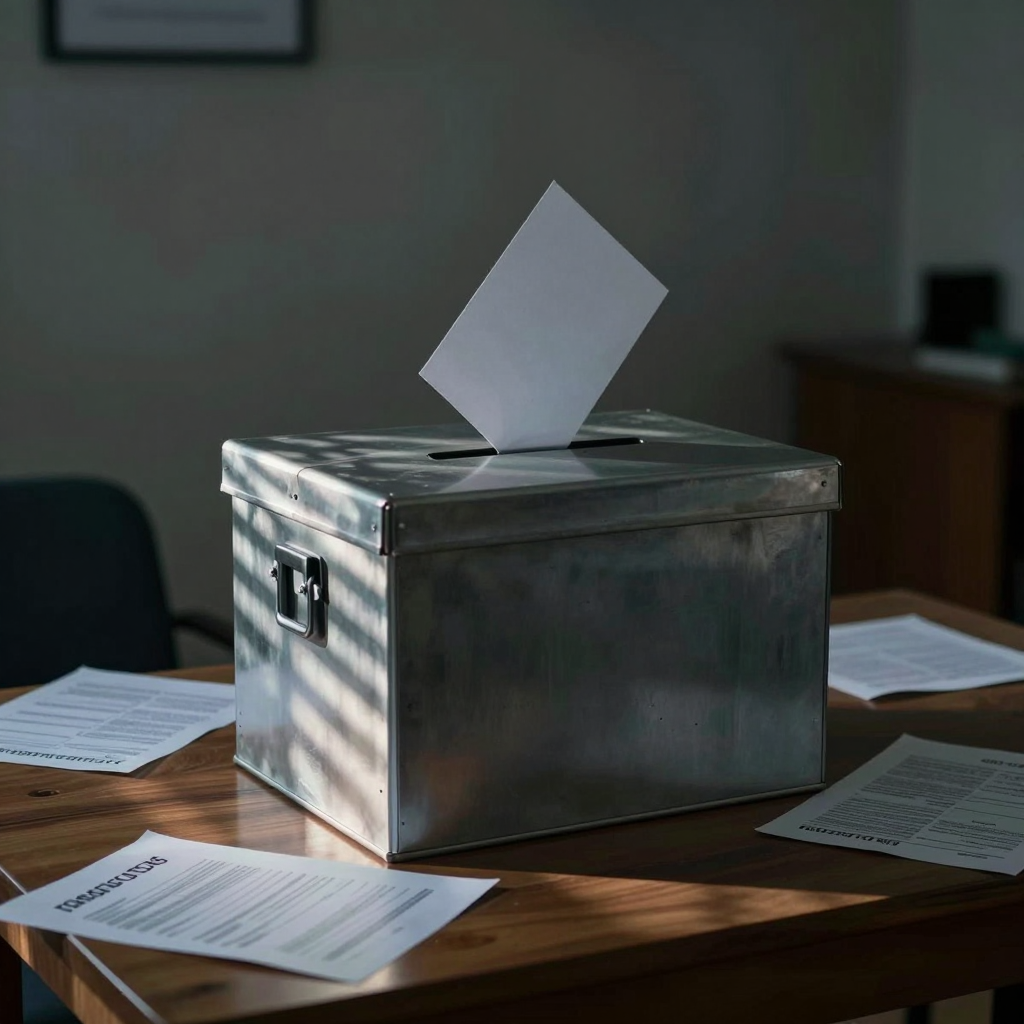
The ballot box is not just a simple container; it is a core democratic device that guarantees the secrecy and fairness of voters. But how well do we truly understand its importance? On election day, the final ‘box’ we face actually holds the sum total of a society’s trust in the election process.
The voting process may seem brief and straightforward: verifying identity, receiving a ballot, marking a choice, and finally placing the ballot into the ballot box. Yet this last step is far from a mere action—it is the moment when democracy’s two fundamental principles come together.
- Completion of the secret ballot: From the instant the ballot enters the box, “who voted for whom” is fundamentally separated. This creates a system in which an individual’s political choice cannot be traced.
- Basis of fairness (trust): Voters participate believing that “their vote will not be lost or altered and will be counted according to the established procedure.” The ballot box physically upholds that trust.
For election management, the ballot box is not just a ‘symbol’ but a control point. Worldwide, ballot boxes are accompanied by similar security measures such as seals, unique identification numbers, handover records, observers overseeing procedures, and chain of custody tracking. The more detailed these safeguards, the greater the inherent trust in the difficulty of tampering.
The controversies over ballot shortages and storage box issues in the recent local elections ironically compel us to reconsider what is essential. The trust in elections is not a grand slogan—it ultimately hinges on the ‘operational details at the polling site,’ including the ballot box itself. Democracy is sustained not by institutions alone but must be visibly secure in ways voters can accept and see with their own eyes.
The Subtle Legal Status and Controversy of the ‘Ballot Storage Box’ Viewed Alongside the Ballot Box
If a single item managed without a legal storage obligation shakes the entire trust in an election, what flaws does this reveal in our election system? The core of this controversy did not actually start with the ballot box itself, but with the ballot storage box—once considered a mere ‘peripheral’ item. And the moment that periphery wavered, the heart of the election wobbled together.
A Box That Isn’t a Ballot Box Yet Serves as ‘Evidence’
The ‘ballot storage box’ usually holds ballots printed and stored prior to election day. Unlike the ballot box, which contains ballots cast by voters, this box belongs to the elections’ preparatory and logistical phase, not its actual execution.
The reason this box suddenly gained importance in this case is simple.
To trace the cause of the ballot shortage crisis, one needs information such as “how many ballots were initially printed, where and how they were distributed, and whether there are signs of additional printing, dispatch, or returns.” Such clues may remain as physical traces. This is why the court designated this box as an object for evidence preservation.
The Gap: “Ballot Boxes Are Obligatory to Manage, Boxes Are Not”
The core position from the election commission can be summarized as follows:
- Ballot boxes have relatively strict legal frameworks and procedures for sealing, transportation, and storage.
- In contrast, ballot storage boxes are not explicitly subject to legal storage obligations and are not necessarily regarded as records that agencies must ‘mandatorily’ preserve.
Here lies the problem. Because the law does not explicitly mandate their management, in practice, the intensity of recording and accountability can sharply decrease. What happens then?
- The movement and storage paths of items (who moved them, when, where, and why) become lax;
- If disputes occur, “physical evidence that should have originally remained” can disappear without clear explanation;
- Ultimately, only claims that ‘procedures were followed’ remain, leaving very weak means to verify trust.
An election must be verifiable not only in results but also throughout the process to arrive at those results. If the ballot box is the symbol of this, then the ballot storage box acts as the invisible underlying structure supporting that symbol.
The Crux of the Controversy: Not Storage Obligation, but Designing Trust
This case is not simply an administrative mishap of “one missing box,” but raises questions about how election trust is designed.
- What criteria legally distinguish between ‘important items’ and ‘non-essential items’?
- To what extent should traces in the logistical phases, which can impact elections, be preserved as evidence?
- In areas not governed by strict controls like those over ballot boxes, what guarantees trust?
In summary, the question remains: Is it enough to strictly protect only the ballot box? Election trust cannot be built on a single ballot box alone. Only when the entire chain of preparation, distribution, and storage leading to that ballot box is transparent can we truly trust not just “the ballots inside the box,” but “the electoral process” itself.
The “Missing Ballot Box” That Shook Trust in the Election—A Crack in Electoral Confidence
With the evidence preservation process having fallen through and distrust in election logistics on the rise, can we truly be confident this won’t happen again in the next election? The discomfort sparked by the Jamsil 7-dong case goes beyond the question of whether the ballot box was even opened. It exposes a more fundamental issue: a system where, even if election materials and records go missing, no one can immediately provide an explanation.
Doubts Arise Outside the Ballot Box: The Reality that “Evidence Disappeared”
The court’s ruling to preserve evidence signals more than just a simple administrative error—it means there is a real need to verify the facts through tangible proof. But if that very proof disappears at the scene, subsequent debates become structurally disadvantaged.
- What remains are only documents and testimonies,
- What is lost is the objectivity provided by physical evidence, and
- As a result, suspicions are less likely to dissipate and instead tend to escalate into political battles over interpretation.
For voters, the issue is strikingly clear: “If election materials can simply disappear, can we truly trust that ballot boxes are secure?”
Trust Breaks Even When Ballot Boxes Remain Intact: The “Link” Problem in Election Logistics
Trust in elections doesn’t rest solely on the ballot box itself. For the final step—sealing the ballot box and transporting it to the counting center—to carry meaning, the entire chain of election logistics—from printing, distributing, storing, transporting, to collecting ballots—must be tightly connected.
This is precisely where the current incident has cracked that chain.
- When exceptions occur, such as a shortage of ballots,
- The key materials needed to prove the cause have vanished, and
- Institutions have drawn a line, stating there is “no legal obligation to retain them.”
Legally, this position may hold. But from a trust perspective, it dangerously sounds like an admission of a management gap. What voters demand, at minimum, is a traceable explanation detailing “where the materials were, who moved them, and until when they existed.”
The Cost of Ballot Box Democracy: The Greater the Suspicion, The Pricier the Next Election
Elections do not end simply with results. Afterward, society pays the cost of accepting those results. The single phrase “evidence preservation was blocked” dramatically inflates that cost.
- Fact-finding slows down,
- Distrust spreads quickly, and
- Ultimately, the system must face calls for more complex and costly control mechanisms to prevent the same issues from recurring.
In other words, the ballot box symbolizes not just the “votes” themselves but the durability of trust that procedural integrity can uphold. The moment the whereabouts of a single box cannot be explained, that durability visibly weakens. The next section will delve more concretely into what institutional checks must be implemented to seal these cracks.
Ballot Box and Election Logistics Management: What Do We Really Need?
“To what extent should the ballot box and its related items (ballot storage containers, sealing stickers, handover documents, transportation means) be treated as ‘evidence’?”
Looking at domestic and international cases, the answer is surprisingly simple: Elections free of suspicion are protected not by the ‘results’ but by the ‘traceability of the process.’ The unresolved challenge this controversy leaves behind is that we must standardize not only the security of the ballot box itself but also the logistics before the ballot box even arrives.
International Standards for Ballot Box Management: “Sealing” Alone Is Not Enough
In many countries, ballot boxes are basically sealed, but the key to trust is not the seal itself—it’s how the seal is combined with ‘documentation.’
- Sealing & Signing: Publicly verify that the ballot box is empty → seal it → leave an “initial condition” record through signatures by officials (including observers)
- Continuous Supervision: Keep the ballot box within constant visual and physical oversight
- Logged Transport: Maintain transport logs detailing who moved it, when, where, by what route, and with whom
- Recount-friendly Storage: Store the boxes under controlled access for a defined period, regularly checking for tampering
The crucial point: protecting the ballot box alone is not enough. If related materials—ballot storage containers, sealing stickers, handover documents—are poorly managed, the trust in the ballot box itself inevitably shakes.
Redesigning ‘Storage Responsibilities’ Including All Election Materials
As this case shows, when legal obligations focus solely on the ‘ballot box’ and items like ballot paper storage containers fall outside the system, the first problem in a dispute is:
- Debating whether the item was even there to begin with.
- Eventually, it boils down to testimony versus testimony without physical evidence.
- Meanwhile, suspicions grow, and election distrust becomes entrenched.
The path forward is clear. All materials that may affect election results should be preserved based on their ‘evidentiary potential.’ For instance:
- Classify ballot paper storage containers (or alternative containers) as ‘election logistics records.’
- Institutionalize rules for storage periods, destruction criteria, and destruction logs.
- Automatically extend preservation periods when disputes (challenges, lawsuits) arise.
This is not an administrative burden increase but an investment that reduces costly post-election conflicts.
The Core Mechanism for Ballot Boxes and Election Logistics: Standardizing the Chain of Custody
The strongest solution in election logistics management isn’t fancy technology but traceable documentation. In other words, building a meticulous Chain of Custody that links “who, when, where, and the condition” for ballot boxes and related items.
Practically, the minimum standards include:
- Assign Unique Identifiers: Attach barcodes or QR codes not only to ballot boxes but also to bundles and storage containers.
- Mandate Handover Logs: For every event—transport, storage, opening, destruction—record signatures, timestamps, and locations.
- Objectively Record Transport Routes: Maintain interconnected records from CCTV, vehicle tracking, and storage room access logs.
- Protocol for Exceptions: Immediately report, isolate, photograph, and notify observers upon loss, damage, or seal irregularities.
When these standards are in place, disputes shift from “What happened?” battles to pinpointing when and where the record was broken, swiftly narrowing down responsibility and cause.
Protocols That Ensure Ballot Box Evidence Preservation Activates ‘Immediately Upon Decision’
If a court orders evidence preservation but the item disappears on-site, the problem goes beyond simple mismanagement to a protocol gap between agencies. What’s needed isn’t after-the-fact recovery but an automatic procedure that seals and isolates items immediately.
- Upon court order notification, the custodian locks and isolates the target items.
- At isolation, document with photos/videos, seal numbers, and storage locations.
- Establish a unified communication system among police, courts, and election commissions (with a designated person in charge).
- Officially prohibit any movement until on-site verification.
In short, ballot boxes and related materials must no longer be “found after the decision” but be made impossible to vanish once the decision is made. This must become the standard.
Conclusion to Protect Our Democracy: The Ballot Box Is Not a “Box” but a “System of Trust”
The ballot box is not just a metal container; it is a trust infrastructure, a set of procedures, documentation, monitoring, and storage operating together. And this trust is not upheld by the box alone.
When even surrounding election materials become traceable, elections are accepted not merely by results but by the process—and suspicion becomes a matter of factual verification.
What we need is not more slogans but tighter standards and more transparent records.
Comments
Post a Comment