Yeonam Park Ji-won: The Most Modern Practical Scholar of the Late Joseon Dynasty and His Ideas of Northern Learning and Satirical Literature
 \n
\n
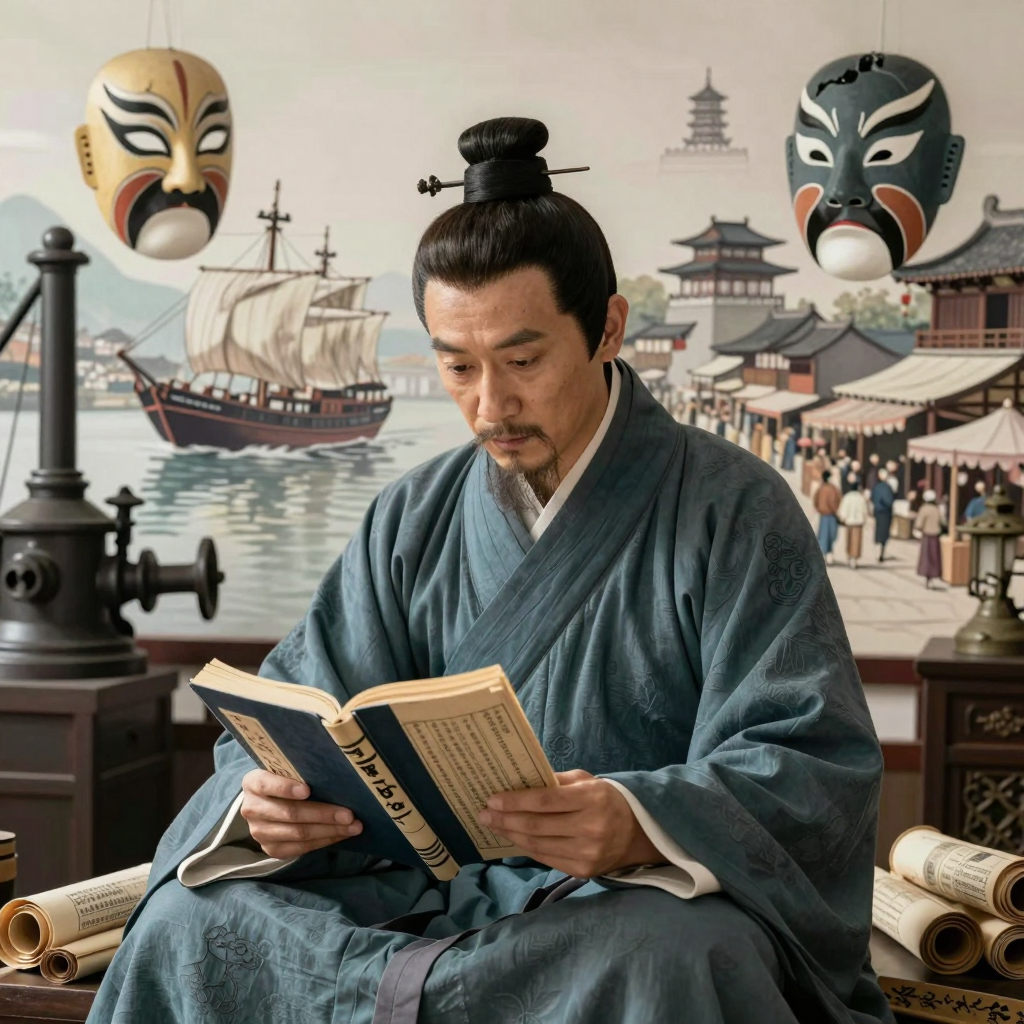
Park Ji-won: The Most Modern Intellectual of Late Joseon, Yeonam Park Ji-won
How did a Joseon scholar, repeatedly failing the civil service exam and distancing himself from an official career, become an icon of Silhak (Practical Learning) thought and a literary master? Surprisingly, the answer is simple. Park Ji-won chose questions that change reality over the “sure path to success.”
For late Joseon intellectuals, the civil service exam was the safest ladder guaranteeing status and power. Yet Yeonam did not remain a failure unable to climb that ladder. After failing the exam, he let go of his obsession with officialdom and turned to scholarship and writing, relentlessly dissecting Joseon society’s worn-out inertia—its dogmatic Neo-Confucianism, unproductive privileged class, and closed worldview.
His “modernity” begins here. Before asking what is right, he asked what actually works, what truly improves the people’s lives. Through his official mission to Qing China, the vibrant cities, the system of commerce and industry, and the efficient technology and transportation that he saw firsthand led Yeonam to one conclusion: beyond emotions and pride, let’s learn what there is to learn. This attitude crystallized in his later work The Jehol Diary (열하일기) and expanded into practical concerns of Northern Learning and utilitarian reforms.
At the same time, Park Ji-won persuaded not through dense treatises but through storytelling. In “Heosaengjeon” and “Yangbanjeon,” he sharply satirized the market and economy, the incompetence of elites, and the hypocrisy of social rank, asking readers: “Does the common sense you believe in really improve reality?” Yeonam’s literature was more than entertaining—it was a device to reveal social structures and imagine alternatives.
Ultimately, Yeonam Park Ji-won was not merely “a Joseon scholar” but a voice speaking meaningfully even to today’s readers. His observations that open closed societies, questions that shake vested interests, and knowledge that enriches life—these three qualities cement him as the most modern intellectual of late Joseon.
Park Ji-won’s 『Yeolha Ilgi』 and His Journey to Beijing: The Civilization Shock between Joseon and Qing
How strange and intense must have been the sight of Qing’s advanced commerce and urban culture to an 18th-century Joseon intellectual witnessing it firsthand? Following a delegation, Park Ji-won traveled to Beijing and Yeolha, confirming with his own eyes the ‘other world’ he had only imagined through books. But he did not stop at mere observation—instead, he transformed these experiences into probing questions that made him reflect deeply on Joseon society, meticulously recording them in 『Yeolha Ilgi』.
‘The Speed of the City’ and the Power of Commerce Observed by Park Ji-won in Beijing
The Qing city Park encountered was, in a word, a living, moving system. Goods flowed, people gathered, information circulated—allowing the city to expand organically. His focus was not on superficial splendor, but on the fusion of commerce, technology, and transportation that made such splendor possible.
- Commerce organizes daily life: a structure where production and consumption are tightly intertwined through abundant goods circulation
- Urban culture drives efficiency: a society that embraces diverse professions and roles, with specialized functions serving communal needs
- Technology and transport infrastructure connect wealth: faster movement and delivery expand markets, and growing markets enrich lives
These observations dulled ideological judgments like “Is Qing a barbarian or not?” Instead, they sparked a pragmatic question: “What can be learned from that system?”
When 『Yeolha Ilgi』 Transforms from a Travelogue into a Critique of Joseon
Though on the surface 『Yeolha Ilgi』 records observations of Qing, the gaze repeatedly returns to Joseon. Park Ji-won did not write to merely praise Qing’s strengths. Rather, he set up a comparative mirror targeting Joseon’s outdated inertia and closed-mindedness.
His questions are sharp and clear:
- Why does Joseon scorn commerce, narrowing its own possibilities?
- Why does it dismiss technology and institutions as mere ‘miscellaneous knowledge,’ blocking paths to improving daily life?
- Why does it rely on abstract principles while leaving reality’s poverty neglected?
This critical consciousness blossomed into practical Western Learning (Buk-hak)—a call to accept advanced knowledge and systems regardless of sentiment, moving the country toward strengthening people’s livelihoods.
The Civilization Shock Recorded by Park Ji-won: “Learning Is the Art of Survival”
The shock Park Ji-won experienced in Beijing was not simply cultural curiosity but a near-answer to the question, “What must a country do to endure?” 『Yeolha Ilgi』 remains relevant because that answer does not apply only to Joseon’s moment in history—it touches on questions recurring through changing eras.
Ultimately, the message Park left after his journey is simple:
Beyond judgments of good or bad, learn what you can and make life better.
This pragmatic sensibility was the greatest ‘civilization shock’ left by his trip to Beijing.
Northern Learning Thoughts and Practical Use for People’s Well-being: Beyond Emotions to Pragmatism — The Question Posed by Park Ji-won
Why did Park Ji-won emphasize learning from Qing dynasty civilization, transcending Joseon’s fixed notion that ‘Qing are barbarians’? The answer is simple. For Yeonam, what mattered was not pride or emotions but the power to truly change the life of Joseon here and now.
Park Ji-won’s Northern Learning Thoughts: “Learn What Must Be Learned, Even From Those You Dislike”
The mainstream perception in late Joseon leaned on culturally belittling the Qing. However, after personally witnessing Qing, Park judged that such a perspective only clouds reality.
His concept of Northern Learning (Buk-hak) was not “worship the Qing,” but rather a bold proposal to adopt what Joseon needs from the advanced Qing technologies, commerce, and urban management.
- Look at the real gap before ideology
- Regardless of emotional hostility, accept useful systems and technologies
- The purpose of learning is not debate but reform and prosperity
In other words, Northern Learning was not pro-Qing but a pragmatic learning strategy.
Park Ji-won’s Practical Use for People’s Well-being: Scholarship Must Enrich People’s Lives
Frequently paired with Park Ji-won’s thought is the key idea of Practical Use for People’s Well-being (Iyong Husaeng).
Literally,
- Practical Use (Iyong): employ technologies, systems, and cultures effectively
- Well-being (Husaeng): and as a result, enrich the lives of the people
For Yeonam, scholarship was not about building ‘elegant words’ or ‘moral justification’ but a tool to improve the conditions of daily life—such as eating, commuting, trading, and producing. Hence, his observations in Yeolha Ilgi ultimately boil down to “What makes life easier for the people?”
When Preconceptions Break, the Language of Reform Begins — The Legacy of Park Ji-won
Park Ji-won did not merely criticize Joseon’s backwardness by viewing Qing civilization. More sharply, he raised the structural question, “Why can’t our society accept what it truly needs?”
Northern Learning and Practical Use for People’s Well-being connect in one core message:
Let’s move towards a country that protects the lives of its people, not just its pride.
This pragmatic awareness is precisely why Yeonam Park Ji-won remains read as a ‘modern classic’ even today.
Social Criticism Through Park Ji-won's Satirical Novels: Heo Saeng-jeon and Yangban-jeon
How did Yeonam sharply expose the root problems of Joseon society through the eccentric merchant’s hoarding and the incompetence of the yangban class? Park Ji-won chose the detour of fiction to reveal society’s bare face in an era when direct criticism was easily blocked. Both Heo Saeng-jeon and Yangban-jeon are condensed social commentaries that, while provoking laughter, ultimately lead readers to ask, “Why does this country operate this way?”
Park Ji-won’s Heo Saeng-jeon: How the Hoarding Experiment Exposed Joseon’s Economy and State System
In Heo Saeng-jeon, Heo Saeng conducts an ‘experiment’ by hoarding goods to make a fortune. Though it appears as an odd success story on the surface, Park Ji-won’s true target lies elsewhere.
- The power of commerce and distribution: It shows that wealth is created not by the “scholars who only know letters,” but by those who understand the market. It forcefully challenges Joseon’s rigid economic outlook — a disdain for commerce and contempt for production and distribution.
- Weakness in state governance: The premise that society can be shaken simply by one individual hoarding and trading implies that the state fails at crisis management and resource allocation.
- The reality of an incompetent ruling class: Facing Heo Saeng’s ingenious proposals and execution, the ruling elite lose touch with reality and flounder, revealing a system with authority but no capability.
Ultimately, Heo Saeng-jeon isn’t a tale applauding “individual cleverness” but a novelized expression of Park Ji-won’s concern (yong-u husaeng) that commerce, industry, technology, and institutions must be practically employed to strengthen people’s livelihoods.
Park Ji-won’s Yangban-jeon: How the Yangban’s Authority Became an ‘Empty Shell’
The very title Yangban-jeon declares its intent. Park Ji-won portrays the yangban not as a class noble by nature, but as a privileged group detached from production and responsibility.
- Status as right but duty shirked: The yangban’s name guarantees social privileges, but they avoid labor and responsibilities toward the community.
- Packaging self-interest in moral language: Outwardly speaking of courtesy and principle, yet their real actions cater to private gain — the core contradiction satire exposes.
- Finding society’s stagnation in the class structure: The problem isn’t reduced to individual corruption but exposes the structural unproductiveness born of a yangban-centered order.
Here, laughter is not mere decoration but a tool to strip away the mask of authority. Readers mock the yangban and before long see “the inertia of the entire society that upholds that authority.”
Park Ji-won’s Novelistic Legacy: A Sharp Yet Humorous Language of ‘Realistic Reform’
While Heo Saeng-jeon reveals the vulnerabilities of the economy and state system through an experiment, Yangban-jeon exposes the emptiness of the status system and vested interests. Both reach the same conclusion: The reason Joseon can’t change is not due to a lack of knowledge, but because of outdated orders and ideas that prevent people from seeing reality.
Park Ji-won’s satire endures because it is not a story that ends with laughter but leaves readers with a lingering question: “Are we still living in an order that values appearances over usefulness?”
Park Ji-won Asks: Questions for Us Today—What Should We Learn and What Should We Let Go?
When reading the writings of Yeonam Park Ji-won, many passages strangely sound like they are spoken in the present tense. In an era ruled by emotions and pride that branded the Qing as "barbarians," he coolly asks: If we are to improve, what must we learn? And what should we boldly discard? This question resonates precisely with today's concerns in Korean society—stagnant growth, polarization, entrenched interests, and anxiety before rapid technological change.
Park Ji-won’s Criterion for ‘Learning’: Not the Right Answer but Utility
Park Ji-won’s essence of “Northern Learning” was not mere “copying foreign ways.” The focus was on outcomes, not origins.
- Practical benefits over emotions and ideology: Regardless of likes or dislikes, if better technologies, systems, or ways of operation exist, they must be adopted.
- Perspective of enhancing human welfare: Knowledge must be judged not by eloquence but by whether it genuinely enriches lives.
Translated to today’s context, this means that when faced with new technologies (e.g., AI), institutions, or industrial structures, we should first examine how much they improve productivity and quality of life rather than simply ask if they meet “our cultural sentiments.”
What Park Ji-won Urged to Discard: The Invisible Costs of “Face” and “Inertia”
Park Ji-won targeted not only outdated systems themselves but also the mindsets that fuel them.
- Automatic approval of status and authority: As exposed in The Story of the Yangban, a structure boasting status without responsibility or productivity inevitably impoverishes society.
- Morality-talk that only sounds good: ‘Plausible words’ failing to solve real problems (livelihood, economy, technology) become costly burdens.
- A culture afraid of failure: Once safe answers are repeated over daring experiments, real change halts.
We see similar scenes in our daily lives: formalistic procedures, excessive reporting, shirking responsibility, and evaluations centered on academic pedigrees and credentials—all appearing orderly yet actually obstructing innovation.
Park Ji-won’s Greatest Legacy: “Criticism Must Lead to Alternatives”
Park Ji-won’s satire doesn’t end in scorn. The way The Story of Heo Saeng reveals market, distribution, and state system flaws through ‘experiments’ resembles today’s approach of using data and field verification to examine policies and structures.
In other words, he implies:
- Don’t stop at complaining about problems
- Seek concrete mechanisms that can change reality
- And test those mechanisms in real-world settings
Applying Park Ji-won’s Questions to Today
Finally, rephrasing Yeonam’s questions for the modern age:
- When learning new technologies and systems, what criteria do we use to select them?
- Among old authorities and customs, which still generate nothing but costs?
- When we criticize, does that criticism connect to alternatives that improve lives?
Park Ji-won’s true gift is not a “right answer” but the ability to ask questions—and these questions remain just as vital. What our society truly needs now is not words that protect face, but choices that change lives—a decisive answer to what to learn and what to abandon.
Comments
Post a Comment