 \n
\n
A Sky Hard to Breathe: Canada’s Wildfires Send an Air Quality Alert Across the U.S.
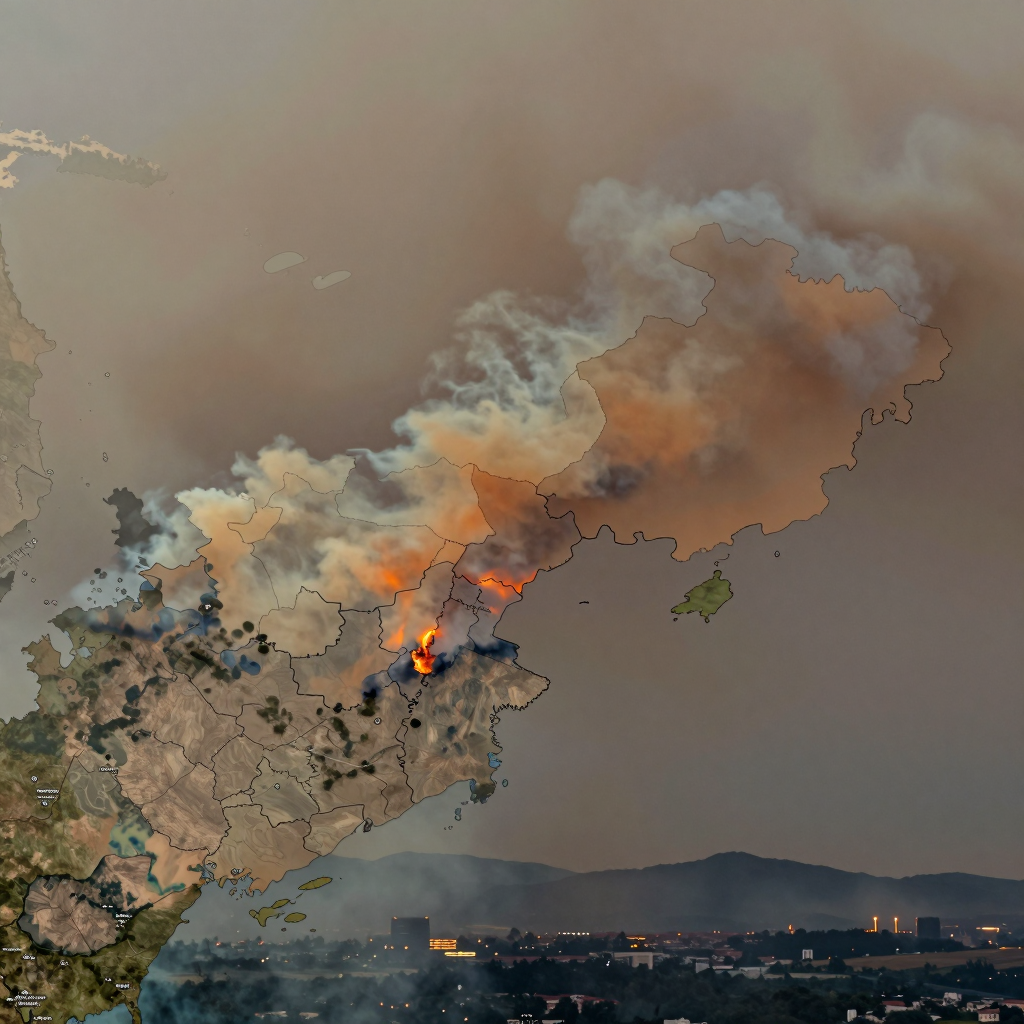
The everyday sky has turned a yellowish-brown, signaling one of the worst air pollution levels globally detected in the U.S. Northeast. But the problem goes beyond the visible “smoke in the air”—invisible ultrafine particles (PM2.5) are spreading widely, shaking the very safety standards of the atmosphere itself. What shocking truth lies hidden within this haze?
Cross-Border Smoke Shakes U.S. Air Quality
At the heart of the crisis is the fact that massive wildfire smoke from across Canada is crossing borders, linking the Northeast and Great Lakes regions in a shared haze. Smoke originating from areas like Ontario rides the winds southward, altering skies simultaneously in New York, New England, Michigan, Wisconsin, and Minnesota.
In other words, this air pollution event reveals a sobering reality: North America’s atmosphere is not divided by borders but united in one vast air mass.
Why “Alerts” Have Become the New Normal: What an Air Quality Alert Really Means
The repeated air quality alerts on the news are far from mere advisories—they signal official confirmation that pollution has reached levels capable of directly harming health. Especially when smoke lingers for days, air quality worsens beyond the “sensitive groups” caution to a level burdensome for everyone.
In some regions, the AQI (Air Quality Index) has surged to extreme highs, turning the question “Is it safe to go outside?” into a daily standard as vital as the weather forecast.
Scarier Than What You See: The Air Quality Risks of PM2.5
While thick smoke is often a warning sign, the more critical point is that danger can exist even when you can’t see it. PM2.5—ultrafine particles that are a key harmful component of wildfire smoke—penetrate deep into the lungs and increase strain on the respiratory and cardiovascular systems.
This is why authorities consistently recommend avoiding strenuous outdoor activities, reducing time spent outside, and exercising especially strict caution for children, the elderly, and those with underlying health conditions. Ultimately, this crisis reveals a paradigm shift: it’s not the color of the sky, but the composition of the air that now governs our daily lives.
Double Crisis in Air Quality: Wildfire Smoke and Urban Air Pollution Engulf the United States
Smoke from Canadian wildfires is crossing borders and spreading from Michigan to New York and Colorado. At the same time, major western cities like Las Vegas are trapped in chronic ozone and fine particulate matter problems. On the surface, it may seem like a single event of “smoke descending,” but in reality, this is a complex crisis where acute (wildfire smoke) + chronic (urban pollution) overlap.
The First Axis Shaking Air Quality: Cross-Border Wildfire Smoke (Acute Pollution)
At the heart of this haze is transboundary air pollution, a phenomenon where pollution originating in one country changes everyday life in another. As large wildfires rage across Canada, smoke has traveled extensively, turning the skies in the U.S. Northeast and Great Lakes region shades of yellow-brown for days on end.
In particular, some areas have seen AQI spike to extreme levels, issuing repeated air quality warnings that go beyond “sensitive groups should take care” to hazards affecting everyone. This signifies that air quality is no longer a mere environmental issue but a daily life variable that influences outdoor activities, event planning, and school schedules.
The Second Axis Worsening Air Quality: Chronic Ozone and PM2.5 in Western Cities (Structural Pollution)
Meanwhile, the problem in western metropolises is structurally bad air quality unrelated to wildfires. For instance, Las Vegas is known for severe ozone pollution, compounded by PM2.5 (ultrafine particles), making it a region with a “poor baseline” air quality even on typical days.
Factors like traffic volume, energy consumption, hot and dry climate, and urban heat islands accumulate to create a pattern where air quality can deteriorate easily even in the absence of wildfires.
The Reality of the Air Quality ‘Double Crisis’: When Acute Smoke Layers Over Chronic Pollution
The most dangerous scenario emerges when these two axes intersect. When wildfire smoke infiltrates cities or regions already burdened with high ozone and particulate matter, the air that residents experience is not just “slightly worse” but a heightened risk from overlapping pollutants.
As a result, air quality news in the U.S. nowadays is not just about isolated spots but expands into a nationwide issue asking, “Which states are impacted, and to what extent, today?”
On-Site Air Quality Alerts That ‘Open and Close’ by Region
From Michigan’s Mohawk area where the AQI soared close to 1,000, to the massive sports stadiums of New York and New Jersey, air quality hazard levels are fluctuating rapidly like a switch that ‘opens and closes’ within days. The critical issue is that this shift isn’t just a minor inconvenience—it's a field variable that can entirely reshape daily schedules and movement patterns.
Michigan & Great Lakes Region: A New Air Quality Routine of “Check Numbers → Postpone Going Out”
Michigan’s air quality alert spans the entire state, reflecting widespread smoke impact. In places like upper Michigan’s Mohawk, where the AQI has spiked drastically, the air is felt as dangerous not only to sensitive groups but to everyone. Residents here respond clearly:
- Rescheduling plans: Postpone outdoor exercise and work; keep essential outings brief
- Indoor-focused living: Keep windows closed and stay in air-conditioned spaces
- Changed checkpoints: Begin the day by checking the AQI (especially PM2.5) rather than weather apps
In other words, it’s not about whether the air “looks clear,” but what the indicators actually say that guides action. The yellow-brown sky is a warning sign, yet awareness is spreading that the real danger may be invisible.
New York & New Jersey: When Air Quality Becomes an ‘Event Operation Risk’ in the City
As ‘unhealthy’ levels appear across New York and NYC’s air quality ranks among the worst of major global cities, outdoor events and sports games feel immediate effects. In large gatherings like New Jersey stadiums, air quality ceases to be just environmental news and transforms into operational questions:
- Can we minimize waiting lines and crowd dwell times for spectators and staff?
- Should we emphasize reducing outdoor exposure as much as “staying hydrated” in pre- and post-event guidance?
- How do we communicate attendance avoidance recommendations to sensitive groups (children, elderly, those with respiratory issues)?
Ultimately, air quality becomes a variable condition for city events — “open indicates proceed, closed means scale down,” while citizens must adjust their travel, viewing, and activity levels accordingly.
When Alerts ‘Open’ and ‘Close’: Practical Air Quality Response Principles on the Ground
Air quality alerts don’t simply come and go; their intensity fluctuates with wind, pressure, and smoke presence. The most practical approach is simple:
- When the alert opens (deteriorates): Stop vigorous outdoor activities and limit time spent outside
- When the alert closes (improves): Don’t rush to “normalize” right away; check AQI and key pollutant levels first, then resume gradually
Currently, America’s air quality challenge is not confined to specific cities—it’s a live, site-specific risk with hazard levels shifting rapidly by region. With air conditions changing even within the same state and day, the era has truly arrived where “today’s plan” means first and foremost checking the air quality.
The Hidden Battle for Health: How Air Quality Alerts Are Changing Our Lifestyles
“Limiting outdoor activities” and “making the most of indoor air environments” are no longer mere recommendations—they have become rules that shape our daily lives. The problem is that poor air days are not “occasional” anymore; wildfire smoke and urban pollution combine to create unpredictable, recurring episodes. This is why a simple weather app no longer suffices. Today’s air quality (AQI) has become the key indicator that reshapes our daily routes and plans.
How Air Quality Alerts Change Your Day: Rearrange “Exercise, Commute, and Appointments”
When an air quality alert is issued, even familiar schedules take on a whole new meaning.
- Switch Up Workout Routines: Postpone outdoor cardio like running or cycling and replace them with indoor stretching, strength training, or low-intensity workouts. Even “light exercise” can increase breathing rate, leading to greater exposure.
- Adjust Your Mode of Transport: On days when walking is common, switch to public transit or driving, and limit necessary outings to shorter, simpler routes.
- Change Appointment Locations: Instead of outdoor terraces or park strolls, prioritize indoor environments with ventilation and filtration (air conditioning, air purifiers in operation).
The key is not about “endurance” but redesigning life by managing exposure time.
Why Weather Apps Aren’t Enough: Air Quality Is a “Neighborhood-by-Neighborhood Reality”
Temperature and precipitation behave uniformly across cities, but air quality can change drastically within just a few kilometers. Just as urban centers and suburbs show vastly different numbers within the same county, relying on “general neighborhood data” leads to unreliable decisions.
Here’s why you need an AQI app:
- Shows the current AQI based on your exact location: Even if the news says “Poor air quality across the entire eastern region,” your specific neighborhood might be worse—or might even improve temporarily.
- Differentiates pollution sources (PM2.5 vs. ozone): Wildfire smoke mainly raises PM2.5 levels, while chronic urban pollution, like in western metros, often spikes ozone levels. Knowing the cause ensures precise countermeasures.
- Tracks hourly variations to find “windows for safe outings”: Even on bad days, there can be time slots—like early morning or evening—when air quality improves.
Ultimately, an AQI app is not just information—it is a vital tool for daily decision-making.
Making Indoor Spaces a ‘Safe Zone’: An Air Quality–Responsive Indoor Environment Checklist
Entering indoors does not automatically mean safety. “Using indoor spaces” is effective only when air quality is actively managed.
- Window Strategy: Don’t ventilate blindly when haze is thick or AQI is high; instead, air out briefly during times when levels drop.
- Use Filtration: Run air conditioners and purifiers, but regularly check filter conditions (old filters lose efficiency).
- Shift to Indoor Activities: Adapt routines like kids’ outdoor play or long pet walks flexibly based on air quality.
Air quality is no longer a matter of “healthy choices” but has become an operational standard for safeguarding our daily lives. Developing the habit of checking AQI is the most practical frontline defense—reducing unnecessary exposure and protecting your day’s well-being.
air quality The Future of Air: America’s Path Beyond the ‘Double Pollution’ Era
Wildfire smoke is no longer just a “briefly bad then better” event; it has become a compounded risk layered on top of the chronic ozone and PM2.5 problems in major cities. In other words, the air quality issues on any given day are no longer simply “because of wildfires” or “due to urban pollution”—both forces operate simultaneously in a new dynamic. So, how must future strategies and individual responses change to secure cleaner air?
air quality Future Strategy 1: Shift from “Disaster Response” to “Continuous Management”
Wildfire smoke easily crosses borders and state lines. Therefore, air quality management limited to one-time alerts is insufficient.
- Advanced Forecasting and Early Warning: Beyond typical weather forecasts, we need detailed modeling of smoke plumes and the potential for PM2.5 surges so that schools, businesses, and events can proactively adjust plans.
- Simultaneous Heat + Smoke Response Protocols: Advising “close windows and turn on the air conditioner because it’s hot” is not a universal solution. Public institutions must expand clean air shelters that provide both cooling and air purification as standard infrastructure.
air quality Future Strategy 2: Lowering the ‘Baseline’ Pollution in Chronic Urban Hotspots
Ozone and fine particulate matter problems in western cities exist independently of wildfires as a persistent “baseline.” When this baseline is high, damage from wildfire smoke rises exponentially.
- Accelerate Transportation and Energy Transitions: Reducing emission sources is critical; otherwise, the risk on smoky days keeps rising. Electrifying public transit, alleviating urban congestion, and improving power generation mixes become not just “environmental agendas” but essential health safety nets.
- Breaking the Link Between Urban Heat Islands and Ozone: Ozone worsens on hot days. Heat management policies like shading, greenery, and cool roofs can simultaneously serve climate adaptation and air quality improvement goals.
air quality Personal Response 1: From ‘Checking the App’ to ‘Designing Actions’
Simply looking at the AQI is no longer enough. It’s vital to make routine not just what to check, but how to act on the data.
- Two Daily Checks: Overall AQI plus the dominant pollutant (usually PM2.5 or O3). Even if the rating is “Good,” PM2.5 levels might be relatively elevated.
- Adjust Exercise and Travel Schedules: Postpone outdoor running or alter commuting routes to less congested streets—small avoidances add up.
- Prioritize Vulnerable Groups: Children, the elderly, and those with respiratory or cardiovascular diseases should avoid the “it’s probably fine” mindset. When alerts are issued, adopting stricter personal thresholds is safer.
air quality Personal Response 2: Make Indoor Air Your ‘Final Line of Defense’
During smoke seasons, “indoors becomes refuge.”
- Manage Doors, Windows, and Filters: Minimize outdoor air inflow and, if possible, use effective filters (air purifiers/ventilation systems) to reduce fine particle exposure.
- Simplify Daily Routines: Rather than crowding errands, exercise, and outdoor plans on smoky days, reschedule to focus more on indoor activities for a practical response.
air quality Conclusion: The ‘Clear Day’ Standard Has Shifted
Future air quality cannot be summed up simply as “smoke-free days = safe days.” In an era of wildfire-driven fluctuation layered on chronic urban pollution, policies must evolve into continuous infrastructure, and individuals must adopt action-oriented routines. Ultimately, what must change is not just the air itself, but the very way we manage and live with it.
Comments
Post a Comment