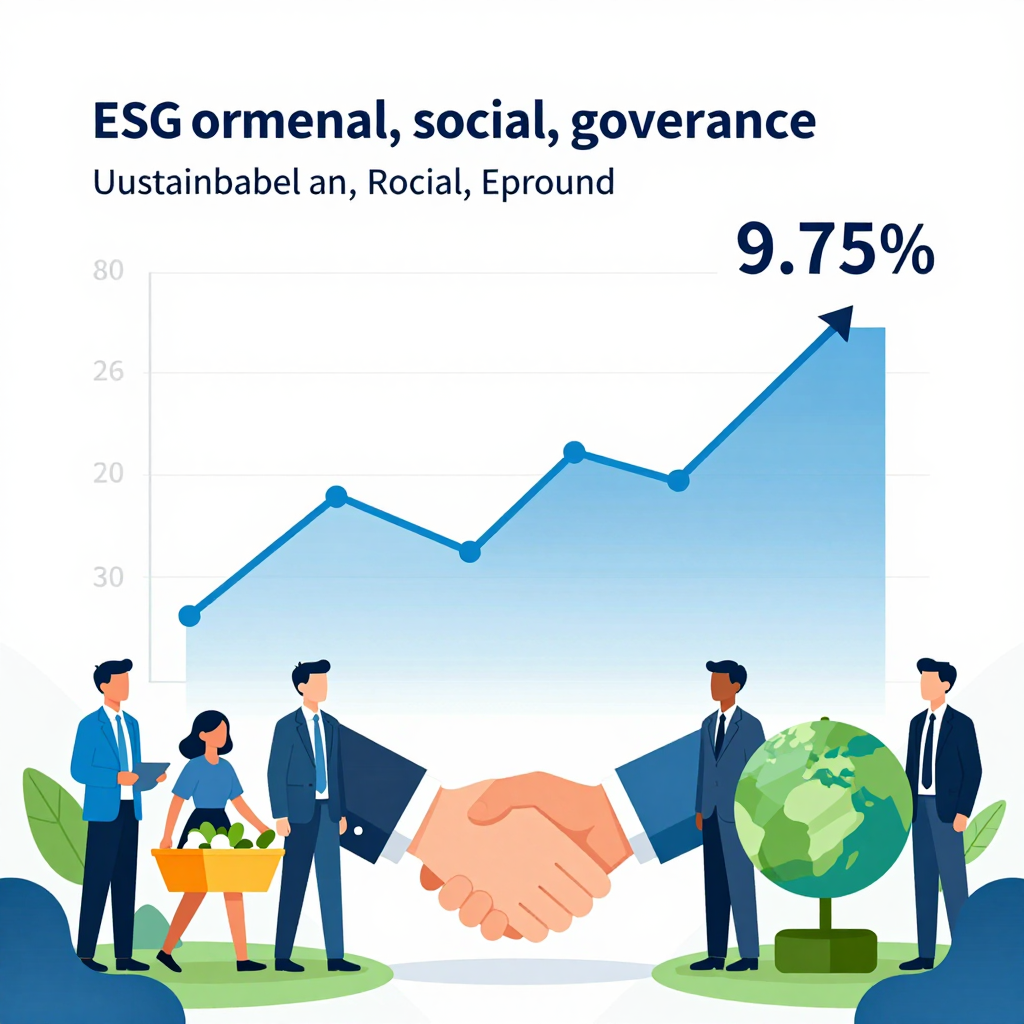
Summary of National Pension Service's 5-Year Return Rate of 9.75% Including ESG and Community Development
 \n
\n
National Pension Service: The Giant Moving Korea’s Retirement Future
Did you know that the National Pension Service (NPS) is more than just a pension provider? It is a colossal player shaping Korea’s stock market, regional economies, and aging society policies. While the monthly premiums we pay may seem like simple ‘savings for retirement,’ the fund accumulated wields real influence directing the course of Korean society.
The NPS is Korea’s largest pension fund management institution. Understanding this organization means going beyond “how much pension will I receive?” to exploring even bigger questions:
- Domestic Stock Market: Buying and selling by major institutional investors and shifts in asset allocation directly impact market trends.
- Corporate Ecosystem: As a shareholder, NPS sends signals on corporate governance and ESG issues through voting rights and stewardship dialogues.
- Regional Economy: The drive to grow ‘local impact’ intensifies through win-win regional programs and collaborative projects.
- Aging Society Policies: In a rapidly aging society, pensions are designed not just for cash payouts but intertwined with life infrastructure—financial education, health, and employment.
In short, the NPS is not only the manager of my pension, but also Korea’s long-term investor, a policy-driven investor upholding public responsibility, and increasingly a social platform. This blog will vividly explore that very nexus—connecting numbers (returns) with non-financial transformations (ESG, regions, and aging society)—to uncover a multi-dimensional portrait of the National Pension Service.
The Secret Behind the National Pension Service's Fund Management: A Shift in 5-Year Returns and Long-Term Performance Evaluation
The National Pension Service (NPS) recently posted a 5-year cumulative return of 9.75%, surpassing its benchmark return of 9.59% by 0.16 percentage points. At first glance, you might wonder, "Is that really a big difference?" But the key point lies in establishing a structure where a massive public fund consistently outperforms its benchmark. So how exactly did the NPS manage to beat the benchmark, and why did performance-based bonuses skyrocket to a recent 5-year high of 78.6%?
What the NPS’s 5-Year Return of 9.75% Really Means: ‘Sustainability’ Over ‘Excess Returns’
For pension funds like the NPS, the goal isn’t to chase aggressive, one-shot gains but to achieve target returns over the long term within a defined risk boundary. That means the small 0.16 percentage point excess return must be understood in the following context:
- The larger the fund size, the harder it is to generate excess returns (huge funds themselves influence the market with every move)
- Consistent management skill relative to the benchmark matters more than the absolute return figure
- Even a modest excess return compounds over time, making a significant difference in long-term investment outcomes
In other words, the NPS’s strength lies not in “spectacular profits,” but in a system that manages a massive fund in a way that consistently performs just a bit better than the benchmark.
How the NPS Beats the Benchmark: Asset Allocation Focused on Overseas & Alternative Investments
When looking at recent returns by asset class, the sources of performance become clear:
- Overseas stocks: 17.82%
- Alternative investments: 12.75%
- Domestic stocks: 11.24%
- Overseas bonds: 6.24%
- Domestic bonds: 1.39%
Two key takeaways emerge here:
1) NPS’s performance isn’t dictated by the Korean market alone; global stock markets, interest rates, and exchange rates (especially the dollar) significantly impact real returns.
2) In a low-interest-rate, volatile environment, alternative investments (infrastructure, real estate, private equity, etc.) serve as a portfolio buffer and help defend returns.
From an individual investor’s perspective, assuming “my pension only depends on the domestic economy” is risky. The NPS’s report card is essentially a report card on global diversification.
NPS’s Performance Bonus Rate Soars to 78.6%: A Shift from ‘Single-Year’ to ‘5-Year Cumulative’ Evaluation
The jump in the performance bonus rate to 78.6% cannot simply be chalked up to “getting lucky this year.” The more important change is that the evaluation method itself has shifted to a long-term perspective.
- Previously: Performance was evaluated annually, causing compensation to fluctuate widely with market cycles
- Now: The focus is on 5-year cumulative performance coupled with a benchmark portfolio
This shift means:
- Reducing short-term performance pressure and encouraging consistent management over the long haul
- Aligning performance evaluation with the fundamental nature of pension funds (which carry liabilities spanning decades)
- Designing compensation to reward long-term results rather than quick wins
Ultimately, the surge in bonuses reflects not just “this year’s returns,” but a recognition that cumulative performance has surpassed the benchmark.
Summary: When Analyzing the NPS, Focus on Its ‘Evaluation Framework’ Rather Than Just ‘This Year’s Returns’
The secret to understanding the National Pension Service’s fund management isn’t a single number—it’s the rules (benchmarks) and the timeline (5-year evaluation) behind those numbers. Instead of fixating on “how much was earned this year,” the real insight comes from seeing what standards the NPS uses and how consistently it manages performance over the long term. That’s where you’ll find the true direction of the National Pension Service.
National Pension Service Rebalancing Controversy and Its Impact on the Stock Market: Is It a Selling Bombshell or a Careful Adjustment?
Whenever the phrase “National Pension Service (NPS) selling bombshell” spreads in the domestic stock market, investor sentiment swings wildly. But is it really true that the NPS dumps massive sell orders all at once at predetermined times? To get straight to the point, rebalancing is less of a “sell signal” and more of an adjustment process to adhere to asset allocation rules, with mechanisms in place during actual operations to minimize market shocks.
The Essence of Rebalancing: Closer to “Risk Management” than “Profit Maximization”
The NPS maintains a Target Asset Allocation system that balances domestic stocks, foreign stocks, bonds, and alternative investments within set ranges. If a particular asset surges sharply, exceeding its target weight, the portfolio’s long-term risk can increase.
Therefore, rebalancing is not about “good news or bad news”—it’s a basic operation for public pension funds to keep portfolio balance.
Why Does the ‘Selling Bombshell’ Narrative Arise? Because the Figures Are Huge and Timing Is Sensitive
In the market, whenever the rebalancing suspension ends and indices rise simultaneously, scenarios forecasting “large-scale selling due to increased domestic stock weighting” repeatedly surface. Especially when the KOSPI passes certain levels, potential selling volumes are heavily estimated, feeding investor communities’ tendency to turn this into a dramatic “bombshell” story.
However, the key point is that a “possible maximum” does not equate to the “actual execution method.” Scale estimates tend to emphasize shock value, but the real management process is far more pragmatic and dispersed.
The NPS’s Real-World Strategy: They Don’t Dump Everything at Once
The message emphasized repeatedly by the NPS and the government is relatively consistent: even during rebalancing, they strive to minimize market impact. From a blogging perspective, the core boils down to three points:
- Staggered Execution: Instead of frontloading volume on a single day, they spread it over time to reduce shocks.
- Liquidity Consideration: Adjusting pace based on daily trading volume, market cap, and supply-demand conditions of each security.
- Strategic Separation: Suppressing short-term market impact while returning to target weights in the mid-to-long term.
In other words, rebalancing involves two distinct challenges: the “decision (what must be done)” and the “execution (how to do it).” The market’s fear usually peaks at the decision stage, but the actual shock depends on execution design.
What Investors Should Focus on: It’s a “Shock Management Signal,” Not Just a Question of Selling
For individual investors evaluating the rebalancing issue, a more useful approach is to ask the following rather than simplifying it to “NPS sells or doesn’t sell”:
- Will rebalancing trigger short-term supply-demand shocks, or will it be absorbed through gradual adjustments?
- How does the NPS’s principle of ‘minimizing market impact’ translate into actual execution methods (speed, timing, targets)?
- Even if domestic stock weighting adjusts, how do global asset flows from foreign stocks and alternative investments create overall portfolio balance?
Ultimately, the term “selling bombshell” is sensational, but the reality of rebalancing is closer to a massive public fund carefully managing risks and gradually realigning positions. Once you grasp this distinction, you’ll be less rattled by headlines and better equipped to understand the market structurally.
국민연금 in the ESG Era: A New Chapter of Transparency and Responsible Management
How will the ‘7 Principles · 12 Items Implementation Report’ announced by 국민연금 transform the future of our pension and impact companies and society? The key is not merely declaring “we do ESG,” but that subscribers and the market can verify in a transparent way what standards, to whom, and how shareholder rights have been exercised.
What 국민연금’s Implementation Report Means: Changing the Rules of Transparency
Until now, 국민연금’s stewardship activities often raised the question, “We know the principles, but what was actually done?” The release of this implementation report signals a commitment to regularly document and answer that question.
- Enhanced Transparency: Clearer standards, processes, and results for voting rights exercise and corporate engagement
- Increased Accountability: ‘Performance’ extends beyond returns to include long-term risk management (governance, environment, social issues)
- Greater Predictability: Both companies and investors can better gauge 국민연금’s decision-making criteria
The Pressure 국민연금 ESG Puts on Companies: An Era of “Action,” Not Just “Evaluation”
With its significant influence as a long-term investor in the domestic market, once the implementation report system is established, companies will no longer focus merely on managing ESG ratings but be compelled to make management decisions that truly reduce risks.
- Governance: Heightened demands for improvements as issues like board independence, shareholder rights protection, and internal controls surface
- Environmental & Social Risks: Serious accidents, supply chain risks, and carbon strategies increasingly tie ‘incident costs’ directly to long-term returns
- Linking Dialogue and Voting: Companies failing to improve through engagement face the likelihood of voting rights being exercised against them
In sum, 국민연금’s ESG is not a “feel-good” campaign, but a risk management tool from the long-term investor’s perspective.
Changes for Subscribers (Us): Higher Resolution on ‘Where My Pension Is Invested’
From the subscribers’ viewpoint, the greatest value of the implementation report is that beyond “returns,” it allows us to see how our pension is influencing the market.
- Track the principles guiding how our pension acts on specific issues (governance, environment, social)
- Stronger explanation responsibility on why votes were cast on controversial issues
- 국민연금 evolves from simply an ‘asset manager’ to a governance platform for public funds
What to Watch Moving Forward: 국민연금 ESG Must Prove Itself Through Results
For the implementation report to drive real change, consistency and follow-up actions matter more than disclosure alone. Keep an eye on:
- How aligned the principles are with actual voting actions
- Whether engagement is a one-off or a process that leads to real improvement
- If ESG solidifies as an investment framework that reduces long-term risk and boosts returns rather than a mere policy slogan
Ultimately, 국민연금’s ‘7 Principles · 12 Items Implementation Report’ boils down to a single question:
“Is our retirement fund being managed more transparently, responsibly, and sustainably?”
Now, we won’t just see the numbers — we’ll see the documented record of actions bringing the answer into view.
국민연금공단 Growing Together with the Community: The Happy Pension Center and Win-Win Project
What new winds might the ‘Happy Pension Center Open Store’ unfolding in Jeonju bring to the lives of local small business owners and seniors, going beyond mere economic activity? The key lies in expanding the concept of “pension” beyond just a flow of money to a living infrastructure that connects the work, health, knowledge, and consumption of people living in the community.
What Makes Jeonju’s Happy Pension Center ‘Open Store’ Special
The open store hosted by the National Pension Service’s Happy Pension Center stands out as a community-driven win-win project designed through collaboration between public institutions and private partners. In the local setting of Jeonju, small business owners get to showcase their products and brands, establishing direct touchpoints with customers, while local residents access trustworthy content and information—all in one place.
- Location: Happy Pension Center, Jeonju, Jeonbuk
- Operation: Win-win style ‘Open Store’ (held over four days)
- Goal: Support growth of local small businesses + Revitalize the local economy
More Than Just a Sales Channel for Small Businesses, a Lifestyle Blueprint for Seniors
The true value of this project lies not in a short-term sales event but in its structure that elevates the capabilities of the local community. Alongside the open store, lectures on economic outlooks, AI industry trends, senior health management, and asset and tax planning provide participants not just with “what to buy” but with insights on “how to live.”
- Small business perspective: Product exposure → Customer feedback → Network expansion (foundation for future opportunities)
- Senior and local residents’ perspective: Strengthen knowledge of health, digital skills, and finances → Expand choices for aging life
- Local community perspective: Consumption, education, and relationships circulate in one space → Strengthen the local economy’s vitality
The Direction of ‘Local Impact’ Shown by the National Pension Service
The National Pension Service’s ongoing efforts signal an attempt to go beyond simply “disbursing” pensions and instead connect vital elements of life at the community level in an aging society. After all, the quality of old age is determined not only by income but also by health, access to information, social networks, and financial literacy.
Jeonju’s Happy Pension Center Open Store is a concentrated example of this transformation. It’s a development worth watching to see how pensions can become a “living, breathing platform” within local communities.
Comments
Post a Comment