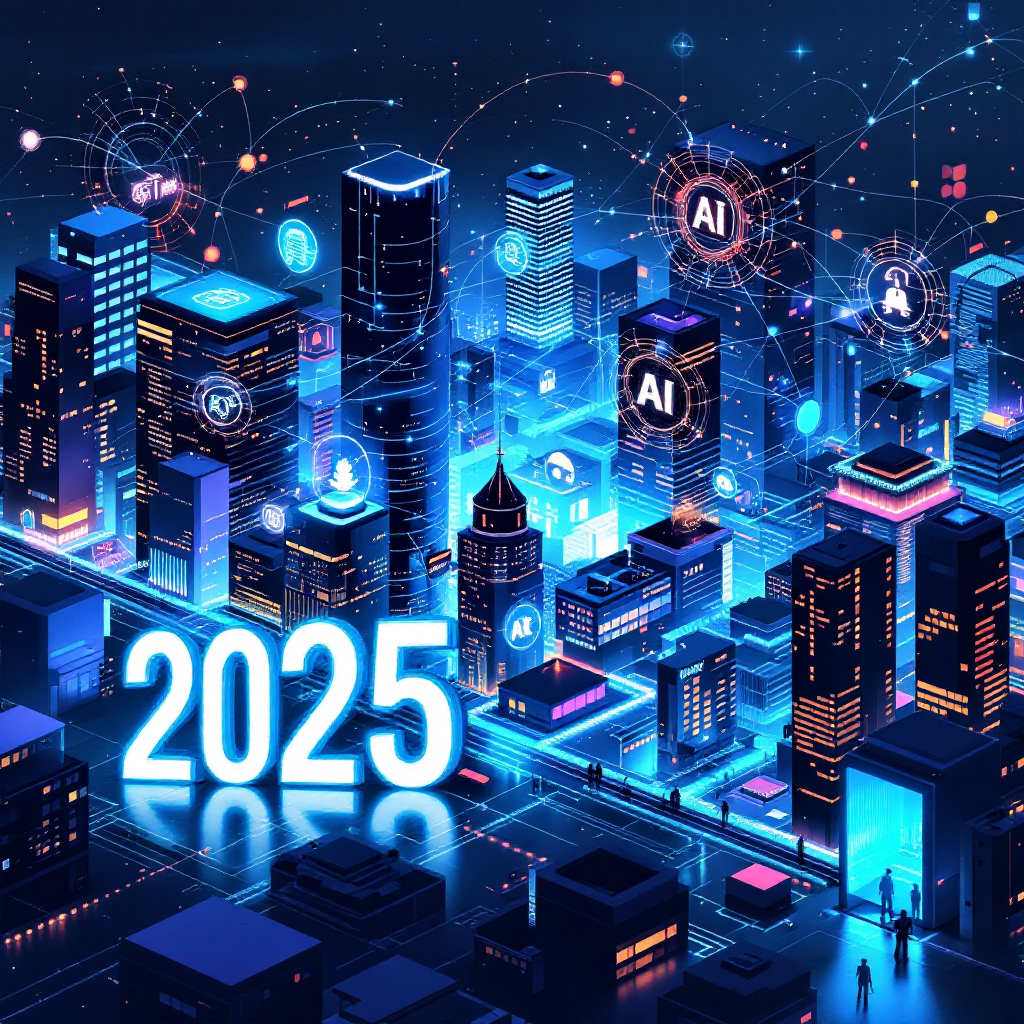
IoAI: The New Paradigm of Future Internet Beyond IoT
What if artificial intelligence could autonomously communicate beyond the Internet of Things? Let’s explore why IoAI (Internet of AI) is poised to become the center of technological innovation in the second half of 2025.
While IoT (Internet of Things) has deeply embedded itself into our daily lives, a new concept has emerged that surpasses its limitations. This is IoAI. IoAI goes beyond merely connecting devices; it signifies an ecosystem where AI agents autonomously communicate and collaborate.
In traditional IoT environments, smart home devices operated based on pre-set rules. For example, the air conditioner would automatically turn on when the temperature rose above a certain level. However, IoAI transcends such simple automation.
AI agents in an IoAI environment learn and make decisions independently, working together with other agents to solve complex problems. Take a smart home as an example: the thermostat AI learns the user’s lifestyle patterns and exchanges information with the lighting system AI to optimize energy efficiency while enhancing user convenience.
The innovation of IoAI is not limited to household devices. It is expected to bring even more revolutionary changes to industrial settings. In manufacturing, robots, conveyor belts, and CNC machines will each function as AI agents, dynamically adjusting production schedules and managing quality in real time, making fully autonomous smart factories a reality.
IoAI opens a new chapter in digital transformation beyond simple technological advancement. This innovative ecosystem—where AI agents communicate and collaborate without human intervention to solve problems—is expected to drive innovation across diverse fields such as smart cities, autonomous driving, and healthcare.
As of the second half of 2025, numerous tech companies, including HypersCycle, are putting their full effort into building the IoAI ecosystem. Consequently, IoAI solutions are anticipated to hit the market in commercial form starting next year. This new paradigm beyond IoT is rapidly approaching, promising to transform our lives and industries in revolutionary ways.
What Sets IoAI Apart from Traditional IoT: The Autonomy and Collaboration of AI Agents
Beyond simple automation, what differentiates a fully autonomous system where AI agents independently make decisions and collaborate from traditional IoT? IoAI (Internet of AI) is an innovative technology that takes the concept of IoT to the next level. Let’s dive into the key differences between these two technologies.
1. Decision-Making Approach
Traditional IoT:
- Operates based on predefined rules and conditions
- Performs simple automation grounded in sensor data
- Often requires human intervention
IoAI:
- AI agents independently analyze situations and make decisions
- Capable of complex pattern recognition and predictive actions
- Continuously learns and improves without human involvement
2. Interaction Between Devices
Traditional IoT:
- Limited communication through central servers or platforms
- Focused mainly on data collection and one-way command delivery
IoAI:
- Direct, autonomous communication among AI agents
- Facilitates two-way information exchange and collaborative problem solving
3. Scalability and Adaptability
Traditional IoT:
- Adding new features requires updating the entire system
- Difficult to respond to unexpected situations
IoAI:
- Flexible expansion through self-learning AI agents
- Quickly adapts to rapidly changing environments in real-time
4. Data Processing and Analysis
Traditional IoT:
- Most data processing and analysis occur in the cloud
- Potential issues with network latency and bandwidth constraints
IoAI:
- Distributed data processing leveraging edge computing
- Each AI agent performs advanced analytics locally
5. Security and Privacy
Traditional IoT:
- Centralized systems pose single points of failure risk
- High potential for massive data breaches
IoAI:
- Distributed architecture disperses security risks
- Enables intelligent security systems powered by AI
IoAI transcends the limitations of traditional IoT, creating a smarter, more autonomous ecosystem. This isn’t just a network of connected devices—it’s a truly intelligent ecosystem. The groundbreaking transformations IoAI will usher in are expected to profoundly impact both our daily lives and industries worldwide.
The Technical Secrets of Autonomous AI Agents: Intelligent Collaborative Systems Beyond IoT
From smart home thermostats to security systems, let's explore how AI agents analyze data and collaborate to make optimal decisions. In Internet of AI (IoAI) systems, each device operates not as a simple IoT gadget but as an independent AI agent, and their cooperation creates an intelligent environment far beyond conventional smart home systems.
Advanced Data Collection and Analysis
AI agents in IoAI environments collect and analyze data far more complex than traditional IoT sensors. For example, a smart thermostat doesn't just measure indoor temperature but comprehensively considers various data such as:
- Indoor and outdoor temperature and humidity change patterns
- Resident activity patterns and preferences
- Energy consumption and costs
- Weather forecast data
By analyzing this multidimensional data in real time, it autonomously determines the optimal temperature settings.
Predictive Behavior Through Machine Learning
AI agents do more than react to the current situation; through machine learning algorithms, they predict the future and respond proactively. For example, smart security systems:
- Learn residents’ regular entry and exit patterns
- Automatically adjust alert levels upon detecting unusual activities
- Analyze crime statistics and local information to strengthen security during high-risk periods
Such predictive actions greatly enhance security efficiency and provide tailored safety for residents.
Mechanisms of Agent Collaboration
The core of IoAI lies in autonomous collaboration among AI agents, realized through the following technical foundations:
- Distributed ledger technology: Utilizing blockchain-like technology for secure and transparent information sharing among agents
- Federated learning: Aggregating learning outcomes from multiple agents while protecting privacy
- Multi-agent reinforcement learning: Multiple AI agents cooperating to optimize overall system performance
For instance, if a lighting system AI in a smart home learns a resident’s sleep patterns, it can share that information with the thermostat AI to automatically create a sleep-optimized environment.
Use of Semantic Web and Ontologies
For AI agents to communicate effectively, a common ‘language’ is essential. IoAI employs semantic web technologies and domain-specific ontologies to achieve this by:
- Providing standardized descriptions of each device and its functions
- Sharing semantic definitions of situations and actions
- Building frameworks that clearly express complex concepts and relationships
This enables AI agents from different manufacturers to collaborate smoothly.
Autonomous AI agents in IoAI leverage these advanced technologies to assess complex situations and perform optimal actions without human intervention. This is not merely an evolution of IoT but an innovative technology creating a completely new dimension of intelligent environments.
Innovation Driven by IoAI in Industrial Sites: An Intelligent Autonomous Ecosystem Beyond IoT
In manufacturing and enterprise environments, IoAI (Internet of AI) is sparking revolutionary changes that transcend the limitations of traditional IoT systems. Let’s explore the groundbreaking world of IoAI, where real-time autonomous production planning and predictive maintenance are carried out seamlessly.
The Evolution of Smart Factories: From IoT to IoAI
Conventional smart factories have operated by collecting data through networks of IoT sensors and devices, analyzed centrally. However, next-generation smart factories powered by IoAI feature each production asset acting as an independent AI agent.
Autonomous Production Line Optimization: AI agents embedded in robotic arms, conveyor belts, CNC machines, and other equipment communicate in real time to automatically adjust production schedules—dramatically boosting productivity and efficiency.
Advanced Predictive Maintenance: Each AI monitors its own condition and shares information with other equipment, enabling far more accurate fault prediction and optimal maintenance scheduling.
Revolutionary Quality Control: Across the entire production line, AI agents collaborate to monitor quality in real time and take immediate action when issues arise.
The IoAI Revolution in Enterprise Environments
IoAI brings breakthrough transformations to offices and business processes as well.
Intelligent Workspaces: Discrete AI agents controlling conference room bookings, lighting, and temperature collaborate to create the most optimal work environment.
Autonomous Business Process Optimization: IoAI is applied across inventory management, supply chain operations, and customer service, allowing continuous enhancements without human intervention.
Data-Driven Decision Support: AI agents from various departments and processes synthesize collected data comprehensively to empower executive strategic decision-making.
The Future of Industrial Innovation Fueled by IoAI
With IoAI adoption, industrial sites will become smarter and more efficient. The fusion of human creativity and AI’s data-processing power will unlock unprecedented innovation and productivity gains for businesses.
As IoAI technology continues to evolve and become mainstream, we will witness a completely new form of industrial ecosystem. This marks the dawn of a true intelligent autonomous systems era—not just automation, but a transformative leap into genuine cognitive autonomy.
The Future of Digital Transformation Unveiled by IoAI: Innovation Beyond IoT
From smart cities to autonomous driving and healthcare, anticipate how IoAI will create a future ecosystem where problems are solved without human intervention. Surpassing the limitations of IoT (Internet of Things), IoAI is set to open a new frontier in digital transformation.
The Evolution of Smart Cities
IoAI technology will revolutionize the realization of smart cities. While conventional IoT-based smart cities merely collected and analyzed sensor data, IoAI-powered smart cities will operate as a vast AI ecosystem encompassing the entire urban environment.
For instance, AI agents in traffic systems will communicate in real time to optimize traffic flow, while energy management systems predict weather and population movement patterns to automatically adjust power supply—resulting in a city that functions organically as a unified whole.
A New Paradigm in Autonomous Driving
In autonomous driving, IoAI enables direct AI communication between vehicles. Each vehicle’s AI agent exchanges information and collaborates in real time with nearby cars and traffic infrastructure to determine the optimal driving routes and prevent accidents.
This creates a groundbreaking traffic ecosystem where every vehicle on the road connects as one intelligent network, moving beyond autonomous driving systems that relied solely on sensor data.
Healthcare Revolution
IoAI will transform healthcare from personal health management to entire medical systems. AI agents in wearable devices continuously monitor and analyze users’ health data, and automatically communicate with medical staff when necessary.
Within hospitals, AI agents embedded in various medical devices and systems cooperate to enhance diagnostic accuracy and develop optimal treatment plans. Furthermore, a global healthcare network could be established by linking medical AI agents worldwide to share real-time information on new diseases and formulate response strategies.
Automation and Optimization Across Industries
In every industry—from manufacturing and logistics to agriculture—IoAI will achieve complete automation and optimization. Each piece of factory equipment will function as an AI agent that communicates and collaborates to maximize productivity, while robots in logistics centers autonomously manage inventory and optimize delivery.
In agriculture, AI agents in drones, irrigation systems, and weather sensors cooperate to monitor crop growth and maintain the ideal cultivation environment.
The digital transformation ushered in by IoAI will fundamentally revolutionize not just technology, but our lives and society as a whole. This new ecosystem—in which AI agents autonomously communicate and solve problems without human intervention—will create innovative services and solutions beyond our imagination. Now is the time to prepare for the era of IoAI, moving beyond IoT.
Comments
Post a Comment