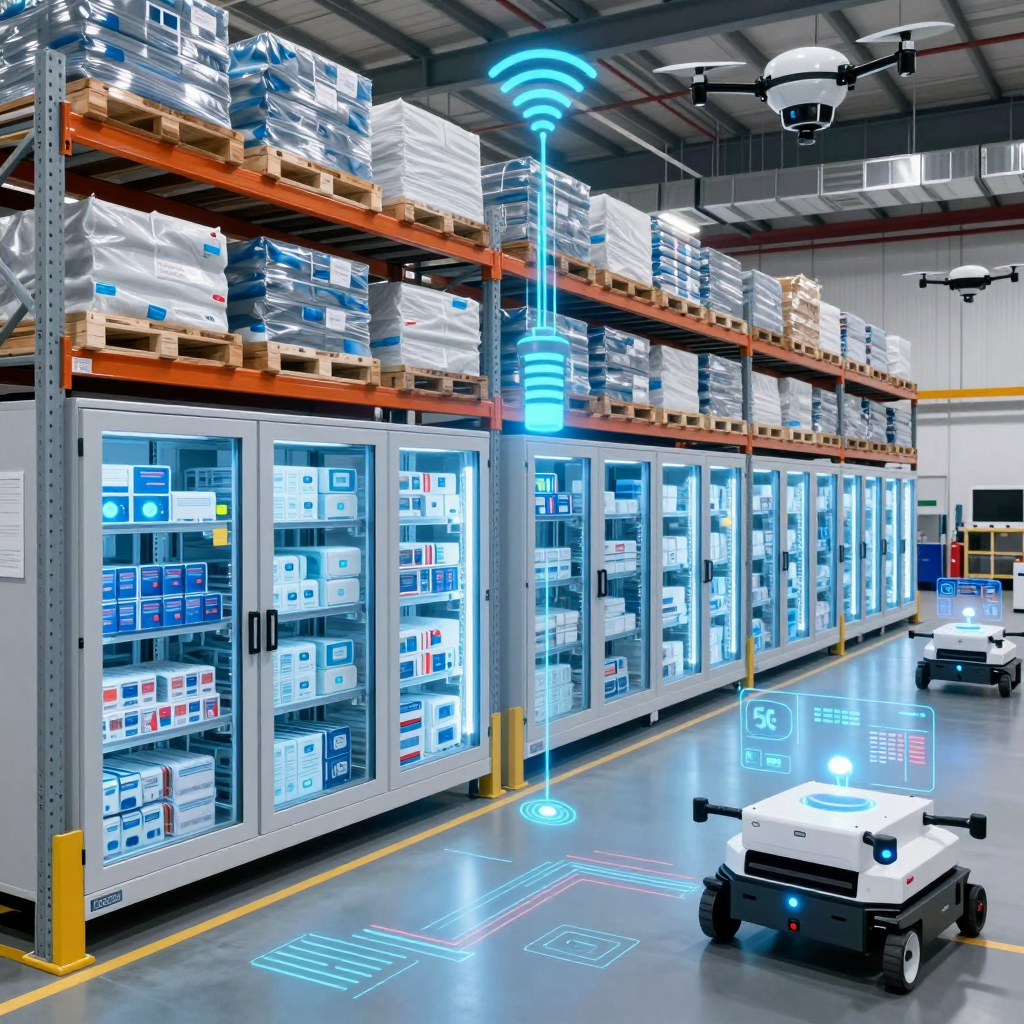
1. The Dawn of Cold Chain Logistics Innovation: How IoT is Transforming the Future
Why is IoT technology in 2026 evolving beyond simple sensors to completely reshape the logistics landscape? Let’s uncover the hidden reality behind this technological revolution.
The Evolution of IoT: From Sensors to Solutions
Whereas past IoT technology focused merely on data collection, today’s IoT has evolved to an entirely new level. This shift is especially dramatic in the logistics and cold chain industries. Moving beyond generic sensors, IoT devices now are designed specifically to fit the unique conditions of transportation and storage environments, emerging as the core of next-generation solutions.
This is not just a technical upgrade. It is a fundamental transformation redefining the entire operational fabric of the logistics industry.
Reality-Centered Design Philosophy: The New Standard of IoT
The most crucial innovation in IoT technology lies in its design centered on real-world logistics environments. While previous generations of technology obsessively chased sensor accuracy alone, contemporary IoT considers a comprehensive set of practical elements.
It begins with physical challenges: withstanding vibrations and shocks during transit while maintaining precise measurements. The ability to operate across extreme temperatures—from freezing cold rooms to ambient conditions—is indispensable. Moreover, solutions must be tailored according to the product’s characteristics—sensitivity, volume, weight—to deliver optimized, customized outcomes.
Such multifaceted requirements mean IoT devices are no longer mere sensors. They are intelligent solutions that truly understand and respond to the entire logistics ecosystem.
The Synergy with 5G Technology: A Catalyst for IoT Expansion
A key enabler behind IoT’s sophistication is the advent of 5G technology. Providing lightning-fast speeds and ultra-low latency, 5G creates an environment where IoT devices can transmit and receive massive amounts of real-time data seamlessly.
As the digitalization of logistics accelerates, next-generation IoT platforms combining real-time environmental monitoring and predictive analytics are flourishing. Logistics companies today can not only track where and under what conditions their products are at any moment but also anticipate potential future issues before they arise.
The Future of Cold Chain Industry: Enterprise-grade IoT Solutions
Currently, IoT devices are embedded across diverse fields—from home appliances and industrial machinery to medical equipment. Among these, food and pharmaceutical cold chains stand out as premier domains for IoT application.
What’s especially remarkable is that IoT solutions in this sector are evolving into enterprise-grade technologies supporting massive scalability and open platform integration. This advancement is poised to lead efficiency improvements across smart cities, advanced manufacturing, logistics, and beyond.
Ultimately, the IoT revolution in 2026 is far more than a mere technological evolution. It is becoming an indispensable infrastructure driving the logistics industry toward a safer, more efficient, and more trustworthy future.
2. The Secret to Designing IoT Devices that Reflect Real-World Conditions
How was IoT technology born to overcome the harsh conditions of actual logistics sites, from temperature fluctuations to shocks? We reveal the core principles of meticulous custom design.
Paradigm Shift in IoT Technology: From Measurement to Optimization
In the past, IoT device development focused solely on sensor measurement accuracy. It was an era where how precisely data was collected was everything. But in 2026, IoT technology has undergone a fundamental transformation—a new philosophy centered on designing around actual logistics environments.
Now, IoT devices do more than simply measure temperature or humidity. They are designed by comprehensively considering all the physical conditions a product encounters during transportation. This innovative approach is revolutionizing the reliability of the modern logistics industry.
IoT Solutions that Overcome the Triple Challenges of Logistics Sites
Real-world logistics environments are far from controlled laboratories. There are three major challenges that IoT devices must overcome.
First, vibration and shock in the transportation environment. The rough movement of cargo trucks and the impacts during loading and unloading put great stress on ordinary sensors. Modern IoT devices are engineered with reinforced structures to withstand these physical shocks while maintaining sensor accuracy.
Second, adapting to diverse temperature ranges. From frozen states (below -18℃) to refrigeration (2–8℃) and ambient temperature transport, IoT sensors must function reliably amid extreme temperature changes. Specialized IoT devices have been developed for each temperature range, optimized for battery life, sensor sensitivity, and data transmission efficiency tailored to each environment.
Third, customized design according to product physical properties. Fresh food, pharmaceuticals, precision equipment—each product differs in sensitivity, volume, and weight. Cutting-edge IoT technology adjusts monitoring intervals, sensor placement, and data transmission methods based on these product-specific characteristics.
Unleashing New Possibilities through Integration with 5G Technology
Another key factor enabling the advancement of IoT technology is the adoption of 5G technology. On a high-speed, low-latency communication infrastructure, IoT devices have evolved from mere data collectors to platforms that combine real-time environmental monitoring with predictive analytics.
This development naturally emerged as digitalization became paramount in the logistics industry. Platforms capable of monitoring product conditions in real time and detecting potential issues before they arise are actively being developed. These integrated solutions are gaining significant attention, especially in the food and pharmaceutical cold chain sectors.
Evolution into Enterprise-Grade IoT Solutions
Today’s IoT devices are no longer simple sensors. They are evolving into enterprise-grade solutions that support large-scale scalability and open platform integration. They can manage thousands or tens of thousands of IoT devices simultaneously and operate seamlessly integrated with diverse systems.
The fusion of customized design and enterprise-grade capabilities is the true secret behind modern IoT technology. Technology that reflects the actual conditions of logistics sites while enabling large-scale system integration—that is the real competitive edge leading the logistics industry in 2026.
Section 3: The Cold Chain Monitoring Revolution Brought by 5G and Digitalization
Beyond simple data collection to real-time predictive analytics, how is 5G technology reshaping the landscape of IoT logistics platforms? Let’s explore the decisive factors driving this market transformation.
The Dawn of IoT Innovation Triggered by 5G Technology
Traditional logistics monitoring systems were limited to data collection. Sensors would periodically record temperature, humidity, and shock information, which were then analyzed after the fact. But as of 2026, the full-scale introduction of 5G has fundamentally revolutionized IoT-based cold chain monitoring systems.
5G means far more than just faster communication speeds. Featuring low latency, high reliability, and massive simultaneous device connectivity, 5G networks have made possible the implementation of advanced IoT platforms that integrate real-time environmental monitoring with predictive analytics. This coincides with an unprecedented demand for digitalization in the logistics industry, ushering in a new era for cold chain solutions.
Evolution from Real-Time Data to Predictive Analytics
The progression of IoT technology represents a fundamental shift in how data is utilized. Whereas earlier systems focused on answering “What is happening now?” modern IoT platforms prioritize forecasting “What will happen next?”
For instance, if temperature fluctuations occur in a specific segment during frozen goods transport, legacy systems would only review and react to this data after delivery. In contrast, 5G-powered modern IoT systems detect temperature anomalies in real time while simultaneously using machine learning algorithms to instantly predict the risk of product damage—alerting drivers or automatically adjusting cooling systems. This marks an evolution from mere monitoring to proactive problem-solving.
Massive Scalability and the Rise of Enterprise-Grade Solutions
Considering the scale of the logistics industry, it is easy to grasp how momentous this IoT expansion is. Managing millions of sensors and devices, especially in food and pharmaceutical cold chains, requires more than basic IoT devices—it demands enterprise-grade solutions supporting open platform integration.
Cutting-edge IoT platforms currently under development integrate sensors and devices from multiple manufacturers, collecting, analyzing, and storing data via cloud-based centralized management systems. Thanks to the stable connectivity of 5G, such large-scale systems can operate effectively, enabling global logistics companies to monitor their entire supply chains at a glance.
The Ripple Effect of IoT Innovation Across Industries
Intriguingly, the advancement of IoT in cold chains is positively influencing other industries as well. Real-time monitoring and predictive analytics technologies similar to those used here are expected to drive operational efficiency improvements in smart cities, manufacturing, retail, and beyond.
This represents more than technological progress alone. The new paradigm forged by the union of 5G and IoT is ushering in a true era of data-driven decision-making. As real-time information generated at every logistics point is instantly analyzed and leveraged, a virtuous cycle emerges—minimizing waste while maximizing efficiency.
Section 4. Large-Scale Expansion and Open Platforms: The Enterprise-Level Evolution of Future Logistics
Discover the blueprint of next-generation IoT solutions that span from food and pharmaceutical cold chains to smart cities and across entire industries. Experience the untapped power of integrated platforms like never before.
The Enterprise-Level Evolution of IoT Technology: Beyond Simple Monitoring
In recent years, IoT technology has evolved from mere sensor data collectors into strategic business solutions. Today’s IoT platforms are designed based on large-scale scalability and open platform standards, enabling seamless support for complex enterprise-level operations.
At the heart of this transformation lie the stringent demands of the food and pharmaceutical cold chain sector. Environments requiring simultaneous monitoring of temperature, humidity, shock, and vibration have set the toughest benchmarks for IoT technology. Overcoming these challenges has led to the birth of truly enterprise-grade IoT solutions.
Industry Synergy Realized Through Open Platforms
The greatest difference between modern IoT solutions and their predecessors lies in their commitment to interoperability. By adopting open platforms, diverse sensors, gateways, and cloud services connect flexibly and integrate effortlessly with existing corporate systems.
This transformation goes beyond technical convenience—it’s reshaping entire business ecosystems:
- Logistics Industry: Maximizing transport efficiency with real-time tracking, predictive analytics, and automated alert systems
- Manufacturing Sector: Ensuring supply chain transparency and scientific quality control
- Smart Cities: Integrating energy management, traffic optimization, and environmental monitoring
- Healthcare: Perfectly tracking pharmaceutical storage conditions and automating regulatory compliance
The Fusion of 5G and IoT: The Technical Foundation for Large-Scale Expansion
If open platforms represent the vision, 5G technology is the infrastructure bringing it into reality. With its low latency and high throughput, 5G enables vast IoT device networks to simultaneously send and receive data—and analyze it in real time.
This capability is critical in cold chain monitoring, where thousands of containers, refrigerated trucks, and storage warehouses transmit data simultaneously, allowing for instant processing and immediate response to anomalies.
Features of Enterprise-Grade Solutions: Scalability and Reliability
Next-generation IoT platforms earn their enterprise reputation through features such as:
Large-Scale Scalability: Managing tens of thousands of sensor nodes at once and scaling effortlessly as business demands grow.
Open Architecture: Freedom from vendor lock-in lets companies select and combine the best available solutions.
High Availability: Guaranteeing uninterrupted service for logistics and pharmaceutical sectors that require 24/7 operation.
Real-Time Analytics and Prediction: Instant data analysis enables proactive problem prediction and timely response.
Future Outlook: Expansion Across All Industries
IoT technology is already widely applied in consumer electronics, industrial equipment, and medical devices. Yet, true innovation starts now. Enterprise-grade IoT solutions proven in food and pharmaceutical cold chains are set to expand into smart cities, manufacturing, energy management, and beyond—heralding a global revolution in operational efficiency.
This is more than a technological evolution. It marks the dawn of an era where data-driven decision-making, predictive maintenance, and automated optimization become fundamental across all industries. Next-generation IoT solutions equipped with open platforms and massive scalability are not just imagining this future—they are building it today.
Section 5. A New Era of Smart Logistics Realized by IoT Cold Chain Monitoring Technology
From the future of unprecedented operational efficiency driven by technology to its profound impact on our daily lives, here is a comprehensive overview of everything about IoT cold chain monitoring systems.
How IoT is Reshaping the Logistics Industry
As of 2026, IoT technology has evolved beyond being just simple “sensors.” While earlier generations of generic IoT devices focused solely on measurement accuracy, today’s IoT cold chain monitoring technology is redesigned around real-world logistics environments. This marks a pivotal moment when innovation that began in food and pharmaceutical distribution is now spreading across all industries.
Especially noteworthy are IoT solutions that comprehensively consider vibration and shock during transport, various temperature conditions like freezing, refrigeration, and room temperature, as well as unique product properties such as sensitivity, volume, and weight. This tailored design approach truly signals the dawn of the smart logistics era.
The Technological Leap in IoT Cold Chain Monitoring Powered by 5G
The widespread adoption of IoT coupled with 5G technology has made sophisticated cold chain solutions a reality. The lightning-fast data transmission speeds and ultra-low latency of 5G enable real-time analysis of information collected by IoT sensors.
Moving well beyond simple data gathering, IoT platforms now blend real-time environmental monitoring with predictive analytics, delivering tangible value on logistics floors. They not only detect temperature fluctuations during delivery but also proactively anticipate potential issues based on historical data.
How IoT Cold Chain Monitoring is Transforming Operational Efficiency
With modern IoT technology embedded across appliances, industrial equipment, and medical devices, the logistics industry is undergoing rapid transformation. The food and pharmaceutical cold chain sector is particularly evolving into enterprise-grade IoT solutions supporting large-scale scalability and open platform integration.
This evolution goes far beyond mere “monitoring.” Through IoT cold chain systems, we’re witnessing concrete efficiency gains such as:
- Minimized Losses: Immediate response to temperature abnormalities prevents product damage
- Enhanced Transparency: Real-time tracking of product conditions at every supply chain stage
- Sophisticated Decision-Making: Data-driven optimization of transportation routes and storage methods
- Regulatory Compliance: Automated IoT records ensuring adherence to food and pharmaceutical regulations
Expanding Influence from Smart Cities to Manufacturing
The revolutionary impact of IoT cold chain monitoring technology extends well beyond logistics alone. It is poised to drive operational efficiency improvements across all industrial domains, including smart cities, manufacturing, and distribution.
For example, public service facilities in smart cities must safely store and transport medicines and vaccines. In manufacturing, maintaining the quality of raw materials is crucial for production efficiency. Across these diverse fields, IoT-based cold chain monitoring is emerging as a unified, indispensable solution.
The Impact on Our Everyday Lives
Ultimately, advances in IoT cold chain monitoring translate directly into better quality products for us. Fresher food, safer medicines, and a more reliable distribution process—all these become possible thanks to the intricate work of invisible IoT sensors.
Smart logistics as envisioned in 2026 is no longer a distant dream. IoT cold chain technology is already quietly operating within our daily lives, and its influence will only continue to grow.
Comments
Post a Comment