 \n
Can the Word "Chinese" Really Be Described with Just One Image? Chinese People
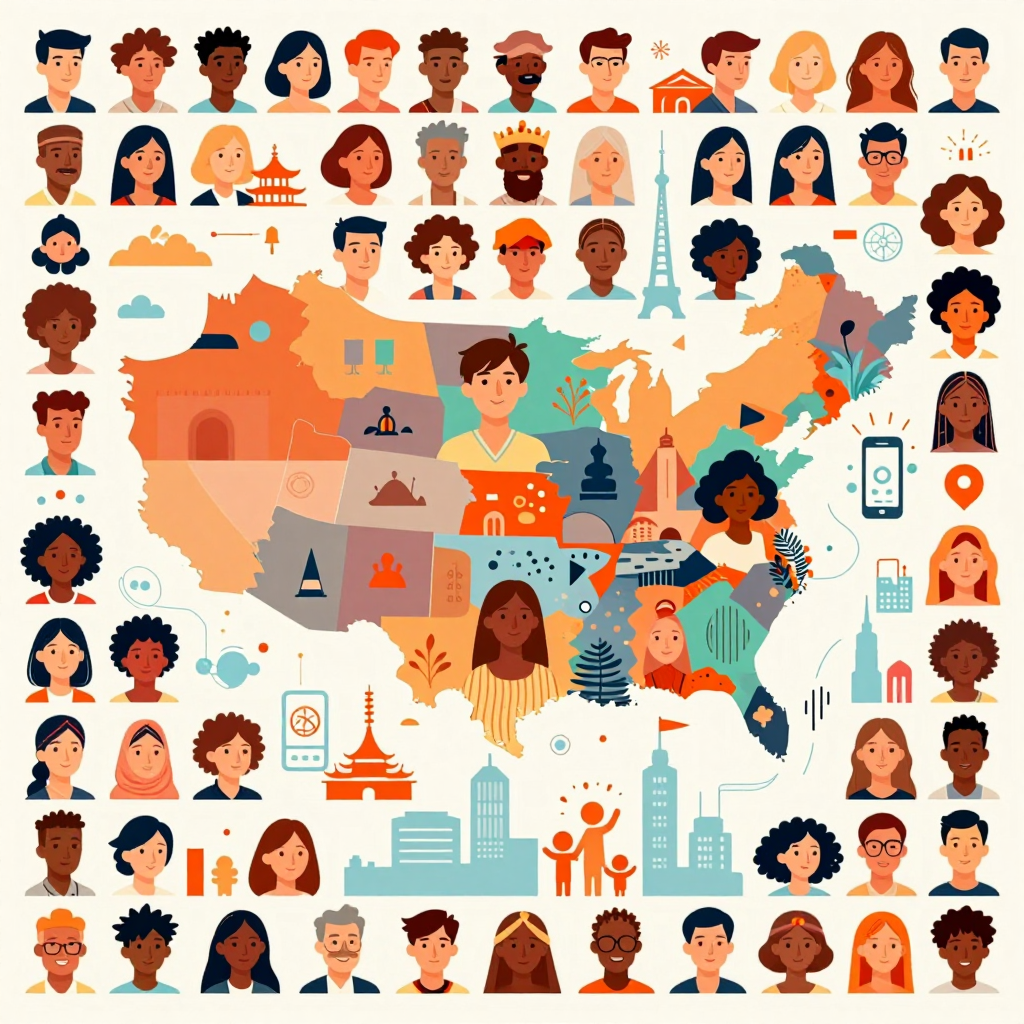
If the image you have of "Chinese people" is too simplistic, that very moment marks the beginning of your disconnect from reality. Grouping 1.4 billion people into a single personality, one culture, or one pattern of behavior might be convenient, but it’s hardly accurate. Even when we casually refer to someone as “Chinese” in daily life, we’re actually blending different groups under the same word.
Generally, the term “Chinese” mixes these layers:
- People holding Chinese nationality (including not just the Han, but all 56 ethnic groups)
- Overseas Chinese living outside mainland China (diaspora communities in Southeast Asia, North America, Europe, etc.)
- Chinese-origin groups commonly encountered in Korea (such as the Joseonjok and Chinese nationals residing in Korea)
The core point here is this: When we say someone is “like that because they’re Chinese,” we often lump together people whose nationality, ethnicity, place of residence, generation, and city size are completely different.
Thus, this article proposes one key standard. From now on, if you must explain “Chinese people,” simply passing these two questions first will significantly boost the accuracy of your writing:
- Nationality/Identity: Are they from mainland China, Hong Kong or Taiwan, or part of the diaspora?
- Generation/Region: Are they from first-tier cities (Beijing, Shanghai, Shenzhen), smaller inland cities or rural areas? Were they born in the ’90s or ’00s, or the ’60s or ’70s?
Without this distinction, when you write “Chinese people are naturally like ~~,” readers receive not understanding but stereotypes. Conversely, if you make this distinction clear, cultural keywords that follow (family-centered values, guanxi, face, educational zeal, digital consumption culture, etc.) won’t be portrayed as “all-encompassing traits,” but rather as tendencies “more frequently observed in certain groups,” making the discussion far more convincing.
The Diversity of Chinese People: Crossing Ethnicities, Generations, and Regions
When people think of “Chinese,” many automatically picture a monolithic Han-centric image. But take just one step deeper, and questions arise. Is it really only Han Chinese? Indeed not. From ethnic minorities to overseas diasporas, there are clear structural reasons why the lives and cultures of Chinese people appear exceptionally diverse.
Chinese People Are Not a ‘Single Block’ but a ‘Multi-Layered Group’
China is a multi-ethnic country constitutionally recognized as home to 56 ethnic groups. The majority is Han Chinese, yet ethnic minorities like Tibetans, Uyghurs, and Mongols differ significantly from Han Chinese in language, religion, clothing, and food culture.
In other words, statements like “Chinese people are generally ~~” actually lump together individuals living completely different worlds.
Add to this the Chinese diaspora outside the borders and the spectrum becomes even broader.
- Southeast Asian Chinese (Huaqiao/Huaren): Deeply entwined with local languages and cultures, their identity often blends “local + Chinese heritage.”
- Second and third generations in North America and Europe: Their lifestyle and mindset align more with “Chinese-descended Westerners,” sometimes feeling quite distant from mainland Chinese culture.
- Joseonjok in Korea: Their language, food, and daily life straddle both Korean and Chinese cultures, making it difficult to simply categorize them as ‘Chinese.’
In conclusion, what we commonly call “Chinese people” is much closer to a ‘complex set’ overlapping nationality (Mainland/Hong Kong/Taiwan/Diaspora), ethnicity (Han/minorities), and migration experience.
Even Among Chinese, ‘Where and When’ You Grew Up Shapes Your Life
One of the most frequently missed dimensions in understanding Chinese people is region and generation. Even among those in their 20s, living environments differ vastly between “Shanghai,” “inland small cities,” and “rural areas,” and these differences shape values and communication styles.
- Coastal metropolises (Beijing, Shanghai, Shenzhen, etc.): Fast spread of globalization, platform-driven lifestyles, and consumer trends
- Inland and rural regions: More deeply rooted community culture and traditional values
Generational gaps are also striking.
- Born in the ’60s and ’70s: Experienced upheaval and the early reform era, tending to emphasize stability and pragmatism
- Born in the ’90s and ’00s: Internet natives with freer expression but often strongly patriotic on historical and political matters
So rather than saying “Chinese people in their 20s are ~~,” it’s far more accurate to say “Among 20-somethings in major cities, there is a tendency toward ~~.”
Why the Diversity? There’s a ‘Structure’ Beyond Population Size
The layered cultural diversity of Chinese people is not simply due to their vast numbers.
Multi-ethnic makeup + regional disparities + generational experiences + diaspora expansions all operate together, making the word “Chinese” point to not a single identity but multiple maps of life.
Grasping this perspective helps us avoid saying “All Chinese people are like this” when exploring family culture, social relationships, or consumption patterns later—and instead lets us explain more vividly which groups tend to exhibit which traits.
Commonalities and Unique Traits of Chinese Culture: From Family to Guanxi and Education Fever
Why do Chinese people seem especially devoted to family-centered values? And why do guanxi (关系) and mianzi (面子) operate almost like the “rules” in business and personal relationships? Lastly, what reality underlies the intense education fever that goes beyond mere competitiveness? Grasping these three key concepts offers a richer, more nuanced understanding of the vast group we call “Chinese.”
Chinese Family-Centered Values: Why Individual Choices Become a ‘Family Project’
In Chinese society, the family often functions as more than just an emotional refuge; it plays a central role in daily life and decision-making. Major choices—such as education, employment, and marriage—are often seen not only as “my life” but as “our family’s future.”
- Why parents intervene so strongly: The child’s achievements are culturally intertwined with the family’s stability and social face.
- Impact of the one-child structure: The concentration of expectations and resources on a single child naturally increases pressure and burden.
- Pressure of filial piety (孝): Supporting parents is often accepted not as a personal choice but as a social norm.
Without understanding this context, one might wonder, “Why do they just obey their parents so unquestioningly?” But for those involved, the family is the most tangible unit for survival and security.
Chinese Guanxi (关系) and Mianzi (面子): When Relationships Outweigh Systems
In Chinese communication, guanxi and mianzi often operate as powerfully as contracts, regulations, and procedures—if not more. The strength of these forces grows especially in relationships built over time rather than first encounters.
- Guanxi (关系): Far more than mere connections, it resembles an accumulation of trust.
- Introductions and recommendations act as powerful forms of credit.
- Once formed, relationships often endure as ongoing exchanges of goodwill and loyalty.
- Mianzi (面子): There is heightened sensitivity to criticism, shame, or direct contradiction in public settings.
- Even pointing out a mistake is best done in a way that “preserves a person’s dignity” for relationship maintenance.
- Problem-solving often involves indirect and tactful communication.
This dynamic is particularly visible in business. Negotiations over terms and numbers may be straightforward, yet assigning blame or highlighting errors involves navigating “directness combined with circumspection” to avoid bruising mianzi.
The Reality Behind Chinese Education Fever: A Choice Closer to ‘Security’ than ‘Success’
For many Chinese, education is not just about prestigious universities or academic rivalry. In countless families, education is viewed as one of the very few ladders for social mobility, which fuels large investments and intense dedication.
- The stakes of exams: Life often revolves around key tests (e.g., the Gaokao), making scores a gateway to opportunity.
- Pressure of urban and regional disparities: The quality of opportunities can vary greatly by location, leading to an overemphasis on education as a tool to “overcome inequality.”
- A family-wide battle: From private tutoring and relocation to cutting household expenses, families often strategize comprehensively to support education.
Thus, Chinese education fever cannot be simply explained by a desire for achievement. More often, it is a pragmatic choice aimed at securing the future amid an often unstable reality.
Family, guanxi and mianzi, and education fever are not labels to pigeonhole the Chinese, but rather recurring coordinates of understanding within Chinese society. Approaching behaviors through these coordinates allows us to read the same actions not as “rudeness” or “excessive obsession,” but as far more accurate reflections of the structures and cultural contexts in which they occur.
Diverse Faces Emerging from Differences in Chinese Urban and Rural Areas and Generations
The moment you group a young white-collar worker from Shanghai and a youth from an inland rural area simply as “Chinese,” the explanation quickly becomes oversimplified. But in reality, differences in living environments (urban/rural) and generational upbringing (era) lead to fundamentally different values, consumption habits, social relationships, and future plans. Understanding these differences can greatly reduce misunderstandings when looking at Chinese people.
Urban (Coastal) vs. Rural (Inland) Chinese: The Same 20-Somethings Living Completely Different Lives
Twenty-somethings in major cities like Shanghai, Beijing, and Shenzhen grow up immersed in global culture and the platform economy. In contrast, youths from inland rural areas (or smaller cities) are more influenced by family and local communities, with opportunities given in very different ways.
Differences in Career Sense
- Urban white-collar workers: Job changes and career shifts happen relatively naturally, with quick choices based on “growth potential, salary, brand” metrics
- Rural/inland youth: A stronger preference for stability (government jobs, state-owned enterprises), or moving to the city itself becomes a primary goal
Differences in Consumption and Lifestyle
- Urban: Fast adoption of café culture, fitness, overseas brands, and the latest apps and services
- Inland: Consumption priorities shift more towards practical challenges like “supporting family, housing, and marriage expenses”
Ways of Building Relationships
- Urban: A tendency toward individualism grows, and relationships often form through light, goal-oriented networking
- Rural/inland: Connections remain centered on kinship and regional ties, with “introductions and reciprocal help” strongly in play
Ultimately, rather than saying “Chinese in their 20s are like this,” the accurate question is, “What kind of city (coastal/inland) and social class does the Chinese person live in?”
Chinese Generations: 60s/70s vs. 90s/00s — Points of Conflict and Integration
Generational differences are not just about trends or modes of expression, but about which historical periods they have passed through. The 60s and 70s generations experienced turbulent times and the early reform and opening-up era, while the 90s and 00s generations generally grew up confident amid the rise of the internet, mobile technology, and national growth.
Common Areas of Value Conflict
- Marriage and childbearing: Parents’ generation emphasizing “family stability” vs. younger generation prioritizing “personal choice”
- Work ethos: “Stability is paramount” vs. “Switch quickly if better opportunities arise”
- Face and hierarchy: A generation avoiding public criticism vs. a generation speaking out bluntly online
Ways Harmony Emerges
- Parents maintain influence by supporting their children’s education and housing, while the younger generation leads family decisions with digital skills and information — a kind of role exchange
- Traditional family-centered values persist but shift from “sacrificing for family” toward “making efficient choices for family”
Viewed this way, generational conflict among Chinese is not a simple “conservative vs. progressive” divide but rather a process where life strategies evolve within a family-centered framework.
One-Sentence Summary: Chinese Are Not a Single Face but ‘Faces That Change According to Circumstances’
Urban and rural residents, and those from the 60s/70s and 90s/00s generations, have lived in vastly different realities within the same country. Thus, the best question to understand a Chinese person is:
“Where did this person grow up, which generation do they belong to, and what opportunities have they had?”
From this question, explanations rooted in reality, not stereotypes, begin to take shape.
Chinese People and Korean Society & the Global Stage: Beyond Prejudice and Reality
Though Chinese people encountered in Korea may seem like a single group, in reality, their image varies greatly depending on “the path through which they came to Korea.” Misunderstandings arise when international students on campus, workers in industrial sites, and group tourists at sightseeing spots are lumped together under one label. When media coverage and policy issues (visas, labor, diplomatic conflicts) are added, the ‘individual’ face fades away, leaving only the frame of the ‘group.’
Chinese International Students: Why “Wealth” and “Distance” Are Seen Simultaneously
Chinese international students on campus are often perceived as a group with strong purchasing power. Yet, even when sharing the same space, if interaction is limited, this quickly leads to the impression of being “closed off.” Language barriers, relationship networks centered on online communities, and a competitive academic and employment environment often solidify them as ‘unfamiliar others difficult to approach.’
The core issue is not personality but environmental design. When there are few chances to mingle and lacking contextual information to understand each other, it becomes easy to jump to conclusions like “Chinese people are naturally like that.”
Chinese Workers and the Joseonjok: Essential Labor Force and Stigma Coexisting
Chinese workers (including the Joseonjok) encountered at workplaces contribute significantly to Korean society in practical terms. However, when certain incidents or crimes are amplified in media coverage, the entire group tends to be perceived as a risky population.
The crucial point here is that residence status, job type, and region—rather than nationality—shape the image. Although sharing Chinese nationality, conditions vary widely between international students, professionals, manual laborers, and marriage immigrants, determining lifestyle and social integration into Korean society.
Chinese Tourists: How ‘Actions of a Few’ Become ‘Image of the Whole’
Tourists are easily judged by noticeable behavior during a short stay. Particularly, issues around group tours, shopping routes, and queuing order leave strong memories when conflicts arise. The problem is that when such scenes meet SNS clips and sensational headlines, they get compressed into simple conclusions like “Chinese people lack public morals.”
Instead of judging national-level civic awareness in a single phrase, a closer look at travel types (group vs. independent), visited regions, guidance systems, and the quality of language support paints a more accurate picture.
Media and Policy Portrayal of Chinese People: When ‘Frames’ Replace ‘Individuals’
Because media must quickly explain events, they tend to place nationality at the story’s center. During times when diplomatic conflicts (THAAD, historical perception, etc.) or industrial competition (batteries, platforms, semiconductors) come to the fore, Chinese individuals are often consumed as representatives of the national image. Policies also tend to be framed around visas, labor, and security, leading the public to think of Chinese people not as “diverse individuals” but as “subjects to manage” first.
Three Checklists for a Balanced Understanding of Chinese People
- Which Chinese people are we talking about? Are they from mainland China, ethnic Chinese abroad (Hua Qiao/Hua Ren), or Joseonjok? (These have different nuances of nationality and identity.)
- Where did they come from and which generation are they? Values and expressions differ between major cities vs. inland areas and generations born in the 60s-70s vs. the 90s-2000s.
- Is this situation shaped by structure? Explaining behavior by individual ‘nature’ without considering language, institutions, labor environment, or tourism systems leads to prejudice.
Ultimately, the image of Chinese people seen in Korean society is less about ‘Chinese people themselves’ and more a result of the modes of contact (study, work, tourism) combined with the interpretive frames (media, policy). Holding this perspective allows conversations to shift from emotional generalizations to realistic understanding.
Comments
Post a Comment