2026 Washington DC Independence Day Fireworks: Everything About the Record-Breaking 850,000 Shell Show
 \n
dc fireworks 2026: The Biggest Night Ever - The Secret Behind Washington D.C.’s 2026 Independence Day Fireworks
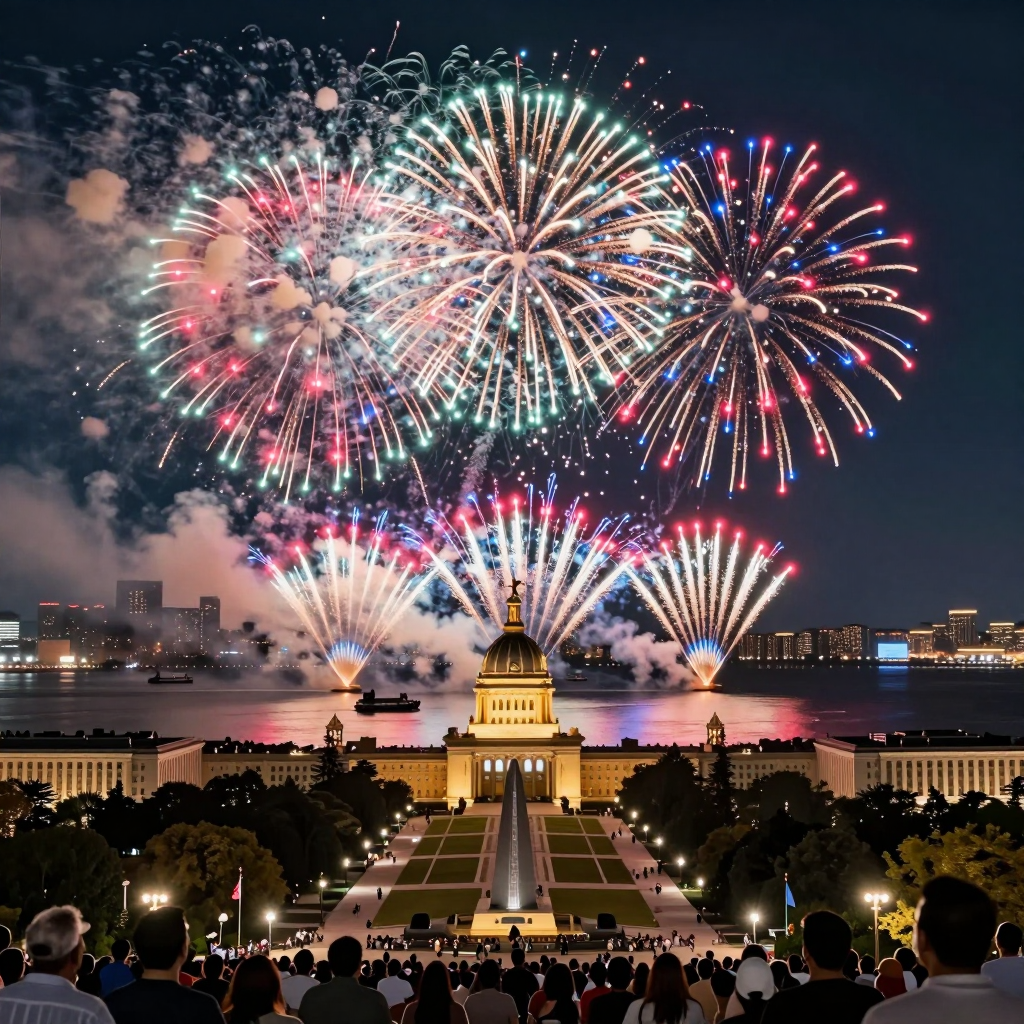
What happened under the sky ablaze with 850,000 fireworks and amidst the packed crowds at the National Mall? Celebrating America’s 250th anniversary of independence, Washington D.C.’s fireworks display was breathtaking in sheer scale. dc fireworks 2026 wasn’t just an “annual event,” but came close to the pinnacle of a national spectacle exploding under the midnight sky.
What the Name “Salute to America 250” Reveals
The official title, “Salute to America 250,” signals much more than just a July 4th fireworks show. It was designed as the capstone finale of nationwide simultaneous celebrations branded under America 250 (250th Independence Anniversary). Managed by Freedom 250, the National Mall itself became a grand stage.
850,000 Shells, 40 Minutes, 10 Launch Sites: Scale as the Statement
The reason this fireworks show has been hailed as the “largest ever” lies not in exaggeration but in its very structure:
- Approximately 850,000 fireworks
- Over about 40 minutes
- Launched simultaneously from 10 different locations
Rather than exploding “big” at one point, it was engineered to surround the entire National Mall in a 360-degree panoramic spectacle. Against the backdrop of the Washington Monument, Lincoln Memorial, and Potomac River, layers of fireworks overlapped, creating a night where spectators didn’t have to choose where to look—they were immersed everywhere.
Planned for 10:30 PM, Realized Just Before Midnight: How Weather Changed the Night’s Rhythm
The fireworks were originally scheduled to start at 10:30 PM, but D.C. faced intense heat and severe thunderstorms that threw the timeline into chaos. As evening fell, safety concerns led to an evacuation of the National Mall, shifting the mood from a celebratory festival to a brief emergency response.
Once storms subsided, the gates reopened late at night, and the fireworks finally launched just before midnight, continuing into the early hours of July 5th. This delay became symbolic—the show didn’t adhere to a preset schedule but exploded at the moment when the whole city collectively caught its breath.
What Unfolded Among the Crowd: Festival Joy and Control in Tandem
Massive events on the National Mall don’t run on excitement alone. The heart of the night was not just the fireworks but the intense operational choreography that made them possible:
- Security screenings (metal detectors) with long entry lines
- On-site safety measures like free water distribution amid the heat
- Evacuations to museums and federal buildings during the thunderstorm
- A “reset” as crowds reassembled after reopening
Spectators weren’t just passive viewers but became part of a massive flow operating within the city’s safety protocols. That’s why dc fireworks 2026 is more than just a fireworks recap—it revealed how a major outdoor event truly functions, weaving together heatwaves, storms, evacuations, and reentry in one unforgettable night.
The Natural Backlash That Shook the dc fireworks 2026 Date: Clash Between Planned Schedule and Severe Weather
On that day when a heatwave warning and thunderstorms hit simultaneously, how did thousands of spectators react? Why was the program, originally set for 10:30 PM, pushed back to just before midnight? The core drama of dc fireworks 2026 wasn’t about the fireworks themselves, but how the weather reshaped the schedule and crowd flow.
The Plan Was Clear: “10:30 PM, 40-Minute Show”
The prior announcements for Freedom 250 were straightforward. From daytime, performances and flyovers took place around the Washington Monument area. After the security gates opened at 5 PM, crowds gathered in the mall, leading up to the 10:30 PM (ET) fireworks kickoff—culminating in a roughly 40-minute grand finale.
From the spectators' perspective, it was a typical Independence Day flow: “Arrive early to claim a spot, then enjoy the peak show at 10:30 PM.”
Reality Was Different: Heatwave → Thunderstorms → Complete Evacuation
However, D.C. faced an Extreme Heat Warning starting in the morning, putting strain on attendees’ stamina and safety well before sunset. Then, as evening approached, a Severe Thunderstorm Watch was issued, rapidly changing the scenario.
The critical moment came around 7 PM when authorities ordered a full evacuation of the National Mall, forcing crowds to relocate to nearby federal buildings and museums. This wasn’t just a delay—it was a complete clearing of the space, essentially a reset. From this point on, dc fireworks 2026 became less of a celebration and more of a weather risk management operation.
How Did Thousands Move? The Regathering Began at “Reopening”
After evacuation, a key question was not just “Where did people go?” but “When could they gather again?” Reports indicate that by around 9:45 PM, the storm subsided enough for the gates to reopen, allowing spectators to stream back into the mall.
Having been forced out once already, the flow was disrupted, and reentry involved another round of security checks, route coordination, and crowd control. Naturally, the fireworks timing had to be pushed back.
Why Just Before Midnight? A Domino Effect of Speeches, Reopening, and Safety Checks
The delay wasn’t due to a single cause but a chain reaction:
- The evacuation cleared the space, breaking the “basic schedule”
- After 9:45 PM reopening, time was needed to reassemble the crowd
- From 11:15 to 11:53 PM, Trump delivered the “Salute to America 250” speech
- Immediately following the speech, the fireworks began, igniting roughly just before midnight (around 11:50 PM)
Ultimately, what was planned for 10:30 PM unfolded well into the early hours of July 5th, after a process of confirming safety → reopening the area → rearranging the program. Still, the show itself lasted about 40 minutes as originally intended, delivering a delayed but powerful finale.
DC Fireworks 2026: Beyond the Fireworks—The Political Stage of Trump and the ‘America 250’ Performance Strategy
What seemed like a simple celebration, DC Fireworks 2026, was in fact a stage that reconstructed the “national holiday” into a “political event.” The fireworks were merely the grand finale; the narrative that kept audiences engaged all day was meticulously woven through President Trump’s ‘patriotic parade’-style direction. As a result, the 40 minutes that lit up the skies of Washington D.C. became a scene read not only as a ‘celebration’ but also as a powerful ‘message.’
The Three-Stage Structure Packaging DC Fireworks 2026: Sports – Fair – Military Show
A key feature of this event was that the fireworks were not an independent program but positioned as a capstone finale tying together multiple events in a single continuum.
- Sports (White House UFC “Freedom 250”): Placing a popular genre that reaches audiences beyond political discourse upfront heightened attention.
- Fair (National Mall’s “Great American State Fair”): Wrapping the event in festive colors framed it as a ‘patriotic event open to everyone.’
- Military Flyover and Airshow: Repeated visual emphasis on the military, a symbol of strong national capital, directly linked state authority with the holiday’s emotional resonance.
Within this sequence, the fireworks became “the day’s conclusion.” Audiences who came for the fireworks found themselves fully immersed in a production where the nation, city, and president overlapped in a single scene.
The Politics of Scale: Headlines Forged by 850,000 Fireworks
The event was pre-announced with the phrase “the LARGEST FIREWORKS SHOW IN HISTORY,” designed so that the scale itself became the message. Indeed, the specs—about 850,000 shells, 10 launch sites, 40 minutes of continuous display—were easily translated into the language of ‘records’ rather than just ‘spectacle,’ perfectly suited for news headlines and social media diffusion.
In other words, while awe seems like a natural reaction, the target of that awe tends not to be the fireworks technology but the presence of political orchestration. The moment “how big it was” connects directly to “who made it,” the fireworks cease to be a festival and instead become a device proving the scale of power.
The Fusion of Music and Space: ‘YMCA’ and the National Mall Creating Symbolic Synthesis
As NPR reported, the site echoed with Trump’s signature song, ‘YMCA,’ and the stage was the National Mall—capturing Washington Monument, Lincoln Memorial, and the Capitol in a single frame—the very axis of American political symbolism. This combination proved unexpectedly powerful.
- The music set a ‘festival’ atmosphere,
- The space elevated the scene into a ‘national ritual,’ and
- Placing the president within this context naturally reshaped the message into a ‘leader-centered narrative.’
Thus, DC Fireworks 2026 does not end with just “the fireworks were spectacular.” In a city where anything can be commemorated and any element can be turned into a symbol, the stage was set, and the fireworks functioned as the most sensory and striking conclusion.
DC Fireworks 2026: A National Event in the Era of Climate Crisis—Risk Management Amid Extreme Heat and Thunderstorms
What safety measures were put in place at the site where extreme heat and thunderstorms overlapped? Why was an evacuation order issued in temperatures soaring above 40°C (104°F), and what challenges did event operations face? DC Fireworks 2026 was not only a “largest-ever spectacular fireworks show” but also a vivid example of how climate risks can upend the management of national events.
DC Fireworks 2026 Heatwave: Safety Took Precedence Over Spectating
On that day in Washington D.C., meteorological authorities issued an Extreme Heat Warning that lasted from morning through evening. The problem wasn’t simply “it’s hot” — it was that a massive crowd spending prolonged hours outdoors faced the risk of cascading emergencies like heatstroke, dehydration, and fainting.
Taking this into account, organizers announced free water distribution and prepared rest areas and response routes, but the heat directly challenged event quality in several ways:
- Queue risks: Longer lines at security checkpoints (metal detectors) meant extended ‘heat exposure’ for attendees.
- Medical response burden: The intense heat can rapidly worsen even mild symptoms, making medical staff, treatment spaces, and evacuation routes critical.
- Reduced scheduling flexibility: Under extreme heat, “just wait a little longer” becomes impossible. The longer people wait, the exponentially higher the safety costs.
DC Fireworks 2026 Thunderstorms and Evacuation Order: “Lightning Was More Dangerous Than the Fireworks”
As strong thunderstorms approached in the evening, authorities announced a full evacuation of the National Mall. The core reason for evacuation was not simply rain but the dangers posed by lightning strikes and gusty winds. Since the National Mall is a large open area, gathering crowds there made them extremely vulnerable to lightning hazards.
In reality, attendees moved to nearby museums and federal buildings to seek temporary shelter, and without this measure, what was meant to be a “festival” could have quickly turned into a “disaster site.” An important point is that from the moment the evacuation order was issued, event management did not merely delay the fireworks but completely shifted into a different operational mode.
- Crowd movement (evacuation) = the biggest variable: When tens of thousands move simultaneously, guidance, control, and preventing collisions become brand-new challenges.
- Difficulty in reopening: The event doesn’t resume just because the rain stops. After verifying safety, reopening gates and re-admitting spectators becomes another complex operation.
- Communication of uncertainty: The harder it is to give a clear answer to “When will it start again?”, the more confusion and fatigue spread among the crowd.
DC Fireworks 2026 Operational Challenges: The Era of ‘Conditional Progress’ Rather Than ‘Forcing Ahead’
Ultimately, the gates reopened late at night, and the fireworks were pushed back to just before midnight. This timeline was not a mere accident but illustrated that national events in the climate crisis era are increasingly approaching conditional operations (weather-dependent management).
- Weather volatility is no longer an ‘exception’ but a basic premise, and
- large-scale events now need to prioritize multiple scenario planning—including evacuation, reopening, and delay plans—over strict “on-time” proceedings.
DC Fireworks 2026 left behind more than just grand fireworks; it raised realistic questions that outdoor national events must face in the future. How can we build a system focused not on “bigger” but on “safer”? That urgent task became crystal clear amid the heat and lightning on the National Mall.
Traffic, Security, and Broadcasting Behind the Success of DC Fireworks 2026: A Comprehensive Guide for Visitors and Media Alike
Where and how could people truly enjoy the event? From entrance queues and free water distribution to TV broadcasts and online streaming—the ultimate way to enjoy the 2026 Washington fireworks at 200% capacity surprisingly depended less on the “fireworks” themselves and more on traffic flow, safety, and viewing routes. Just like the record-breaking scale, the operations were on a massive scale too.
DC Fireworks 2026 On-Site Admission: “Where You Enter” is Half the Battle Won
The National Mall viewing centered around the area near the Washington Monument, and the first major challenge visitors faced was the entry queue.
- Main entry points: Approaches from Constitution Ave NW or Independence Ave SW
- Queue convergence: Movement funneled near 14th St NW
- Security check start time: Metal detectors (magnetometers) activated from 5 PM onward
- Key tip: The advice to “arrive early” wasn’t just lip service; it was the only realistic way to reduce waiting times.
Especially at large-scale events, where you enter and when you arrive make all the difference in satisfaction. When the fireworks themselves started close to midnight (due to weather delays), your “entry time” directly affected “where you ended up watching from.”
DC Fireworks 2026 Transportation and Parking: Driving is ‘Not Recommended,’ Not Just ‘Impossible’
The official tone was clear: parking was extremely limited, practically narrowing your choices to just two options.
- Public transit (Metro): The most reliable mode of transport, repeatedly recommended
- Ride-share (Uber/Lyft etc.): Convenient for access, but heavy delays expected post-event due to demand surges and restricted zones
On days with variables like evacuation and re-entry (gate reopening), road closures and crowd flows changed multiple times. Thus, the critical question isn’t “Can I bring a car?” but rather “Do I have a plan for getting home?”
DC Fireworks 2026 Heatwave and Thunderstorm Preparedness: Free Water and ‘Evacuation Protocols’ Proved Life-Saving
In 2026, D.C. faced a severe heat alert followed by intense thunderstorms, exposing the vulnerability of outdoor events. The operational focus was not “atmosphere” but survival and safety.
- Complimentary water distribution: Official response based on heat risks
- Realistic evacuation guidance: A full evacuation of the National Mall was carried out at dusk, with visitors directed toward nearby federal buildings and museums
- Re-entry after reopening: Gates reopened after weather calmed, allowing spectators back in
The takeaway from that day was simple: The quality of a massive fireworks show depends on a foundation of safe operations. Designing for “adaptive responses” rather than “fixed plans” preserves the viewing experience.
DC Fireworks 2026 Broadcasting and Streaming: Catching Every Moment on ‘Multi-Platform’ Even If You Can’t Be There
When on-site attendance was difficult or uncertain due to weather delays, the strength of the broadcast infrastructure truly shined. This event was not just a standard TV broadcast but a multi-platform event combining public and online offerings.
- Special TV programming: CBS, CNN, FOX, and others packaged pre-events, speeches, and the fireworks display
- C-SPAN live stream: A free channel to watch the presidential speech and fireworks
- Official live stream (Freedom 250): Originally scheduled for 10:30 PM, it covered the main show despite delays
- Monument Cam (webcam): Provided a bird’s-eye view from the Washington Monument for immersive on-site perspective
- YouTube live and replay: Multiple channels spread real-time and recorded coverage widely
In summary, DC Fireworks 2026 wasn’t just an event consumed at one location—it was a national event completed simultaneously across on-site, TV, public streams, webcams, and YouTube platforms. Whether present or not, the doors were open to connect in your own way.
Comments
Post a Comment