 \n
\n
Ceuta, Europe’s Gateway Fortress in Africa
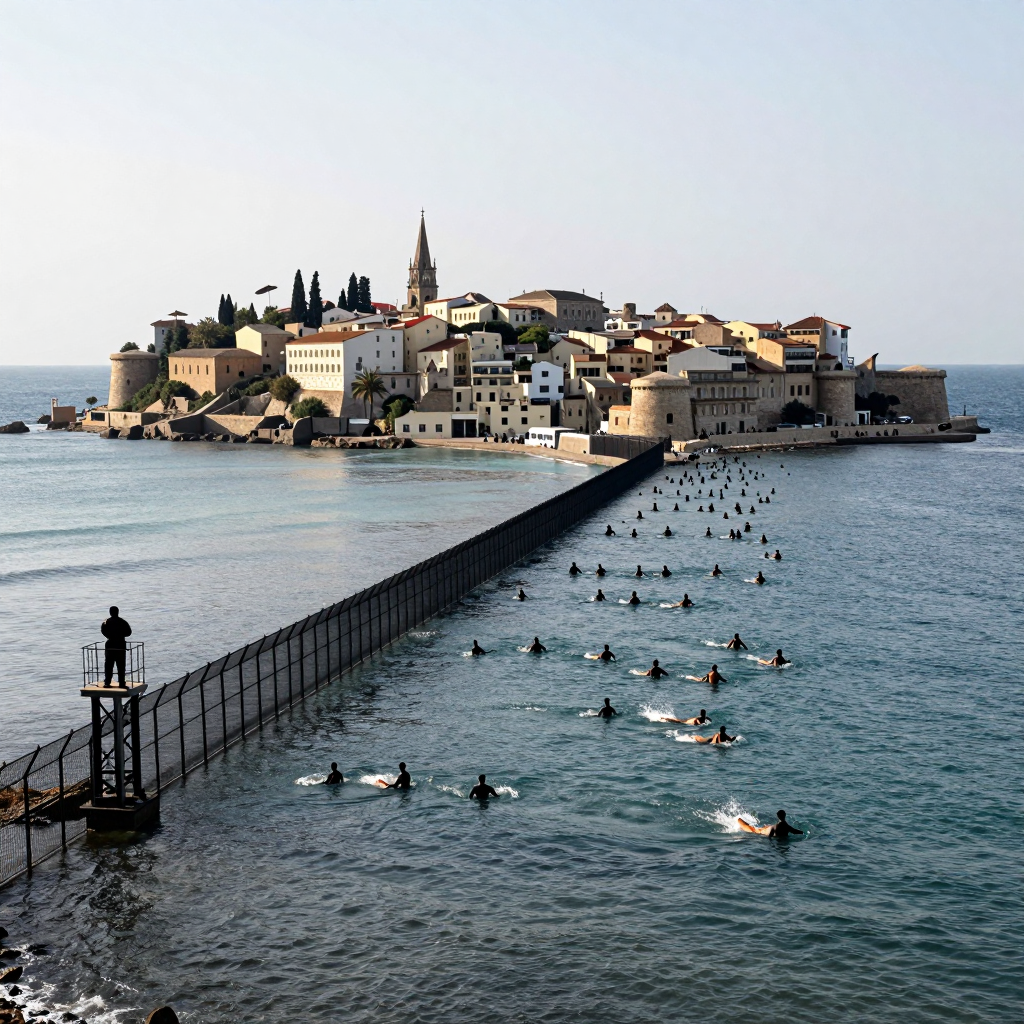
Thousands of people plunge into the sea, heading toward a small city at the northern tip of Africa. Despite the dangers of night waters, strong currents, and hypothermia, they are not making for a Moroccan port. They are heading toward Ceuta, legally part of Spain and the European Union (EU).
The city covers just 18.5 square kilometers and has a population of approximately 85,000. Yet because of its unique location—across the Strait of Gibraltar, attached to Morocco’s northern coast—this small city has become one of the most acute testing grounds for European border policy.
Ceuta lies on the African continent but is an autonomous city governed under the Spanish Constitution. It uses the euro, Spanish law applies there, and it serves as an external border of the European Union. Sharing an approximately 8-kilometer land border with Morocco, Ceuta, together with Melilla, is regarded as one of the only de facto land gateways where the EU directly meets Africa.
The reason the city has once again drawn attention is clear. Thousands of migrants have attempted to reach Ceuta by climbing over its border fences or swimming across the sea, and some have died in the process. The city’s reception facilities, medical services, and security personnel have rapidly approached their limits, prompting the Ceuta government to request additional police and military support from the central government.
Yet this situation cannot be viewed simply as a “surge in illegal migration.” Ceuta is a place where human mobility, border control, refugee protection, and the sovereignty dispute between Spain and Morocco all converge. Morocco regards Ceuta as an “occupied territory” and does not recognize Spain’s sovereignty over it. This is why analysts argue that whenever relations between the two countries deteriorate, border management can function as a tool of diplomatic pressure.
That is why Ceuta’s double fences and maritime patrols are more than mere physical barriers. They are a symbol of the questions facing Europe: how far can it go to defend its borders, and how will it protect human lives and legal rights in the process? A small European door set on African soil, Ceuta now stands on the front line of a question that all of Europe can no longer avoid.
Ceuta, Those Who Crossed the Sea: A Crisis Told in Numbers
In recent weeks, more than 1,500 people have attempted to cross the sea from Morocco’s coast toward Ceuta. Rather than climb the border fence, they chose the cold strait and its powerful currents. Some entered the water at night without even basic flotation equipment, and in the process, at least nine people lost their lives.
The numbers make the speed of the crisis even clearer.
- From January 1 to July 15 this year, 2,826 irregular migrants arrived in Ceuta
- A 149% increase from the 1,133 who arrived during the same period last year
- Ceuta’s reception facilities are rapidly approaching capacity
- Spanish authorities are calling for additional police and military support
But statistics alone cannot convey the full weight of this scene. Choosing to swim across the sea to reach Spanish territory is not simply an act of crossing a border. It is the result of overlapping fears and hopes: the possibility of a dangerous return, an unstable life, the pressure to survive, and the belief that reaching Europe could change the future.
On a map, Ceuta may be a small port city. But its coastline has now become one of the harshest front lines where Europe’s migration policies collide with humanitarian principles. Caught between the demand to defend the border and the responsibility to rescue human beings, the night sea has become the stage for the most perilous choice—every day.
Ceuta: A Diplomatic War Beyond the Border Fence
Ceuta’s border fence is far more than a barrier designed to stop people from crossing. Along its tangled steel wires, Morocco and Spain’s territorial dispute, the European Union’s border policies, and migrants’ struggle for survival all collide at once. The small city of Ceuta now serves as one of the most sensitive political levers along Europe’s southern frontier.
Morocco defines Ceuta and Melilla as “occupied territories” within its own land and refuses to recognize Spanish sovereignty over them. Spain, meanwhile, regards the two cities as territories fully integrated into its constitutional system—and, by extension, as part of the EU’s external border. Because the two countries fundamentally disagree over the legitimacy of the border itself, migration can quickly escalate into a diplomatic confrontation.
In particular, the intensity of Morocco’s border enforcement is often interpreted as a signal of the state of relations with Spain. A recurring pattern has been observed: when tensions between the two countries rise, border controls loosen and movement toward Ceuta surges. From Spain’s perspective, migration flows are therefore not merely a matter of public security; they can also become a form of diplomatic pressure wielded by a neighboring country.
The EU’s policy dilemma further complicates the situation. Europe strengthens fences, surveillance systems, and maritime patrols to prevent irregular entry. Yet for those attempting to cross the sea, authorities also bear obligations to conduct rescues and protect human rights. As legal constraints on the practice of immediately sending intercepted migrants back grow stronger, the divide between border control and humanitarian principles becomes increasingly stark.
Ultimately, Ceuta’s crisis cannot be solved simply by making the fence higher. Border management, asylum screening, expanded reception facilities, diplomatic cooperation with Morocco, and responsibility-sharing at the EU level must all move together. The confrontation unfolding across a single line of fencing is one of Europe’s sharpest tests—forcing it to confront how it will reconcile migration, sovereignty, and human rights.
The Sea Between the Military and the Courts: Ceuta’s Dilemma
Spain has urgently deployed 60 army troops and 200 special police officers to Ceuta to protect its border. As thousands attempt to cross the sea from the Moroccan coast or scale the border fence, the small port city’s capacity to provide shelter and maintain security is rapidly reaching its limit.
But reinforcements alone cannot seal the border. Recently, Spain’s Supreme Court put the brakes on the practice of immediately returning migrants rescued or intercepted at sea to Morocco without following due process. When people are found at sea, the state cannot simply treat them as border violators. Rescue, identification, and an assessment of their need for protection must follow as part of a legal procedure.
The ruling confirms an important principle in the protection of human rights. At the same time, it creates a more complicated reality on the ground. Ceuta’s reception facilities are already overcrowded, while medical staff, interpreters, and personnel to assess asylum claims are in short supply. As the practice of immediately returning people after intercepting them at sea is restricted, the burden of processing new arrivals is pushed into the city itself.
In Ceuta, protecting the border and protecting people at sea have become inseparable challenges.
The military can support border order and public safety. But it cannot take the place of asylum authorities, child-protection services, medical support, or the state’s obligations under international law. Conversely, the court’s ruling safeguards procedural rights, but if implemented without sufficient funding and personnel, it could deepen the confusion on the ground.
Ultimately, Ceuta’s path forward will not end with higher fences or more troops. Spain’s central government must expand reception capacity, cooperate meaningfully with Morocco, and secure responsibility-sharing at the EU level. This crisis, which began at sea, is no longer merely a matter of border control. It has become a test of how Europe will protect both security and human rights.
The Questions Ceuta Poses to America’s Border Debate
Ceuta’s crisis is not solely a European story. The deployment of troops to the border, courts putting the brakes on executive repatriation policies, and a neighboring country using migration flows as a diplomatic bargaining chip all bear a striking resemblance to the debates surrounding the U.S.–Mexico border.
Is Deploying the Military a Solution—or a Sign of Crisis?
Additional police and military personnel have recently been deployed to Ceuta. The small city’s reception facilities and security forces were struggling to cope with the surge in arrivals. This calls to mind the recurring debate in the United States over deploying the National Guard and federal personnel to the southern border.
The military can quickly strengthen surveillance, rescue, and logistical capabilities. But a military response alone cannot address the root causes driving migration, including poverty, conflict, the climate crisis, and human-smuggling networks. In fact, as borders become more dangerous, people may choose even more perilous routes.
The Courts and the Executive: Who Draws the Line on Border Policy?
A key factor in the Ceuta crisis has been the Spanish judiciary’s decision to halt the practice of immediately returning migrants intercepted at sea to Morocco. It is a case in which the need for border control collided head-on with due process and the principles of refugee protection.
The United States is no different. Executive actions concerning asylum procedures, detention, deportation, and policies requiring migrants to wait outside the country have repeatedly clashed with the rulings of federal courts. Ceuta’s case shows that border policy does not end with an administrative order. Rapid action at the border may be necessary, but approaches that bypass legal rights and humanitarian standards can create even greater conflict over the long term.
Migration Flows Can Become a Tool of Diplomatic Pressure
The relationship between Ceuta and Morocco reveals that migration is not merely a matter of public security; it is an issue where diplomacy, territorial sovereignty, and economic negotiations intersect. How strictly Morocco enforces border controls has a direct impact on Spain and the European Union.
The United States, too, cannot design border policy without cooperation from Mexico and other Latin American countries. Migrant enforcement, efforts to combat human smuggling, repatriation agreements, refugee protection, and economic assistance are all linked to diplomatic relations. In other words, a border is not simply a line on a map—it is a space where trust between neighboring countries is put to the test.
The Questions Beyond the Numbers
The people who have died trying to cross the sea from Ceuta are not statistics; they are individuals who felt they had no choice but to risk their lives. The same is true at the U.S. border. If the success of border control is measured solely by the number of arrests or deportations, issues involving rescue, protection, and screening capacity may be pushed aside.
The central question Ceuta poses is clear: Can borders be controlled while preserving human dignity and the rule of law? And can migration be addressed not merely as a threat, but as a long-term challenge shaped by diplomacy, economics, and humanitarian concerns? The crisis unfolding in this small African territory of Europe is becoming a mirror reflecting the future of America’s border debate.
Comments
Post a Comment