What is Self-Evolving MLOps? A 7-Step Analysis of Seamless AI Model Retraining and Generation Replacement in Manufacturing Sites
 \n
\n
The Hidden Challenge of MLOps in Evolving Manufacturing Floors: Focusing on Model Aging
Why is the ‘aging’ phenomenon that affects countless sensors and AI models installed in manufacturing processes an issue that cannot be ignored? Just like machines on the brink of breakdown, AI models also suffer performance degradation over time. The problem is that this decline doesn’t come in the obvious form of a “failure” but rather quietly erodes productivity, quality, and cost efficiency.
Understanding ‘Model Aging’ from an MLOps Perspective
Models on the manufacturing floor typically handle tasks such as:
- Defect prediction / quality scoring
- Anomaly detection (equipment or process abnormalities)
- Process condition optimization (recipe recommendations, parameter tuning)
When deployed initially, these models perform well. But as time passes, data distributions shift (Drift), causing model performance to deteriorate. This phenomenon is known as model aging.
Just as machines lose performance due to “wear and tear,” models experience “alignment wear” with reality caused by factors like:
- Sensor replacement/calibration: Changes in sensor manufacturers, calibration cycles, measurement units, etc., alter data characteristics
- Process recipe changes: Adjustments in temperature, pressure, or speed shift the boundaries between normal and abnormal
- Raw material variability: Changes in suppliers or batch differences shake input data properties
- Line expansion / equipment aging: Applying the same model on different production lines accumulates subtle discrepancies
In other words, manufacturing models aren’t “one-and-done” software; they are more like living entities constantly exposed to on-site changes. Addressing these issues systematically demands MLOps.
Why Model Aging Signals Are Particularly Dangerous in MLOps: “Performance Declines, but No One Notices”
The critical danger of model aging in manufacturing is that performance degradation gets obscured within operational metrics:
- Defect prediction models: Recall drops causing missed defects, but delayed label confirmation postpones issue detection
- Anomaly detection models: False alarms increase, turning warnings into “noise,” eventually leading operators to ignore alerts (alert fatigue)
- Optimization models: Minor accumulated errors gradually raise raw material and energy costs, yet root cause tracking is difficult
A typical scenario unfolds as:
- Model performance slowly declines
- The floor only senses “something feels off”
- Causes are analyzed belatedly, followed by retraining and redeployment
- In the meantime, accumulated defects, downtime, and costs become confirmed losses
The core insight is clear: model aging is both a ‘technical’ and an ‘operational’ problem. Thus, rather than simple model tweaks, a full lifecycle approach—including monitoring, diagnosis, retraining, and deployment—is essential: the very heart of an MLOps system.
Two Technical Drivers Describing Model Aging in MLOps: Data Drift vs Concept Drift
Model aging generally stems from two main changes:
- Data Drift: Changes in the distribution of input data
- Example: Sensor replacement alters the mean/variance of a specific temperature sensor’s readings
- Concept Drift: Changes in the relationship between inputs and the correct outputs
- Example: Recipe changes redefine what level of vibration counts as “normal”
In manufacturing, these two drifts occur simultaneously and repeatedly. Therefore, managing model aging properly requires more than just observing “performance drops.”
You must also track:
- How input data has shifted (statistics and distribution changes)
- How those changes impact performance (performance trends and KPI effects)
- Whether changes represent temporary noise or structural shifts (persistence and correlations)
This is precisely where MLOps-driven monitoring and observability begin.
The MLOps Answer to the Question: “When Should We Retrain?”
The essence of the model aging problem is straightforward:
“Retraining is inevitable—but when is the safest and most cost-effective time to do it?”
MLOps replaces guesswork with operational criteria such as:
- Performance degradation thresholds: Trigger warnings or actions if predictive performance stays below a benchmark for a set period
- Drift indicators: Initiate root cause analysis or retraining when input distribution shifts exceed thresholds
- Integration with on-site events: Intensively check model status following equipment swaps or recipe adjustments
Without such criteria, manufacturing AI risks falling into the classic trap of “successful initial demos but failed live operations” over time. The next section explores self-evolving approaches that answer the question: ‘Can the system autonomously detect and respond to model aging?’—an evolved breakthrough in MLOps.
What Is the Self-Evolving MLOps Ecosystem?
“AI that retrains and evolves itself without human intervention?”
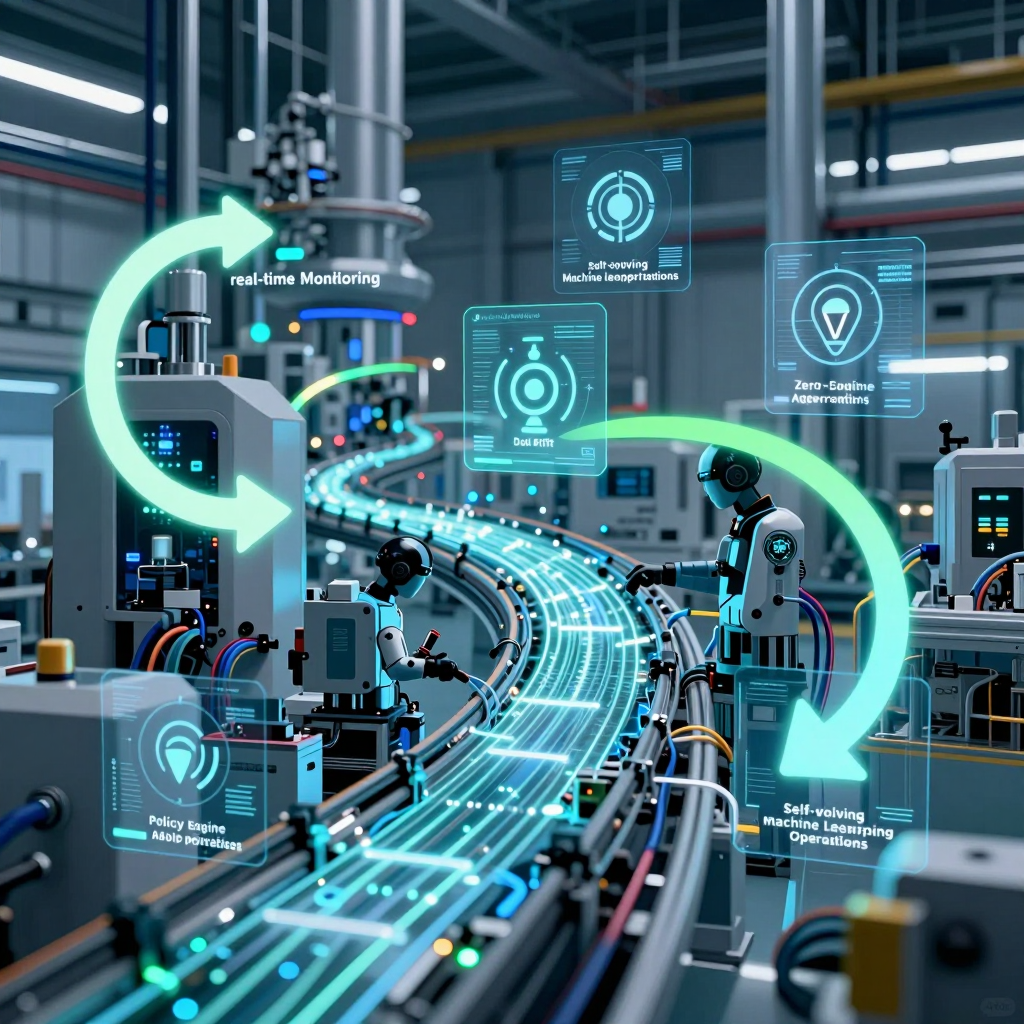
If this sounds exaggerated, you might not have yet experienced the transformation happening on manufacturing floors. The Self-Evolving MLOps Ecosystem is the next-generation operational architecture designed so that models, even after deployment, continuously monitor their own status, detect aging, and autonomously trigger retraining or replacement when needed. The key breakthrough is moving beyond “automated operations” to a whole new level of “autonomous evolving operations.”
How Is It Different from Traditional MLOps?
Conventional MLOps typically follows this flow:
- Deploy the model
- Detect anomalies through monitoring
- Have humans analyze the root cause
- Manually trigger retraining, validation, and redeployment
The problem is, in domains like manufacturing and industrial IoT where environments subtly change all the time, this process tends to respond ‘too late.’ Even minor shifts in data distribution caused by sensor replacement, equipment calibration, or process recipe changes gradually degrade model performance (model aging). However, humans often only recognize this after quality issues have already occurred.
The self-evolving ecosystem challenges this norm by asking,
“Why must humans be the ones to detect model anomalies and start retraining?”
Defining the Self-Evolving MLOps Ecosystem: Self-Diagnosis → Self-Retraining → Self-Replacement
This ecosystem ties model operations into a closed autonomous loop:
- Self-Diagnosis: The system continuously monitors data drift and performance degradation, not merely sending alerts but assessing meaningful aging signals
- Self-Retraining: When conditions are met, pipelines automatically launch to retrain and tune candidate models with the latest data
- Self-Replacement: Only models that pass offline evaluation and live traffic validations (e.g., shadow or canary testing) are seamlessly swapped in without downtime, with automatic rollback on failure
In other words, while traditional MLOps revolves around CI/CD + Monitoring, the self-evolving ecosystem adds automated decision-making (Policy Engine) and a safe, zero-downtime generation replacement mechanism to realize truly “self-updating” model operations.
The Core Engine: The Policy Engine Decides ‘When to Change’
The standout difference in this architecture is the Policy Engine. Monitoring is ubiquitous, but automatically deciding when to retrain and when to deploy is an entirely different challenge.
Typical policies include:
- Trigger Conditions: Retraining only initiates if performance metrics stay below a threshold for a sustained period (filtering out temporary fluctuations)
- Drift Conditions: Automation levels increase only if statistical drift surpasses specific thresholds and show strong correlation with domain events (e.g., equipment replacement logs)
- Safety Conditions: Manufacturing safety requirements are enforced through policies limiting retraining frequency, performance variation, and capping specific error types (e.g., false negatives)
- Human-in-the-Loop Conditions: In scenarios with high uncertainty or risk, automatic deployment is blocked, switching to an approval process
Thanks to this policy engine, the self-evolving MLOps system is not just a “good alarm machine” but a system that ‘acts’ based on pre-defined criteria.
Why Is This a Paradigm Shift in Manufacturing AI Operations?
Manufacturing environments change frequently, and these changes directly impact quality and cost. The operational shift brought by the self-evolving ecosystem is clear:
- Transitioning model performance management from ‘reactive fixes’ after the fact to continuous prevention
- Automating event-driven retraining, validation, and deployment to accelerate quality risk response times
- Designing model replacement with zero downtime, reducing the deployment risks feared by operation teams
- Capturing operation policies as code and logs, shifting governance from “who changed what when and why” to “which policy made what change based on what evidence”
In summary, the Self-Evolving MLOps Ecosystem redefines manufacturing AI as not a “deploy-once project,” but a living operational system that survives and adapts to on-site changes autonomously. This marks a fundamental shift in manufacturing AI operations—from emphasizing “model development capabilities” toward prioritizing automation in operations and policy design capabilities.
Complete Analysis of Self-evolving MLOps Architecture: From Monitoring to Seamless Model Replacement
How does self-evolving MLOps simultaneously achieve high-level automation and operational safety from model monitoring to seamless generation replacement? The key lies beyond merely “good monitoring”: interpreting observations into policies and automatically triggering actions (retraining, validation, deployment)—locking this Self-evolving Loop into the architecture. Below is the most convincing layer breakdown used in the field.
MLOps Observability Layer: Automating “Problem Awareness” as the Foundation
The starting point of self-evolving MLOps is observability. Here, observability is not just simple server metrics but a framework that encompasses data, models, and business signals together.
Data Drift Monitoring
- Continuously track shifts in input features’ distributions (mean/variance/quantiles), changes in categorical ratios, and sudden spikes in missing rates.
- Representative detection methods: KS test, PSI, ADWIN, etc. (In practice, evaluation uses a bundle of metrics, not a single indicator.)
- Key point: Drift means “change” but does not equate to “performance degradation.” Therefore, integration with the next layer (diagnosis/policy) is essential.
Model Performance Monitoring
- Monitoring design varies depending on whether ground-truth labels arrive immediately (real-time) or with delay.
- Online, proxy metrics (e.g., alert rate, classification score distribution changes) quickly capture anomalies,
- After label collection, precise metrics (Accuracy/F1/RMSE, class-wise Recall, etc.) confirm “actual performance drops.”
Operational & Business Observability
- In manufacturing, environmental event logs—such as process parameter change history, sensor replacements/calibrations, and line recipe modifications—are integrated to enable root cause analysis.
- These logs provide the system with grounds to explain “why the model aged.”
MLOps Diagnosis & Policy Engine Layer: The Brain of Automation
Traditional MLOps often relies on human judgment reviewing monitoring outcomes. Self-evolving MLOps takes one step further: the system itself makes decisions. This layer enables the automatic transition from “observation → action.”
Aging Diagnosis Logic
- Distinguishes whether declines are trend-based rather than temporary fluctuations (e.g., sustained drop over 2 weeks, drop magnitude relative to volatility, structural changes following process events).
- Diagnoses whether drift signals and performance drops coincide and identifies which feature changes cause the issue (feature importance shifts, SHAP distribution changes, etc.).
Core Design of the Policy Engine
- Defines rules on “when to automatically trigger retraining.”
- Example policy concepts:
- Retrain if performance metrics stay below threshold for T hours and drift metrics exceed D.
- Immediately generate candidate models if specific safety metrics (e.g., False Negative rate) approach critical thresholds (deployment requires approval).
- Automatically halt retraining and alert operators if retraining frequency exceeds a threshold (e.g., more than N times per week).
- Practical tip: Start conservatively with simple rules plus exception handling (switching to human intervention) to ensure stability.
Realistic Implementation of Human-free Routine
- Not “fully hands-off,” but safely switching between autonomy during normal times and Human-in-the-loop during anomalies.
- The policy engine acts as both the automation’s engine and its “brake” to stop automation when necessary.
MLOps Retraining & Evaluation Layer: Automatically Creating and Validating Candidate Models
Once the policy engine triggers, the pipeline must reproducibly run without human intervention. The critical point is not just retraining but generating multiple candidate models and safely filtering them through evaluation.
Automated Retraining Pipeline
- Collect recent data windows (last N days/weeks/months) → data cleaning and label consistency checks → feature generation (linked with Feature Store) → training/tuning all in one workflow.
- Since tuning is costly, it’s effective to differentiate between “lightweight tuning” and “full tuning” based on policy rules.
Two-stage Evaluation: Performance + Safety
- Performance evaluation: Check improvements compared to current production model, class-wise metrics, and performance on data slices (lines/machines/product groups).
- Safety/Operational evaluation: Especially in manufacturing/industry, excessive or missing alarms carry high costs, so hard gates for critical metrics (e.g., recall lower bounds, false negative upper bounds) are enforced.
- Result: Models that simply “look better” are not advanced—only “deployment-eligible models meeting all conditions” move forward.
MLOps Deployment & Seamless Model Replacement Layer: Change Without Interruption
The true challenge of self-evolving MLOps lies more in “replacement” than in “training.” The deployment layer comprises mechanisms that ensure services and production lines never halt even if new models cause problems.
Shadow Deployment
- Attach new models to live traffic without using their outputs for decision-making; only collect comparison logs against existing models.
- In manufacturing quality and anomaly detection, this stage enables “real-world validation without field risk.”
Canary / Blue-Green Deployment
- Canary: Gradually ramp traffic (e.g., 10% → 30% → 100%) while verifying stability.
- Blue-Green: Run two parallel environments and switch between them, enabling fast rollback.
- Regardless of method, the core is the same: deployment must be a process accompanied by verification, not just an event.
Automatic Rollback (Fail-back)
- If new model metrics exceed thresholds, automatically revert to the previous version.
- Threshold definitions must integrate with the policy engine, and operators must receive the rationale and evidence for changes.
MLOps Governance Layer: The Lifeline of Automation Is Record-keeping
Self-evolving systems offer convenience, but without knowing “when and why changes occurred,” operations become a black box. Hence, the higher the automation, the more governance is a must.
Audit Trail
- Document retraining trigger reasons (drift/performance/event logs),
- training data scope, feature versions, hyperparameters, evaluation results,
- deployment methods (Shadow/Canary), and rollback status all in a cohesive flow.
Stepwise Automation According to Regulation
- In lightly regulated domains: expand automation from “candidate generation → validation → deployment.”
- In highly regulated domains: realistic design applies boundaries like “auto candidate generation/validation + manual final approval.”
Key Summary from the MLOps Perspective: The ‘Self-evolving Loop’ Connecting Layers Makes the Difference
Self-evolving MLOps isn’t just a list of separate technologies (monitoring, retraining, CI/CD).
It systematically binds Observability → Diagnosis/Policy → Retraining/Evaluation → Seamless Replacement → Governance into a closed loop, enabling self-evolving operations.
Well-designed, this structure transforms models from disposable deployment artifacts to production systems that safely update themselves aligned with environmental changes.
Self-Evolving MLOps Scenario Applied to Real-World Manufacturing Sites
Process sensor data changes in ways that are almost impossible to detect with the naked eye. Tiny offsets in pressure sensors, shifts in temperature controller response characteristics, and viscosity variations caused by batch changes in raw materials — these “small tremors” accumulate, silently aging a model that was once accurate.
The true power of self-evolving MLOps lies in creating an operational loop that never misses these subtle changes, automatically retrains the model, and deploys updates without ever stopping.
MLOps Field Setup: ‘Silent Performance Degradation’ Experienced by Defect Prediction Models
- Target Process: Assembly/processing lines with multivariate sensors (temperature, pressure, vibration, current, etc.)
- Model Role: Predict defect risk on a batch-by-batch basis to trigger proactive actions (rework, process adjustment, enhanced inspection)
- Problem Pattern
- Sensor calibration changes after equipment maintenance,
- Fine-tuned process recipes, or
- Shift changes between night/day operations
cause the input data distribution to drift gradually, yet operators hardly notice it.
Consequently, defects are missed (increased False Negatives), or unnecessary alerts increase (rising False Positives), leading to loss of model trust on the shop floor.
MLOps Observation Phase: Capturing Data Drift and Performance Decline Simultaneously
Self-evolving MLOps goes beyond simply detecting “drift,” it combines data distribution changes with model performance trends to craft precise aging signals.
1) Data Monitoring (real-time/batch)
- Detect distribution changes per feature using KS test, PSI, window-based methods (e.g., ADWIN)
- Monitor sensor missing rates, noise, and range violations
- Store process event logs (equipment replacement, recipe changes, inspection history) alongside data to leave “clues for root cause analysis”
2) Performance Monitoring (accounting for delayed labels)
- In manufacturing, labels (inspection results) frequently arrive with delay.
Therefore, prediction time and label confirmation time are separated, enabling:- Recalculating metrics like F1, Recall, and defect detection rate after labels are confirmed
- Detecting persistent downward trends using rolling averages over 2 or 4 weeks
- On the floor, safety metrics like defect miss prevention (Recall, upper bound on False Negatives) are prioritized over overall accuracy.
MLOps Policy Phase: Quantitatively Deciding ‘When to Trigger Automatic Retraining’
Observation alone is insufficient. The core of self-evolving MLOps is that policies (Policy Layer) trigger automatic retraining to keep the model fresh.
Example policy (site-oriented):
Retraining trigger conditions
- Defect Recall over the last 10 business days drops by more than 3 percentage points from baseline AND
- At least 2 out of 5 major features exceed PSI thresholds AND
- Process event logs record equipment inspection/replacement events
→ Retrain only when all three conditions are met, preventing excessive retraining
Human-in-the-loop (HITL) conditions
- More than 3 retrainings occur within a month
- New candidate model shows significant performance gain (e.g., sharp Recall increase) but experiences abrupt spike in false alarms in specific segments
- Accompanied by data quality alerts (sharp rise in missing rates, sensor range violations)
→ Block automatic deployment and switch to approval workflow
Thanks to this policy layer, operations shift from “humans interpreting monitoring dashboards” to the system autonomously taking actions based on clear criteria.
MLOps Retraining Phase: Generating Candidate Models from Fresh Data and Passing Safety Criteria
Once the policy engine decides to retrain, the pipeline automatically performs:
1) Data Collection/Cleansing
- Automatically load latest 30 days or N recent batches
- Prioritize using data with “confirmed labels,” considering label delays
- Remove outliers, filter sensor spikes, synchronize intervals (timestamp alignment)
2) Feature Reproduction (Feature Store-based)
- Reuse the same feature pipeline for training and serving to prevent skew between them
3) Multiple Candidate Model Generation
- Generate 5–20 candidates via algorithm and hyperparameter search
- Select models meeting field constraints rather than just highest scores
- e.g., upper bounds on defect misses (False Negatives), minimum Recall for specific product lines, alert frequency limits
4) Evaluation and Risk Checks
- Offline performance comparison plus segment-level analysis (product line, equipment, shift)
- Check for overfitting signs especially in segments with large data distribution shifts
- Conduct “guardrail tests” assessing impact of model changes on process safety
MLOps Zero-Downtime Deployment Phase: ‘Never-Stopping’ Model Rollouts via Shadow → Canary
Downtime in manufacturing means cost. Thus, self-evolving MLOps is designed on the premise of zero-downtime replacement.
Shadow Deployment
- Attach the new model as a “shadow” to produce predictions on actual traffic without influencing decisions
- Compare outputs against the current model under real conditions to verify stability
Canary Rollout
- Gradually increase traffic coverage: 10% → 30% → 100%
- At each stage, automatically monitor:
- Defect Recall, alert rate, processing latency (SLA adherence)
- Localized failures showing degraded performance only in certain equipment or product groups
Automatic Rollback
- Instantly revert to previous model upon threshold violation
- Log rollback events and relevant signals (drift, data quality, performance metrics) to inform next policy improvements
Through this seamless process, models don’t “quietly age” but continuously undergo generation updates aligned with subtle field changes.
MLOps Operational Outcomes: Tangible Improvements Felt on the Floor
Once self-evolving MLOps stabilizes, manufacturing sites typically see:
- Faster response times as the system detects performance drops early, rather than relying on human late discovery
- Model replacement becomes a continuous operational loop instead of a scheduled project
- Production system risk reduces thanks to zero-downtime deployments, increasing floor acceptance and trust
- All retraining and deployment evidence is logged, simplifying audit and root cause analysis
The key takeaway:
Subtle changes in sensor data directly trigger retraining and safe model replacement without interrupting service. This is the operational innovation self-evolving MLOps brings to real manufacturing environments.
Challenges and Tasks for Engineers Preparing for the Future of MLOps
The vision of “models that learn and replace themselves automatically” is undeniably captivating. However, the moment Self-evolving MLOps enters real-world operations, engineers face questions even tougher than improving performance.
Let’s explore the hidden risks behind full automation, the limits of automation within regulatory environments, and the new skills required to operate such systems.
MLOps Risk 1: False Positives/Negatives in Drift Detection Can Escalate into Operational Failures
The starting point of self-evolving MLOps is detecting drift and performance degradation. The problem is that detection can never be perfect.
- False Positives: Statistically, the distribution may shift, but the change might have little to no business impact.
- Consequence: Unnecessary retraining happens frequently, increasing deployment events, operational complexity, and costs.
- False Negatives: Metrics remain stable while real process changes accumulate prediction errors.
- Consequence: Quality or safety thresholds are breached later than they should be, leading to greater losses.
Therefore, from a technical standpoint, drift metrics alone (PSI, KS test, etc.) should not trigger automatic retraining. Instead, they must be combined with:
- Performance metric trends + duration of deviation
- Alternative metrics considering label latency (e.g., changes in prediction distributions, uncertainty, downstream KPIs)
- Correlation with process event logs (equipment replacement, recipe changes)
- A stepwise pipeline: Alarm → Diagnosis (root cause analysis) → Policy decision → Execution, rather than simply Alarm → Retrain → Deploy
The key is not mere “detection” but the quality of decision-making after detection, where MLOps evolves from a monitoring system into an operational control system.
MLOps Risk 2: Over-retraining Breaches Cost Boundaries and Destroys Consistency
Frequent automatic retraining hurts more than just GPU or cluster costs.
- Rapid model version changes can break prediction consistency
- Field operators lose trust as the system’s decisions differ day to day
- Downstream components (alerts, automatic control, inventory/logistics optimization) suffer cascading decision variability
To prevent this, the policy engine must enforce:
- Retraining cool-down: Limits retraining frequency within a set period
- Minimum performance improvement threshold: No replacement for “just a minor improvement”
- Safety and quality constraint gating: Deployment is blocked if certain error rates (e.g., false negatives) exceed a limit
- Guaranteed minimum shadow/canary periods: No generation swapping without sufficient real-traffic validation
In short, automation in self-evolving MLOps should be about changing more safely, not just learning more frequently.
MLOps Risk 3: Black-box Operations and Accountability — It’s Not “Who Changed It?” but “Why Did It Change?”
As the self-evolving loop stabilizes, organizations paradoxically feel more uneasy because operators find it harder to grasp real-time changes — creating a black-box operation.
What’s needed in practice is not just logs but auditability:
- Which metrics crossed thresholds?
- Which policies were triggered (rules, weights, exceptions included)?
- What data scopes and feature versions were used for training?
- Which validations (offline, shadow, canary) passed?
- What criteria drove rollbacks in failure cases?
These records go beyond fault analysis; they form essential evidence for accountability, internal controls, and regulatory compliance. This is why, in self-evolving MLOps, the governance layer becomes more important than mere serving infrastructure.
Regulatory Challenges in MLOps: Designing “Partial Self-evolving” Systems Where Full Automation Is Impossible
In heavily regulated industries like finance, healthcare, and pharmaceuticals, the very concept of “models deploying themselves” might not be permitted. The practical workaround is Partial Self-evolving architectures:
- Automated:
- Drift and performance detection, data collection and cleansing, candidate model training, offline evaluation report generation
- Human-in-the-loop required:
- Final deployment approval, threshold policy changes, model replacement for specific risk groups
Here, engineers must design architecture not in terms of “automation vs manual,” but clearly delineate what decisions the system makes autonomously and what requires human approval. In other words, success in self-evolving MLOps hinges not on model performance but on the quality of approval, control, and audit design.
Shifting Skill Sets in MLOps: From Model Builders to Designers of Policy and Safety
As self-evolving MLOps becomes reality, the skills demanded of engineers evolve dramatically:
- Advanced Observability: Ability to connect data, models, and business KPIs to explain “why anomalies matter”
- Policy Engineering: Quantifying retraining/deployment conditions and designing exception scenarios (rules + statistics + decision logic)
- Safe ML Deployment Strategies: Managing shadow/canary/blue-green deployments, automatic rollback, and defining stop conditions for generation swaps
- Data/Feature Governance: Ensuring reproducibility including feature versions, label quality, and data lineage
- Domain Understanding: Knowing field risks in manufacturing, logistics, finance, etc., to ensure policy thresholds serve as realistic safety guards
In summary, future MLOps demands more than pipeline automation skills. The core competitive advantage lies in the ability to safely govern systems that change automatically.
Comments
Post a Comment