2026’s Latest Edge AI Technologies: The Future of the Intelligent Edge Powered by the EU EdgeAI Project
 \n
\n
AI’s Counterattack from Beyond the Cloud: Edge AI
What would happen if the network went down at the exact moment a factory camera detected the faintest sign of equipment trouble? If the system had to send all the data to the cloud and wait for a decision, it could lose those crucial few seconds. The result could be anything from a halted production line to a serious safety accident.
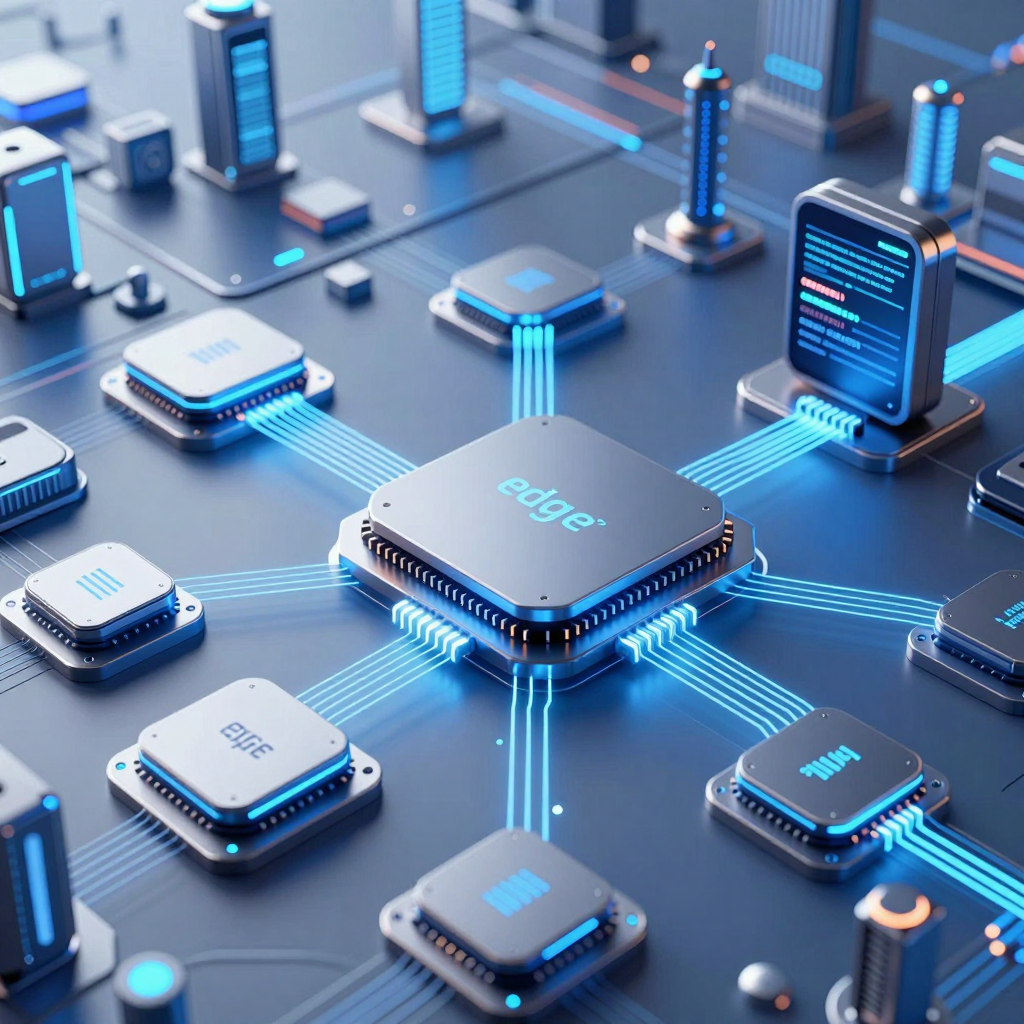
Edge AI begins with precisely this challenge. Rather than sending data to a distant data center for processing, it is a computing paradigm in which AI performs inference directly on the device where the data is generated—and takes action immediately.
For example, factory cameras, IoT sensors, vehicles, smartphones, and industrial gateways can perform AI inference based on video, sound, vibration, and temperature data collected on-site. Once they determine whether something is abnormal, they can quickly trigger a chain of actions, such as issuing a warning, shutting down equipment, or notifying the person in charge.
Why Edge AI Is Needed
Traditional cloud AI excels at large-scale computation and centralized data analysis. However, sending all data to the cloud has several clear limitations in on-site environments.
- Latency: Transmitting video or sensor data, having a server analyze it, and receiving the results again takes time. In areas such as autonomous driving, robot control, and equipment safety—where responses are required within milliseconds—this can be critical.
- Network dependency: If communications become unstable or are interrupted, cloud-based decision-making can also come to a halt. Edge AI, by contrast, can continue performing essential inference even in offline environments.
- Privacy and security: For data that is difficult or risky to send outside—such as video from inside a factory, medical data, or vehicle operation information—processing it on-site is safer.
- Bandwidth and cost: Continuously transmitting raw data generated by hundreds of cameras and thousands of sensors drives up both network and cloud processing costs. Sending only the necessary results selected at the edge can significantly reduce this burden.
In other words, rather than completely replacing the cloud, Edge AI enables a division of roles: the edge makes immediate decisions on-site, while the cloud handles training, integrated analysis, and long-term management.
How Edge AI Makes Decisions on Site
At the heart of Edge AI is the deployment of AI models on edge devices such as sensors, cameras, gateways, and in-vehicle computers. These devices preprocess collected data locally, execute model inference, and, when necessary, send control signals immediately.
For instance, a predictive maintenance system analyzes equipment vibration and noise in real time. When it detects a pattern that differs from normal behavior, the AI can assess the likelihood of a failure and send a slowdown or shutdown signal to the equipment control system. In this case, the cloud does not need to receive every raw signal. It only needs summarized information such as the time of the anomaly, its risk level, and the equipment’s condition.
Achieving this requires more than simply installing a small AI model. It also calls for low-power chips and AI accelerators that can operate within limited power and memory constraints, lightweight and quantized models, middleware that connects heterogeneous devices, and systems for remote updates and security management.
The Stage of AI Infrastructure Moves On Site
At the center of this shift are initiatives such as the EdgeAI project being pursued by the European Union. The project seeks to design microelectronics for the edge, processing architectures, connectivity, AI software, algorithms, and middleware as a single full-stack system.
The key point is that this is not merely about “moving AI from the cloud onto smaller devices.” The goal is to redesign hardware and software together so they can operate quickly and securely within limited resources, while building an infrastructure that organically connects sensors, cameras, PLCs, and gateways across industrial sites.
The next AI competition will not be determined solely by who builds the largest model. It will also depend on how quickly, safely, and reliably decisions can be made at the very place where data is generated. Edge AI is emerging as the most practical answer to that question.
Edge AI: The EU’s EdgeAI Project Is Designing the Entire Stack—not Just a Chip
Can true Edge AI be achieved simply by deploying an AI model on a small device? No matter how accurate the model is, it has little practical value in industrial settings if it stops working when power is limited, memory runs short, or the network goes down.
This is precisely where the EU’s EdgeAI project comes in. The project goes far beyond developing a specific AI chip or a single piece of software. It aims to create an intelligent processing foundation optimized for edge environments by designing microelectronics, processing architectures, connectivity, AI algorithms, software, and middleware as one integrated system.
Edge AI Must Start with a Different Kind of Chip
Edge devices operate under very different conditions from cloud servers. Cameras, sensors, industrial gateways, vehicles, and robots must make rapid decisions with limited power and memory. As a result, general-purpose CPUs alone struggle to handle high-performance AI inference efficiently.
The microelectronics and new processing architectures emphasized by the EdgeAI project are designed around these constraints.
- Low-power computing design: AI inference must be possible even on battery-powered or always-on equipment.
- AI acceleration architectures: Dedicated accelerators such as NPUs can rapidly perform video analysis, anomaly detection, and sensor data classification.
- Memory optimization: Data movement and storage must be minimized so that models and data can run within limited on-chip memory.
- Hierarchical processing: Sensors, devices, gateways, and local servers divide responsibilities and process data at different levels.
For example, a vibration sensor on factory equipment can detect early signs of abnormal behavior on-site and send only the necessary summary information to a higher-level server. This reduces network traffic and cloud costs while accelerating responses to equipment failures.
Software and Middleware That Turn Model Performance into Product Performance
Real-world Edge AI does not end with a trained model file. Models must operate reliably across chips, sensors, operating systems, and communication environments from different manufacturers. That is why the EdgeAI project treats algorithms and middleware as elements just as important as the hardware itself.
An edge software stack generally needs the following capabilities:
- Model compression and quantization: Reduce model size and computational requirements so models can run on resource-constrained devices.
- Hardware-specific compilation and optimization: Convert the same model to suit CPU, GPU, and NPU environments.
- Model deployment and OTA updates: Update models and software without physically retrieving equipment from the field.
- Device fleet management: Monitor the status of hundreds or tens of thousands of cameras, sensors, and gateways.
- Security and authentication: Protect on-site AI systems through secure boot, device authentication, and access control.
In other words, middleware is the operational layer that connects AI models to real-world equipment. In industrial environments, deployment, updates, incident response, and security matter just as much as model accuracy. The maturity of this layer ultimately determines how effective Edge AI will be in practice.
Connectivity Is Essential to Creating an “Intelligent Edge”
Edge environments are not completely isolated devices. They are distributed systems in which multiple devices and servers work together. This is why the EdgeAI project includes connectivity as part of its design scope.
In the field, sensors collect data, gateways perform initial analysis, and local servers or the cloud handle more complex analysis only when necessary. In this process, communication technologies such as 5G and 6G, industrial networks, and time-sensitive networking (TSN) are more than simple channels for transmitting data. They are part of the Edge AI architecture that determines what data is processed where and when it should be sent to higher-level systems.
In fields such as predictive maintenance, autonomous mobile systems, and smart-city safety monitoring—where responses are required within milliseconds or tens of milliseconds—waiting for a round trip to the network is not an option. The ability to infer and control operations instantly on-site is essential.
The defining difference of the EU’s EdgeAI project is not that it “moves AI to the edge,” but that it redesigns the entire technology stack so AI can operate continuously at the edge.
This approach can be seen as part of Europe’s strategy to secure an independent Intelligent Edge foundation for industrial and public systems—one that goes beyond serving as a supporting layer for cloud-centered AI infrastructure. Ultimately, future competitiveness will depend not only on larger models, but also on Edge AI infrastructure capable of making decisions more safely and rapidly, closer to where they are needed.
Field Intelligence Driven by Ultra-Low-Power Edge AI Chips and Hierarchical Architectures
How would industrial systems change if, instead of sending every piece of raw data collected by sensors to the cloud, they could immediately determine on site whether there is “no abnormality” or whether an “immediate shutdown” is required?
The answer goes far beyond simply improving speed. Factory equipment, logistics systems, and smart-city infrastructure that once depended on network connectivity are now shifting toward a structure in which they make decisions and take action autonomously where the data is generated. This transformation is precisely why the EU EdgeAI project is attracting attention.
Ultra-Low-Power Microelectronics That Transcend Power Constraints
Sensors, cameras, and controllers deployed in the field cannot be equipped with data-center-class GPUs. Battery life, heat generation, installation space, and cost are all tightly constrained. As a result, the core of Edge AI lies not only in achieving high computing performance, but also in how efficiently the necessary inference can be performed within limited power budgets.
To achieve this, the EU EdgeAI project identifies edge-optimized core electronic components and new processing architectures as key development targets. In practical terms, the following directions are particularly important:
- Ultra-low-power MCUs and MPUs: They must collect sensor data and handle basic control while still being capable of running small AI models.
- NPUs and AI accelerators: They process tasks involving repetitive matrix operations—such as image classification, anomaly detection, and speech recognition—more efficiently than CPUs.
- Memory optimization: Because edge devices have limited memory capacity, it is crucial to reduce model parameters and intermediate processing data.
- Lightweight models: Technologies such as quantization, pruning, and TinyML help strike a balance between accuracy and power consumption.
For example, if a vibration sensor on a factory motor sends the signals it collects to the cloud every second, communication traffic and costs continue to rise. By contrast, if an ultra-low-power chip analyzes vibration patterns, it can retain only a brief “no abnormality” result under normal conditions and transmit detailed data only when signs of failure are detected.
This approach reduces communication costs while dramatically shortening response times to equipment anomalies.
A Hierarchical Structure Connecting Sensors to the Cloud
Field intelligence cannot be achieved with a single powerful device. It requires a hierarchical architecture in which sensors, equipment, gateways, local servers, and the cloud divide responsibilities among themselves.
A typical Edge AI structure can be organized as follows:
| Layer | Primary Role | Examples of Processing | |---|---|---| | Sensor and Device Layer | Immediate detection and ultra-lightweight inference | Vibration anomaly detection, object detection, temperature threshold assessment | | Edge Gateway Layer | Data integration across multiple devices and more advanced inference | Multi-camera analysis, comparison of equipment conditions | | Local Server Layer | Site-level analysis and operational optimization | Quality analysis by factory line, production schedule adjustments | | Cloud Layer | Long-term storage, large-scale training, and model management | Model retraining, analysis of data across all facilities |
The key point is that not every decision is made in the same place. Decisions directly related to the safety of people or equipment must be processed close to the sensor or device. By contrast, comparing long-term data from multiple factories or training new models is better suited to the cloud.
In other words, edge technology does not completely replace the cloud. It is a technology that places tasks requiring immediate decisions directly in the field.
How Industrial Systems Change When “Immediate Shutdown” Becomes Possible
In industrial environments, even a delay of several tens of milliseconds can make a major difference. When a person enters a hazardous area, a conveyor belt operates abnormally, or a robotic arm deviates from its expected path, there is no time to wait for a round trip to the cloud.
Edge AI-based systems can analyze camera and sensor data on site and directly execute controls such as:
- Sending a warning when a worker is detected not wearing required safety equipment
- Automatically slowing down or stopping equipment when an intrusion into a hazardous area is detected
- Generating a preventive maintenance alert when abnormal motor vibration is detected
- Automatically separating defective products when visual defects are detected
- Immediately controlling vehicles or logistics robots to avoid detected obstacles
With this structure, raw video or complete sensor logs do not need to be continuously transmitted outside the site. Most data is processed locally, while only the information needed for incident analysis or model improvement is selectively sent to higher-level systems. This is beneficial not only for reducing bandwidth costs, but also for protecting manufacturing and video data.
Why Hardware and Middleware Must Be Designed Together
Simply installing an AI model on an edge device is not enough to create an operational environment. In industrial settings with hundreds or thousands of connected cameras and sensors, model deployment, performance monitoring, security updates, and device management must all be handled together.
For this reason, the EU EdgeAI project treats middleware as a key component alongside chips and algorithms. Middleware is the intermediate layer that connects and operates sensors, cameras, controllers, and gateways from different manufacturers.
Field-ready middleware typically needs to provide the following functions:
- AI model deployment and version management for each device
- Remote updates through OTA
- Monitoring of inference latency and power consumption
- Device authentication, secure boot, and access control
- Communication abstraction for heterogeneous equipment such as sensors, cameras, and PLCs
- Event logging and integration with higher-level systems when abnormal situations occur
Ultimately, the competitiveness of field intelligence is not determined by the performance of a particular chip alone. A reliable Edge AI system is completed only when low-power hardware, lightweight AI models, real-time networks, and operational middleware are connected as a single stack.
This full-stack approach is precisely what the EU EdgeAI project aims to achieve. The field is transforming from a simple place for collecting data into an intelligent operating environment that can see, make decisions, and respond immediately on its own.
Edge AI’s Harder Problem Isn’t the Model—it’s Operating Thousands of Devices
Just because an object detection model works well on a single camera does not mean Edge AI has been successfully deployed in the field. The moment thousands of devices are deployed across factories, logistics centers, retail stores, vehicles, and smart cities, the nature of the problem changes completely.
In the field, questions emerge that are just as important as model accuracy—if not more so:
- Which version of the model is deployed on each device?
- How can a device recover if the network goes down during an update?
- How can legacy devices and the latest AI accelerators be managed together?
- How can malfunctions or performance degradation be detected?
- How can devices and models be protected from tampering by external attackers?
The technology that answers these questions is Edge AI middleware. This is why people say that the real battleground in Edge AI is not the model itself, but the platform layer that operates models and devices at scale.
The Core Roles of Edge AI Middleware
Middleware is the operational layer that connects diverse equipment—such as sensors, cameras, gateways, industrial controllers, and local servers—with AI software. It is more than a simple connectivity tool: it is the foundation that makes it possible to manage distributed AI systems as a single service.
In large-scale environments, the following capabilities are especially essential.
| Operational Function | Why It Is Needed | |---|---| | Model deployment and version management | To control model versions by device and deploy only validated versions | | OTA updates | To remotely update models, firmware, and configurations without visiting the site | | Device fleet management | To check the connectivity status, temperature, memory, battery, and failures of thousands of devices | | Hardware abstraction | To manage different CPUs, NPUs, cameras, and operating systems through a common interface | | Log and performance monitoring | To detect inference latency, error rates, accuracy degradation, and changes in data distribution | | Security and authentication | To ensure that only authorized devices and signed models are allowed to run |
For example, imagine a manufacturing site with 3,000 vision cameras. If a new defect-detection model is installed on every device simultaneously, an unforeseen error could affect the entire production line. That is why canary deployment, which applies the update to a small number of devices first; gradual deployment, which expands it incrementally; and rollback, which reverts to the previous model when a problem occurs, are generally essential.
These approaches are familiar from cloud service operations, but they are far more difficult in edge environments, where connectivity is unreliable and hardware varies widely.
It’s Not a “Deployment” Problem—it’s a “Lifecycle Management” Problem
Operating Edge AI does not end with copying a model file to a device. The entire process must be managed—from model training and optimization to conversion, deployment, monitoring, and retraining.
A typical workflow looks like this:
Model Training and Validation
The model is trained in the cloud or a data center using the original data.Optimization for the Edge Environment
Quantization, pruning, and compilation are performed to reduce the model’s size and computational demands. For example, converting an FP32 model to INT8 can reduce memory usage and inference latency.Device-Specific Packaging
Even for the same model, the conversion method differs depending on the execution hardware, such as an NPU, GPU, or MCU. Execution packages must therefore be created for each device type.Secure Remote Deployment
The system verifies that the model is signed, checks the network status and available device resources, and then deploys the model in stages.Monitoring and Response During Operation
Inference speed, errors, device temperature, memory usage, and changes in input data are continuously monitored.Retraining and Redeployment
When changes in field data cause model performance to decline, the model is improved using new data and deployed again.
Without stable lifecycle management, even an excellent model can quickly lose its value in the field. This is especially true when real-world conditions change due to factors such as lighting, seasons, camera placement, and equipment aging. A system that can detect model drift and data drift early is therefore critical.
Why the EU EdgeAI Project Emphasizes Middleware
This is also why the EU’s EdgeAI project identifies middleware as a key area of development alongside hardware and algorithms. Edge environments are, by nature, distributed systems in which heterogeneous devices are connected in complex ways.
Industrial sites do not contain only the latest AI accelerators. Legacy PLCs, low-power MCUs, industrial PCs, sensors and cameras from various manufacturers, and different network protocols all coexist. To scale AI in such an environment, a common operational layer is needed—one that is not locked into a particular chip or cloud provider.
The middleware envisioned by EU EdgeAI is likely to evolve into a reference stack that performs functions such as:
- Unified registration and management of heterogeneous edge devices
- Secure deployment, validation, and rollback of AI models
- Real-time monitoring of device status and inference performance
- Control of data flows between sensors, cameras, and gateways
- Secure boot, device authentication, and remote integrity verification
- Minimal data synchronization between the cloud and the edge
Ultimately, this platform will determine competitive advantage not by answering “Which model is more accurate?” but by answering “Which organization can operate thousands of AI devices more safely and consistently?”
The scalability of Edge AI is determined not by the size of the model, but by the maturity of the operating system around it.
Checkpoints for Successful Edge AI Operations
When evaluating a large-scale Edge AI deployment, the following areas must be reviewed alongside model performance metrics:
- Can the model and firmware version on each device be identified immediately?
- Can the system safely roll back remotely when a problem occurs?
- Will critical inference and control continue even if the network connection is lost?
- Are access controls and authentication systems in place for models, data, and devices?
- Are device temperature, power consumption, memory, and latency continuously monitored?
- Can new hardware be easily integrated into the overall operating system?
- Can performance degradation caused by changes in field data be detected and connected to a retraining process?
AI models can ultimately be replaced. But the middleware and operating systems that connect, update, protect, and monitor thousands of devices are not so easily changed. That is why, when designing an Edge AI strategy, platform and middleware architecture deserve just as much attention as model selection.
Edge AI: From a European Experiment to Korea’s Next Platform Competition
While the United States has taken control of the center of AI infrastructure through massive cloud data centers and a GPU ecosystem, Europe is asking a different question: “Does all data really have to be sent to the cloud?”
That is precisely why the EU’s EdgeAI project aims to co-design edge chips, processing architectures, connectivity, algorithms, and middleware. AI competitiveness is no longer determined solely by model size or the number of servers. It is shifting toward how quickly and securely decisions can be made where the data is generated.
In industries such as manufacturing equipment, autonomous driving and mobility, smart cities, and medical devices—where even a few milliseconds of latency can be critical—the round trip to the cloud itself becomes a limitation. A factory camera detecting defects, an industrial sensor analyzing abnormal vibrations, and a vehicle assessing a dangerous situation must operate instantly, regardless of network conditions. This is why Europe is investing not merely in AI services, but in an intelligent edge platform.
More Important Than the Chip: An Edge AI Operating Framework
One notable aspect of Europe’s approach is that it does not focus solely on hardware. Even with low-power NPUs, MCUs, and sensor processors, a common software layer is essential for deploying and maintaining these systems at scale in real industrial environments.
In this context, middleware effectively serves as the operating system of Edge AI.
- Lightweighting and deploying AI models according to each device’s computing capabilities
- Efficiently executing models on specific chips through quantization and compilation
- Managing models and security patches through OTA updates
- Monitoring the status, logs, and performance of thousands or tens of thousands of devices through fleet management
- Establishing security through device authentication, secure boot, and remote attestation
- Providing communication abstraction to connect heterogeneous equipment such as cameras, sensors, PLCs, and gateways
Ultimately, the essence of the competition is not about having “one great AI chip.” It is about securing a platform standard that can run AI reliably across different chips and devices. The EU EdgeAI project can be seen as an effort to establish precisely this common stack for Europe’s industrial environment.
What Opportunities Could This Create for Korea’s Manufacturing, Telecommunications, and Semiconductor Industries?
Korea has a strong starting position in the Edge AI race. Its industrial base is deeply rooted in areas where AI intersects with the physical world—including semiconductors, telecommunications, smartphones, automobiles, shipbuilding, and factory automation.
For semiconductor companies, demand could grow for low-power NPUs, AI MCUs, image signal processing chips, and automotive and industrial SoCs. In edge environments, purchasing decisions are driven less by peak performance than by power efficiency, memory bandwidth, heat management, long-term supply stability, and security features. This requires a design edge distinct from that of high-performance server semiconductors.
For telecommunications companies, opportunities will emerge in industrial networks combining 5G and 6G, MEC (Multi-access Edge Computing), and TSN. For example, when the results of camera-based inference inside a factory must be delivered to an equipment controller, predictable latency and high reliability matter more than communication speed alone. Telecommunications networks can evolve beyond being mere conduits for data and become real-time industrial infrastructure connecting AI inference with control systems.
For manufacturers and solution providers, the most direct market is already taking shape. Equipment anomaly detection, visual inspection, worker safety monitoring, energy optimization, and logistics automation are all Edge AI applications that can already be validated in the field. The key is not to adopt generic AI, but to jointly design field-ready models, devices, and operational software tailored to each process’s data structures and control requirements.
Europe’s Direction Is Both an Opportunity to Participate and a Battle Over Standards for Korea
The Intelligent Edge ecosystem envisioned by the EU means more to Korean companies than simply an export market. If Korean firms can provide sensor modules, cameras, edge servers, and AI middleware that meet Europe’s industrial security requirements, data sovereignty principles, and device interoperability standards, opportunities could emerge for joint research and supply-chain cooperation.
At the same time, if Europe builds its own reference stack—from chips to middleware—the entry requirements for the industrial AI market could become even more demanding. Korea must therefore prepare not only to sell individual hardware products, but to develop all three of the following capabilities together:
- Low-power, high-reliability edge semiconductor capabilities
- Middleware capabilities that connect industrial equipment with AI models
- Operational platform capabilities that meet global standards and security regulations
The next AI competition will not take place only inside cloud data centers. Every location where data is generated—factory floors, vehicles on the road, cranes at ports, cameras across cities, and medical devices in hospitals—will become a stage for new AI infrastructure.
Europe’s Edge AI experiment is a strategic declaration aimed at that transformation. For Korean industry, it is also a signal that there is still time to turn this shift into manufacturing competitiveness and platform competitiveness.
Comments
Post a Comment