 \n
\n
How Low-Code Is Shifting Ownership of AI Development
Who is most likely to notice the earliest signs of customer churn? In most cases, it is not the data scientist building the model, but the sales team—those who speak with customers every day and manage contract renewals. The same applies to equipment failures. The people most likely to detect subtle changes in noise or recurring warning alerts first are often the workers on the front lines.
So what if they could build predictive models themselves?
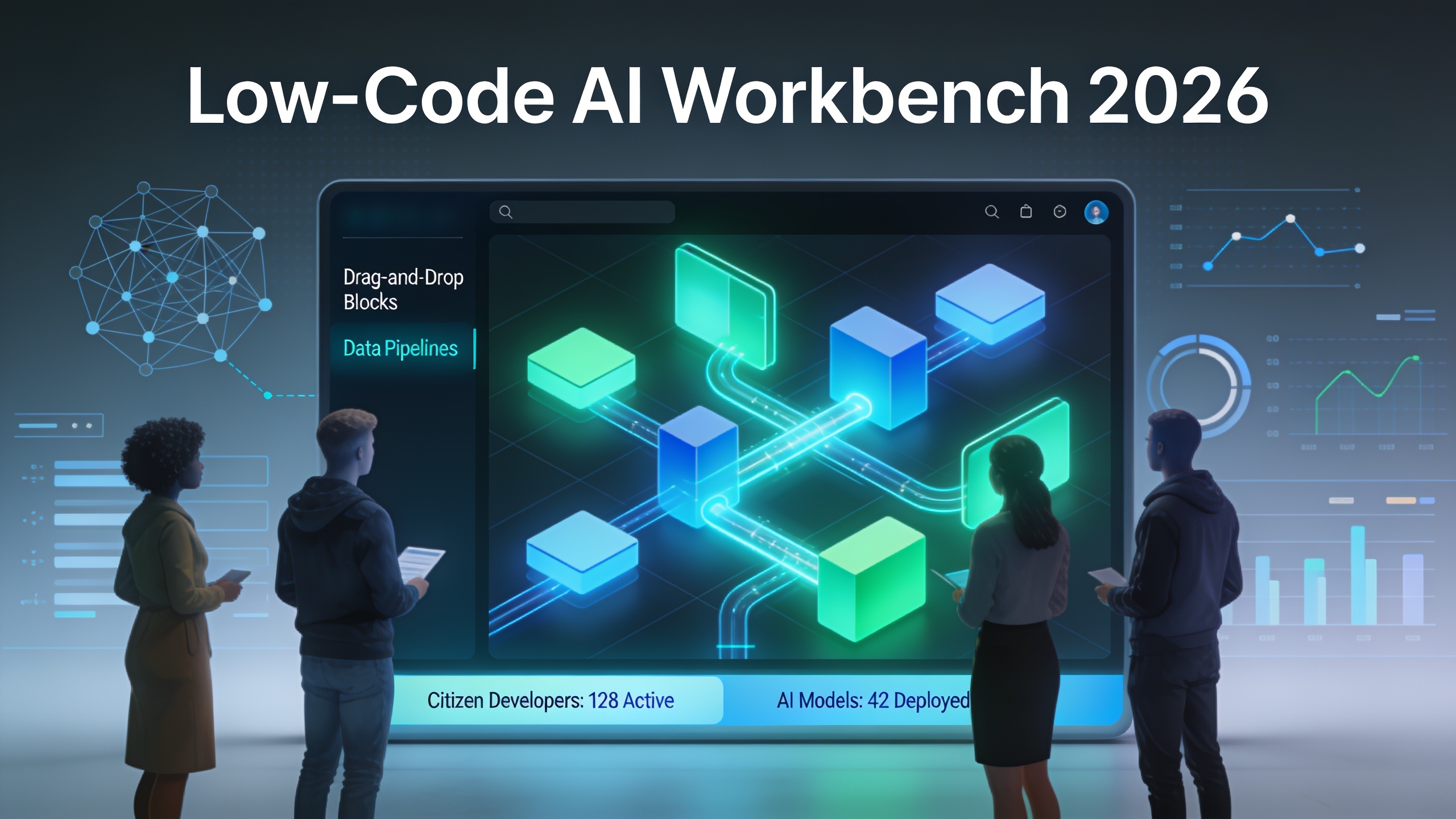
Low-Code Machine Learning starts with precisely this question. By allowing users to visually configure everything from data preparation and model training to performance evaluation and deployment, it is expanding ownership of AI development beyond professional developers and data scientists and into the workplace itself.
Domain Knowledge Becomes the Starting Point for AI Models
Traditional machine learning projects usually involve a lengthy process:
- A business department requests an analysis from the data team.
- A data engineer collects and cleans the data.
- A data scientist designs and trains the model.
- The development team integrates it into a service and deploys it.
- The business department reviews the results.
This structure is effective for ensuring expertise and quality. However, it can take a long time to turn a real-world business problem into an AI solution. Context can be lost as the request is passed along, and adapting the model to reflect changes in actual business operations may require repeated collaboration.
Low-code ML platforms shorten this workflow. A sales representative can connect CRM data, contract histories, and customer inquiry records, then handle missing values and build a customer churn prediction model within a visual pipeline. An operations manager can combine order volumes, inventory levels, and seasonal data to create a demand forecasting model.
The point is not that business professionals need to become data scientists. It is that the people who understand the business best can now define the starting point for AI experiments.
Machine Learning Pipelines Built Through Drag and Drop
Low-code ML breaks down the complexity of machine learning into a series of blocks. Users connect these blocks to design the flow of data and models.
For example, a customer churn prediction pipeline might look like this:
Connect CRM data → Remove duplicate customers → Generate recency of last purchase and inquiry count → Split training data → Train a classification model → Evaluate accuracy and AUC → Deploy a list of customers at risk of churning
Along the way, the platform can automate repetitive tasks such as algorithm selection, hyperparameter tuning, and cross-validation through AutoML features. Rather than implementing every mathematical principle behind a model from scratch, users can focus on identifying which data signals customer churn and which outcomes are actually useful to the business.
Code can still be used when necessary. Standard data processing and model training can be handled through visual components, while complex preprocessing or company-specific rules can be extended with Python, SQL, or scripts. This is the strength of Low-code—and what distinguishes it from No-code.
Real-World Change Driven by Citizen Data Scientists
As Low-code ML becomes more widespread, professionals close to day-to-day operations—such as data analysts, marketers, sales managers, and production managers—can take on the role of citizen data scientists.
Representative use cases include:
- Sales teams: Predict the likelihood of churn and upselling based on customer contact frequency, purchasing cycles, and inquiry types
- Logistics and operations teams: Forecast demand and the risk of inventory shortages by analyzing order volumes, inventory levels, and supply lead times
- Customer support teams: Classify ticket priority and urgency based on inquiry content and historical resolution records
- Manufacturing operations: Detect potential equipment failures or quality issues using sensor data, equipment inspection histories, and production conditions
The value of this shift does not lie simply in “building more models.” It lies in bringing AI closer to real-world decision-making and business processes, as business teams formulate hypotheses themselves and validate them quickly.
Easier Does Not Mean Less Responsibility
However, Low-code does not automatically solve problems related to data quality, security, or model accountability. A model trained on flawed data can produce flawed decisions even if it was built through a visual interface. When handling sensitive data—such as customer information, financial data, or medical records—access permissions, privacy protection, and reviews for model bias are essential.
The most practical approach, therefore, is to divide responsibilities between business teams and specialized organizations.
- Business departments are responsible for defining problems, providing domain knowledge, and applying the results.
- Data teams manage data quality, standardization, security, and governance.
- ML experts support the validation of high-risk models, advanced algorithms, and performance optimization.
Low-code ML is less a tool for replacing experts than a tool for allowing experts to focus their capabilities on more important challenges. People who understand customers, equipment, and operational environments best can start AI experiments, while specialized teams make those experiments safe and scalable. This is how ownership of AI development is moving into the hands of the front lines.
The 4.5-Month AI Project Timeline Enabled by Low-Code
How would the way companies compete change if AI projects were no longer years-long research initiatives, but could be turned into production systems within just a few months?
According to G2’s 2026 analysis, low-code ML platforms take an average of 4.5 months to deploy a model into a production environment after adoption. Of course, this figure does not apply equally to every AI project. But one thing is clear: the process—from data preparation and model training to deployment and monitoring—is being significantly compressed.
Traditional machine learning projects generally go through the following steps:
- A business unit requests an analysis from the data team.
- A data engineer collects and cleans the data.
- A data scientist designs and trains the model.
- An ML engineer deploys the model to a service environment.
- During operations, the team reassesses performance degradation, data changes, and security issues.
When each stage is divided among different teams and tools, even a small change can take anywhere from several weeks to several months. By contrast, low-code ML connects data integration, preprocessing, model training, performance evaluation, and deployment configuration within a single visual workflow. Standard tasks are automated through templates and AutoML, while specific requirements can be extended with SQL or Python.
For example, imagine that a sales organization wants to build a customer churn prediction model. In the past, this would have required collaboration across multiple teams—from extracting CRM data and combining customer behavior data to handling missing values, developing the model, and integrating it with a dashboard. Today, a flow like the following can be configured relatively quickly in a low-code environment:
Connect CRM → Clean customer data → Generate churn-probability features → Train with AutoML → Compare performance → Deploy predictions to the CRM or dashboard
The importance of this speed goes beyond simply shortening development time. Instead of beginning analysis only after market changes have occurred, companies can now build models while changes are unfolding and incorporate operational results. This makes a particularly significant difference in situations where response time is critical, such as sudden spikes in demand, rising customer churn, inventory shortages, and equipment failures.
That said, the four-and-a-half-month timeline should not be interpreted as meaning that “AI can be completed with just a few clicks.” Data quality, privacy protection, access control, integration with existing systems, and model validation still require substantial expertise. Rather than eliminating complexity, low-code is better understood as a tool that reduces repetitive, standardized tasks and helps specialists focus on more important problems.
Ultimately, a company’s competitive advantage is likely to come not from building the most dazzling AI model, but from connecting validated models to real-world business operations faster and more safely than anyone else. The 4.5 months associated with low-code ML is not merely a measure of technology adoption time—it is a signal of the new pace at which companies are moving AI from experimentation into production.
How to Complete the Journey from a Low-Code Pipeline to Model Operations
There is a single line connecting everything from data sourcing and cleansing to feature generation, model training, evaluation, and deployment. At first glance, it may look like a simple workflow, but this connection alone does not immediately become a real-world AI system.
The real difference lies in how far AutoML can automate, where business users and data experts can customize the process, and how the model is operated and monitored after deployment. The value of a low-code machine learning platform is not merely the ability to create models through an easy-to-use interface. It lies in managing the entire process of bringing AI safely into the workplace and continuously maintaining it.
Low-Code Visual Pipelines: Turning Data into a Language Models Can Understand
The basic structure of a low-code ML platform is a graphical pipeline. Users place blocks and connect them with lines to design how data moves and in what order it is processed.
A typical flow looks like this:
Connect data sources
→ Clean and transform data
→ Join, aggregate, and generate features
→ Train the model
→ Evaluate performance
→ Deploy and generate predictions
Each stage is an independent task, but model performance is often determined less by the algorithm than by the data processing steps that come before it.
Suppose, for example, that you are building a customer churn prediction model. After connecting CRM data, purchase histories, and customer service inquiry records, you would need to carry out processes such as:
- Removing duplicate customer records
- Handling missing purchase amounts or login histories
- Generating features such as the date of the most recent purchase, monthly usage frequency, and inquiry frequency
- Excluding identifiers with no predictive value, such as customer IDs
- Splitting the data into training and validation sets
A visual editor makes this process more transparent. It lets users see at a glance where the data came from, what rules transformed it, and which tables became model inputs. This is not simply a feature for accelerating development. It also serves as a collaboration mechanism that allows business stakeholders and data teams to review analytical logic together.
However, connecting blocks does not automatically solve data quality issues. Data aggregated according to the wrong criteria, biased samples, and data leakage caused by information from after the training point can all occur in a visual environment just as they can elsewhere. Low-code is not a tool that eliminates data engineering. It is better understood as a tool that makes the process faster and easier to understand.
AutoML and Code Extensions: Balancing Automation and Control
The core feature that enables rapid experimentation on low-code ML platforms is AutoML. AutoML typically automates tasks such as:
- Selecting candidate algorithms suited to the problem type
- Searching and tuning hyperparameters
- Performing cross-validation
- Comparing performance metrics
- Recommending leading model candidates
For example, in a classification problem that predicts whether a customer will churn, the platform may compare models such as logistic regression, random forests, and gradient boosting algorithms, then present candidates based on metrics such as accuracy, precision, recall, and AUC.
In real-world business settings, however, the model with the “highest accuracy” is not always the best choice. If missing a customer likely to churn is costly, recall should be given greater weight. Conversely, if the goal is to reduce unnecessary discount offers, precision may matter more. Users should therefore avoid accepting AutoML recommendations at face value. Instead, they must select evaluation criteria and thresholds that align with their business objectives.
This is where the strengths of low-code become clear. Standard tasks are automated, while extension points are provided for exceptional or advanced work.
- Adding complex data extraction and aggregation logic with SQL
- Writing custom preprocessing functions in Python
- Applying organization-specific feature-generation rules
- Integrating external model libraries or internal APIs
- Calculating evaluation metrics tailored to a specific industry
In other words, low-code ML is not an environment where “code is unnecessary.” It is an environment where code is used only where it is needed. Business users can quickly build the structure with visual blocks, while data scientists and engineers can refine only the sections that require greater precision.
From Deployment to Operations: A Model Creates Value When It Is Used, Not Merely Trained
A project does not end when model training is complete. In fact, even more questions emerge during the actual operational phase.
- Which business system should receive the prediction results?
- Should they be delivered through a real-time API or generated through a daily batch job?
- Will model performance remain stable over time?
- Who will respond if the structure of the input data changes?
- Could the model produce unfavorable predictions for a particular customer group?
In traditional ML environments, deploying and operating models often requires a separate MLOps framework. Teams may need to design container deployments, API servers, schedulers, model registries, monitoring tools, and CI/CD pipelines themselves.
Low-code ML platforms conceal much of this complexity. They typically provide the following capabilities through visual settings or templates:
- Deploying models as REST APIs
- Scheduling batch predictions to run at set times
- Connecting prediction results to CRMs, ERPs, and data warehouses
- Monitoring performance metrics such as accuracy, AUC, and error rates
- Configuring workflows to retrain models with new data
- Supporting model version control and approval processes
For example, a workflow can be configured to calculate the likelihood of customer churn every morning, store the scores in the CRM, and notify sales representatives only about high-risk customers. In this case, the model does not merely exist on an analytics screen. It becomes a system that determines the next action in real customer management.
Why Lightweight MLOps Enables Faster Commercialization
The competitiveness of low-code ML cannot be explained by model accuracy alone. More important is the time required to move from purchase to actual operation—in other words, time-to-value.
When visual pipelines, AutoML, deployment templates, and monitoring capabilities are integrated into a single platform, teams can spend less time connecting multiple tools separately. The entire process—from preparing data to exposing a prediction API, running batch jobs, and checking performance—can be managed as one continuous flow.
However, “lightweight MLOps” does not mean “MLOps without governance.” In environments involving sensitive or highly regulated data—such as customer information, financial data, medical data, or manufacturing equipment data—the following standards are essential:
- Data access permissions and personal information protection policies
- Review and approval procedures before model deployment
- Designation of responsible owners and operational managers for each model
- Monitoring for performance degradation and data drift
- Change histories and reproducible training records for each model
- Standards for reviewing bias and fairness
Ultimately, a good low-code ML environment is not simply a platform that lowers the barrier to development. It is an environment designed to let business teams experiment quickly while enabling IT and data organizations to control the quality of data and models.
A model can be born quickly when blocks are connected. But for that model to lead to trustworthy business decisions, the convenience of automation, the control provided by customization, and the sense of responsibility required during operations must all be connected as well.
From CRM to the Factory Floor with Low-Code: AI Moves into Business Systems
When predictive models remain confined to a separate data science lab, AI still feels to frontline employees like “technology that makes them wait for analysis.” But when predictions and recommendations are embedded directly into CRM platforms, logistics dashboards, call center screens, and factory equipment management systems, AI becomes a tool that helps people take immediate action within their workflows.
This is where the value of low-code ML becomes most apparent. It enables teams to visually configure everything from data collection and preprocessing to model training and deployment, then connect completed models to existing business applications so users can apply them through familiar interfaces.
Low-Code CRM: Predicting Customer Churn and Recommending the Next Action
Sales and customer management teams are often the first to benefit from customer data. By connecting purchase histories, login frequency, inquiry records, contract renewal information, and other CRM data, companies can score each customer’s likelihood of churn or potential for upselling.
For example, a CRM screen might display information such as:
- Churn risk: A risk score reflecting declining recent usage and unresolved inquiries
- Recommended action: Priority measures such as offering a discount, assigning a dedicated representative, or sending a renewal notice
- Customer priority: A list of customers the sales representative should contact first
- Expected revenue: Each customer’s purchase potential and estimated contract value
The key point is that model results appear not in a separate analytics report, but directly within the customer detail screen sales representatives use every day. Instead of switching to another tool to interpret the data, representatives can view the customer and consult the AI’s judgment at the same time.
Low-Code Logistics and Inventory Systems: Turning Predictions into Operational Decisions
In logistics and inventory management, the speed and connectivity of predictions are critical. Even when a demand forecasting model is available, it is difficult to respond immediately to shortages or excess inventory if the results remain confined to a monthly report.
A low-code-based pipeline can combine sales data, seasonality, promotion schedules, supplier lead times, and warehouse inventory information to build a demand forecasting model. Once the results are delivered to an inventory dashboard or purchasing system, the following types of automation become possible:
- Calculating the gap between expected demand and current inventory for each item
- Alerting users to items at high risk of falling below safety stock levels
- Recommending order quantities and ordering times
- Displaying inventory redistribution priorities by region and warehouse
In this structure, AI does not stop at simply saying, “Demand will increase next month.” It provides actionable information directly within the screens where operations teams place orders, move inventory, and respond to changing conditions.
Low-Code Call Centers: Improving Ticket Priorities and Service Quality
Call centers and customer support organizations are areas where the impact of AI can emerge quickly, given their high inquiry volumes and limited handling time. By using ticket titles, message bodies, customer tiers, previous inquiry histories, and sentiment analysis results, teams can predict ticket urgency and handling priorities.
Low-code ML connects these data sources through visual workflows and uses classification models to automatically categorize tickets. For example, it can support functions such as:
- Automatically detecting inquiries likely to involve outages, refunds, or cancellations
- Prioritizing tickets from VIP customers or customers at risk of churning
- Automatically routing inquiries to the appropriate department by type
- Providing early alerts for cases likely to experience delays in resolution
- Analyzing the likelihood of declining satisfaction after an interaction ends
Agents do not perceive AI as a separate system. They simply check guidance such as “Prioritize,” “Specialist assignment recommended,” or “Customer at risk of churning” within the existing ticket screen and carry out their work. When AI is naturally woven into the process in this way, frontline adoption also increases.
Low-Code Factory and IoT Systems: Turning Equipment Data into Preventive Maintenance
Manufacturing sites generate a wide range of operational data, including equipment sensor readings, PLC data, SCADA data, production histories, and quality inspection results. By leveraging this data, organizations can detect the likelihood of equipment failures, fluctuations in production volumes, and early signs of quality issues.
For example, a low-code ML pipeline can combine equipment temperature, vibration, pressure, operating hours, and past maintenance records to create anomaly detection or failure prediction models. The model results can then be reflected directly in equipment management screens or maintenance work-order systems.
A prediction such as “82% likelihood of equipment anomaly” creates far more value when displayed on a maintenance work-order screen than in a report.
On the factory floor, teams can use this information to adjust maintenance priorities, prepare spare parts, and reduce unplanned equipment downtime. However, because safety and connection reliability are critical in industrial environments, organizations must also design controls for OT system access, data latency, and response procedures when models make incorrect predictions.
The Core of Low-Code AI Is Not the ‘Model,’ but the ‘Workflow’
The goal of adopting low-code ML is not to build one impressive predictive model. More important is designing how the model’s results will connect to the right person, at the right time, and to the right action within the actual work process.
To do this, organizations should begin by examining the following questions:
Who will use the model’s results?
The screens and explanation methods required will differ depending on whether the user is a sales representative, logistics operator, customer service agent, or equipment engineer.What action will the prediction trigger?
Organizations must decide whether to provide alerts only or automate processes all the way through assigning staff, recommending orders, and requesting maintenance.How will incorrect predictions be controlled?
For high-impact tasks—such as customer cancellations, production shutdowns, and safety-related decisions—human review and approval procedures are necessary.Who will manage the data and models?
Even if business departments build models quickly, data quality, security, and model performance monitoring must be managed within the governance framework of central IT and data organizations.
Ultimately, AI’s value is not determined solely by the accuracy measured in a data science lab. When it enables faster, better decisions within the everyday systems used to manage customers, inventory, support operations, and equipment, low-code-based AI becomes a genuine source of competitive advantage.
Low-Code Is Not Magic: What It Takes to Make Fast AI Safe AI
Does saying that anyone can build a model really mean that anyone can take responsibility for its results?
Low-code machine learning platforms dramatically shorten the process from data preparation and model training to deployment. But creating a model by connecting visual blocks does not automatically solve problems with data, security risks, or regulatory obligations. In fact, AI deployed rapidly without proper validation can spread flawed decisions and security incidents even faster.
To apply fast AI safely in real-world business operations, you must clear the following final hurdles.
Data Quality Management Is the Starting Point for Low-Code AI
A model cannot be smarter than its data. Low-code environments make tasks such as handling missing values, transforming data, joining datasets, and aggregating records much easier. But visual convenience does not eliminate fundamental problems in the data itself.
Imagine, for example, that you are building a customer churn prediction model. If customer status values are defined differently across departments, or if data on canceled customers has not been recorded properly, the model will learn distorted patterns. Its accuracy may look high on screen, yet in a real operating environment it could offer discounts to the wrong customers or miss those most likely to churn.
Before deployment, the following items should be checked:
- Are the data sources and collection purposes clearly defined?
- Is the same metric being managed according to different standards across systems?
- Are the criteria for handling missing values, duplicate values, and outliers documented?
- Is the distribution of the training data substantially different from that of the actual production data?
- Do the model inputs contain sensitive information or unnecessary personal data?
Low-code can simplify data processing, but it cannot replace the work of defining data standards and quality criteria. This stage requires collaboration among business users, data engineers, and security professionals.
Security and Access Controls for Low-Code Models Must Be Designed Separately
The ability to deploy models as REST APIs or configure batch prediction jobs is one of the strengths of low-code ML. However, the easier it becomes to connect systems, the more important access control becomes.
Models connected to CRM, ERP, data warehouses, and industrial IoT systems may have access to customer information, financial data, and equipment operation data. If permissions are left excessively open for the sake of user convenience, the risks of data leakage and misuse increase.
At a minimum, safe operations require the following principles:
- Apply the principle of least privilege to users and service accounts.
- Separate data and permissions across development, testing, and production environments.
- Do not store API keys, passwords, or tokens directly in pipeline screens or scripts.
- Maintain audit logs of model calls, data access, and deployment changes.
- Apply masking, encryption, and access-approval procedures to personal and sensitive information.
The ability to “deploy with just a few clicks” is an advantage only when security controls are already in place. Otherwise, those same few clicks could become a channel for exposing critical data to the outside world.
Low-Code AI Cannot Escape Regulation or Explainability
When AI is used in areas that directly affect individuals or businesses—such as hiring, lending, insurance, healthcare, customer ratings, or pricing—accuracy alone is not enough. Organizations must manage what data the model relies on, whether it produces unfair outcomes for particular groups, and who will stop or correct it when something goes wrong.
Low-code platforms lower the barrier to creating models, but they do not lower the barriers imposed by regulation and ethics. In particular, when AutoML automatically searches across multiple algorithms and parameters, it becomes even more important to establish a process for reviewing the basis of the selected model’s decisions.
Before putting a model into operation, you should be able to answer the following question:
What business decision does this model support, and does the final decision belong to a person or to the model?
With this question as the starting point, document the model’s intended use, input data, performance criteria, bias assessment results, approval owner, and review cycle. For high-risk decisions, it is essential to preserve human review and appeal procedures.
Low-Code Vendor Lock-In Can Become Technical Debt
Low-code ML platforms are highly effective for quickly implementing standard tasks such as classification, regression, demand forecasting, and anomaly detection. However, the more heavily you depend on platform-specific components and visual workflows, the harder it may become to migrate to another environment later.
The problem becomes visible when requirements grow more complex. Once you need specialized model architectures, customized preprocessing, on-premises infrastructure, high-performance real-time inference, or detailed CI/CD policies, the platform’s built-in capabilities may no longer be enough.
At the adoption stage, verify the following:
- Can data pipelines and models be exported as code or in standard formats?
- Can model metadata, training history, and evaluation results be integrated with an external model registry?
- Does the platform create excessive dependence on a particular cloud provider or proprietary data store?
- Can it be extended through Python, SQL, APIs, or other interfaces?
- How will data and models be migrated when the contract ends or the platform is replaced?
Starting quickly and being able to leave easily are two different things. When choosing low-code, evaluate not only development speed but also portability and scalability.
Citizen Development with Low-Code Needs Governance to Prevent Shadow IT
Citizen development—where business teams build predictive models themselves—clearly offers significant advantages. Sales teams understand the context behind customer churn, while operations teams are closest to the causes of demand fluctuations. The problem arises when these projects proliferate outside the oversight of central IT and data organizations.
Different departments may build separate churn models using the same customer data, connect to unapproved external data, or leave behind models that no one manages after their owners leave the company. This is shadow IT in the age of AI.
The solution is not to block citizen development, but to enable it within safe boundaries.
- Operate a central registry for registering models and data pipelines.
- Apply approval procedures based on business impact.
- Provide shared datasets, validated templates, and standard security settings.
- Clearly designate model owners and technical leads.
- Regularly monitor performance degradation, data changes, and signs of bias.
- Define criteria for operational shutdown and retirement in advance.
The speed of business teams and the control of central organizations are not inherently conflicting goals. Well-designed governance is not control for control’s sake; it is the foundation that enables business teams to build more AI with greater confidence.
The Real Completion of Fast Low-Code AI Is Not Deployment but Operations
The value of low-code ML lies in building models in a short amount of time. But the true value a company should seek is not a fast demo—it is a reliable operating model.
The most practical approach is clear. Use low-code aggressively for prototypes, internal decision support, and standardized prediction tasks. On the other hand, customer-facing mission-critical AI, systems requiring advanced security, and areas where proprietary algorithms are a competitive advantage should be developed in parallel with traditional ML development practices.
Ultimately, low-code is not magic. Only when the conditions of data quality, security, regulatory compliance, vendor independence, and governance are in place can low-code become a powerful tool for transforming fast AI into safe and sustainable AI.
Comments
Post a Comment