 \n
\n
Banknotes Haven’t Disappeared: The Cash Paradox in the Digital Age
While everyone talks about mobile payments and QR codes, India still produces roughly 28–30 billion new banknotes every year. Despite the explosive growth of digital payments, the number of banknotes in circulation has reached approximately 176 billion.
Transactions have clearly moved into the digital realm. So why do people still hold cash in their hands?
The answer is simple. Digital payments are a convenient way to transact, while cash is a safety net for the unexpected.
Cash Is Less About Payment Than ‘Access’
Mobile payments are fast, leave a record, and are highly efficient for everyday spending. But when your smartphone battery dies or the telecommunications network and payment systems fail, the situation changes. The banknotes in your wallet need no internet, app, or authentication process.
That is why many people actively use digital finance while still keeping a certain amount of cash on hand. The point is not to stubbornly cling to banknotes. It is about preserving the feeling that money will be immediately accessible when needed—in other words, the psychological value of liquidity.
Transactions go digital; the safety net remains cash.
Consumers in the digital age are using both systems at the same time.
Why Demand for Cash Persists Even as Digital Payments Grow
Cash is still used not only in emergencies, but also for informal transactions, small purchases, and spending where people want to minimize the exposure of their personal information. Above all, cash plays a psychological role: you can see your balance, and you feel the act of spending more directly.
That is why the digital transition is not eliminating cash altogether. Instead, it is changing cash’s role. Once the centerpiece of everyday payments, cash is now becoming more like a supplementary asset—one kept for crisis response and freedom of choice.
That said, storing excessive amounts of cash at home is not always safe. There is always the risk of loss, theft, fire, or damage. In India, for instance, there have even been cases of banknotes buried underground being damaged by termites.
Ultimately, the important question is not, “Should we use cash or digital payments?” The more practical challenge is this: while taking advantage of digital convenience in everyday life, how can we maintain an appropriate level of cash-like assets so that we can still cope with the unexpected?
The Government’s Cash Politics: Who Gets the Fruits of Growth?
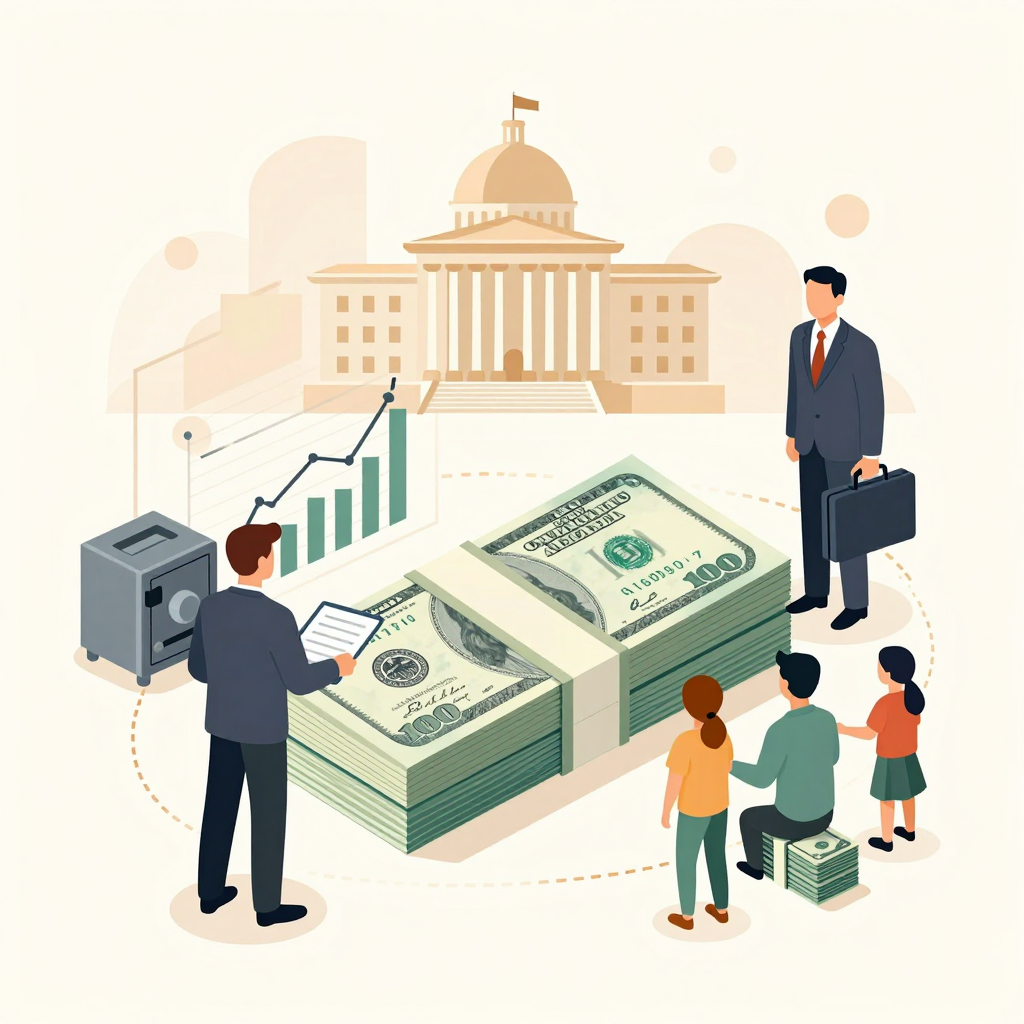
If AI expands the economy, whose wallets should the gains flow into? Taiwan’s government has a clear answer: it plans to return the additional revenue generated by the AI industry boom to the public in the form of NT$10,000 in cash per person.
This policy is more than a simple subsidy. It sends a powerful political message: “The gains from the growth of advanced industries should not belong solely to certain companies and investors; they should be shared by everyone.”
What makes this even more intriguing is that the story did not end there. The opposition pushed back by calling for NT$20,000 in cash per person—twice the amount proposed by the government. How the gains of the AI industry should be distributed has become, in effect, the language of political competition that voters can feel directly.
Cash and In-Kind Welfare: Different Ways to Pursue the Same Goal
While Taiwan has chosen cash that goes straight into people’s wallets, South Korea leans more toward reducing household burdens through in-kind welfare in areas such as healthcare, education, and childcare. When the government directly covers the cost of services through health insurance, free education, and free childcare, households gain greater room to spend elsewhere.
The differences between the two approaches are clear:
- Cash support: Gives individuals the freedom to spend immediately wherever they need it most.
- In-kind welfare: Reduces essential expenses such as healthcare and education, thereby strengthening household stability.
Ultimately, the key issue is not simply the amount of money. It is how the government provides people with reassurance and freedom of choice.
Cash Is Now Both the “Result of Policy” and the “Language of Politics”
In the past, cash payments were often viewed as one-off stimulus measures designed to boost consumption during economic downturns. But with the emergence of high-growth industries such as AI, cash is being transformed into a symbol of redistributing the gains of growth.
The government’s wallet is no longer merely a tool for executing the budget. It is becoming a political mechanism that allows people to genuinely feel the benefits of economic growth.
In other words, today’s cash is not simply money. It is the most direct message of all about where the fruits of growth are headed.
Cash: How Households and Businesses Buy Options for the Future
People who spread emergency cash across their wallets, drawers, and bank accounts. Households moving their money into short-term deposits with maturities of six months or less. And companies stockpiling tens of billions of dollars in cash. At first glance, all of these behaviors may look like “letting money sit idle.”
But they share one clear trait: accumulating cash is not about giving up returns—it is about buying the option to respond to an uncertain future.
For Households, Cash Means the Reassurance That It’s Available
People who keep emergency cash in multiple places may not simply be more anxious than others. What matters to them is not just the size of their balance, but the sense that they can access their money immediately when the unexpected happens.
When a card payment fails, a phone is lost, or a sudden medical bill or repair expense arises, cash becomes the fastest way to respond. Even if it is never actually spent, the fact that “it’s available whenever I need it” serves as a psychological safety net.
From this perspective, cash is less money meant for consumption than a buffer that absorbs life’s shocks.
A Preference for Short-Term Deposits Means Having Room to Wait
The recent preference among households for fixed-term deposits of six months or less, rather than long-term deposits, follows the same logic. Instead of locking up their money for an extended period in pursuit of higher interest, they are preserving the possibility that an investment, housing, education, or spending opportunity may arise in the near future.
Short-term deposits may look somewhat disappointing when judged solely by their returns. But they offer an important advantage: the money is not tied up. Markets may become volatile and create investment opportunities, or unexpected expenses may arise.
In other words, what households want is not simply interest income, but the liquidity to change direction at any time.
Cash-like assets are not “money doing nothing.”
They are money waiting to move when the moment demands it.
Corporate Cash Creates Both Crisis Resilience and Offensive Power
The reasons companies hold large cash reserves are no different. Whether they are purchasing Bitcoin, buying back shares, repaying debt, investing in new facilities, or pursuing mergers and acquisitions, major corporate decisions ultimately begin with sufficient liquidity.
Cash becomes especially valuable when markets are unsettled. Even if financing conditions deteriorate, a company can continue investing. It can also acquire attractive assets or businesses when competitors hesitate. If necessary, it can maintain shareholder-return policies and preserve the market’s confidence.
Corporate cash is not merely a number on a balance sheet. It is a strategic asset that serves as a shield in a crisis and a weapon when opportunity strikes.
The Key Question Is Not “How Much?” but “Why?”
Of course, holding excessive amounts of cash comes with the costs of inflation and opportunity cost. Money that is not invested may lose purchasing power over time.
That is why the important question is not, “Should I hold a lot of cash?” A more precise set of questions would be:
- Do I have enough cash to prepare for sudden expenses?
- Have I tied up money in investments that I may need to use in the near future?
- Do I have enough flexibility to act immediately when a good opportunity appears?
- Is my cash sitting there because of fear, or have I set it aside as part of a plan?
The real reason households and companies accumulate cash is the same: the future cannot be predicted with precision. And when circumstances are impossible to predict, the most powerful asset is the freedom to choose when the moment comes.
Is Cash a Safety Net—or an Asset Slowly Melting Away?
One million won kept in a safe is still one million won a year later. The number has not changed. But once you consider what that money can buy in goods and services—as well as the investment opportunities missed during that time—the story changes. Cash is the most immediate safety net, but it is also an asset whose purchasing power can quietly decline the longer it sits untouched.
The Visible Amount and the Purchasing Power That Disappears
The time value of money is simple: money you have today is worth more than the same amount in the future because you can spend it now, earn interest on it, or invest it.
For example, when prices are rising, the real value of cash left untouched in a bank account or safe declines. The face value of one million won may remain unchanged, but a few years later, it may no longer be enough to cover the same living expenses or buy the same goods.
The danger of cash lies in the fact that the balance does not decrease.
Because the number stays the same, it is easy to miss the gradual loss of purchasing power.
So when holding cash, you need to consider not only “How much do I have?” but also “When will I need to use it?” Money intended for immediate spending and money set aside for the long term do not need to be managed in the same way.
Cash Is Not Absolutely Safe Either
Physical cash has the advantage of being immediately usable during electronic payment outages or problems within the financial system. But banknotes themselves are not always safe.
In fact, one Indian farmer experienced the destruction of banknotes he had stored underground after termites gnawed through them. Hidden money may avoid theft, but it cannot necessarily escape risks such as moisture, fire, loss, or physical damage.
This raises a question about the belief that “holding cash in your hands is the safest option.” Cash is highly accessible, but depending on how it is stored, it can also carry physical risks.
The Key Is Not ‘Holding’ but ‘Allocating’
There is no universal answer that means you should always reduce or increase your cash holdings. Money for emergencies is necessary, but if you tie up all your funds—including those intended for long-term goals—in cash, you may become vulnerable to inflation and opportunity costs.
A more realistic approach is to divide your cash strategy according to its purpose:
- Cash for living expenses: Funds needed for monthly spending and short-term payments
- Emergency cash: A safety net for unexpected medical bills, unemployment, repairs, and other emergencies
- Opportunity funds: Flexible money available when an important decision—such as investing, moving, or starting a business—arises
- Long-term goal funds: Money that should be considered for separate management through deposits, bonds, investments, or other options, with the time value of money in mind
Cash is less an asset that generates returns than an asset that preserves your freedom to choose in uncertain moments. But even that freedom comes at a cost. Cash accumulated for longer than necessary may look safe, yet over time it can lose both purchasing power and growth potential.
In the end, there is one question that matters: Is my cash truly a necessary safety net—or is it money quietly melting away because I have failed to manage it?
My Personal Cash Strategy: Design Your Options, Not Just Your Money
Is your cash simply money sitting in your bank account? Or is it a source of choice—something that prepares you for both sudden crises and unexpected opportunities?
The answer is neither “hold as much cash as possible” nor “invest every dollar.” What matters is creating a standard that allows you to move at any time, based on the uncertainties in your life and your goals.
Think of Cash as Serving Three Different Roles
When developing a cash strategy, it is better not to view all your money as one single account balance. Dividing it by purpose can reduce anxiety and make investment decisions clearer.
- Living-expense cash: Money set aside for expenses that must be paid every month, such as rent, loan interest, utilities, and food.
- Emergency cash: A safety net for unpredictable situations, such as unemployment, medical bills, or unexpected repair costs.
- Opportunity cash: Money that expands your future choices, such as investment opportunities, preparing for a career change, education, or starting a business.
Emergency funds and opportunity funds may look like the same kind of cash, but they serve different purposes. An emergency fund is a safety device that must never be compromised, while an opportunity fund is strategic flexibility that allows you to act when the timing is right.
Decide “When You’ll Use It” Before Deciding “How Much”
When determining how much cash to hold, people often begin by asking, “How much should I save?” But the more practical question is this:
“In what situations will I use this money, how much will I use, and in what order?”
For example, if you have designated three to six months’ worth of living expenses as emergency savings, you need a rule that prevents you from investing that money simply because the market has declined. On the other hand, if you have separately set aside opportunity cash, you can use it when investment prices have undergone a major correction or when an essential opportunity for personal development arises.
Without these standards, cash can easily become unstable. When anxiety rises, you may accumulate too much of it. When markets are overheated, you may end up investing even your emergency fund.
Liquidity Is Not the Opposite of Returns
Cash may appear to offer lower returns than investment assets. In an inflationary environment, money left untouched may also lose purchasing power. But that does not mean cash is “idle money.”
Cash provides the following kinds of value:
- The flexibility to avoid selling assets at a loss during an emergency
- The agility to respond to a market crash or an attractive buying opportunity
- The security of not having to rely excessively on loans or credit
- The time to consider life choices such as changing jobs, taking a leave of absence, or starting a business
In other words, cash is an asset that is difficult to evaluate by returns alone. Because it is immediately available when needed, cash is both insurance against uncertainty and the source of future choice.
Create a Cash Framework That Fits You
There is no need to start with something complicated. Begin by writing down your own standards as shown below.
| Category | Question to Ask | My Standard |
|---|---|---|
| Living expenses | How much money do I need until my next paycheck? | Based on fixed monthly expenses |
| Emergency fund | How long do I need to be able to survive without income? | Three to six months of living expenses, etc. |
| Opportunity fund | Do I have money available for investments, education, or a career change? | Save separately for each goal |
| Deposit management | When am I most likely to need this money? | Stagger short- and medium-term maturities |
| Investment principles | How much money can I afford to expose to investment losses? | Separate emergency funds from investment funds |
The key is not the numbers themselves. The appropriate cash allocation varies depending on the stability of your income, whether you support dependents, the size of your debt, the nature of your profession, and any major expenses you expect in the near future.
Cash Is Not What’s Left Over; It Is Money You Allocate First
People without a cash strategy typically invest first and keep whatever remains as cash. But if you value having options, you need to reverse that order.
First secure the funds needed to protect your daily life and handle emergencies. Then determine your investment allocation based on your goals and risk tolerance. That way, even when market volatility increases, your overall plan will not be thrown off balance.
Cash is not merely a balance sitting still in an account. It is a resource that protects you in a crisis and enables you to act when an opportunity arises. What you need now is not a decision to blindly increase or decrease your cash holdings, but to design what choices you need to be able to make in different situations.
Comments
Post a Comment