Colombia Hit by Powerful 7.4-Magnitude Earthquake: 111 Dead, Coffee-Growing Region Devastated—Is the U.S. Safe?
 \n
\n
colombia earthquake: At 7:34 a.m., the city began to shake
It was supposed to be an ordinary Monday morning. At 7:34 a.m., as commuters began their journeys, shops opened their doors, and children headed to school, powerful tremors originating in western Colombia turned into screams, frantic evacuations, and the wreckage of collapsed buildings within just a few seconds.
According to the U.S. Geological Survey (USGS), this colombia earthquake had a magnitude of 7.4. The epicenter was located near San José del Palmar in Colombia’s western department of Chocó, approximately 250–280 kilometers west of the capital, Bogotá. The earthquake struck at a depth of about 107 kilometers.
Earthquakes that occur deep underground can generally send tremors across a wider area than those that happen just beneath the surface. This time was no exception. Shaking was detected not only across Colombia, but also in Ecuador, Panama, and Venezuela. In major cities such as Bogotá and Medellín, residents rushed out of buildings in emergency evacuations.
The areas hit hardest were the western and central Andes. Reports of building collapses and structural damage emerged one after another from Pereira, Manizales, Cali, Quibdó, and other cities. In some areas, airport operations were suspended, while communication disruptions made it difficult for rescue teams and families to assess the situation and confirm the extent of the damage.
The Colombian Geological Service described the earthquake as the strongest recorded in Colombia over the past decade. Despite its relatively deep epicenter, the damage was extensive because the earthquake itself was exceptionally powerful, and its tremors spread across densely populated cities and areas filled with aging, vulnerable buildings.
The shaking that morning was more than a simple natural-disaster headline. It was a catastrophe that simultaneously brought homes, transportation, communications, and livelihoods in one region to a standstill—and one that could continue to affect the global supply chain connected to Colombia’s coffee-producing regions.
Why the Colombia earthquake death toll rose from 20 to 111
The death toll announced immediately after the disaster was 20. But within a few hours, it rose to 69, and then to at least 111. This increase is not simply a statistical correction. It is the gradual revelation of the tragedy’s true scale—of people who may still be trapped beneath the rubble or stranded in isolated areas.
Early reports focused on deaths confirmed in cities that could be reached relatively quickly, including 18 in Pereira and 2 in Manizales. However, as data from rescue teams, local governments, and hospitals reached central authorities later, the known extent of the devastation rapidly expanded.
- Initial count: At least 20 dead
- Intermediate count: At least 69 dead
- Latest official announcement: At least 111 dead, with many injured
In the immediate aftermath of a major earthquake, it is difficult to assess conditions in outlying areas because of collapsed roads, communication disruptions, airport shutdowns, and the risk of aftershocks. In particular, this Colombia earthquake struck multiple cities across the western and central Andes at the same time, while rescue operations are still continuing at collapsed buildings.
Therefore, even the current figure of 111 should not be considered final. USGS impact analyses leave open the possibility of a much higher loss of life, and the death toll may rise further as communication networks and access for rescue operations are restored in the affected areas.
In disaster reporting, numbers can appear cold and impersonal. But behind them are people who still have not been able to contact their families, survivors waiting to be rescued from collapsed buildings, and communities still working to determine the full extent of the damage. The sharp rise in the death toll is a direct reflection of that reality.
The Day the Heart of Coffee Collapsed: The Ripple Effects the Colombia Earthquake Could Leave on America’s Morning
If you think this earthquake has nothing to do with the tables of American households, consider where the coffee you drank this morning came from. The western and central Andes, where the Colombia earthquake caused extensive damage, border Colombia’s core coffee-producing belt.
The areas near Pereira, Manizales, and Cali are not merely provincial cities. They form a crucial axis of Colombia’s coffee industry, linking countless small farms and cooperatives with processing facilities and transportation networks. This is why Bloomberg identified the affected region as the “coffee heartland.”
The damage confirmed so far has been concentrated in human lives and residential infrastructure. Around 1,600 homes have reportedly been damaged, while more than 60 buildings are believed to have completely collapsed. With airports, roads, and communications networks also disrupted, the impact could extend beyond rescue operations to agricultural transportation and regional logistics.
The Coffee Supply Chain Can Come to a Halt Beyond the Farm
Coffee is not completed on the farm where the beans grow. The harvested cherries must be processed, dried, transported to collection centers, and then connected to ports and export networks. If the earthquake halts local airport operations and damages buildings and communications infrastructure, the entire process could slow down.
Colombian coffee is supplied widely to major U.S. franchises, grocery stores, independent roasteries, and specialty cafés. If the damage persists, the following effects could emerge:
- Delays in collection and processing schedules at the source
- Higher inland transportation and export logistics costs
- Greater supply uncertainty for some specialty beans
- Increased volatility in contract prices and retail coffee prices
That said, it is still too early to conclude that coffee prices in the United States will immediately surge. The actual impact will depend on the extent of the damage to farms, the pace of road and port recovery, inventory levels, and the schedule for the upcoming harvest. What matters is that this disaster is not merely a natural catastrophe in a distant country—it has exposed a vulnerable link in the global supply chain.
The Daily Lives of Vulnerable Communities Collapse First
The damage suffered by coffee-producing regions cannot be explained by economic indicators alone. Many producing farms are small, family-run businesses. When homes collapse, local roads are cut off, and communications fail, the farmers’ livelihoods—and their preparations for the next harvest—come to a standstill as well.
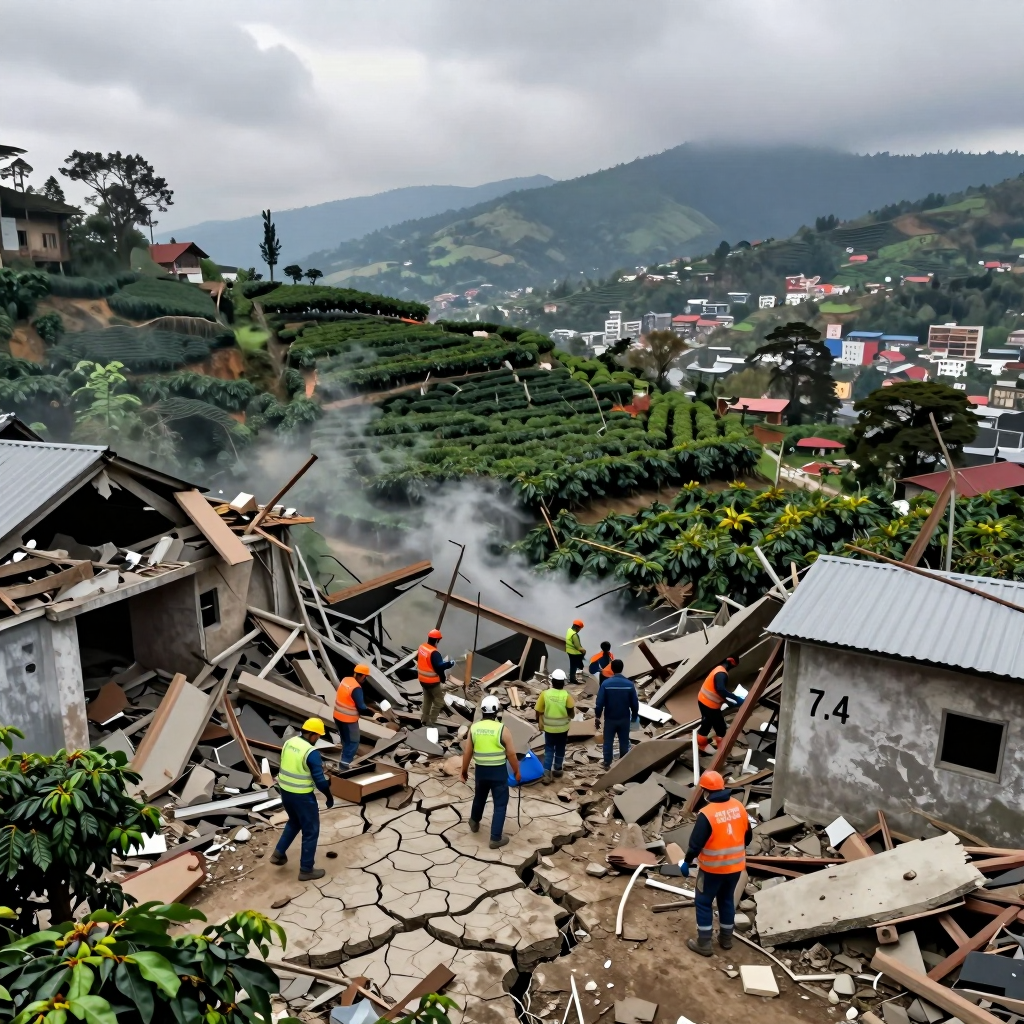
Images of citizens searching for survivors amid the rubble of collapsed buildings after the powerful earthquake make the priorities of this disaster clear. What is needed now is not a forecast for bean prices, but rescue efforts, medical support, temporary shelter, and the recovery of local communities.
For American consumers, Colombian coffee may be nothing more than a familiar morning cup. But behind that cup are the interconnected daily lives of farmers, transportation workers, processors, and local communities. This Colombia earthquake is once again forcing us to ask just how deeply the products we consume every day depend on people and infrastructure far beyond our borders.
Why Did a Vibration That Began Deep Underground Cause Destruction So Far Away? The Paradox of the colombia earthquake
If the hypocenter is approximately 107 kilometers underground, shouldn’t the damage at the surface actually be less severe? Generally speaking, that is true. Because the energy of a deep earthquake disperses before reaching the surface, the kind of damage involving the ground splitting open directly above the hypocenter may be relatively limited.
But this colombia earthquake overturned that simple assumption. When the powerful energy of a magnitude 7.4 earthquake combined with a deep hypocenter, the seismic waves did not remain confined to a single area. Instead, they spread widely across Colombia and as far as Ecuador, Panama, and Venezuela.
A Deep Earthquake Is Not a “Weak Earthquake”
An earthquake’s destructive power is not determined by the depth of its hypocenter alone. The key factors include its magnitude, ground conditions, the seismic resistance of buildings, and the distance from densely populated areas.
This earthquake occurred at a depth of approximately 107 kilometers, but its magnitude was exceptionally high. Powerful seismic waves originating deep underground can travel relatively far as they pass through solid rock. As a result, strong shaking was detected even in major cities such as Bogotá and Medellín, to the point that residents evacuated.
A deep earthquake may reduce surface rupture near the hypocenter, but it can shake a much wider area at the same time.
Widespread Shaking Meets Vulnerable Buildings
According to USGS analysis, approximately 2 million people may have experienced “very strong shaking.” The issue is not only how far the seismic waves traveled, but also what kinds of buildings they reached.
In the western and central Andes—including Pereira, Manizales, and Cali—building collapses and severe structural damage followed. Buildings with inadequate earthquake-resistant design or those weakened by age can suffer extensive damage even from shaking that lasts for a relatively long time.
A deep hypocenter was not a protective shield that eliminated damage. Rather, it became a condition that distributed the danger across a broad area, while vulnerable homes and infrastructure amplified that danger into a disaster.
The Warning Left by This colombia earthquake
This case shows that earthquake risk should not be judged simply by asking how close an area is to the hypocenter. A major earthquake can cross national borders and city limits, disrupting power grids, communications, airports, roads, and local economies all at once.
Ultimately, the key to reducing disaster damage is not stopping earthquakes, but building a society capable of withstanding the shaking. That is why stricter building codes, the reinforcement of aging structures, rapid warning systems, and local rescue capabilities are essential.
The Questions the Colombia Earthquake Raises for U.S. Cities
Amid the rubble of collapsed buildings, citizens searched for survivors with their bare hands. It was a moment when neighbors had to save neighbors before rescue teams arrived. The world watched the devastation unfold through footage from the scene and USGS data, but the next question ultimately comes back to us:
If an earthquake of similar magnitude struck the city where we live, how prepared would we be?
This Colombia earthquake was not merely a disaster in a distant country. The magnitude 7.4 quake occurred deep underground, but when it struck vulnerable buildings in a densely populated urban environment, it caused devastating damage. Millions of people felt powerful shaking, approximately 1,600 homes were damaged, and more than 60 buildings were reportedly completely destroyed.
The Data Shows the Risk, but Buildings Determine the Damage
USGS data on magnitude, epicenter, and shaking quickly reveals the scale of a disaster. Yet numbers alone cannot explain one crucial point: even in the same earthquake, the damage is ultimately determined by the condition of buildings, seismic standards, structural systems, and the capacity for early response.
In the affected areas of Colombia, particularly severe damage occurred in structures with poor seismic performance or significant deterioration. This is not an unfamiliar story for U.S. cities. From California and the Pacific Northwest to central regions that could be affected by the New Madrid Seismic Zone, many American cities still contain old brick buildings, schools and hospitals in need of reinforcement, and homes built before modern seismic standards were introduced.
The question is simple:
Will we rescue people after an earthquake strikes, or will we make sure buildings do not collapse before it happens?
Disasters Shake the Most Vulnerable Places First
Earthquake vibrations pass through an entire city, but the damage is not distributed equally. Neighborhoods where economically vulnerable residents live are more likely to have aging homes and unstable buildings, while residents also face greater difficulty accessing insurance, evacuation options, and funds for recovery.
That is why disaster resilience is not merely a matter of the number of rescue workers or the effectiveness of warning systems. It is also about the right to live in safe housing, stronger building codes, assistance to reinforce aging structures, and a social safety net that allows people to rebuild their lives after a disaster.
The images of Colombian citizens clearing rubble showed the strength of community solidarity. At the same time, they made clear that solidarity should not depend solely on citizens using their bare hands.
What U.S. Cities Need to Assess Now
This disaster leaves cities and communities across the United States with several practical challenges:
- Do I know the earthquake risk in my area and the evacuation guidance?
- Do my home, workplace, school, and hospital meet the latest seismic standards?
- Do I have an emergency contact plan to use if my family and I lose contact?
- Do I have at least several days’ worth of emergency supplies, including water, medicine, lighting, and backup battery packs?
- Are local governments investing enough in reinforcing aging buildings and supporting disaster-vulnerable populations?
USGS data tells us where an earthquake occurred and how powerful it was. But how deeply a city will be wounded is shaped by decisions made long before the shaking begins. What matters is how building codes were designed, how vulnerable housing was managed, and what preparedness resources were made available to residents.
The stories of collapse and rescue emerging from Colombia are ultimately a warning that asks us to examine the safety of our own cities. Disasters may not cross borders, but their lessons do.
Comments
Post a Comment