 \n
\n
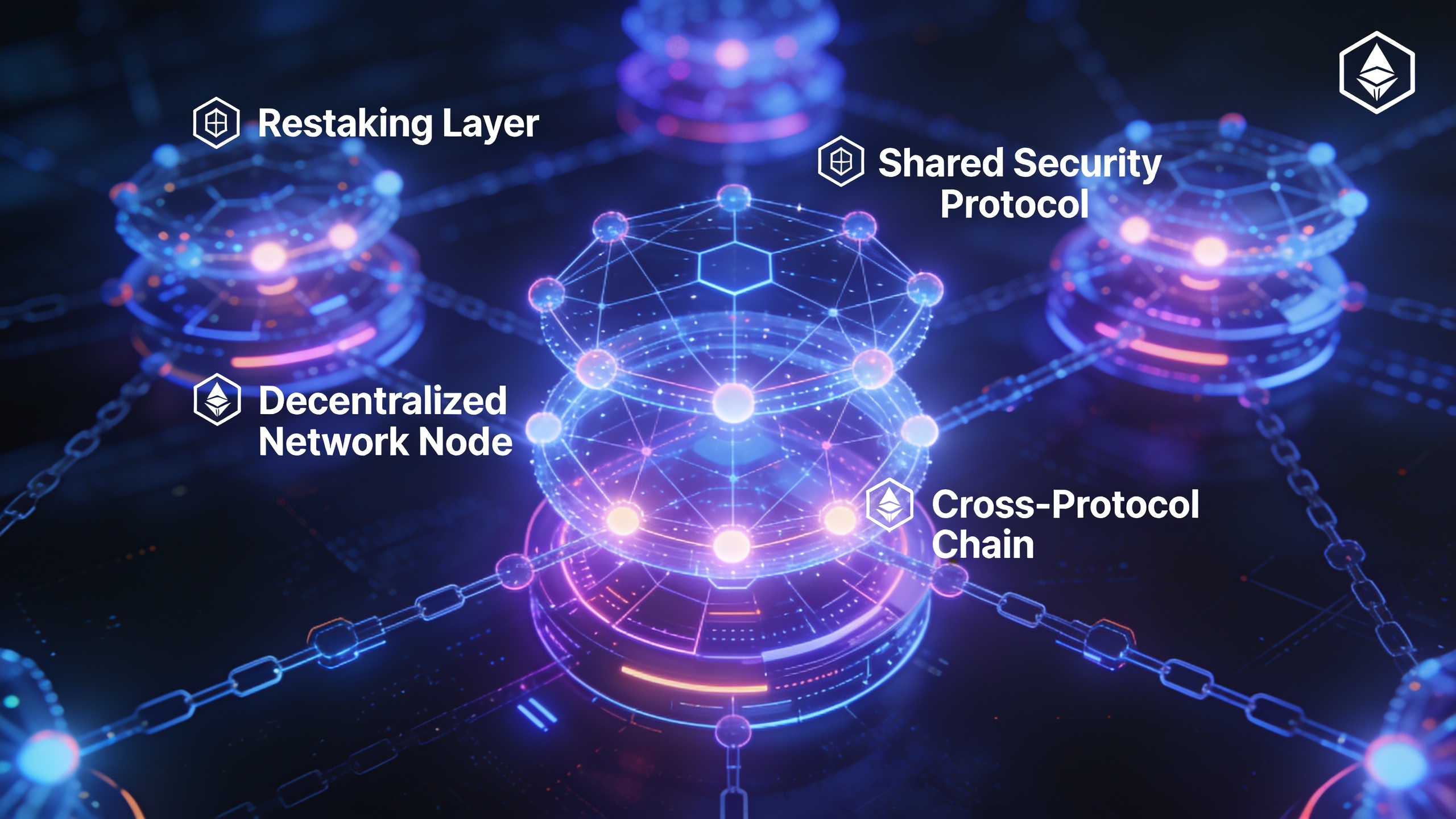
A New Question in Blockchain Security: What If One Staked ETH Secured Five Networks?
What if the ETH I staked on Ethereum didn’t stop at securing a single chain?
What if that same ETH could verify the reliability of price oracle data, monitor asset transfers across cross-chain bridges, protect rollup operations, and even support a data availability layer? This is not simply a story about gaining more opportunities for rewards. It represents a shift in how Blockchain security itself is built and distributed.
In a traditional Proof-of-Stake environment, staking was relatively straightforward. Validators deposit ETH and participate in producing and verifying blocks on the Ethereum network. If they act honestly, they receive rewards; if they violate the rules, a portion of their deposited assets may be slashed. In other words, one stake was connected to the security of one network.
But the same problems emerged whenever a new service appeared.
- A new rollup had to create its own validators and incentive structure.
- A new bridge had to secure sufficient collateral and monitoring systems.
- A new oracle had to build an independent verification network to prevent data manipulation.
- Smaller protocols could face lower attack costs because the value of their native tokens was low.
Every time, new capital, validators, and token economics were required to create security.
Restaking: Connecting One Stake to Multiple Security Tasks
Restaking is a structure that uses ETH already staked on Ethereum—or liquid staking tokens such as stETH—for the validation work of other services as well. The key idea is not simply that “ETH is deposited again,” but that existing economic security is connected to multiple services.
The process generally works as follows:
- ETH stakers register or delegate their stake to a Restaking protocol.
- Operators use the delegated assets to participate in multiple verification services.
- AVSs, such as oracles, bridges, rollups, and data availability services, assign verification tasks to these operators.
- Operators receive additional rewards for performing honestly, but may incur losses under each service’s slashing conditions if they violate the rules.
A leading example of this structure is EigenLayer. EigenLayer is Restaking infrastructure that helps various AVSs (Actively Validated Services) secure themselves by leveraging Ethereum’s staked capital.
Put simply, instead of each project recruiting its own security personnel and building up a security budget from scratch, this model taps into Ethereum’s security foundation—where trust and capital have already accumulated.
What It Means to Say One ETH Secures Five Networks
The phrase “one ETH secures five networks” does not mean that the same asset is physically divided and deposited in five different places. It more closely means that a single stake functions as a bond guaranteeing behavior across multiple services.
For example, one operator could perform all of the following roles at the same time:
- Oracle: Verify that external price data has not been manipulated
- Bridge: Confirm that messages transferring assets between chains are valid
- Rollup infrastructure: Verify that transaction ordering or state transitions follow the rules
- Data availability layer: Monitor whether the required data has actually been made available
- Decentralized services: Verify the results of specific computations, proofs, or order processing
Each service performs a different function, but they can share the economic incentives that encourage trusted validators to follow the rules. In this structure, staked ETH is no longer merely a deposit. It becomes shared capital that guarantees the integrity of multiple digital services.
The Moment Blockchain Security Shifts from “Project-Specific Costs” to “Shared Infrastructure”
This change matters because security is one of the most difficult challenges facing new projects. Even with strong technology, a system can be more vulnerable to attack if it has only a small number of validators and limited collateral.
Shared security built on Restaking could lower this barrier to entry. Instead of issuing its own token and building a validator set from the ground up, a small team could leverage Ethereum-based stake pools and operators that provide verification services.
As a result, the standards for competition across the Blockchain ecosystem may also change.
Security may become infrastructure that must be connected and designed through trustworthy mechanisms, rather than an asset that every project has to build from scratch.
Of course, reusing security comes with a cost. The more AVSs a single operator participates in, the wider the potential impact of failures, bugs, and malicious behavior may become. Poorly designed slashing rules, in particular, could lead not to additional revenue but to unexpected losses.
Even so, Restaking raises a clear question: Does every network really need to build its own security from the ground up? If Ethereum’s stake expands into the foundation of trust for multiple services, blockchain could evolve beyond a collection of individual chains into a vast infrastructure network in which security is shared.
EigenLayer’s Stage: The Triangular Structure of Stakers, Operators, and AVSs—and Shared Blockchain Security
The Restaking ecosystem has three key players: Stakers, who provide the assets; Operators, who perform the actual verification work; and AVSs, which borrow security. Once these three roles come together, the security capital of an existing Blockchain network no longer remains confined to a single chain—it expands across multiple services.
The core of EigenLayer is not simply redepositing ETH. It is connecting the economic trust already staked in Ethereum so that multiple validation services can make use of it.
| Role | Core Function | Value Gained | Main Responsibility | |---|---|---|---| | Staker | Restake ETH or LSTs and delegate them to Operators | Additional earning opportunities beyond standard staking rewards | Additional slashing risk under AVS rules | | Operator | Run AVS validation nodes using delegated assets | Operating rewards and fee income | Responsibility for downtime, double-signing, and malicious validation | | AVS | Validation service that uses shared security | Can secure its network without issuing its own token | Responsibility for designing consensus and slashing rules |
Staker: Participants Who Supply Security Capital
A Staker is a participant who registers ETH staked on Ethereum—or an LST (Liquid Staking Token) such as stETH—with EigenLayer. Rather than operating their assets across multiple services themselves, Stakers can delegate them to trusted Operators.
From a Staker’s perspective, Restaking creates an opportunity to stack additional earnings on top of existing staking returns. In addition to Ethereum validation rewards, they may receive a portion of the validation rewards generated by AVSs in which their Operator participates.
However, greater earning potential also means broader responsibility. With conventional ETH staking, participants only need to consider the rules of the Ethereum network. Restaking participants must also examine the performance and slashing conditions of the AVSs connected to the Operators they delegate to. In other words, a Staker is not merely a depositor—they are a participant supplying capital to the security market.
Operator: Validators Who Put Security into Practice
An Operator performs AVS validation tasks using the restaked assets delegated by Stakers. Put simply, if Stakers provide the security collateral, Operators are the technical execution layer that uses that collateral to run the actual services.
The work an Operator performs depends on the nature of the AVS.
- Processing and validating transaction ordering for rollups
- Verifying cross-chain bridge messages
- Validating oracle data, including price data and external information
- Storing and verifying data availability (DA) data
- Operating decentralized sequencers or coprocessors
Throughout this process, Operators must maintain high uptime, sign correctly, and execute protocols accurately. If a node remains offline for an extended period, signs conflicting data, or performs an action prohibited by an AVS, it may become subject to slashing.
That makes the choice of Operator critically important for Stakers. Rather than looking only at the reward rate, they should also evaluate the Operator’s operating history, infrastructure reliability, security systems, and the risk profile of the AVSs in which it participates.
AVS: Services That Borrow Security
AVS stands for Actively Validated Service, referring to a service that requires continuous validator activity. Instead of building its own validator network and token economy from scratch, an AVS can leverage EigenLayer’s restaked assets and Operator network.
Imagine, for example, a team building a new Blockchain bridge. Issuing an independent token and securing enough validators and collateral would require considerable time and massive incentives. But if the bridge is designed as an AVS, it can use a set of Operators backed by restaked ETH to raise its initial security level.
The three key elements an AVS must design are:
Validation Rules
Define which data and actions will be recognized as honest.Reward Structure
Design sufficient fees and incentives to attract Operators and Stakers.Slashing Conditions
Clearly specify which actions will be punished. If these rules are unclear or excessive, even honest participants may suffer losses.
Slashing rules, in particular, determine an AVS’s credibility. If they are too weak, they may fail to deter attackers. If they are too strict or imperfectly implemented, they can trigger large-scale malfunctions and unnecessary asset losses.
How the Triangular Structure Works
EigenLayer’s shared security market operates through the following flow:
- Stakers restake ETH or LSTs.
- Stakers delegate their assets to specific Operators.
- Operators participate in one or more AVSs and perform validation tasks.
- AVSs pay validation fees or token incentives.
- Operators and Stakers share the rewards while bearing the risk of slashing if the rules are violated.
The key feature of this structure is that capital, labor, and demand for services are separated. Stakers provide the capital, Operators handle technical operations, and AVSs build products that require security. Because each participant can focus on their own role, new services can reduce the burden of building a security network from the ground up.
What Matters Is Not “Sharing,” but “Connecting Responsibility”
Restaking improves capital efficiency by allowing a single unit of ETH to contribute to the security of multiple services. At the same time, this also means that a single mistake or vulnerability can affect multiple participants.
That is why the key question in the EigenLayer ecosystem is not simply, “How much more can I earn?” Participants must also understand which Operator they are delegating to, which AVS rules they are agreeing to follow, and how far the slashing risk extends.
The triangular structure of Stakers, Operators, and AVSs is the engine that expands Ethereum’s economic security across a broader range of Blockchain services. And the more reliably this structure operates, the more security can evolve from an individual project expense into shared infrastructure used by multiple protocols.
From Blockchain Staking to Slashing: How Shared Security Works
The moment a staker deposits assets, rewards and risks no longer move in just one direction. By performing validation honestly, a staker can earn AVS rewards in addition to Ethereum staking rewards. Conversely, a single incorrect signature, operational failure, or smart contract error can lead to the loss of restaked assets.
Restaking-based shared security is not simply a way to “increase yield.” Because one stake serves as the foundation of trust for multiple Blockchain services, both the reward structure and the responsibility structure expand alongside it.
Staking: Entrusting Capital to Ethereum’s Security
In a conventional Proof-of-Stake environment, validators deposit ETH and participate in proposing and validating blocks on the Ethereum network. In return for performing their duties properly under the network’s rules, validators receive rewards.
The core of this structure is economic collateral. If a validator approves a fraudulent block or attempts to undermine network consensus, part of the deposited assets may be slashed. In other words, the system encourages honest behavior by making the potential loss from an attack far greater than its possible gains.
Restaking: Using the Same Stake Across Multiple Services
With restaking, participants who have already staked ETH on Ethereum or hold LSTs (Liquid Staking Tokens) register those assets with a protocol such as EigenLayer. They can then operate services themselves or delegate their assets to an Operator.
Operators use delegated stake to participate in multiple AVSs. AVSs refer to infrastructure requiring independent verification, such as oracles, bridges, data availability services, and rollup sequencers.
The process can be understood as follows:
- The staker restakes ETH or LSTs.
- The staker delegates operating authority to a trusted Operator.
- The Operator performs validation duties across one or more AVSs.
- The AVS provides additional rewards for proper operation.
- If a rule violation occurs, slashing may be executed under conditions defined by the AVS.
Through this process, a single asset becomes both the foundation of Ethereum’s economic security and collateral securing multiple external services.
Why Do the Rewards Increase?
Restaking participants generally expect to earn income from several sources:
- Base staking rewards from the Ethereum network
- Rewards generated through the use of liquid staking protocols
- Validation rewards or service fees paid by AVSs
- Incentives for early participation in an ecosystem
AVSs also gain significant advantages. Rather than issuing their own token and building a validator network from scratch, they can leverage Ethereum’s existing pool of staked assets and its Operator ecosystem. This gives even smaller protocols the possibility of launching with a relatively high level of economic security.
However, higher rewards usually reflect greater risk. Additional yield does not appear for free—it is compensation for taking on additional validation responsibilities and the possibility of slashing. That trade-off must be understood clearly.
Slashing: Enforcing the Cost of Misbehavior
Slashing is a mechanism that deducts part of a validator’s deposited assets when the validator violates the rules of a network or AVS. Common causes include:
- Signing conflicting messages for the same situation
- Submitting false data or manipulated validation results
- Violating consensus rules while performing bridge, oracle, or sequencer duties
- Remaining offline for an extended period and harming service availability
- Violating specific security conditions defined by an AVS
The crucial point is that Ethereum-level slashing and AVS-level slashing may differ in both their rules and execution mechanisms. Violations of Ethereum’s consensus rules are subject to penalties at the Ethereum protocol level, while AVS violations are subject to penalties determined by restaking contracts and the design of the relevant service.
From the user’s perspective, however, the same economic foundation—ETH or an ETH-linked asset—may be exposed to risk. Therefore, the key question is: “Which rules, and for which services, have I agreed to follow?”
The Strengths of Shared Security—and Its Cascading Risks
Shared security is highly efficient because new services do not need to separately assemble their own validator set and collateral. Blockchain infrastructure in its early stages is especially vulnerable to attacks due to limited security budgets, and restaking lowers this barrier to entry.
But as a single stake becomes connected to more AVSs, the risks also become increasingly intertwined. For example, if a major Operator participates in several services at once and suffers a software bug or key-management incident, multiple AVSs could be affected simultaneously.
This is known as Systemic Slashing risk. An error at one service may not remain an isolated loss for a single project; it can also undermine confidence in other services involving the same Operator and Stakers.
Criteria to Check Before Participating
Restaking participants should examine the following factors before focusing on APY:
- The Operator’s operating history and degree of node distribution
- The role of each participating AVS and how it actually generates revenue
- The specificity of slashing conditions and whether the smart contracts have been audited
- The level of risk exposure when participating in multiple AVSs
- The waiting periods required for withdrawals, undelegation, and redelegation
- Depegging and liquidity risks when using LSTs
Shared security is a powerful model that extends Ethereum’s stake across a much broader digital infrastructure. But at its core, it is a structure in which one pool of collateral is assigned more responsibilities. Understanding that additional rewards come with additional responsibility is the most important starting point for evaluating Restaking.
The Birth of a Market for Borrowed Blockchain Security—and the Risk of Contagion
It takes a long time for a new protocol to issue its own token, attract enough validators, and raise the cost of an attack. Early networks are especially vulnerable because they often lack sufficient token liquidity and participants.
Restaking dramatically shortens this process. Instead of building an independent validator network from scratch, a new service can leverage the economic security of ETH already staked on Ethereum. This represents a shift in the Blockchain ecosystem: security is no longer merely a technical function, but an infrastructure resource that can be sourced and allocated as needed.
A Structure That Procures Security as a “Service”
In Restaking structures such as EigenLayer, an AVS is a verification service that performs a specific function, such as operating an oracle, bridge, data availability layer, or rollup sequencer. Rather than issuing its own token to attract validators, an AVS can offer rewards to Restaking participants and Operators to secure the level of protection it requires.
The mechanism is relatively straightforward.
- Stakers register ETH or LSTs they have already staked within the Restaking structure.
- Operators use the delegated assets to participate in the operation of one or more AVSs.
- AVSs establish verification rules, reward conditions, and slashing conditions.
- Honest verification is rewarded, while misconduct or downtime triggers slashing.
As this structure spreads, the competitiveness of new projects may shift away from “How large a proprietary token-based security pool have they built?” toward “What performance and user experience can they deliver by leveraging shared security?” In other words, security moves from being an asset that each project must build exclusively to something closer to a shared layer that multiple services can connect to and use.
The core value of Restaking is not creating new security, but connecting existing economic security more quickly.
The Price of Efficiency: Using the Same Collateral Multiple Times
However, higher capital efficiency also means that the same collateral is exposed to multiple risks simultaneously. When a single staked ETH position serves not only as a guarantee for Ethereum validation but also as backing for multiple AVSs, that asset effectively takes on multiple obligations.
For example, assume that one Operator participates simultaneously in a bridge AVS, an oracle AVS, and a data availability AVS. If a failure occurs in the Operator’s operating environment or its keys are compromised, a single incident could be classified as misconduct or downtime across several services at once. As a result, one operational failure could develop into multiple slashing risks.
From a financial perspective, this structure resembles rehypothecation—the reuse of the same collateral in multiple places. While it increases asset utilization, it also means that when a market shock occurs, losses can spread more broadly and rapidly than expected.
Three Paths to Contagion Risk
1. Failure to Design Slashing Rules Properly
Slashing conditions may differ from one AVS to another. Problems arise when these rules are overly aggressive or fail to accurately distinguish normal operational failures from malicious behavior.
For example, if network delays, client bugs, or faulty upgrades affect multiple Operators simultaneously but are still classified as misconduct, large-scale slashing could occur. Rules designed to strengthen security could instead shift excessive risk onto participants.
AVSs must therefore carefully design more than a simple rule stating, “If you do something wrong, your assets will be deducted.” They must address the following:
- Criteria for distinguishing malicious behavior from operational error
- The scale and upper limits of slashing
- Appeal and recovery procedures when an error occurs
- Exceptions for upgrades and network outages
- Whether slashing exposure overlaps across multiple AVSs
2. Operator Concentration and Common-Mode Failures
Shared security models may favor large Operators. Businesses that already possess infrastructure, capital, and operational personnel can easily participate in multiple AVSs and are more likely to receive greater delegations from Stakers.
However, if a small number of Operators run several critical services simultaneously, an outage at one business can become a common-mode failure across the entire ecosystem. A failure in a particular cloud infrastructure provider, a bug in the same software client, or a failure in operational key management could affect multiple AVSs at once.
Blockchain decentralization cannot be judged by node count alone. In practice, the following questions are more important:
- How concentrated is the stake among Operators?
- Do major Operators rely on the same cloud providers and software?
- How many AVSs could be affected by a single failure at the same time?
- Can users assess their risk exposure by Operator?
3. Simultaneous Shocks to Market Confidence and Liquidity
Large-scale slashing does not stop at reducing on-chain assets. It can also send a psychological shock through LSTs linked to Restaking positions, DeFi collateral markets, and derivatives markets.
If participants focused only on the additional yield without fully understanding the risks, withdrawals, selling, and collateral liquidations could occur simultaneously after a slashing event. In such a situation, a technical failure at an AVS could be amplified into a liquidity crisis and a loss of market confidence.
Restaking yields therefore should not be interpreted in the same way as ordinary staking yields. The additional rewards come together with smart contract risk, Operator risk, AVS-specific slashing risk, and liquidity risk.
The Condition for Growth Is Not “More Rewards,” but “More Sophisticated Risk Management”
A market for borrowed security can lower the barriers to entry for new services and expand a shared security layer centered around Ethereum. However, for this market to grow sustainably, the transparent separation of risks must come before competition over rewards.
The key is to ensure that every participant can clearly understand which AVSs they are exposed to, through which Operators, and with what level of slashing risk. Shared security can achieve both efficiency and trust only when risk ratings for each AVS, Operator diversification, slashing conditions, and loss-response procedures are disclosed transparently.
Restaking is a way to obtain security more easily, but it is also a structure that can widen the potential impact of a security incident. Ultimately, the success of this technology will depend less on how much ETH is restaked than on how precisely it can control the contagion risks that may arise on top of shared collateral.
Ethereum and Blockchain: Can It Become Web3’s Trust Layer?
As restaking matures, Ethereum’s role could change dramatically. Until now, Ethereum has primarily been a leading blockchain network for processing transactions and executing smart contracts. In the future, however, it could evolve into a shared trust infrastructure where various Web3 services purchase security and delegate verification.
The key lies in restaking structures such as EigenLayer. If ETH already staked on Ethereum can be used as a verification resource for various AVSs—including oracles, bridges, data availability (DA) services, and rollup sequencers—new protocols will have less need to build their own tokens and validator networks from scratch. Instead, they can leverage the Ethereum ecosystem’s economic security and launch their services more quickly.
From Building Security Directly to Procuring Security
Traditional blockchain projects have generally followed a process like this:
- Issue their own token.
- Provide rewards to validators.
- Secure sufficient staked assets and participants.
- Accept security vulnerabilities until the cost of attacking the network becomes high enough.
For early-stage projects, however, this process is extremely difficult. When token value and liquidity are low, the cost of an attack is also low. When there are few validators, the network’s decentralization is weakened. For services such as bridges and oracles that must protect large amounts of asset value, the initial security design can become a matter of survival.
Restaking solves this problem in a different way. Rather than building a security network from the ground up, protocols can leverage the economic collateral already provided by ETH staking. This resembles the way companies in the cloud era purchase computing resources instead of building and maintaining their own servers. In the future of Web3, security itself could become a resource procured as a service.
Ethereum Can Provide More Than Just ‘Consensus’
The consensus of Ethereum’s mainnet protects Ethereum’s own transactions and state. Restaking-based AVSs, by contrast, seek to extend Ethereum’s staked capital and operator network to verification tasks beyond the mainnet.
For example, the following services could leverage shared security:
- Rollup infrastructure: Monitor sequencer misconduct, verification delays, and data submission issues
- Cross-chain bridges: Verify the legitimacy of messages involving asset transfers between chains
- Oracle networks: Verify the reliability of prices, real-world data, and event outcomes
- Data availability services: Confirm that rollup data has actually been published and remains accessible
- Decentralized automation services: Verify liquidations, transaction execution, and state updates
If this structure is widely adopted, Ethereum could become more than just a single chain. It could evolve into something closer to Web3’s trust layer, relied upon by multiple chains and protocols. Each service would compete on functionality and user experience, while securing part of its security through a shared infrastructure centered around Ethereum.
However, ‘Shared Security’ Does Not Mean ‘Identical Security’
There is an important point to keep in mind: using restaking does not automatically give every AVS the same level of security as the Ethereum mainnet.
An AVS’s actual safety depends on several factors:
Clarity of Slashing Rules
It is crucial to define which actions will be considered malicious and determine how accurately those actions can be proven on-chain or externally. If the rules are ambiguous, honest operators may be punished unfairly—or malicious behavior may go unpunished.Operator Concentration
If many AVSs rely on a small number of large operators, shared security could become a shared single point of failure. Operators need to be diversified across geographic, technical, and economic dimensions.Smart Contract and Bridge Design
Vulnerabilities in restaking contracts, delegation structures, withdrawal delays, or reward-distribution logic could put large amounts of collateral at risk. Security audits and gradual rollouts are essential.Balancing Rewards and Risks
Even if the additional yield appears attractive, simultaneously taking on the slashing risks of multiple AVSs may mean that the return is not simply interest, but compensation for a complex bundle of risks. Participation should not be judged by yield alone.
In other words, Ethereum’s stake is a powerful starting point, but it cannot substitute for the quality of each service’s design.
Conditions for Becoming a Trust Layer
For Ethereum to truly develop into shared public trust infrastructure, technical expansion alone will not be enough. At least three conditions must be met:
- Safe slashing standards: Verifiable slashing designs and risk-management standards must be established so that arbitrary, AVS-specific punishment rules do not expand unchecked.
- Operator diversification: The ecosystem must avoid a structure in which a handful of large providers handle most verification and ensure that independent operators can continue to participate.
- Transparent risk information: Stakers must be able to clearly see which AVSs they are indirectly exposed to, as well as the expected rewards and potential maximum losses.
Ultimately, the future of restaking will depend less on “how much ETH has been restaked” than on “how carefully that collateral is allocated and managed.”
Ethereum has the potential to become Web3’s shared security infrastructure. But that future is not guaranteed. For shared security to serve as an innovative foundation, sophisticated risk design, decentralization, and trustworthy operational structures must come before high yields.
Comments
Post a Comment