Five Key Themes in the 2024 Conversation About Daughters-in-Law: From In-Law Conflicts to Sexual Autonomy
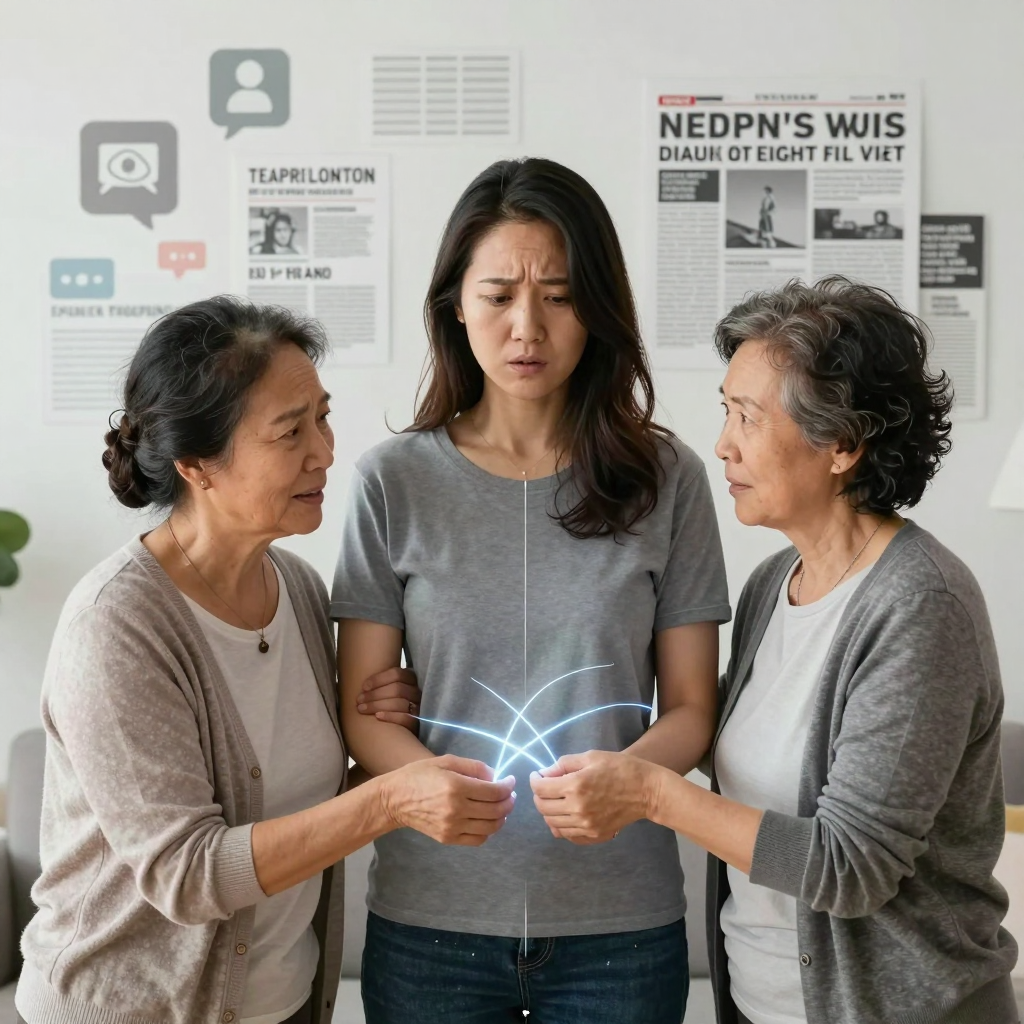 \n
\n
The Unexpected Protagonist in an Accident Report: the “Daughter-in-Law”
Why was a traffic accident involving a woman in her 60s reported not simply as an “accident caused by a driver,” but as a “daughter-in-law’s accident”?
A recent report on an accident in Okcheon, North Chungcheong Province, featured the headline: “90-year-old mother-in-law killed by daughter-in-law’s parked car.” Looking only at the facts, it was a tragic traffic accident in which a parked vehicle struck an elderly pedestrian. Yet the headline placed the family relationship between daughter-in-law and mother-in-law front and center, rather than the functional relationship between driver and victim.
That single word makes us read the incident in an entirely different way.
If the report referred to her as a “woman in her 60s,” readers might first think of parking safety, protecting older pedestrians, or vehicle blind spots. But the moment she is labeled a “daughter-in-law,” the accident is reconstructed as a tragedy unfolding between a mother-in-law and her daughter-in-law. A layer of family history and emotion is added to what would otherwise be an ordinary accident report.
In Korean society in particular, the term “daughter-in-law” means more than simply a son’s spouse. It carries with it long-standing social images involving holiday labor, caregiving, relationships with the husband’s family, and financial expectations. As a result, even before judging the cause of the accident or assigning responsibility, readers may easily find themselves asking moral questions such as, “Was she taking care of her mother-in-law?” or “Shouldn’t she have been more careful?”
Even when the incident is the same, the responsibility and emotion readers feel can change depending on whether someone is called a “driver” or a “daughter-in-law.”
Of course, family relationships may sometimes be necessary to explain the context of an incident. But when that relationship becomes the focus of a headline, a person can be reduced to a particular family role before being seen as a driver or a citizen. The title “daughter-in-law” still carries implicit expectations: that she should be good at caregiving and bear greater responsibility toward her husband’s family.
This style of reporting ultimately leaves us with a question. Are we reacting more strongly to who occupied what position within the family than to the cause of the accident or the measures needed to prevent similar incidents?
The “daughter-in-law” in an accident report may appear to be an unexpected protagonist. In fact, however, the word reveals the emotions and moral expectations that Korean society has long attached to family relationships. When the choice of a single word transforms a simple accident into a family drama, we need to look more carefully at the frames created by language.
The Watched Daughter-in-Law and the Husband Who Allows It: The Rules of Marriage Begin to Shift
The mother-in-law hired a private investigator to check on her daughter-in-law’s private life. Yet the husband’s reaction was entirely unexpected. Regarding his wife’s infidelity, he invoked sexual autonomy, saying, “Just because you’re married doesn’t mean you can claim exclusive rights over your partner.”
It is a scene in which the language of marriage from an entirely different era enters the familiar framework of long-standing in-law conflicts.
Seeing Privacy as Something the Family Has the Right to Monitor
Under traditional family norms, a daughter-in-law’s behavior was not treated as merely a matter of personal choice. It was often interpreted as being connected to various family concerns, such as the in-laws’ honor, their son’s marriage, and the environment in which their grandchildren were raised.
That is why the premise of a mother-in-law suspecting her daughter-in-law of infidelity and hiring a private investigator goes beyond simple personal curiosity. It reveals a perspective that still sees a daughter-in-law’s private life as an area the family has the right to manage and judge.
The problem is that, in this process, the voice of the person directly involved can easily disappear. Conflicts within a marriage are, by nature, matters that the couple should discuss and decide first. But as the in-laws’ surveillance and interference grow, the marital relationship begins to look like something the entire family has the right to control.
The Unfamiliar Language of Marriage Called “Sexual Autonomy”
By contrast, the husband’s explanation of infidelity as “sexual autonomy” remains unfamiliar and controversial in Korean society. It clashes with the widespread belief that marriage is an exclusive relationship.
What matters here, however, is not whether infidelity should be unconditionally justified. This scene shows the reality that the rules of marriage can no longer be maintained as a single, unquestioned answer.
- How far should marriage guarantee individual freedom?
- Should an agreement between spouses take precedence over the family’s moral judgment?
- How far should a spouse’s family be allowed to intervene in a couple’s private life?
These are not questions concerning daughters-in-law alone. They are questions facing modern families about how to balance the boundaries of marriage, family interference, and an individual’s right to self-determination.
The Heart of the Conflict Is “Agreement,” Not “Permission”
One side keeps watch, while the other grants permission. But the standard for a healthy relationship is not one person unilaterally monitoring the other or becoming unusually tolerant. The key is whether the two people clearly understand what kind of relationship they want and have reached an agreement freely.
The position of a daughter-in-law is especially complicated because it combines the roles of spouse and family member. As a result, her personal choices can easily become the subject of judgment by her in-laws, while a private marital matter can escalate into an incident involving the entire household.
In situations like these, what is needed is not moral condemnation but clear boundaries. Couples need to establish the rules of their relationship first, while the in-laws need to recognize that they are not the decision-makers in that relationship, but family members on the outside who must respect it.
The old conflict between the “daughter-in-law and mother-in-law” has not disappeared. But within it, a new language of marriage—autonomy, agreement, and boundary-setting—has now emerged alongside the familiar language of surveillance and control.
Beyond Korea, Into China: Why Daughter-in-Law Stories Cross Borders
A mother-in-law who takes her son’s entire paycheck, a family that uses the daughter-in-law’s postpartum recovery money to buy a car for the husband’s sister, an affair caught on a dashcam. Surprisingly, these stories are not unique to Korea. On Chinese portals and short-form content platforms, conflicts between daughters-in-law and mothers-in-law are also a staple theme, capable of provoking empathy and outrage faster than almost anything else.
The reason these narratives cross borders is simple. In both Korea and China, marriage has long been viewed not merely as the union of two individuals, but as the union of two families. Even after marriage, matters such as financial control, child-rearing, caring for elderly parents, and holiday and family-event obligations remain closely tied to the husband’s family.
At the heart of the conflicts repeatedly portrayed in such content are usually three things:
- Money: Who controls the couple’s income and assets?
- Caregiving: Who bears responsibility for childbirth, child-rearing, and supporting elderly parents?
- Boundaries: How far can the husband’s family intervene in the private life of a married couple?
In family-story content originating in China, dramatic scenes frequently feature mothers-in-law managing their sons’ paychecks or spending postpartum recovery funds meant for the daughter-in-law on another child. This is also why Korean readers respond to such stories by saying, “It feels just like my own family.” The expressions and details may differ, but the experience of resources and authority being distributed unequally within a family is far from unfamiliar.
That said, this type of content also tends to edit conflicts into sharper, more dramatic forms rather than showing reality exactly as it is. The familiar setup of an “evil in-law family” and a “wronged daughter-in-law” easily draws clicks and comments. Even so, these narratives continue to endure because real-world anxieties are embedded within the exaggerated stories.
Ultimately, daughter-in-law narratives that cross borders are not simply tales of one person’s suffering. They are stories about family structures that make it difficult to achieve independence even after marriage. And today’s readers are no longer willing to readily accept the idea that “a daughter-in-law must endure because that is her role.” As awareness grows that couples themselves should define the boundaries around money, caregiving, and privacy, this long-standing narrative is evolving beyond a record of conflict into a language of negotiation and change.
Daughters-in-Law: From Those Who Endure to Those Who Negotiate
One person’s experience of saying she would no longer shoulder holiday food preparation and family caregiving alone can quickly become a practical guide for hundreds of people online. Brief posts such as, “I didn’t make jeon this holiday,” “My spouse and I agreed to divide childcare first,” and “We coordinate visits to my in-laws around our family’s rest and schedule” are more than simple complaints. For some, they become a real-life manual for learning the language of refusal and negotiation for the first time.
The traditional role of a daughter-in-law rested on many invisible assumptions: that she would prepare the holiday food, take care of the elderly, and be the first to endure any discomfort within the family. But now that dual-income households and nuclear families have become the norm, these expectations are increasingly difficult to accept as simply “the natural way families work.”
The phrase “You’re the daughter-in-law, so you have to put up with it”
is now giving way to: “We need to agree on who will handle what, when, and how much.”
Seeing Holiday Labor as Labor—not “Helping Out”
The biggest shift can be seen in how people view holidays, ancestral rites, and family events. When one person handles everything from grocery shopping and cooking to setting the table, washing dishes, and cleaning up, describing it as “helping out” obscures who is actually responsible. But once it is recognized as housework, caregiving, and emotional labor, the basis for discussion changes as well.
For example, instead of saying, “I’ll take care of everything this holiday,” couples can discuss specific questions such as:
- Whether to buy prepared food or cook it themselves
- Who will share responsibility for preparation and cleanup
- How to decide visiting hours and whether anyone will stay overnight
- Who will take responsibility for childcare and eldercare
- What role each spouse will take in relation to their own family of origin
These questions do not mean becoming cold toward one’s family. On the contrary, they are a way to sustain relationships over the long term by reducing a structure in which the burden falls disproportionately on one particular family member—especially the daughter-in-law.
The Language of “Setting Boundaries” Created by Online Communities
In anonymous online communities, the experiences of people dealing with conflicts involving their in-laws accumulate quickly. When someone writes, “I refused their demand that I come over starting the day before the holiday,” the comments that follow are often less about blame and more about practical advice. People share what to say to their husbands first, how to coordinate visiting hours, and how to discuss financial support separately from caregiving demands.
Through this process, daughters-in-law learn not how to become “good daughters-in-law,” but how to maintain relationships with their families while protecting their own lives. The key is not to confront others emotionally. It is to clarify roles, time, costs, and responsibilities.
For instance, expressions like the following can help open a conversation rather than escalate a conflict:
- “I’d like us to decide in advance how much I’m able to help.”
- “I think it would be better if we changed things this time so that we prepare together as a couple.”
- “I have my own schedule, so I’d like to arrange a visit for the day itself.”
- “Caregiving shouldn’t fall entirely on one person; the family needs to share the responsibility.”
The Family Rules Couples Need to Set First
Many conflicts that appear to be problems with one’s in-laws actually begin with the division of roles within the marriage. When a spouse avoids taking responsibility in dealing with their own family of origin, the daughter-in-law is easily placed in direct opposition to her mother-in-law. That is why, before speaking to the in-laws, it is important for the couple to establish shared standards first.
Family rules do not have to be grand or complicated. Couples can begin by agreeing on everyday matters such as how often to visit during holidays, how to share the cost of family occasions, how to divide responsibility for caring for parents, and how to respond to sudden requests. In particular, the principle that “each spouse should take primary responsibility for communicating with their own parents” can reduce unnecessary misunderstandings and emotional exhaustion.
Today’s daughters-in-law are no longer confined to the role of simply enduring everything. Some reduce the amount of labor they take on during holidays. Some share caregiving responsibilities. Others draw clear boundaries around their time and financial independence. Together, these choices are gradually reshaping the long-standing rules within families.
Will the Daughter-in-Law Disappear—or Be Reborn as a New Kind of Individual?
The title “daughter-in-law” still evokes holiday labor, caregiving, propriety, and sacrifice for many people. But today’s daughters-in-law are no longer simply expected to quietly carry out predetermined roles. They are becoming individuals who speak up about the value of their time and labor, establish the rules of their marriages together with their spouses, and set boundaries against unfair demands.
What matters is not merely eliminating the term “daughter-in-law” itself. It is removing the obligations that once came automatically attached to it. Rather than asking, “What must she do because she is the daughter-in-law?” families should ask, “Who can do how much, and what arrangements does each person agree to?”
Family relationships in the future need to be redesigned around the following principles:
Caregiving must be a shared family responsibility, not one person’s burden.
Holiday preparations, childcare, and caring for elderly parents should not be concentrated on a particular daughter-in-law.Spouses should agree on family standards first.
Matters likely to cause conflict—such as how often to visit, financial support, participation in family ceremonies, and childcare—should be discussed and decided in advance.Goodwill and obligation must be distinguished.
Helping one another can enrich relationships, but the moment one-sided sacrifice is taken for granted, the relationship quickly becomes depleted.Individual boundaries and personal rhythms must be respected.
A daughter-in-law is an independent individual before she is someone’s wife, daughter, employee, or caregiver. Her privacy and right to make choices must not be violated simply because she is part of the family.
Ultimately, the families of the future must move toward equal relationships that respect one another’s lives, rather than structures that demand a “good daughter-in-law.” Whether the name “daughter-in-law” will disappear or remain with a new meaning is still uncertain. But one thing is clear: the name must no longer signify a role that demands sacrifice. Instead, it must become a language of self-determination and negotiation.
Comments
Post a Comment