 \n
\n
Novak Djokovic’s First-Round Streak Ends After 20 Years
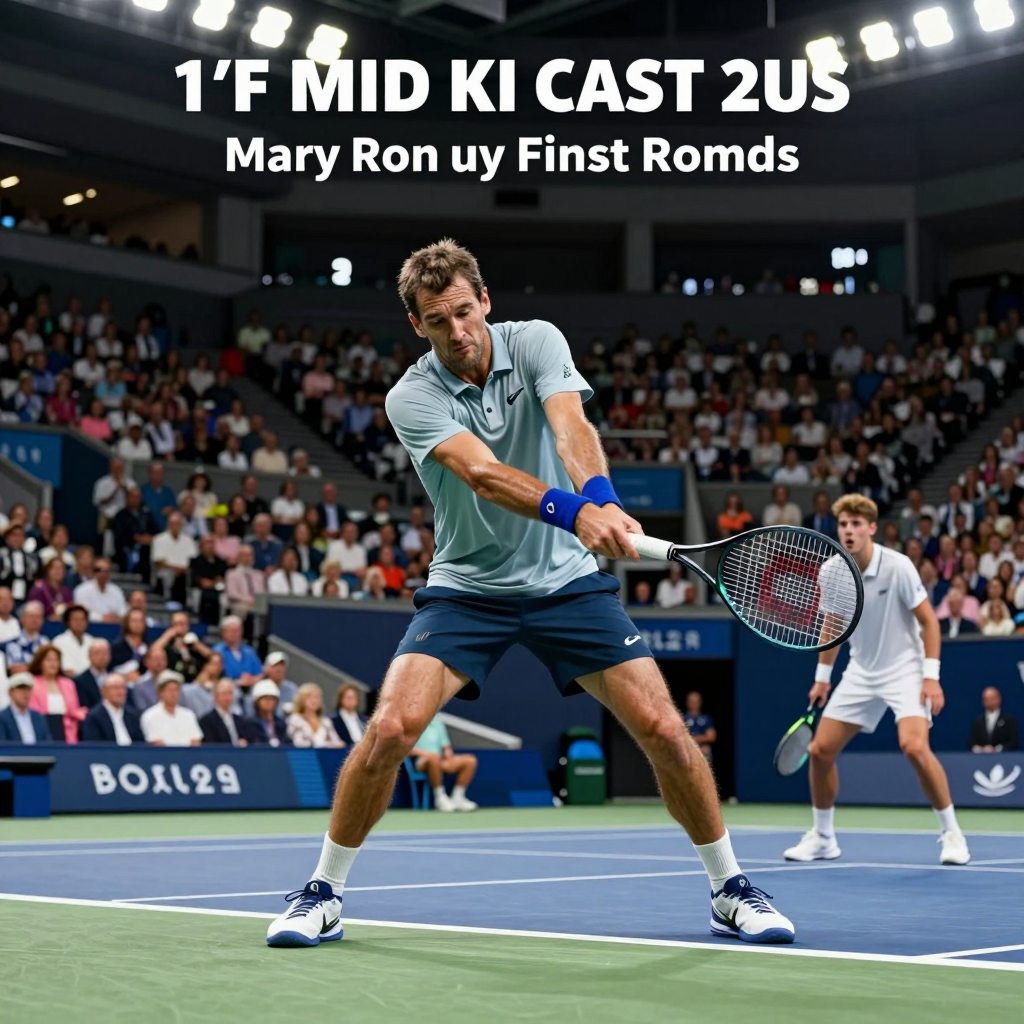
On a New York night, a scene unfolded that no one had expected. Novak Djokovic walked off the court in the first round of the US Open. It was the first time he had lost in the opening round of a Grand Slam since the 2006 Australian Open—a span of no fewer than 20 years.
His opponent was Mariano Navone, an Argentine ranked No. 48 in the world. The match was anything but easy. The two battled through five sets over 4 hours and 36 minutes, with Navone ultimately recording a 7-6(5), 5-7, 4-6, 6-2, 6-1 victory.
At first, the match seemed to be following a familiar script for Djokovic. After dropping the opening set, he claimed the second and third, turning the match around with his experience and concentration. But everything changed in the final two sets. Djokovic began to fade in his serve and movement, while Navone repeatedly extended the rallies, testing his endurance to the very limit. In the end, Djokovic collapsed, losing 11 of the final 12 games.
What made the defeat even more shocking was that it meant far more than a simple upset. For the past 20 years, Djokovic had been virtually untouchable in the opening rounds of Grand Slam tournaments. His run of 77–78 consecutive first-round victories came to an end here.
His physical condition during the match added even greater weight to the loss. Djokovic was reportedly suffering from vomiting and cramping, and his serving motion appeared to be restricted as well. Even so, he fought with every ounce of emotion until the final point. The applause from the New York crowd after his defeat felt less like a reaction to the result of a single match and more like a tribute to a champion who had dominated the court for so many years.
That day’s US Open was not merely the night a title favorite was eliminated. It was the night that showed even the unshakable strength of the Djokovic era could be shaken, and a moment that signaled tennis had arrived at the threshold of a new era.
A Broken Record, the End of the Big Three Era: Novak Djokovic’s Shocking First-Round Exit
Since the 2006 Australian Open, Novak Djokovic had never lost in the first round of a Grand Slam. This record, which had stood for nearly 20 years, was more than just a winning streak—it symbolized the fact that Djokovic was always the kind of player who survived the early stages of major tournaments.
But at this year’s US Open, that belief was shattered. Djokovic lost to Mariano Navone in a grueling five-set battle, bringing his Grand Slam first-round winning streak to an end at 77–78 matches. The exact figure varies slightly depending on how the record is calculated, but the magnitude of the shock remains unchanged.
Djokovic’s “Survival” Was a Given for 20 Years
Djokovic’s last first-round exit at a Grand Slam came at the 2006 Australian Open. At the time, he was still a young player far from the top of the world. From there, he went on to build one of the most dominant careers in tennis history.
Along the way, Djokovic won 24 Grand Slam titles, spent more weeks at No. 1 than any player in history, and claimed dozens of Masters titles. That is why, for fans in New York, Djokovic getting through the first round felt less like a prediction and more like an unquestioned assumption.
That is also what made this defeat feel so unfamiliar. Fans could imagine Djokovic failing to win the title, but they could hardly picture him leaving the tournament on its opening day.
The First Grand Slam Second Round Without the Big Three Since 2003
This result did not merely bring one of Djokovic’s records to an end. For the first time since 2003, none of Djokovic, Rafael Nadal, or Roger Federer remained in the second round of a Grand Slam.
Federer has already retired, while Nadal has also moved away from the tour. And with Djokovic now eliminated in his opening match at the US Open, the presence of the Big Three—something fans had grown accustomed to for so long—is no longer guaranteed from the very beginning of a major tournament.
That does not mean the complete end of Djokovic’s era. He still possesses one of the greatest careers in the history of the sport and remains an active player. If his health and preparation are in place, he can still return to the fight for another major title.
Still, this night in New York left behind a defining image. The dominance of the Big Three, once the default setting of Grand Slam tennis, is now becoming a memory—and tennis is shifting toward a new center.
Novak Djokovic’s Relentless Fight Through Vomiting and Cramps
He did not simply play a poor match. The most shocking aspect of this defeat was not the scoreboard, but the condition of Novak Djokovic’s body on the court.
Djokovic actually vomited during the match, and afterward appeared to suffer what looked like cramping in his left foot, causing his movement to slow dramatically. Discomfort in his back and shoulder also seemed to affect his serve. The movement that normally allowed him to cover every corner of the court before firing a sharp counterpunch became noticeably more limited as the match wore on.
His serve, in particular, is a crucial starting point for Djokovic’s game, but on this day, both its power and accuracy wavered. His second serve gave his opponent opportunities to attack, while he repeatedly found himself a step late in long rallies. As his body failed to keep up, his defensive range narrowed, and the rock-solid rhythm unique to Djokovic began to crumble.
Even so, he refused to give up. Every time he won a point, he poured out his emotions, and even in the most difficult moments, he continued trying to draw energy from the crowd. Even in the fifth set, when the balance of the match had already tipped decisively, Djokovic stayed on the court until the very last ball was played.
That is why this moment leaves behind more than the meaning of a first-round exit. It was not the image of a perfect champion. Rather, it looked like the image of a human being battling the limits of his own body. The applause from the New York crowd was not consolation offered to a defeated player, but a tribute to the competitive spirit and fighting heart he had displayed on the Grand Slam stage for 20 years.
Navone’s Blueprint for Bringing Down Novak Djokovic
Navone’s victory was not a lucky result achieved simply by relying on Djokovic’s mistakes. Of course, Novak Djokovic was dealing with clear disadvantages during the match, including vomiting, cramps, and a drop in his serving form. But Navone read those weaknesses perfectly and continued imposing his tactics without wavering, even through the most difficult moments.
The key was the length of the rallies. Navone did not try to end points with one or two reckless power shots. Instead, he consistently sent deep strokes to keep Djokovic pinned behind the baseline. In his prime, Djokovic would likely have used such long rallies to draw errors from his opponent and turn defense into counterattacks. But in this match, Djokovic’s court coverage and recovery speed were noticeably below their usual levels.
Especially after the fourth set, Navone made Djokovic run one more time and handle one more low ball. Viewed in isolation, each point might have seemed like an ordinary choice. But over a match lasting more than four hours, that repetition becomes the cruelest kind of pressure for a physically exhausted player.
Another key factor was attacking the second serve. As the power behind Djokovic’s first serve declined, Navone actively adjusted his return position. Against the second serve, he stepped inside the court and responded aggressively, refusing to settle for merely getting the return back in play. From the moment of the return, he seized control of the rally and forced Djokovic to hit a defensive first shot.
- He maximized Djokovic’s physical exhaustion through long rallies.
- He attacked the weakened second serve to gain the upper hand in return games.
- Rather than recklessly competing in a battle of winners, he chose depth and consistency.
- As the match progressed, he relentlessly targeted the areas where Djokovic’s defensive range had narrowed.
In the end, Navone was not simply a player who happened to face a fallen legend. He was a player who knew how to keep applying pressure until an opponent in decline finally broke. Djokovic losing 11 of the last 12 games was not merely a collapse in concentration. It was the result of Navone’s long rallies, aggressive returning, and unwavering tempo.
novak djokovic: Not the End, but the Next Page of a Legend?
Is this defeat truly Novak Djokovic’s final scene? Or is it simply one page in a long and extraordinary career—a brief pause before he makes his return?
His first-round exit at the US Open is undeniably shocking. It was something that had never happened in 20 years, and the vomiting, cramps, and diminished movement he displayed during the match made the reality of time impossible to ignore. It may now become difficult to call novak djokovic an automatic favorite at every Grand Slam.
But one defeat cannot define an entire career.
- 24 Grand Slam singles titles
- 101 career titles
- 40 ATP Masters 1000 titles
- An Olympic gold medal
- A record 428 weeks as world No. 1
His pursuit of a 25th major title came to a halt in New York. But the goal itself has not disappeared. If anything, Djokovic may now have to compete by entering fewer tournaments, preparing with greater precision, and focusing on the stages that matter most.
The question is no longer, “Can he dominate every tournament the way he used to?” The real question is, “Can he win once again when the moment matters most?”
The defeat in New York may look like the end of an era. At the same time, it could be the beginning of a legend’s attempt to survive in a new way—by accepting the limits of age and the body. Djokovic’s next chapter may be more difficult than anything that came before, and that may be exactly what makes it even more compelling.
Comments
Post a Comment