The Hillside Behind Our Home Is Giving Way: Everything You Need to Know About Urban Landslides in an Era of Extreme Rainfall
 \n
\n
Landslide: A Dawn Warning That Swept Over a Sleeping City
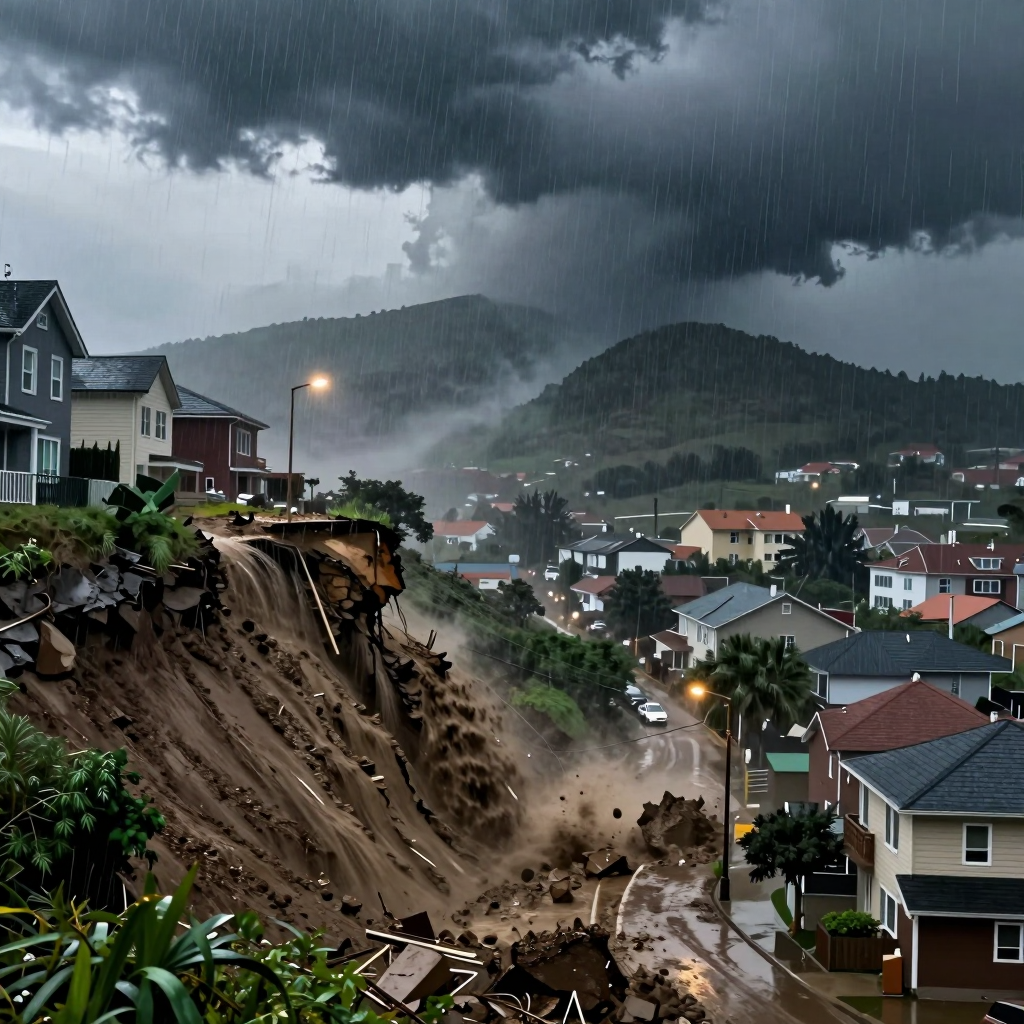
After 815.5 mm of rain poured down over three days, a slope behind an apartment complex in Geoje collapsed. The mudflow, which seemed destined to end deep in the mountains, pushed past a retaining wall and passageway and into the homes where residents were asleep. Landslides are no longer disasters confined to remote, uninhabited mountains. They have become disasters in the very places where we live—on slopes bordering urban neighborhoods, beside aging retaining walls, and along road cuttings—capable of striking at any moment.
The danger of this torrential rain was not simply that “a lot of rain fell.” After days of rainfall, the ground was already saturated. Then, as explosive bursts of intense rain continued through the early morning hours, the forces holding the soil and rocks in place weakened in an instant. The slope could no longer withstand the pressure, and the debris flowed toward the nearest, lowest points: apartment buildings and roads.
The fact that it happened while people were asleep makes it even more terrifying. A landslide can surge forward without warning with a deafening roar, meaning that waiting to check what is happening outside the window before taking action may be too late. This is why emergency alerts and evacuation instructions are so vital during prolonged nighttime downpours. They must not be dismissed as mere notifications; they must lead to immediate evacuation.
Urban landslides are natural disasters, but they are also a consequence of the way cities are built. When slopes carved into mountains, paved surfaces that prevent rainwater from soaking into the ground, and retaining walls with poor drainage meet extreme rainfall, the damage can multiply. In the end, what we need to inspect is not some distant mountain, but the slope, wall, and drainage path behind our own homes.
If water begins bubbling up from a slope near your home, or new cracks appear in walls or floors, treat it as an immediate warning. If trees or utility poles start leaning, or you hear an unfamiliar rumble, move away from slopes and valleys and evacuate to a safe location. The dawn that swept over Geoje’s sleeping city left behind a clear message: A landslide is not merely a problem in the mountains—it is a matter of safety for the cities and homes where we live.
More Frightening Than the Amount of Rain Is the Way It Pours Down: Landslides
“Once-in-200-years extreme rainfall” has stalled over a narrow area. The problem is not simply that a great deal of rain has fallen. The real danger is that, onto mountainsides already saturated with water, an unbearable volume of rain has poured down again within a short period. This is the moment when landslides become reality—without warning.
In coastal areas along the southern coast, including Geoje and Tongyeong, more than 800 millimeters of rain reportedly fell over three days, followed by around 500 millimeters of concentrated downpour within just a few hours before dawn. Rainfall exceeding 100 millimeters per hour gives drainage channels, rivers, and soil no time to process the water. The earth stops being ground that can hold water and turns into a mass that slides downhill under its own weight.
“Accumulated Rainfall + Explosively Concentrated Downpours” That Trigger Landslides
The risk of landslides is difficult to assess based on daily rainfall alone. The key questions are how long the rain has continued and how intensely it pours at the end.
The first rains seep into the soil, saturating the ground. As this happens, the cohesion between soil particles weakens, while the ability of tree roots to hold the soil together approaches its limit. The downpour that follows creates channels of water inside the slope and increases earth pressure. Eventually, the mountainside can no longer withstand its own weight and collapses.
A mountain that has received heavy rain is not solid ground. It is closer to a gigantic sponge soaked with water.
The danger is especially great in urban areas where apartments, roads, embankments, or retaining walls stand below slopes. That is because a natural slope may not simply collapse in place; mud, soil, and rainwater can race along artificial structures and rapidly sweep into residential areas.
“Stationary Water Bombs” Created by Warmer Seas
One factor behind recent extreme downpours is rising sea-surface temperatures. When waters off the southern coast warm to 27–28°C, the ocean supplies more water vapor to the atmosphere. Water vapor is the fuel that powers torrential rain.
When this combines with moist air flowing in from a typhoon, along with the movements of low- and high-pressure systems, a powerful corridor of wind known as a low-level jet can form. This wind corridor continuously pushes water vapor into a particular region. If rain clouds are unable to move and remain stalled over a narrow area such as Geoje or Tongyeong, localized torrential rainfall develops, repeatedly drenching the same place.
In other words, in an era of climate crisis, extreme rain does not fall evenly across a wide area. It strikes one region with intense force over a short period. And this pattern accelerates the risk of landslides dramatically.
Why Downpours After Drought and Heat Waves Are More Dangerous
Heavy rain following prolonged heat waves and droughts also demands caution. Soil that has remained dry for a long time may harden or develop cracks. When torrential rain arrives, the water may fail to soak in gradually and instead rush rapidly across the surface.
On a slope, these flows scour away the soil, while water seeping into cracks weakens the ground from within. Tiny gaps that were invisible can become the starting point of a collapse in an instant. That is why the claim that “everything looked fine until the rain came” does not mean a slope is safe from landslides.
Going forward, we must look beyond rainfall totals alone. We need to consider how many consecutive days it has been raining, how much hourly rainfall is forecast overnight, and whether the slopes and retaining walls around our homes are already saturated with water. Landslides may begin not with the total amount of rain, but with the way rain comes crashing down without giving the ground even a moment to hold on.
Landslides: It Wasn’t the Mountain That Collapsed, but the Boundary Between the Mountain and the City
The moment a retaining wall or slope behind an apartment complex gives way, the definition of a “landslide risk area” changes completely. Landslides are no longer disasters that occur only deep in the mountains. The hillside visible from your window, the retaining wall behind your residential complex, and the cut slope beside the road can all become the starting point of danger.
Recently, in and around Geoje, slopes and retaining walls adjoining apartment complexes collapsed, sending earth and debris into residential areas. The boundary that once separated the mountains from the city had disappeared. In the past, landslide risk was regarded as a problem limited to “forested areas.” Now, it must be understood as a safety issue involving slopes adjacent to urban areas.
Landslide Risk Is Determined More by “Waterways” Than by the “Distance to the Mountain Behind Your Home”
The presence of a mountain behind your home does not automatically mean that you are in danger. However, when heavy rain continues, you need to carefully examine the condition of the slope and the path taken by flowing water.
The following conditions can significantly increase the risk:
- A tall slope or retaining wall directly behind an apartment or house
- Areas around cut slopes created by road construction or development
- Drainage systems that are blocked, or layouts that funnel rainwater into one place
- Locations where water leaks from a retaining wall or muddy water flows out during rainfall
- Places where minor soil runoff, cracks in walls, or ground subsidence have occurred in the past
The real danger emerges during extreme rainfall. When a large amount of rain falls in a short period, the soil can no longer absorb it. Water then moves all at once along the inside and surface of the slope. At that moment, aging retaining walls, inadequate drainage systems, and slopes weakened during development can become channels for a landslide.
Developed Slopes Are Where Natural Disasters and Urban Structures Collide
Landslides around cities are not caused by rain alone. They are also the result of cutting into mountains to build roads and homes, filling in areas around valleys, and covering the ground where rainwater once seeped in with concrete and asphalt.
When rain cannot gradually infiltrate the soil, surface runoff increases. The water quickly gathers in low-lying areas and at the bottom of slopes. In the end, a landslide is no longer a disaster caused solely by the forces of nature. It becomes a complex disaster produced by the overlap of the climate crisis and vulnerabilities in urban planning.
That is why we need to broaden the question, “Is this a landslide risk area?”
Who manages the slope behind our home, when do they manage it, and according to what standards?
When torrential rain falls, where does the water flow—and can the retaining wall and drainage system withstand it?
Is the Mountain Behind Your Home Really Safe?
If there is a mountain or retaining wall near your home, it is important not to dismiss even small changes before or after heavy rain. New cracks in walls or floors, leaning trees or utility poles, water seeping from a retaining wall, and unusual rumbling sounds may all be warning signs.
If heavy rain continues through the night and a landslide advisory has been issued, deciding to “wait and see a little longer” can be dangerous. Move away from slopes and valleys, and prioritize evacuating early in accordance with emergency alerts and instructions from local authorities.
In the age of landslides, safety can no longer be determined simply by the height of a mountain or the distance between a home and a mountain. The reality we must now accept is that every boundary where the city meets the mountain can become the scene of a disaster.
Landslide Alerts: How to Get People Moving at 6 a.m.
Twenty-four emergency messages were sent over a 12-hour period. The alerts clearly sounded. But the heaviest rain and landslides struck at dawn—the time when people were sleeping most deeply.
This leaves us with an important question:
Why is there such a wide gap between receiving an alert and actually evacuating?
Emergency messages need to be brief and forceful, but when they arrive too frequently, people become accustomed to them. The moment they think, “It’s probably just another warning about heavy rain,” the urgency of the alert begins to fade. At night, in particular, many people keep their phones on silent, while older adults may not be able to check smartphone notifications.
Landslides do not wait. If a slope is already saturated with water, even a small amount of additional rain can cause soil and retaining walls to collapse in an instant. That is why deciding to wait and watch the situation outside a little longer can be extremely dangerous.
An Alert Should Be an ‘Instruction to Act,’ Not Just ‘Information’
An effective landslide alert must do more than simply say, “Please be careful.” It must clearly convey the following information so residents can make an immediate decision:
- Which areas are at risk: Specific guidance based on familiar local units, such as neighborhoods, villages, or apartment complexes
- What people should do: Clear instructions, such as “Residents living below the slope must evacuate immediately”
- Where they should go: Information on nearby shelters and safe evacuation routes
- By when they must move: A clear time frame, such as “Evacuation is recommended before 6 a.m.”
The sentence, “Residents in homes adjacent to the slope behind the building must move to the evacuation shelter immediately,” prompts far stronger action than the vague phrase, “There is a risk of a landslide.”
Waking Sleeping People Is Not Just a Technological Problem
Emergency text messages, smartphone alerts, village broadcasts, and announcements from apartment management offices are all necessary. But the final step ultimately depends on connections among neighbors and within the community. Older adults who live alone, families with infants, and residents with limited mobility may find it difficult to evacuate based on a single text message.
That is why the following preparations are especially important in areas at risk of landslides:
- Create a nighttime emergency contact network for each family
- Designate emergency contact coordinators at the apartment-complex or village level
- Check the locations of shelters and evacuation routes in advance
- Move proactively when heavy-rain and landslide alerts overlap
- Establish a brief communication system for checking on neighbors
An alert at 6 a.m. is not simply a notification sound. For some, it may be the signal that wakes them from sleep; for others, it may be the last moment they have to leave home.
Future landslide response cannot end with sending more alerts. A system that ensures people who receive an alert actually reach a safe place—that must become the core of disaster communication.
The Last Line of Defense Against Landslides Starts at Home
Before the next heavy downpour arrives, there are warning signs you can check in just 10 minutes. Landslides are not disasters that happen only deep in the mountains. Small changes in places close to everyday life—such as the slope behind your house, an aging retaining wall, or a roadside cut slope—can be where it all begins.
Especially on days when heavy rain and landslide advisories are issued together, “Let’s watch it a little longer” is far less safe than “Let’s check now and act early.” Once soil and debris begin to move, the time to make a decision—and the opportunity to evacuate—can disappear quickly.
A 10-Minute Check: Warning Signs to Look for Around Your Home
Before heavy rain begins or while it is raining, check the area outside your home and around your windows for the following signs:
- Is water leaking from—or suddenly gushing out of—the slope or retaining wall behind your home?
- Have new cracks appeared in fences, walls, floors, parking areas, or other surfaces?
- Do trees, utility poles, fences, or railings appear to be leaning more than usual?
- Is soil, rock, or debris gradually accumulating or sliding down below the slope?
- Has a subtle structural change appeared, such as doors or windows suddenly refusing to close properly?
- Can you hear an unusual humming sound or rumble coming from the mountain?
If you clearly spot even one of these signs, take photos for documentation and immediately notify your building management office, local government authorities, or the fire department. However, do not approach a dangerous slope to inspect it more closely. Signs of a landslide are not safer the closer you get—instead, they are signals to move away sooner.
Your Family’s Evacuation Route Must Be Decided Before the Rain Comes
During a sudden downpour in the early hours of the morning, it can be difficult for an entire family to make decisions at once. That is why it is important to establish a simple evacuation plan in advance, rather than waiting until an emergency alert arrives.
Agree on these three things with your family:
Where will you go?
Decide in advance on a safe building in the opposite direction from the mountain or retaining wall behind your home, a designated shelter, or a nearby relative’s house.Which route will you take?
Avoid valleys, areas along streams, underpasses, and steep roads. During heavy rain, even familiar routes can become flooded or blocked by soil and debris.Where will you meet if you cannot reach one another?
In case family members become separated, decide on a common meeting point and a way to stay in contact.
It also helps to keep a small emergency bag near the entrance containing a phone charger, flashlight, essential medicines, bottled water, and copies of identification documents. What matters is not perfect preparation, but setting a minimum standard for action so you will not hesitate on a dangerous night.
The key to responding to a landslide is not what you do after the soil starts moving.
Seeing a leaking retaining wall, cracked ground, or leaning fence—and acting first—is the last line of defense.
If heavy rain is in the forecast, spend just 10 minutes today checking behind your home. Simply knowing your home’s slopes and evacuation routes can give you far more time to make a choice when disaster strikes.
Comments
Post a Comment