 \n
\n
The Day the Exchange Rate Turned Upside Down: What a 100-Won Drop in One Month Tells Us
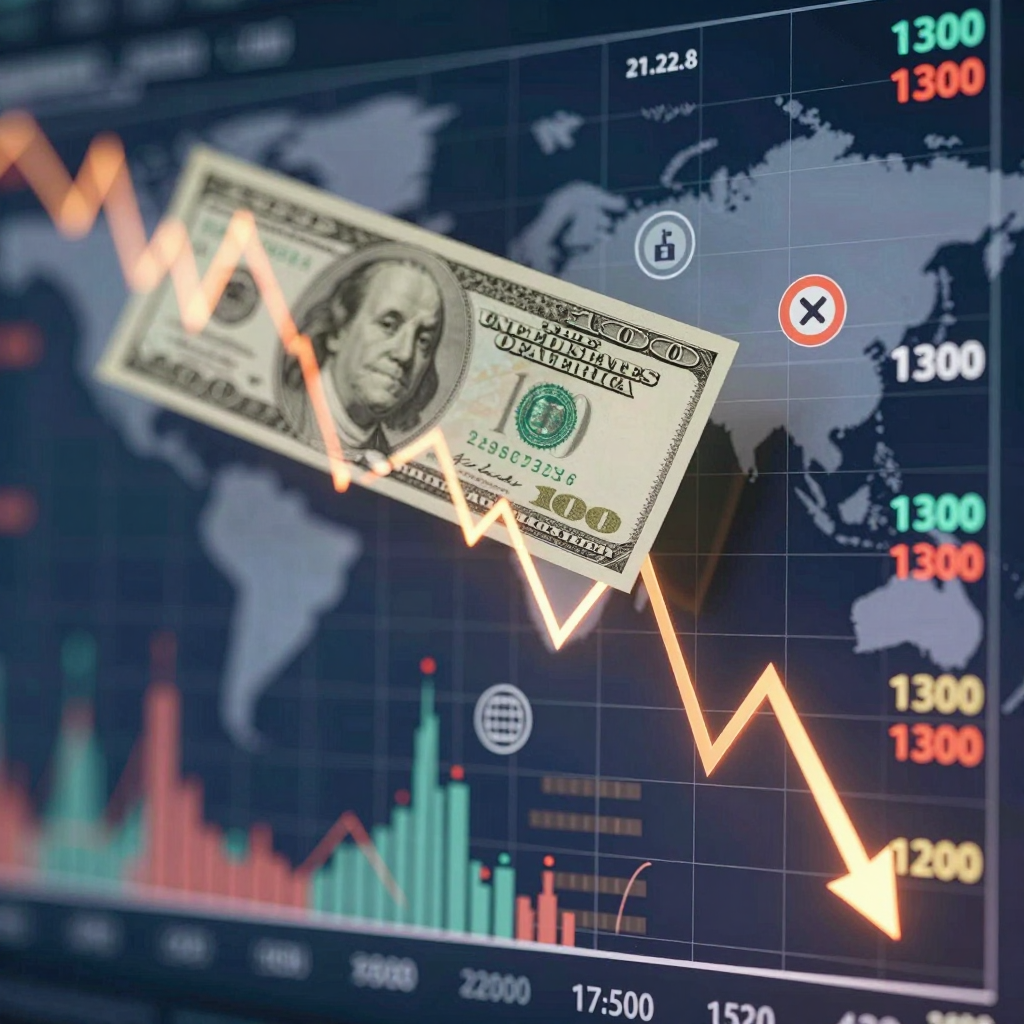
Just a few weeks ago, the won-dollar exchange rate was heading toward the mid-1,500-won range, heightening anxiety in the market. But on August 28, 2026, the won-dollar rate closed at 1,372.5 won in Seoul’s foreign exchange market. That was 8.4 won lower than the previous day and marked its lowest level in roughly 13 months.
At first glance, the story appears simple: “The price of the dollar has fallen.” But the exchange rate’s decline—from 1,549.4 won at the end of June to 1,424 won at the end of July, and then to the 1,370-won range by the end of August—is difficult to dismiss as a mere series of daily fluctuations. It looks more like a dramatic reversal in the market’s direction, with the rate moving by more than 170 won in a short period.
If fewer won are needed to buy one dollar, it means that the value of the won has strengthened by the same measure.
Several factors combined to drive this reversal, including the narrowing interest-rate gap between South Korea and the United States, dollar-selling by exporters, foreign capital flows, and a recovery in risk appetite. In particular, the Bank of Korea’s rate hike narrowed the policy-rate gap between Korea and the U.S. to 0.75 percentage points, increasing the relative appeal of won-denominated assets—a development widely seen as a key variable.
Still, a stronger won does not necessarily mean that the Korean economy has achieved complete stability. A decline in the exchange rate is welcome news for overseas travel, studying abroad, online shopping from foreign retailers, and purchases of dollar-denominated assets. But for export-oriented companies with a high proportion of dollar revenue, it can weigh on sales and profitability when translated into won. This is why industries with substantial overseas sales—such as electronics, automobiles, and chemicals—cannot simply celebrate a rapid decline in the exchange rate.
What is particularly interesting is how companies have responded. As the exchange rate fell, businesses actually bought more dollars and accumulated them in foreign-currency deposits. Corporate dollar deposits increased by more than $10.1 billion in July alone, while the outstanding balance of foreign-currency deposits held by residents expanded to a record-high level. Rather than viewing the won’s strength simply as “dollar weakness,” companies saw it as an opportunity to secure dollars in preparation for future volatility.
Ultimately, the figure of 1,372.5 won means more than just a favorable moment to exchange currencies. Today’s exchange rate shows that the Korean economy stands at the crossroads of interest rates, exports, foreign capital, and global dollar movements. After a sharp decline, a rebound can occur at any time. Rather than betting on a particular number, the key is to understand why the exchange rate moved in the first place.
The Invisible Forces Behind the Falling Exchange Rate and Stronger Won
The U.S. Federal Reserve continues to express concerns about inflation, while the yield on two-year U.S. Treasury notes has risen to 4.29% annually. Under normal circumstances, this would be an environment likely to strengthen the dollar. Yet the won-dollar exchange rate has quickly fallen from the mid-1,500-won range to the 1,370-won range.
The key point is not so much that the dollar has weakened, but that multiple forces strengthening the won have been working simultaneously. Changes in interest-rate differentials, the outlook for exports, foreign capital flows, and corporate dollar selling all moved in the same direction, accelerating the decline in the exchange rate.
A Narrower Interest-Rate Gap Increased the Appeal of Won-Denominated Assets
Exchange rates are highly sensitive to the interest-rate gap between two countries. That is because currencies offering higher interest rates can attract more capital inflows.
Following the Bank of Korea’s recent policy-rate hike, the Korea-U.S. policy-rate differential has narrowed to 0.75 percentage points. Although U.S. interest rates remain high, a smaller gap increases the relative appeal of won deposits and Korean bonds.
From an investor’s perspective, the incentive to hold dollars weakens to some extent, while the motivation to move funds into won-denominated assets grows. As dollar selling and won buying increase in this process, the won-dollar exchange rate naturally declines.
A narrower interest-rate gap is more than just a change in numbers. It can become a signal that changes how global capital views the won.
Expectations for Exports and the Current Account Built the Won’s Fundamental Strength
The Korean won is a representative export-driven currency. When expectations for the performance of major export industries such as semiconductors, automobiles, and shipbuilding improve—and prospects for a stronger current account grow—the foreign-exchange market begins to anticipate a larger inflow of dollars into Korea.
The process by which exporters convert the dollars they earn overseas into won is also important. In particular, when companies that had been holding dollars at high exchange-rate levels recognize the won’s strengthening trend, they may become more inclined to sell dollars and convert them into won before the exchange rate falls further.
When so-called nego flows, or dollar-selling volumes from exporters, become concentrated in the market, the exchange rate can fall even faster. Such supply-and-demand factors also played a role in pushing the intraday won-dollar exchange rate down to the low 1,370-won range in August.
Foreign Capital Added Support to Korean Stocks and the Won
When foreign investors want to buy Korean stocks or bonds, they must convert dollars into won. As a result, foreign capital inflows are likely to lead to a stronger won and a lower exchange rate.
Market participants believe that if the won-dollar exchange rate stabilizes below 1,420 won and is accompanied by foreign buying, a relatively favorable environment could emerge for the Korean stock market. If the exchange rate settles in the 1,300-won range, as it has recently, anxiety over a sudden exchange-rate surge may ease, while the price appeal of Korean assets could become more prominent.
However, foreign investor flows can change quickly depending on U.S. interest rates, global economic conditions, and geopolitical risks. Rather than determining the direction of the stock market based solely on the exchange rate, it is advisable to examine it alongside foreign investors’ spot and futures trading.
The Complex Supply-and-Demand Picture Created by Corporate Dollar Selling and Dollar Deposits
One development worth watching in the recent exchange-rate movement is how companies have managed their foreign-currency assets. As the won-dollar exchange rate plunged from 1,549.4 won at the end of June to 1,424.0 won at the end of July, companies also bought large amounts of dollars and accumulated them in deposits.
Corporate dollar deposits increased by more than $10.1 billion in July, while the outstanding balance of foreign-currency deposits held by residents rose to a record level. This suggests that companies viewed the period of exchange-rate decline as an opportunity to secure dollars for the long term.
At the same time, export-revenue conversions, payment needs, and currency-hedging transactions can lead to dollar selling in the short term. In other words, companies may accumulate dollars over the long term while also selling dollars in the market for operating funds and hedging purposes. This complex supply-and-demand dynamic is one reason exchange-rate volatility can increase.
Why the Won Can Strengthen Even in a Strong-Dollar Environment
The fact that U.S. Treasury yields are rising and concerns over further Fed tightening remain does not mean that every currency will weaken in the same way. Exchange rates are not determined by the strength of the dollar alone.
The won currently has several strengthening forces working together:
- Improved appeal of won-denominated assets following the narrowing of the Korea-U.S. interest-rate gap
- Expectations of a recovery in exports and the current account
- The possibility of foreign capital inflows
- Dollar selling and nego flows from exporters
- A rebound driven by the perception that the won’s weakness had gone too far
Ultimately, the recent decline in the exchange rate is difficult to explain simply as “dollar weakness.” Even amid the headwind of high U.S. interest rates, Korea’s economic supply and demand, policies, and capital flows have tilted toward the won. It is therefore more accurate to view the current environment as a complex phase of won strength.
Why Did Companies Build Up Their Dollar Holdings Even as the Exchange Rate Fell?
When the exchange rate declines and the won strengthens, it is easy to think, “Shouldn’t companies be selling their dollars?” But the actions of Korean companies in the summer of 2026 were the exact opposite. As the dollar became cheaper, companies actively bought more dollars instead of selling them and piled them into deposits.
According to data from the Bank of Korea, the won-dollar exchange rate fell by more than 125 won in just one month, from 1,549.4 won at the end of June to 1,424.0 won at the end of July. During that period, companies’ dollar deposits increased by $10.11 billion in July alone, marking the largest monthly increase on record. The balance of foreign-currency deposits held by residents also rose to $128.34 billion, reaching an all-time high, while dollar-denominated deposits surpassed $100 billion for the first time.
Why Companies Saw the Falling Exchange Rate as a “Buying Opportunity,” Not a “Selling Signal”
The key factor is future uncertainty. Exporting companies earn dollars by selling their products, but they often also pay for raw materials, equipment, and overseas investments in dollars. As a result, a period of won strength—when the cost of purchasing dollars falls—becomes an opportunity to secure the foreign currency they will need in advance.
In particular, after the exchange rate rapidly dropped from the 1,500-won range to the low 1,400-won range, companies may have increasingly felt that “the current level is relatively inexpensive.” From a corporate perspective, it can be more rational to purchase dollars in installments to reduce the potential increase in expenses if the exchange rate rebounds.
- Securing funds for payments for overseas raw materials and components
- Building up dollar reserves for overseas subsidiaries and investment plans
- Protecting against higher costs in the event of a future exchange-rate rebound
- Earning interest on dollar deposits while maintaining liquidity
The Increase in Dollar Deposits Is More About Risk Management Than Exchange-Rate Forecasts
A company’s dollar purchases do not necessarily mean it simply expects “the dollar to rise soon.” Rather, after experiencing sharp exchange-rate fluctuations, companies are focusing on foreign-exchange risk management—securing sufficient foreign-currency liquidity instead of betting on a single direction.
Exporting companies may hold dollar revenues, convert them into won when needed, and buy dollars again during further declines to cover future expenses. In an environment of high exchange-rate volatility, it can be more stable to hold dollars accumulated gradually at different price levels than to sell everything or buy all at once.
The Message from Companies That Individual Investors Should Also Consider
The actions of companies offer individual investors a useful clue. A falling exchange rate does not automatically mean they should reduce their dollar assets, nor does it mean they need to make a large purchase all at once. What matters is considering the exchange-rate level together with future dollar needs and the purpose of asset allocation.
If you expect to need dollars for overseas stock investments, tuition, travel expenses, or dollar deposits, you may want to consider converting won into dollars in installments while the won is strong. However, exchange rates can shift sharply again depending on the interest-rate gap between Korea and the United States, Federal Reserve policy, export trends, and foreign capital flows.
Ultimately, companies built up their dollar holdings not to “call the bottom” of the exchange rate. They were taking advantage of a moment when dollars had become relatively cheaper to prepare for future costs and uncertainty. In a rapidly changing foreign-exchange market, it is more important to secure the foreign currency you need in a planned manner than to make a definitive bet on the direction of the market.
How Exchange Rates Divide Travel Opportunities and the Burden on Dollar Investors
If the won/yen exchange rate falls to the 860-won range per 100 yen, that is welcome news for people preparing to travel to Japan. With the same amount of Korean won, they can exchange for more yen, reducing the burden of airfare, accommodation, and shopping expenses. Overseas online purchases and study-abroad costs are also representative areas that benefit from a stronger won.
On the other hand, a falling exchange rate is not entirely good news for investors who already hold dollar-denominated assets. Even if the dollar value of dollar-denominated stocks or deposits remains unchanged, their valuation may decrease the moment they are converted into Korean won. For example, if you hold $10,000 and the won/dollar exchange rate falls from 1,500 won to 1,370 won, the asset’s valuation in won decreases by approximately 1.3 million won solely due to the exchange-rate movement.
The same drop in the exchange rate can mean
a discount for those who are about to buy foreign currency,
but a potential valuation loss for those who already hold it.
If You’re Preparing for Travel or Overseas Shopping: Staggered Currency Exchange Is a Practical Approach
When the won is strong, it can be useful to exchange money in installments according to when you need it, rather than converting the entire amount at once. The exchange rate could fall further, but it could also rebound in the short term.
For a trip to Japan in particular, don’t look only at the won/yen exchange rate. Be sure to check the following costs as well:
- Preferential rates and exchange fees offered by banks and currency-exchange apps
- How overseas payment cards apply exchange rates
- Refund and cancellation terms for airfare and accommodations
- How much cash you are likely to use locally and what card benefits are available
Even if the market exchange rate is low, substantial fees during the actual currency-exchange process can reduce the benefits you feel. It is important to compare exchange costs based on your total travel budget.
If You’re a Dollar Investor: Separate Asset Returns from Currency Returns
It is difficult to evaluate the performance of overseas stocks or dollar deposits based solely on changes in asset prices. Returns measured in Korean won are determined largely by two factors:
- Changes in the price of the dollar-denominated asset itself
- Changes in the won’s exchange rate against the dollar
Even if U.S. stocks rise, a rapid strengthening of the won can cause returns measured in won to fall short of expectations. Conversely, even if stock prices do not rise significantly, a weaker won can help support the asset’s valuation in Korean won.
Therefore, investors holding dollar-denominated assets for the long term should avoid overreacting to short-term exchange-rate fluctuations and first reassess their investment objectives. Their response should differ depending on whether they are investing in the growth of overseas assets or preparing for the risk of a weaker won.
The Key Question Is: “Am I Buying Foreign Currency—or Do I Already Hold It?”
The recent decline in exchange rates can be an opportunity for consumers by easing the burden of overseas spending. However, for investors with a high proportion of dollar-denominated assets, it is also a warning sign that volatility in the value of their assets measured in Korean won may increase.
Exchange rates appear as the same numbers to everyone, but their consequences can be entirely different depending on one’s asset allocation and spending plans. Those preparing for travel should use the situation as an opportunity to reduce costs, while investors should take it as a chance to review their portfolios.
A Checklist for Reading What Comes Next After USD/KRW Falls to 1,372.5
The fact that the USD/KRW exchange rate has fallen to 1,372.5 does not, by itself, justify concluding that “the dollar has finally bottomed” or that “the won’s strength will continue.” The exchange rate is not just a single number—it is the result of interest rates, dollar supply and demand, policy statements, and investor sentiment acting simultaneously.
To gauge where the exchange rate may head next, it is important to develop the habit of looking beyond daily price movements and reviewing the following factors together.
The Korea–U.S. Interest Rate Differential and Central Bank Statements
One of the most important drivers of the exchange rate is the interest rate differential between Korea and the United States. The narrowing of the policy rate gap to 0.75 percentage points following Korea’s rate hike could provide a favorable backdrop for the won.
However, if the U.S. Federal Reserve emphasizes inflation concerns or hints at the possibility of further tightening, dollar strength could return. In particular, keep an eye on the following events and indicators:
- The Bank of Korea’s Monetary Policy Board decision and the governor’s remarks
- U.S. FOMC meetings and the release of employment and inflation data
- Movements in the U.S. 2-year Treasury yield
- Interest-rate comments from Federal Reserve officials
If short-term U.S. Treasury yields rise rapidly and the Fed’s hawkish messaging intensifies, upward pressure on the USD/KRW exchange rate could build again.
Foreign Investor Flows and the Direction of the Domestic Stock Market
Won strength often occurs alongside an inflow of foreign capital. If, as recently seen, the USD/KRW exchange rate remains stable below 1,400 and foreign investors continue to make net purchases of Korean stocks and bonds, the downward trend in the exchange rate could continue.
By contrast, caution is warranted when the following signals appear together:
- Large-scale net selling of Korean stocks by foreign investors
- Increased selling of KOSPI futures
- A sharp decline in global stock markets and a flight from risk assets
- A sharp intraday rebound in the USD/KRW exchange rate
Rather than looking at the exchange rate in isolation, tracking foreign investors’ spot and futures flows can provide a faster read on the market’s actual appetite for risk.
Exporters’ Dollar Selling and Dollar Deposit Flows
The recent decline in the exchange rate was also influenced by exporters’ dollar selling, commonly referred to as “nego” transactions. When exporters increase the amount of dollars they convert into won, upward pressure on the won may intensify.
On the other hand, if companies begin holding on to their dollars and accumulating them in foreign-currency deposits, the supply of dollars entering the market will decrease. In fact, an increase in companies’ dollar deposits can also signal that demand for buying dollars at lower prices remains strong during periods of exchange-rate declines.
Accordingly, review the following trends:
- The volume of dollar selling by exporters at month-end and quarter-end
- Changes in foreign-currency and dollar deposits held by residents
- Dollar-buying demand from importers for settlement payments
- The burden of energy import payments resulting from higher international oil prices
NDFs and the Dollar/Yen Exchange Rate
Looking only at the domestic spot market may mean reacting too late. Offshore won-dollar NDFs often reflect overseas investors’ outlook for the won and their hedging demand ahead of the spot market.
For example, if one-month NDFs are trading above the spot exchange rate, this can be interpreted as a sign that some market participants are preparing for the possibility of a future rebound in the USD/KRW exchange rate. Of course, no conclusion should be drawn from a single indicator alone; the difference from the spot rate and the broader global dollar trend should also be considered.
The dollar/yen exchange rate is also important. If the yen continues to weaken against the dollar while the won alone remains strong, it is worth assessing how long the won’s relative strength can last.
Five Key Things to Check Every Day
- The closing rate, intraday high, and low of the USD/KRW spot exchange rate
- The U.S. 2-year Treasury yield and the Fed’s interest-rate outlook
- Foreign investors’ flows in stocks, bonds, and futures
- The difference between the won-dollar NDF and the spot exchange rate
- Movements in the dollar/yen, won/yen, and international oil prices
1,372.5 is not the conclusion of the exchange-rate story—it is the starting point for judging what comes next. Whether won strength continues or the dollar rebounds will depend on whether the narrowing interest rate gap persists, whether foreign capital continues to flow in, and whether companies and market participants are selling dollars. More important than any single number is understanding the combination of interest rates, supply and demand, and policy events that produced it.
Comments
Post a Comment