 \n
\n
Haynes King Turns the NFL Stage Upside Down with Two Seconds Left
In the 2026 Pro Football Hall of Fame Game, the Carolina Panthers trailed the Arizona Cardinals 27–30 until the final moments. Even in a preseason game, the last two seconds are a pressure-packed moment for anyone.
At the center of it all was a name still unfamiliar to many fans: undrafted rookie quarterback Haynes King.
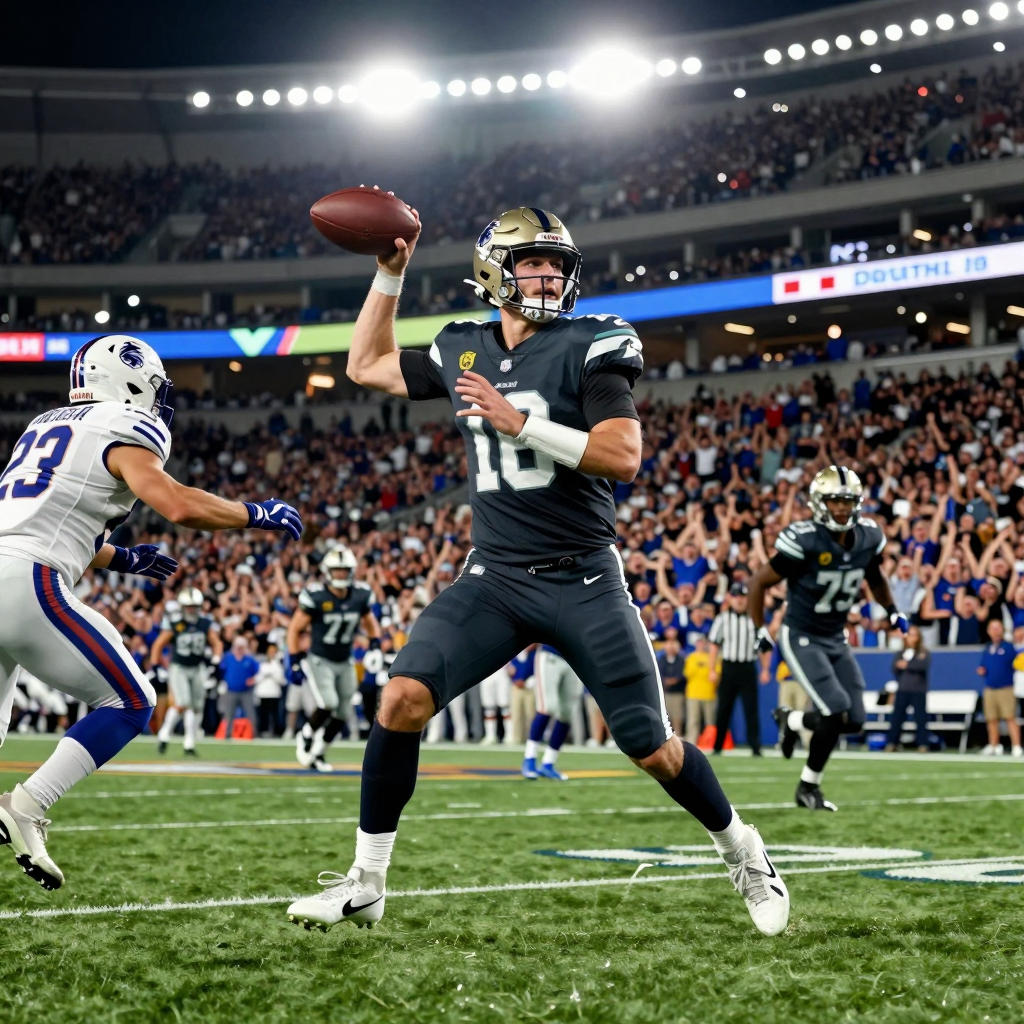
With the ball in the red zone, King searched for an opening from inside the pocket. But when the passing lane failed to fully open, he did not hesitate. He immediately escaped the pocket, cut toward the middle, sprinted five yards, and launched himself into the end zone. The moment he extended the ball across the goal line, the Panthers completed a 33–30 comeback victory.
This was more than just a preseason game-winning touchdown. It was the moment a player once viewed in college as having “excellent running ability but needing to prove himself as an NFL passer” displayed his greatest strength with absolute clarity in the most intense moment of the game.
Haynes King finished the night with 180 passing yards and two touchdowns, along with 39 rushing yards and the game-winning rushing touchdown. It was not a flawless performance. He also missed an open receiver in the end zone with an overthrown pass. But he operated the offense without throwing an interception and made bold, precise decisions when they mattered most.
For an undrafted player, every play is an audition. But King turned the final scene of that audition into his own highlight reel. Those five yards with two seconds remaining transformed him from a mere QB3 for the Panthers into the centerpiece of one of the most compelling underdog stories to watch this preseason.
Why Haynes King, the ACC Player of the Year, Went Undrafted
In the 2025 season, Georgia Tech’s Haynes King was unquestionably one of the biggest stars in college football. He won both ACC Player of the Year and ACC Offensive Player of the Year, producing 3,904 total yards through the air and on the ground. He rushed for 953 yards and 15 touchdowns, while passing for 2,951 yards and 14 touchdowns.
And yet, his name was never called by the time the 2026 NFL Draft concluded. Judging solely by his impressive awards and production, the outcome was difficult to understand.
The Question Mark Over His “Pro-Style Passing”
NFL scouts do not evaluate quarterbacks based on college statistics alone. Haynes King, in particular, had long carried a certain evaluation: he was a dual-threat quarterback with outstanding athleticism and the ability to break through defenses, but questions remained over whether he could consistently control games as a passer at the NFL level.
His rushing threat played a major role in Georgia Tech’s success. Defenses had to account for the quarterback run, which created space for the offense in RPO and play-action situations. But NFL teams ask more demanding questions:
- Can he deliver accurate passes into tighter windows?
- Can he work through his progressions when his first read is taken away?
- Can he stay in the pocket and maintain his timing under pressure?
- Can he operate an offense on every down without relying on his running ability?
Plays that could be solved with his legs and physical strength at the college level may not work in the NFL. Ultimately, King’s tape featured plenty of explosive plays, but it did not fully provide teams with confidence that he was a “steady passer” in the traditional sense they were looking for.
His Ups and Downs at Texas A&M Also Mattered
King revived his career at Georgia Tech, but during his time at Texas A&M, injuries and competition prevented him from establishing the kind of clear-cut starting career many had expected. NFL teams prefer sustained consistency over multiple seasons, along with repeatable success against high-level competition, rather than one explosive year.
Of course, his 2025 performance made up for much of that. Still, throughout the draft process, another question likely followed him: “How much did Georgia Tech’s offensive system and emphasis on the run amplify King’s strengths?” In other words, teams lacked complete confidence that his college production would translate directly into NFL passing ability.
Going Undrafted Wasn’t Failure—it Became a Different Starting Point
Ironically, being overlooked in the draft gave Haynes King even greater motivation. After signing with the Carolina Panthers as an undrafted free agent, he recorded 180 passing yards, two passing touchdowns, and a game-winning rushing touchdown just before the final whistle in the Hall of Fame Game.
King was not simply a quarterback who relied on his legs in that game. He worked through reads from the pocket, got the ball out quickly, and used his mobility at crucial moments. It is still too early to say that he erased the doubts surrounding him on draft night with a single performance, but he certainly put a crack in the perception that he was “nothing more than a runner at quarterback.”
The reason he went undrafted despite being the ACC Player of the Year was not a lack of production. The bigger concern was whether he possessed the precision and consistency as a passer that the NFL demands. Now, King’s task is simple: beyond one bright preseason performance, he must continue proving that he is a player who can win as a quarterback in the NFL.
Haynes King Sheds the “Running Quarterback” Label
The easiest way to describe Haynes King during his college days was as a “dual threat.” His explosive mobility, designed quarterback runs, and ability to break through in the red zone were obvious strengths. What remained a question mark, however, was whether he could survive at the NFL level as a pocket passer.
But his debut in the Hall of Fame Game offered a different perspective on that question mark. King completed 21 of 34 passes for 180 yards and two touchdowns. On paper, those numbers may look like a flashy preseason stat line. More important, though, was the way he worked through the offense.
Even when his first read was covered, he resisted the urge to immediately scramble and instead shifted his eyes within the pocket. He waited for his receivers’ routes to develop, then delivered the ball decisively the moment a throwing window opened. His quick feet were an escape tool, but the offense began with his passing progression.
Of course, the game was not perfect. An overthrow to an open receiver in the end zone served as a reminder that he still needs to sharpen his precision within the NFL’s narrow margin for error. Even so, the fact that he managed the game without an interception and minimized reckless decisions under pressure carried real significance for a rookie.
And King’s running remained a powerful weapon. He gained 39 yards on three carries, then completed a 33–30 comeback victory with a five-yard game-winning rushing touchdown with two seconds left. Still, that play should not be viewed merely as a highlight from a quarterback who “runs well.” It was the result of stretching the defense with his passing before calling on his athleticism at the most decisive moment.
Ultimately, this one game did not prove that Haynes King is a finished NFL quarterback. Preseason is still preseason, and he will need to continue finding answers against faster defenses and more complex pressure packages. But at the very least, he left behind a meaningful signal: King has the potential to become more than a player who survives on his running ability—a quarterback who can read and throw from the pocket, then run when the moment calls for it.
Haynes King Emerges as a QB2 Contender from QB3
The Panthers’ official quarterback hierarchy seemed clear: Bryce Young was the starter, Kenny Pickett was the experienced backup, and Haynes King was the undrafted rookie QB3 waiting behind them. But after just one Hall of Fame Game, that order no longer looks set in stone.
Haynes King led the Panthers to a dramatic 33–30 comeback victory over Arizona, throwing for 180 yards and two touchdowns while adding another touchdown on the ground. His five-yard rushing touchdown with just two seconds remaining was more than a simple preseason highlight. It was the kind of moment that left the impression: “A QB3 can make the play when it matters.”
Why It’s Hard to Leave Him Off the 53-Man Roster
One preseason game does not change every evaluation. King’s case, however, is a little different. Although he went undrafted, he was an ACC Player of the Year and a dual-threat quarterback who produced both as a passer and a runner in college. He also displayed poise and big-play ability in his NFL debut.
From the Panthers’ perspective, it has become much harder to simply stash him on the practice squad. If they leave him off the 53-man roster, they will have to accept the risk that another team could claim him. That is why local media outlets are arguing that the Panthers “have to find a way to keep him on the roster.”
King is not a finished product yet. But he has shown too much obvious potential to simply hand him over to another team.
Real Pressure on Kenny Pickett
Of course, this is not a story about Bryce Young’s starting job being in immediate danger. The real variable is QB2. Kenny Pickett has first-round pedigree and NFL starting experience, but King is younger, more mobile, and gives the offense a different set of options.
If the Panthers make aggressive use of RPOs, play-action bootlegs, and designed quarterback runs, King’s strengths could become even more apparent. He is not simply a quarterback who takes off at the first opportunity. He showed the ability to work through his progressions in the pocket and escape when necessary. That is an important distinction in a backup quarterback competition.
Pickett holds the edge in experience, while King is chasing him with potential and playmaking ability. If King continues to show the same level of poise throughout the rest of the preseason, the “QB2 competition” among Panthers fans could grow beyond a talking point and become a genuine roster debate.
Now More Than Just a Backup Candidate
Becoming a one-game hero may not be impossible. But forcing a team to reconsider its roster strategy after one game is something else entirely. Haynes King has reached that stage.
He is still officially QB3. But whether the Panthers can continue to view him as merely their third quarterback remains uncertain. The undrafted rookie’s uprising has only just begun—and Kenny Pickett’s position has become far hotter than it was before.
Haynes King: Not Just a Miracle, but the Start of a New Career?
Of course, it was not a perfect debut. Haynes King left a glaring miss on an entirely open receiver in the end zone, and his final stat line of 21 completions on 34 attempts hardly suggests overwhelming accuracy. It would be premature to make any definitive judgment about his NFL future based on just one preseason game—especially the Hall of Fame Game, where backups see extensive playing time.
Even so, there is a clear reason this performance feels like more than a simple “one-shot miracle.” Haynes King recorded 180 passing yards and two passing touchdowns, then added the game-winning rushing touchdown with just two seconds remaining, proving his value both through the air and on the ground. More important than the stats, however, was the flow of the game. Inserted while his team was trailing, he changed the tempo of the offense and, when the moment arrived, showed no hesitation in running straight into the end zone himself.
Now, the question the Panthers need to answer is simple: Can King repeat this energy and composure in the next preseason game, throughout training camp, and against stronger competition? His accuracy from the pocket, speed in reading the field, and decision-making under complex pressure still need to be tested. But his dual-threat ability, aggressive mindset, and instinct for embracing decisive moments are assets that cannot be easily taught.
His starting point as an undrafted player makes the story even more intriguing. He was the ACC Player of the Year, yet went unselected in the NFL Draft. Now, as a UDFA rookie, he is fighting for a spot on the 53-man roster. That is why the phrase “Someone should have drafted him” will likely follow him from here on out.
The comeback victory in the Hall of Fame Game is not the conclusion—it is the starting line. Whether Haynes King remains a one-game preseason sensation or develops into a true NFL quarterback capable of shaking up the Panthers’ backup competition will be answered by the games still to come.
Comments
Post a Comment