 \n
\n
The erin piacenti Case: A Moment No One Expected in Times Square
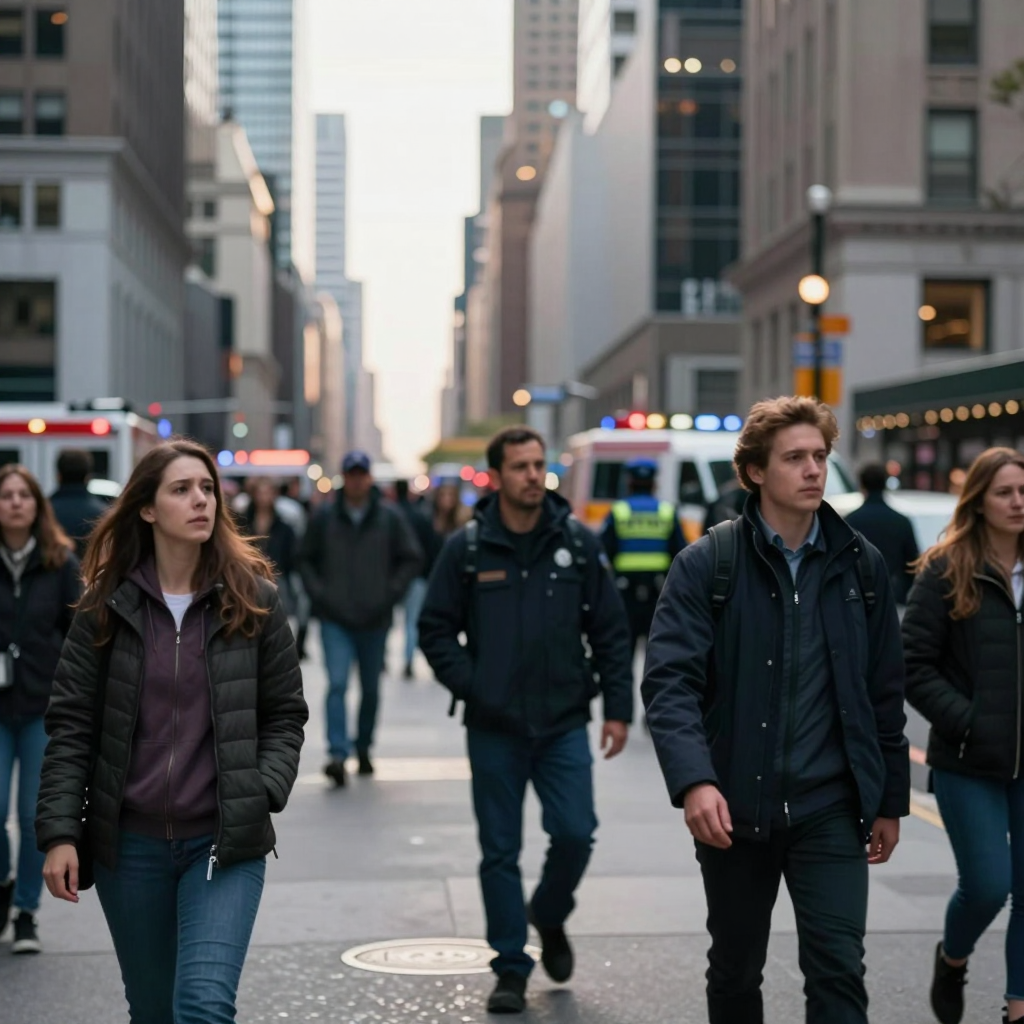
In broad daylight, Times Square is filled with countless tourists and office workers coming and going. In the heart of Manhattan, where billboards, vehicles, and pedestrians blend together, an ordinary day turned into tragedy in an instant.
The incident occurred on a weekday afternoon in late August, near the intersection of West 42nd Street and Seventh Avenue. According to police and local reports, a woman carrying two knives attacked civilians. A 68-year-old man was first injured in the abdomen. She then inflicted fatal abdominal wounds on erin piacenti, who worked as a vice president at Bank of America.
The victims were immediately taken to the hospital, but Piacenti ultimately died. Since it was suggested that she may have been on her way to work in Midtown, just a few blocks away, the incident left New York’s office workers deeply unsettled as well.
There is a clear reason the NYPD described the attack as “random and unprovoked.” Based on the information available so far, no personal connection or prior conflict between the victims and the suspect has been identified. The apparent targets were not specific individuals, but rather civilians who happened to be passing through that place at that time.
Police used a Taser at the scene, but when the suspect approached officers while brandishing the knives, they opened fire. The suspect died at the scene. Police described her as being in a mentally unstable state, but no specific diagnosis or motive has yet been publicly confirmed.
The incident caused even greater shock because of the symbolism of its location. Times Square is the heart of New York’s tourism industry and a place where financial and corporate workers, along with countless civilians, pass through every day. The fact that unpredictable violence can occur even in an area with a heavy police presence and a large flow of people has once again raised questions about urban safety and systems for intervening in mental health crises.
The Life Erin Piacenti Left Behind
Erin Piacenti is not someone who should be remembered merely as the victim of a single incident. She was a 32-year-old professional who had graduated from a prestigious university and law school before rising to the position of vice president at a global financial institution. The fact that she was entering a new chapter in both her career and personal life makes this tragedy all the more profound.
Born in Chester, New Jersey, Erin Piacenti graduated from the University of Pennsylvania in 2016 with a major in political science and a minor in history. She later attended Fordham Law School, earning her law degree with distinction in 2021. Her achievements extended far beyond academics. During college, she participated in a cappella and women’s organizations, and after graduation, she continued to stay connected with younger students by serving as an admissions interviewer for her alma mater.
She worked at Bank of America as a vice president in business selection and conflicts-of-interest management. It was a role that involved important decision-making and coordination within the global corporate and investment banking business. Because she was building a career in finance and earning recognition for her expertise at such a young age, the shock felt by her colleagues and the financial industry was especially profound.
In her personal life, Piacenti was also preparing for a new chapter. According to reports, she had recently celebrated her second wedding anniversary and had just purchased her first home with her husband. A life in which work, love, and plans for the future were naturally coming together was brought to a sudden halt by unprovoked violence in the heart of New York City.
That is why this case extends far beyond a simple crime statistic. Erin Piacenti’s life resonated with the everyday lives of countless young professionals who work in a major city, build relationships, and plan for the future. The path she left behind stands not only as a record of one individual’s remarkable achievements, but also as a painful reminder of how easily ordinary life can be threatened.
The Questions Left by the Erin Piacenti Case: Was the Target Really “Anyone”?
If there was no known relationship between the victim and the attacker, who was the real target in this case? Perhaps the answer is the most unsettling one: “anyone” who happened to be passing through that place at that time.
That is also why the NYPD described the incident as a “random, unprovoked attack.” Erin Piacenti was not known to have been targeted because of a specific conflict or personal grudge. She was simply going about her daily routine on a weekday afternoon, on a street near Times Square crowded with residents, tourists, and office workers.
This makes the incident difficult to view as merely a personal crime. Times Square is one of New York’s most iconic tourist destinations, as well as part of Midtown—a major district packed with large corporations and financial firms. The fact that an indiscriminate knife attack took place in an area constantly filled with police and crowds raises a difficult question: How effectively does the city’s safety net actually protect people in their everyday lives?
The police explanation that the suspect was in a mentally unstable state also leads to broader policy questions. We must examine whether mental-health and emergency-response systems are sufficiently equipped to identify and support people in crisis before a crime occurs—or to intervene when necessary. At the same time, we must be cautious about equating mental-health problems with violence in simplistic terms. The central task is to build public systems that do not overlook warning signs and that can protect both those in crisis and the public.
The reason Erin Piacenti’s death has resonated so deeply is not simply because she held the title of vice president in the financial sector. It is because the sudden loss of a person who was commuting to work or simply moving through her daily life touched the fear shared by everyone living in a major city. In the end, the heaviest question left by this case is a single one: How can a city prevent violence in which anyone could become the victim?
A Deeper Urban Fracture Than the Police Shooting: The Questions Left by the Erin Piacenti Case
Police first used a Taser on the suspect, who was armed with a knife. But when the suspect charged at officers while swinging the weapon, live rounds were ultimately fired. Given the tense situation unfolding in the heart of Times Square, crowded with tourists and civilians, the discussion immediately after the incident went beyond the simple question of whether the police response had been appropriate.
The more fundamental question was this:
Why were the warning signs not identified and addressed sooner?
Police described the suspect as being in a mentally unstable state, but no official confirmation has been provided regarding an exact diagnosis or any history of treatment. Therefore, it is not possible to conclude that the individual had a mental illness. Nevertheless, in the wake of the incident, New York is once again confronting how to support and manage people in crisis before violence occurs.
Times Square, in particular, is a major tourist destination where police personnel and surveillance systems are heavily concentrated. Even so, two civilians were attacked with a weapon, and one of them, Erin Piacenti, a former Bank of America vice president, lost her life. This shows the reality that simply increasing the number of police officers on the scene cannot completely prevent unpredictable violence.
What the city needs is not only swift control after an incident occurs. A broader safety net must also function at earlier stages—through mental-health crisis counseling, community-based intervention, coordination with emergency response teams, and systems for monitoring recurring signs of danger.
Erin Piacenti’s death is a tragedy for one individual, her family, and her colleagues. At the same time, it serves as a warning, prompting New York City to look back and ask what it has been overlooking in its efforts to protect the everyday safety of its residents.
After Times Square: Redesigning Safety in the Wake of the Erin Piacenti Case
Times Square will remain crowded. Tourists will take photos, theatergoers will head to performances, and Wall Street and Midtown employees will commute to work again the next day. But the death of Erin Piacenti has left an unavoidable question hanging over a daily routine that once seemed so ordinary:
How can we learn to trust again the spaces we believed were safe?
This incident cannot be dismissed as nothing more than an individual misfortune. The fact that it occurred in one of New York’s most prominent tourist destinations—where police and crowds are ever-present—and in Midtown, where financial firms and major corporations are concentrated, makes the issue all the more serious. What citizens and visitors need is not vague fear, but a practical safety net that can detect and respond to danger more quickly.
What the City Must Do: “Rapid Crisis Intervention,” Not Surveillance
It is difficult to predict random knife attacks completely. That does not mean prevention is impossible. The key does not lie simply in increasing the number of police officers.
- On-site response teams and treatment systems that can connect people showing signs of a mental health crisis with appropriate support
- Rapid emergency response systems that activate immediately when a report is made in tourist destinations and transportation hubs
- Information sharing and follow-up care among police, medical institutions, and community services
- Clear safety guidance to help citizens evacuate and report danger during an emergency
In particular, an incident should not be explained merely by describing someone as “mentally unstable.” An accurate diagnosis and history must be confirmed, but institutional solutions to narrow the gap between public safety and access to treatment must clearly be discussed.
What Companies Must Do: Commuter Safety Is Also a Workplace Benefit
Companies located in the heart of downtown business districts, such as Bank of America, where Erin Piacenti worked, cannot treat employee safety as solely an individual responsibility. Commuting, off-site work, and late-night duties are all extensions of the workplace environment.
Companies could consider providing the following support:
- Safe-travel assistance and escort services for employees returning home late
- Emergency response training and strengthened internal reporting channels
- Regular safety inspections of high-risk areas around offices
- Psychological counseling and recovery programs for employees after an incident
- Expanded work options depending on circumstances, including remote and flexible work
These measures are not intended to exaggerate anxiety. They are the minimum organizational responsibility needed to help employees return to their daily lives.
What Citizens Need Is Preparation, Not Fear
It is impossible to avoid every danger in urban life. But recognizing a threat, quickly creating distance, and asking for help can reduce the likelihood of harm. In crowded places, people should briefly familiarize themselves with nearby exits and the locations of police and security personnel. If they witness a threatening situation, they should prioritize reporting it immediately from a safe distance rather than attempting to subdue the person themselves.
The energy of Times Square will not disappear easily. But for that energy to endure, the city, businesses, and citizens must all move beyond the belief that “safety is a given.” The heaviest task left by the Erin Piacenti case is to build a system capable of protecting ordinary commutes and journeys so they can once again remain ordinary.
Comments
Post a Comment