 \n
\n
The 800 Billion Won Alarm Triggered by Four Cashier’s Checks
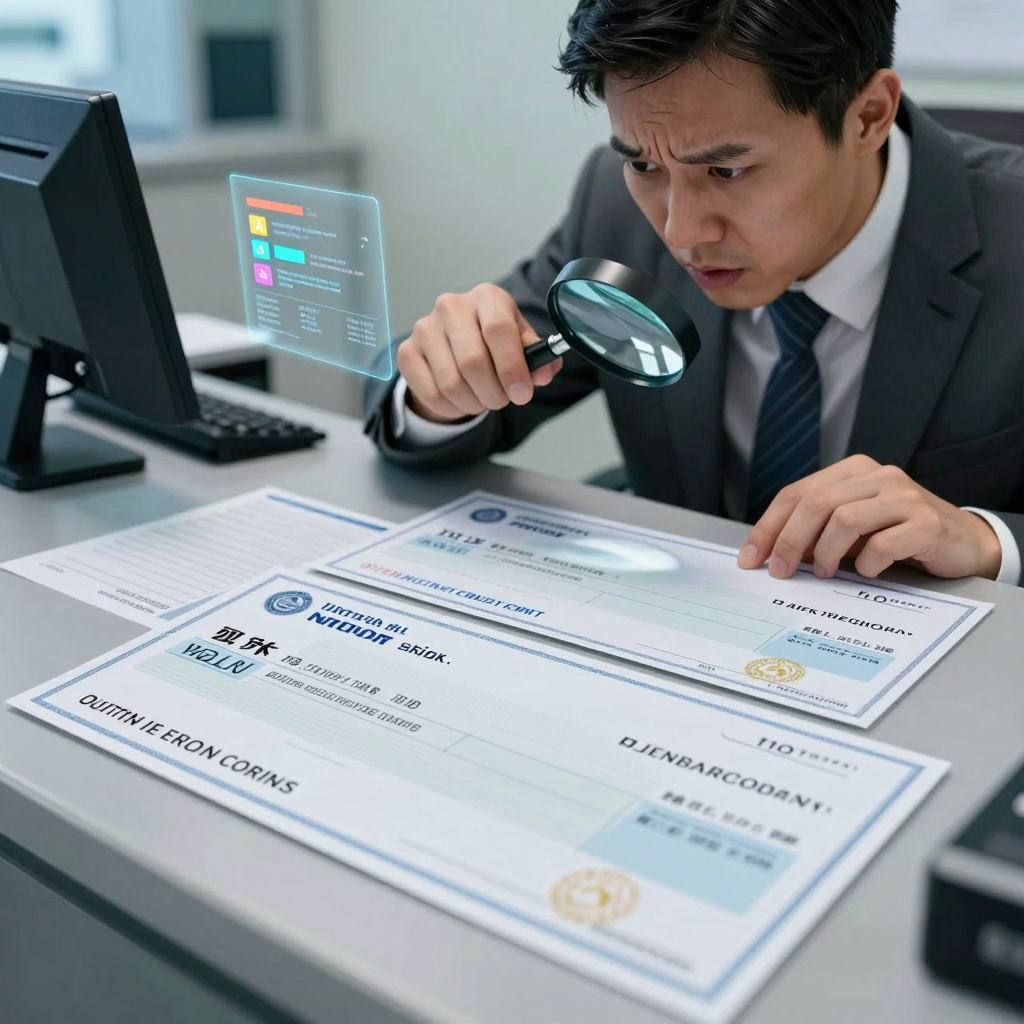
Four cashier’s checks worth 200 billion won each were presented at a bank counter. The total came to a staggering 800 billion won. The figure alone may seem almost unreal, but if an employee had skipped even one computer verification step, those pieces of paper could have become the starting point of an actual financial transaction.
The incident began when a man asked to deposit four cashier’s checks into his account. However, the teller regarded their face values—far beyond the scale of an ordinary transaction—as a serious warning sign. A computerized inquiry into the checks found no information matching their issuance records, and the bank immediately reported the matter to the police. The checks were ultimately confirmed to be forged securities.
The message from this case is clear. A cashier’s check is a payment instrument issued and guaranteed by a bank, but that does not automatically guarantee that the paper itself is genuine. A bank’s guarantee applies only to checks that were properly issued.
In particular, an amount as unrealistically large as several hundred billion won is not merely a high-value transaction—it is a warning sign that must be verified. What stopped the crime in this case was not the visual inspection of elaborate security patterns, but a computerized check of the serial number, issue date, amount, and issuance details.
In a high-value check transaction, the most important question is not, “Is this a bank check?”
It is, “Is this check actually registered in the bank’s system?”
Trust in a cashier’s check begins with the bank’s name, but the safety of the transaction is ultimately secured by the verification of its authenticity.
What It Really Means When a Cashier’s Check Is “Guaranteed by the Bank”
Why are cashier’s checks considered safer than ordinary checks? The difference lies not in the appearance of a piece of paper, but in who stands behind the promise to pay.
Ordinary checks are issued by individuals or companies based on their own bank accounts. As a result, the recipient must determine whether the issuer actually has enough money in the account and whether the balance will remain sufficient until the payment date. If the balance is too low, the check may be dishonored.
By contrast, a cashier’s check is issued directly by a bank. Once the customer deposits the full amount of the check or has it withdrawn from their account, the bank issues the check based on those funds and promises to make the payment. In simple terms, it is not an individual saying, “I’ll pay you,” but rather a bank guaranteeing, “We will pay this amount.”
| Category | Ordinary Check | Cashier’s Check |
|---|---|---|
| Issuer | Individual or corporation | Bank |
| Basis of payment reliability | Issuer’s account balance and creditworthiness | Bank’s payment guarantee |
| Main risks | Insufficient funds, possibility of dishonor | Counterfeiting, loss, or theft |
| Typical uses | Everyday payments, business transactions | High-value, one-time transactions such as real estate or vehicle purchases |
For this reason, cashier’s checks have long been used in transactions involving large sums, such as real estate closing payments or purchases of high-value assets. They reduce the burden of carrying cash while also fitting the transaction practice of preferring a visible payment instrument over a bank transfer.
However, there is one crucial point to remember: the bank guarantees a genuine check that was properly issued. A counterfeit cashier’s check is not covered by the bank’s guarantee. Especially now, when counterfeit checks with unusually large denominations may appear, recipients should never finalize a transaction based solely on the impression that a check “looks like it was issued by a bank.”
If you receive a high-value cashier’s check, the safest course of action is to visit a bank branch on the day of the transaction and verify the serial number, issue date, amount, and issuance status through the bank’s system. Ultimately, the reliability of a cashier’s check depends not on the paper itself, but on whether the bank’s system confirms that it was actually issued.
Why Cashier’s Checks—Once Seen as a Safe Payment Method—Have Become Targets for Fraud
A cashier’s check, issued by a bank with payment guaranteed by that bank, has long been regarded as “money almost as safe as cash.” But that very trust becomes the most powerful disguise in a counterfeiter’s arsenal. With just one check, a fraudster can lower the other party’s guard and create an opportunity to take possession of high-value assets.
Exploiting the Trust of a Bank Guarantee
The key feature of a cashier’s check is that the bank—not an individual or a company—promises to make the payment. This makes the other party likely to assume that there is no need to verify the issuer’s account balance or creditworthiness.
The problem is that even a counterfeit check can exploit this trust if it looks convincing enough. Fraudsters capitalize on the belief that “a check issued by a bank must be safe,” encouraging the other party to skip thorough verification.
The stronger the perception of safety, the greater the danger when verification is skipped.
The Larger the Transaction, the Easier It Is to Lose Perspective
Cashier’s checks are commonly used in transactions involving large sums of money, such as real estate purchases, high-end vehicles, and one-time business payments. The larger the amount, the more difficult it is to exchange cash directly, while some parties may also feel uneasy relying solely on a bank transfer.
In such situations, a physical check that can be held in one’s hand provides a sense of reassurance. But that reassurance can become a trap. When a check bears an unrealistically large face value—such as hundreds of billions of won—it should not simply be dismissed as something that might happen in a major transaction. The entire structure of the deal should be viewed with suspicion.
Why It Is Difficult for Ordinary People to Determine Authenticity
With a sophisticated counterfeit cashier’s check, it is difficult to determine its authenticity based solely on the logo, printed wording, signature, or security patterns. A check’s natural-looking appearance does not mean it was actually issued by a bank.
In a recent counterfeit cashier’s check case involving ₩800 billion, the crucial factor was not visual inspection but a search of the bank’s internal system. A bank employee found the unusually large amount suspicious and checked the issuance details and serial number. The bank found no record that the check had ever been issued, allowing the counterfeit to be identified.
The Most Dangerous Illusion Is That It “Looks Like Cash”
Unlike cash, a cashier’s check is not money simply because it is a piece of paper. It has value only once the bank’s system confirms that it was issued and that payment is possible. Therefore, receiving a check should never be treated as the same thing as receiving money.
If you receive a high-value cashier’s check, follow these principles for safety:
- Verify through the bank’s system at a branch on the day of the transaction that the check was actually issued
- Directly confirm the bank named on the check and the issuance information
- Reconsider any unusually large amount or vague reason for the transaction
- Keep transaction records, including the contract, a copy of the check, and conversation logs
A bank guarantee is undoubtedly a powerful safeguard. However, that guarantee has meaning only after the check is confirmed to be a genuine cashier’s check. The more trusted the payment method, the more thorough the verification process must be.
The Bank’s Critical Verification Moment: Telling a Genuine Cashier’s Check from a Forgery
The authenticity of a cashier’s check cannot be determined solely by whether its logo is sharp or its paper looks convincing. Counterfeit checks can be remarkably sophisticated in appearance. Ultimately, the decisive moment that stops the crime is the few seconds spent confirming whether the information written on the check actually exists in the bank’s system.
In a recent counterfeit cashier’s check case involving a total of KRW 800 billion, a bank employee first detected that the face value was abnormal. The employee then requested an electronic system check, but the issuance details could not be verified, immediately leading to a police report. It was a case in which system verification—not visual inspection—exposed the forgery.
What Do Banks Check?
At a bank counter, employees typically cross-check the following information:
- Serial number: They confirm whether a check bearing that number was actually issued.
- Issue date and amount: They compare the issue date and face value recorded in the system with the information written on the check.
- Issuing bank and branch information: They verify whether the issuing institution shown on the check matches the actual records.
- Security features and printing quality: Signatures, security patterns, official wording, and print quality are reviewed together.
- Suspicious signs in the transaction: If the amount is unusually large or the reason for the transaction is unclear, additional verification procedures are carried out.
Electronic system verification is particularly crucial. No matter how genuine a check may look, it is difficult to recognize it as a valid cashier’s check if the bank’s internal records show no issuance or if the serial number or amount does not match.
More important than the words “a check issued by a bank” is whether the bank’s system can confirm that it was actually issued.
For Private Transactions, “Verify It Immediately” Is the Rule
If you receive a cashier’s check in a high-value transaction involving real estate, a vehicle, or an expensive item, do not hand over the property or transfer rights based solely on the other party’s explanation. The safest approach is to have the check verified through the issuing bank’s system at a branch on the day of the transaction.
Until verification is complete, it is best to follow these principles:
- Keep a copy of the check together with the contract and receipt.
- Request direct verification from the issuing bank or branch.
- Be cautious of unrealistically large face values or unclear reasons for the transaction.
- Do not rush to transfer ownership, deliver the goods, or return cash before the check’s authenticity has been confirmed.
A cashier’s check is a secure means of payment backed by a bank’s credit, but that security exists only on the assumption that the check was genuinely issued. The larger the transaction, the more important it is to verify the issuance record in the system before trusting the visible piece of paper.
Cashier’s Checks: Not a Vanishing Payment Method, but a Safeguard That Will Remain Selectively
Now that mobile transfers and real-time account payments have become part of everyday life, is there really any reason to carry a paper check to complete a transaction? In practice, bank transfers are rapidly replacing cashier’s checks for routine payments and ordinary high-value transfers.
That does not mean cashier’s checks will disappear entirely. Rather than serving as a payment method for every type of transaction, they are likely to remain as a high-trust payment instrument chosen only in specific situations.
Areas Being Replaced by Digital Transfers
Internet and mobile banking have the edge over paper checks when it comes to transfer speed and convenience. Transaction records are created instantly, while verifying the recipient’s account and managing the flow of funds are relatively straightforward.
This trend is becoming increasingly common, particularly in the following transactions:
- Direct payments through real-time account transfers
- Fund transfers linked to the execution of bank loans
- Corporate settlements based on electronic bills and digital payments
- Transaction documentation using contracts, transfer confirmations, and electronic receipts
Against this backdrop, cashier’s checks are being pushed aside as the “convenient default option.” They must be stored and physically delivered, while the risks of loss, theft, and forgery must also be taken into account.
Where Cashier’s Checks May Still Have a Place
Cashier’s checks may still serve a purpose when the parties to a transaction want to directly verify a bank-issued certificate. This may be the case when the transaction involves a substantial amount, the parties do not fully trust one another, and handing over cash would be burdensome.
The areas in which they may continue to be used include the following:
| Situation | Why a cashier’s check may be chosen |
|---|---|
| Certain real estate and asset transactions | It is easy to leave a documentary record of the payment |
| Face-to-face transactions involving high-value goods | Safer than carrying cash and perceived as a bank-issued certificate |
| One-off payments between specific companies | An alternative payment and documentation method may be needed beyond a bank transfer |
| Transaction environments with limited digital access | It can serve as an alternative when an immediate transfer is difficult |
The key point is simple. Cashier’s checks are no longer likely to be a “fast payment method.” Instead, they are increasingly likely to be used only in high-value, face-to-face, documentation-focused transactions.
Even as Usage Declines, the Safety Net Around Cashier’s Checks Will Tighten
A recent counterfeit cashier’s check case involving KRW 800 billion clearly highlighted the risks of paper checks. After a bank employee became suspicious of the unusually large face value and conducted an electronic inquiry, the counterfeit checks were prevented from entering the actual financial system.
Going forward, the financial sector’s management practices are likely to become more sophisticated, moving beyond simple visual inspections in the following ways:
- Detecting unusual signs involving abnormally large face values and repeated transactions
- Verifying authenticity electronically using serial numbers, issue dates, issuing branches, and amounts
- Introducing additional verification procedures when high-value checks are deposited or cashed
- Linking internal reporting and notifications to investigative authorities when suspicious transactions occur
- Strengthening customer identification and checks on the source of funds
In other words, even if the overall use of cashier’s checks declines, the transactions that remain may be subject to even stricter verification. Because a single piece of paper can represent a substantial amount of money, financial institutions have no choice but to make confirmation of issuance their most important safeguard.
In Personal Transactions, Verification Matters More Than Simply “Receiving” the Check
The mere fact that you have received a cashier’s check does not mean the payment has been made safely. Until the check is confirmed to be genuine and issued by the bank, it may be nothing more than a piece of paper.
For high-value transactions in particular, the following principles can help reduce risk:
- Request an authenticity check at a bank branch on the day you receive the check.
- Personally verify the issuing bank and the issuance details written on the check.
- Be cautious of unusually large amounts or unclear transaction terms.
- Keep copies of the check, the contract, the receipt, and all conversation records together.
- Do not rush to hand over the goods or transfer ownership before electronic verification is complete.
Ultimately, cashier’s checks should no longer be understood as payment instruments that are “automatically safe because a bank guarantees them.” They are better understood as payment instruments that become safe only after being verified through the banking system. Even in an era when checks are disappearing, the safety net surrounding the checks that remain is becoming stronger.
Comments
Post a Comment