 \n
\n
The Cloud Era: From Renting Servers to Orchestrating Containers
What if, the moment traffic suddenly surged, hundreds of services could increase their resources on their own without going down simultaneously—and replace failed containers automatically? This is precisely the starting point of CaaS (Containers as a Service), which has emerged as a core element of Cloud application operations in 2026.
In the past, enterprises primarily focused on “how quickly they could rent servers” when adopting the Cloud. IaaS, which enables virtual servers, storage, and networks to be created whenever needed, brought about a major shift from the practice of purchasing and operating physical equipment directly.
However, as applications became more complex, simply preparing servers no longer solved operational challenges. A monolithic architecture, built as one massive program, required the entire application to be deployed even when only a minor feature was changed. Likewise, a sudden spike in traffic to a specific feature meant scaling the entire application.
Containers That Changed Cloud Application Operations
Containers are a technology that packages an application together with the libraries and configurations required to run it into a single execution unit. They reduce the familiar problem of an application working properly on a developer’s laptop but failing on a production server, while enabling applications to run consistently anywhere.
This approach became even more powerful when combined with a microservices architecture. For example, a shopping platform can be divided into multiple services as follows:
- Product catalog service
- Order and payment service
- Inventory management service
- Membership and authentication service
- Notification service
Each service can be deployed in an independent container. When order volume surges, only the order service needs to be scaled up. If the notification feature encounters a problem, only the relevant container needs to be replaced. There is no need to stop the entire service or scale every server at once.
However, once the number of containers grows from dozens to hundreds or even thousands, new challenges emerge. It becomes difficult for people to manually determine which servers should host each container, how failed containers should be restarted, and how many additional instances should be launched in response to rising traffic.
CaaS: A Cloud Platform That Automatically Orchestrates Containers
CaaS is a managed platform for deploying and operating container-based applications. It is generally built on container orchestration technologies such as Kubernetes, enabling enterprises to use container management capabilities while reducing the burden of managing complex clusters.
Its value lies in more than simply running containers. With CaaS, operators declare the desired state of an application, and the platform continuously manages the actual environment to maintain that state.
For example, suppose an operator configures the system to “always maintain 10 instances of the order service.” If a particular container terminates due to an error, the CaaS platform detects the failure and automatically creates a new container. If CPU or memory usage exceeds a threshold because of rising traffic, it increases the number of containers. When traffic declines, it scales them back down, helping prevent unnecessary costs.
Key CaaS operational capabilities include:
- Automatic placement: Places containers on appropriate nodes based on available resources
- Self-healing: Detects unhealthy containers and restarts or replaces them
- Automatic scaling: Adjusts the number of containers according to traffic and resource usage
- Zero-downtime deployment: Rolls out new versions sequentially and reverts to the previous version if a problem occurs
- Service connectivity: Enables multiple microservices to reliably discover and communicate with one another
- Access and policy management: Controls access permissions, security rules, and resource usage by team and service
How CaaS Differs from IaaS and PaaS
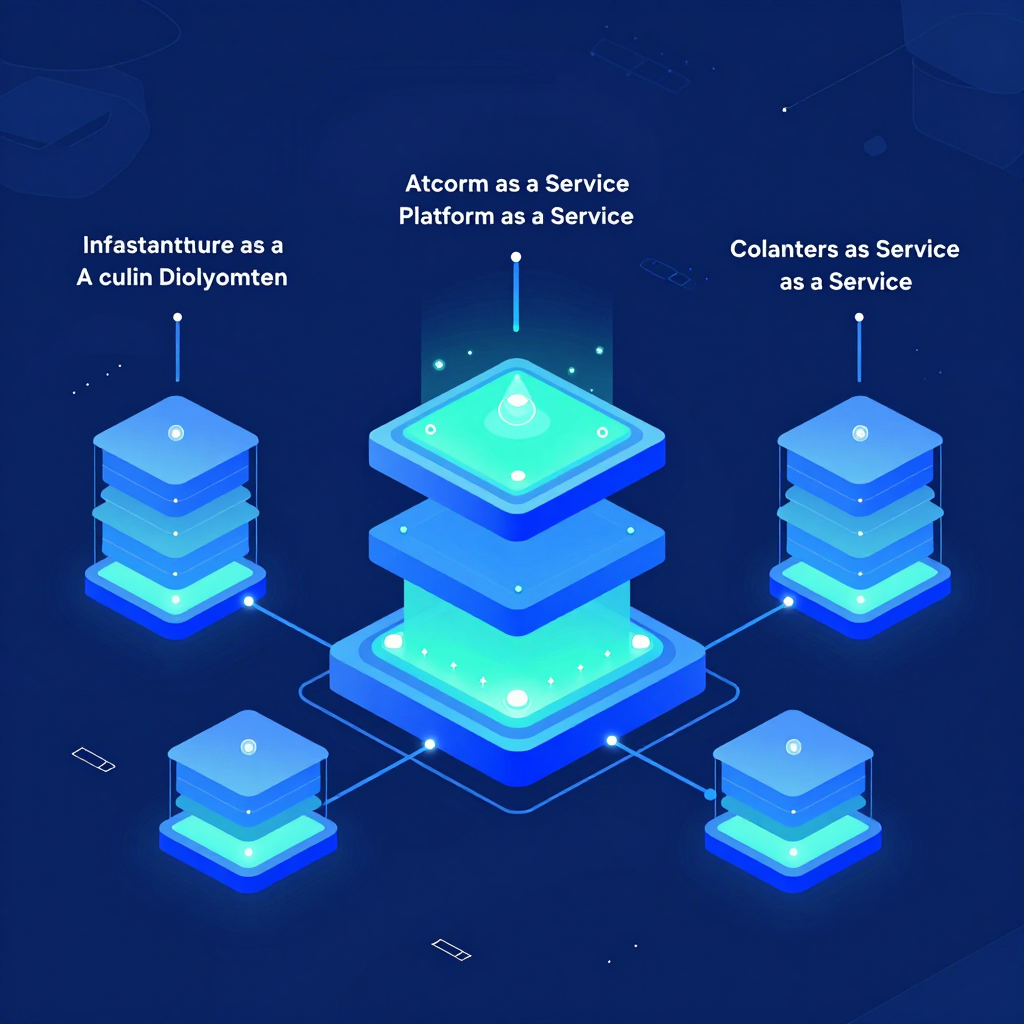
A simple comparison of Cloud service models makes CaaS’s position clearer.
| Service model | Primary offering | Areas primarily managed by the user | |---|---|---| | IaaS | Virtual servers, storage, and networks | Operating systems, middleware, and applications | | PaaS | Development and execution platform | Applications and data | | SaaS | Complete software | Service settings and user data | | CaaS | Container clusters and orchestration environments | Container applications, deployment policies, and operational settings |
If IaaS is “a way to rent servers,” CaaS is closer to “a way to operate an organization of services built from containers.” Development teams can focus more on application deployment and service quality rather than the detailed configuration of infrastructure, while operations teams can manage large-scale environments through standardized policies and automation.
Ultimately, Cloud competitiveness in 2026 will depend not on how many servers an organization has secured, but on how quickly and reliably its applications respond to changing demand and failure situations. CaaS is the core infrastructure layer that turns that responsiveness into reality.
The Birth of a New Infrastructure Created by Cloud Microservices
What if, instead of fixing one massive application, you could independently deploy dozens of small services, each organized around a specific function? Development would move faster, and the risk of an error in one feature bringing down the entire service would be reduced.
But that is when a new problem begins.
Who will place and connect hundreds of containers—and scale them as traffic changes?
Microservice architecture is an approach that breaks an application into smaller components. For example, an online shopping service would not put membership, products, orders, payments, and shipping into one enormous program. Each function would be separated into an independent service, packaged in a container, and deployed separately.
This structure is undeniably agile. You can modify and rapidly deploy only the ordering function, and when payment traffic surges, you can scale up only the payment service. However, as the number of services grows, operational complexity grows with it.
- You must decide which container should be placed on which server.
- Failed containers must be restarted automatically.
- Only the services that need to scale must be expanded as traffic increases.
- Communication paths and security policies between services must be managed.
- New versions must be deployed without interrupting user-facing services.
This is an area that is difficult to handle manually. The key technology that emerged to solve this problem is container orchestration, and Kubernetes is its leading platform.
Kubernetes is not simply a tool for running containers. It is a platform that continuously manages the actual environment so that it maintains the desired application state you declare. For example, if you configure it to “always run five instances of the order-service container,” Kubernetes automatically creates a new container if one fails. When traffic increases, it can also add more instances according to the configured criteria.
These capabilities standardize microservice operations in the following ways:
| Operational Challenge | Kubernetes-Based Solution | |---|---| | Container failures | Health checks and automatic restarts | | Traffic surges | Horizontal Pod Autoscaling (HPA) | | New version deployments | Rolling updates and blue-green deployments | | Service connectivity | Service, Ingress, and service discovery | | Insufficient server resources | Node autoscaling and scheduling | | Separating permissions by team and service | Namespaces and RBAC |
The problem is that Kubernetes itself is complex. Building and operating a cluster directly means managing everything from servers, networking, security, and storage to upgrades and monitoring. As a result, instead of running orchestration environments themselves, companies began adopting Kubernetes services managed by cloud providers.
This is where CaaS (Containers as a Service) emerged.
CaaS is a model that provides container clusters and orchestration capabilities as a service in a cloud environment. Rather than designing servers and the control plane from scratch, companies can focus on application deployment and operational automation on top of a managed Kubernetes environment.
In other words, if IaaS provides virtual servers and PaaS provides a development and runtime environment, CaaS provides the standard operational layer for running container-based applications at scale.
Microservices have given development organizations faster deployment and independent scalability. CaaS is the infrastructure that supports that freedom, ensuring it does not turn into operational complexity. The moment small services grow into dozens or hundreds, the ability to systematically orchestrate containers in a cloud environment is no longer optional—it is essential.
Inside CaaS and the Cloud: From Compute to Automation
Running a single container is not difficult. On a development PC, you can launch an application with one line: docker run. Real-world service environments, however, are a different story. Hundreds of containers must communicate with one another, scale with changing traffic, and automatically replace instances when they fail.
This is where the real value of CaaS (Containers as a Service) becomes clear. CaaS is not simply a Cloud service for running containers. It is a platform that brings compute, networking, storage, security, observability, and deployment automation together into a single operating framework.
The Cloud Compute Layer: The “Ground” Where Containers Run
The starting point of every CaaS environment is compute resources. Containers may appear to run independently, but in reality, they operate on nodes such as VMs or bare-metal servers.
In managed Kubernetes-based CaaS environments, the Cloud provider typically manages the control plane, while users configure the worker nodes on which application workloads will run. In this structure, what matters is not simply the number of servers, but the ability to automatically secure and release resources when needed.
- Node autoscaling: Automatically adds nodes when there is not enough space to schedule Pods.
- Pod autoscaling: Increases or decreases the number of containers based on CPU, memory, or custom metrics.
- Failure recovery: Reschedules workloads onto other nodes when a node or container enters an unhealthy state.
- Resource limits: Sets upper limits on the CPU and memory each service can use, preventing a particular service from monopolizing resources.
If this layer is not designed properly, services may slow down during traffic spikes. Conversely, unnecessary nodes may remain active, driving up Cloud costs.
Kubernetes Orchestration: The Engine That Moves Hundreds of Containers as One
At the heart of CaaS is container orchestration. Kubernetes is the most widely used example. It works by allowing you to declare the desired state of an application and continuously bringing the actual state into alignment with it.
For example, if you configure Kubernetes to “always keep 10 instances of the order service running,” Kubernetes automatically creates a new instance whenever one of the containers terminates. This is why operators do not need to locate and restart failed instances one by one.
The key resources include:
| Resource | Role | |---|---| | Pod | The smallest execution unit, grouping one or more containers | | Deployment | Declaratively manages the number, version, and update strategy of Pods | | Service | Provides stable network addresses and distributes traffic across multiple Pods | | Ingress | Routes external HTTP/HTTPS requests to internal services | | Namespace | Logically separates resources and permissions by team, environment, or project | | ConfigMap / Secret | Manages configuration values and sensitive information separately from application code |
Thanks to this structure, development teams can focus less on “which server should we deploy to?” and more on “what state should the application maintain?” CaaS provides the foundation for shifting infrastructure operations to a declarative model.
Cloud Networking and Service Connectivity: How Containers Communicate
In a microservices environment, communication between services is at the core of the application. If payment, order, member, and notification services are separated into individual containers, they must be connected securely and reliably.
CaaS generally provides network capabilities such as the following:
- CNI-based networking: Assigns each Pod a unique network address and establishes communication within the cluster.
- Service discovery: Maintains stable connections through service names even when Pods are replaced and their IP addresses change.
- Load balancing: Distributes requests across multiple Pods belonging to a single service.
- Ingress control: Routes external user requests to the appropriate internal services based on domains and paths.
- NetworkPolicy: Reduces the risk of lateral movement attacks by restricting communication to only the services that need to communicate.
As the environment grows, a service mesh may also be worth considering. Tools such as Istio provide service-to-service encryption, traffic splitting, retry policies, fault injection, and request tracing without requiring changes to application code.
For example, when deploying a new version of the payment service, you can send only 5% of the traffic to the new version first and check its error rate instead of switching all traffic at once. This is a canary deployment—and a prime example of where CaaS’s network control capabilities truly shine.
Storage and Data: Designing for Stateful Containers
Containers are, by default, ephemeral execution environments that can be replaced at any time. Therefore, if important data is stored on a container’s internal disk, that data may disappear when the Pod is recreated.
To address this, CaaS uses persistent volume capabilities integrated with Cloud storage.
- Persistent Volume (PV): A storage resource available for use within the cluster
- Persistent Volume Claim (PVC): A declaration through which an application requests the capacity and access method it needs
- StorageClass: Defines storage policies, such as high-performance SSD, general-purpose block storage, or file storage
- Dynamic provisioning: Automatically creates the required volume in response to a PVC request
However, not all data needs to reside inside Kubernetes. In many cases, separating databases into managed DBaaS, files into object storage, and message processing into managed queue services provides greater operational stability.
In other words, CaaS is not a technology for putting everything into containers. It is an architecture for connecting container workloads with Cloud data services in the right way.
Security and Access Management: Operational Challenges Hidden Behind Convenience
The more automated a CaaS environment becomes, the wider the impact of a single misconfiguration can be. Security, therefore, should not be treated as an item to check after deployment. It must be incorporated from the design stage.
Key security considerations include:
- RBAC: Grants users and service accounts only the minimum permissions they need.
- Image security: Uses trusted registries and applies vulnerability scanning and image signing.
- Secret management: Keeps API keys, database passwords, certificates, and other sensitive information out of source code and images.
- Network isolation: Blocks unnecessary Pod-to-Pod communication through NetworkPolicy.
- Policy-based control: Uses policy engines to block deployments involving unauthorized images, excessive permissions, or missing resource limits.
- Audit logs and monitoring: Tracks who changed which settings and detects suspicious activity.
Access permissions for the Kubernetes API are particularly important. If cluster administrator privileges are compromised, not only applications but the entire set of Cloud resources may be put at risk.
Automation and GitOps: Keeping Operations Out of Human Memory
The true completion of CaaS is determined by automation. As environments grow, manually logging into a console to add servers, deploying by hand, and entering commands after failures quickly reaches its limits.
Modern CaaS operations typically combine CI/CD with GitOps.
- A developer modifies the code and commits the changes to the repository.
- The CI pipeline runs tests, builds the application, and scans the image for vulnerabilities.
- The container image is stored in a registry.
- The deployment configuration is updated.
- A GitOps tool such as Argo CD or Flux synchronizes Git’s declared state with the cluster.
- Kubernetes deploys the new version using a rolling update strategy.
The advantages of this approach are clear. Because infrastructure and application deployment states are recorded in Git, it is easy to track change history and roll back to a previous version. Operational knowledge no longer depends solely on a particular person’s memory or on manual procedures.
Ultimately, CaaS Is Not a “Container Service” but an Operations Platform
It is easy to miss the point if CaaS is understood simply as a Cloud product for renting Kubernetes. The essence of CaaS lies not in running containers themselves, but in operating complex distributed systems in a repeatable and secure way.
Only when compute autoscaling, service-to-service network control, persistent data management, least-privilege security, and Git-based deployment automation work together can hundreds of containers behave like a single service. That is why CaaS is so important in the transition to cloud-native operations.
Where CaaS Is Driving the Korean Cloud Market
Financial transaction systems, startup mobile services, and AI inference APIs are choosing the same technology. The reason is not simply that containers are popular. To handle unpredictable traffic, shorter deployment cycles, and the high level of accountability that comes with service failures, organizations need an execution engine that can run applications quickly and reliably.
At the center of this shift is CaaS (Containers as a Service). In Korea’s Cloud market, CaaS is becoming more than an environment for running containers. It is evolving into a platform that provides Kubernetes-based standards for deployment, scaling, recovery, and operations.
Finance and the Public Sector: Environments That Demand Both Stability and Control
The finance and public sectors are areas where service disruptions immediately become matters of trust. At the same time, they face strict requirements for regulation, security, auditing, and data protection. In such environments, it is more important to establish an operational system that validates changes and applies them through controlled procedures than to deploy an application once and leave it running for a long time.
CaaS addresses these requirements in the following ways:
- Replace versions without service interruptions through rolling updates
- Automatically restart failed containers through auto-healing
- Increase the number of instances as traffic grows through auto-scaling
- Control access by team and business function through namespaces, RBAC, and network policies
- Use logs, metrics, and tracing data to maintain operational records and analyze incidents
For example, in a financial service where transaction volume is concentrated during specific hours, only the necessary number of Pods can be operated under normal conditions, then scaled out automatically as request volume increases. Once traffic declines, the system can scale back down to reduce resource waste. This approach is faster than simply adding servers and also improves the cost efficiency of Cloud resources.
Startups: A Foundation for Rapid Experimentation and Deployment
For startups, time is one of the most valuable resources. If infrastructure work takes too long to modify a single feature, or if even minor updates require service downtime, their ability to respond to the market inevitably slows down.
CaaS enables development teams to package applications as container images and deploy them repeatedly through CI/CD pipelines. Another major advantage is that it reduces the gap between development and production environments while allowing the same deployment definitions to be managed as code.
For services such as mobile applications and commerce platforms, where traffic can surge due to events, advertising campaigns, or seasonal demand, the following capabilities become a real competitive advantage:
- Canary deployments that gradually expose new features
- Blue/green deployments that operate existing and new versions in parallel
- Microservices operations that allow specific services to be modified and scaled independently
- GitOps, which synchronizes deployment status based on Git changes
In other words, CaaS allows startups to become less like organizations that “manage servers” and more like organizations that “improve products quickly.” However, the inherent complexity of Kubernetes must still be taken into account. In the early stages, a practical approach is to choose a managed Kubernetes service and gradually establish the operational standards that are needed.
AI Inference APIs: Managing GPUs and Traffic Fluctuations Together
As generative AI and machine learning services continue to spread, AI inference APIs are becoming an important CaaS use case in Korea’s Cloud environment. Unlike typical web applications, AI services must manage GPUs, large model files, high memory usage, and request latency at the same time.
In a container-based environment, the model server and API server can be separated, with resources allocated according to the needs of each workload. For example, inference Pods that require GPUs can be connected to GPU nodes, while API Pods responsible for authentication, request handling, and result delivery can run on general-purpose CPU nodes.
The key advantages of this architecture include:
- Reduce dependency conflicts by creating an independent execution environment for each model
- Manage response latency by adjusting the number of inference Pods according to request volume
- Minimize waste of expensive resources by separating GPU nodes from general-purpose nodes
- Validate quality and stability by applying new model versions to a portion of traffic first
- Continuously analyze response time, error rates, and GPU utilization through observability tools
For AI workloads, the fact that “containers are being used” matters less than how precisely resource control and deployment automation are designed. Incorrect auto-scaling configurations or GPU resource requests can cause costs to surge, so usage monitoring and resource limit policies must be designed together.
A Common Execution Unit for Hybrid and Multi-Cloud Strategies
Many Korean companies operate on-premises infrastructure alongside public Cloud environments, depending on their security policies, existing systems, data locations, and reliance on specific Cloud services. In this context, CaaS can serve as a common execution unit that connects multiple environments.
When applications are built around Kubernetes standards, deployment structures can remain relatively consistent without becoming overly tied to the configuration of a particular infrastructure. Of course, complete portability is not guaranteed automatically. Areas such as storage, networking, IAM, and load balancing often require separate designs because their implementations vary by Cloud provider.
Even so, standardizing container images, deployment manifests, Helm charts, and GitOps policies can significantly reduce operational differences between environments. This not only lowers the risk of vendor lock-in but also creates a foundation for more flexible service expansion and disaster recovery strategies.
The value of CaaS does not lie in running a large number of containers.
It lies in transforming changing traffic and deployment requirements into predictable operations.
In Korea’s Cloud market, CaaS is no longer an option reserved for a select group of technology organizations. It is expanding into a common platform for solving different challenges across financial institutions that prioritize stability, startups that prioritize speed, and AI companies that require high-performance resource operations.
Mastering Cloud Automation: Operating Principles for CaaS Success
CaaS significantly reduces tasks such as server provisioning, container placement, failure recovery, and auto-scaling. However, operational responsibility does not disappear. In fact, the broader the scope of automation, the greater the risk that a single misconfigured permission or one unverified deployment could escalate into an outage affecting hundreds of services.
In Cloud environments using managed Kubernetes, the CSP manages the control plane and some of the underlying infrastructure. However, application deployment, access permissions, network policies, image security, and cost control remain the organization’s responsibility. To operate CaaS successfully, organizations must design controllable automation before pursuing automation itself.
Minimize Permissions and Separate Administrative Privileges
Kubernetes Role-Based Access Control (RBAC) is powerful, but broadly granting cluster-admin privileges can allow a small mistake to bring down the entire cluster. Developers, operators, CI/CD pipelines, and external tools all require different permissions, so their roles must be separated.
The key principles are as follows:
- Apply the principle of least privilege to users and service accounts
- Separate Namespaces by team and service to isolate operational scope
- Protect administrative privileges in production environments with multi-factor authentication and approval procedures
- Use short-lived tokens and workload identities instead of long-lived access keys
- Record permission changes in audit logs and review them regularly
CI/CD tools are particularly dangerous when they have excessive privileges. Deployment automation accounts should be restricted to only the Namespaces and resources they actually need.
Deploy Quickly, but Never Change Everything at Once
The advantage of container-based deployment is speed. However, fast deployment does not necessarily mean safe deployment. If an incorrect environment variable, excessive CPU limit, or faulty image is applied to the entire service at once, even auto-scaling can amplify the outage.
For this reason, Cloud-native environments require progressive deployment strategies:
- Rolling Update: Gradually replace existing Pods with the new version
- Canary Deployment: Expose the new version to only a portion of the traffic first
- Blue/Green Deployment: Separate the existing and new environments, then switch traffic between them
- Automatic Rollback: Restore the previous version when error rates, latency, or resource usage exceed defined thresholds
Before deployment, image vulnerability scanning, configuration validation, policy checks, and test-environment validation should be automated. Managing declarative configurations in a Git repository through a GitOps approach also makes change histories and approval processes clear.
Apply Security Policies Before Deployment, Not After
CaaS security does not end with protecting the cluster boundary. Container images, Pod configurations, networks, Secrets, and the software supply chain must all be managed together.
In production environments, it is advisable to enforce the following standards through policy:
- Use images from trusted registries
- Verify image signatures and vulnerability scan results
- Restrict the execution of containers with
rootprivileges - Block Privileged Containers and unnecessary host path mounts
- Do not include Secrets in source code or images
- Minimize communication paths between services with NetworkPolicy
- Set resource requests and limits to prevent excessive resource consumption
With policy engines, deployments that do not meet the required standards can be automatically blocked without requiring people to inspect them every time. This is not regulation that slows down delivery; it is a safety mechanism that prevents outages and security incidents at the deployment stage.
Without Observability, Automation Cannot Be Trusted
Automatic recovery and auto-scaling must operate based on accurate signals. Simply checking whether a Pod is alive is not enough. The application may still be running while its database connection has been lost or its response time has suddenly deteriorated.
Reliable CaaS operations require the integration of the following three types of observability data:
- Logs: Identify the causes of errors and trace request flows
- Metrics: Track CPU, memory, request volume, error rates, and latency
- Traces: Analyze call paths between microservices and identify bottlenecks
When these are connected to SLOs (Service Level Objectives) and alerting thresholds, operations teams can respond based not on whether “the server is healthy,” but on whether “the user experience is healthy.” Auto-scaling policies should also consider service-level indicators such as request volume, queue length, and response latency rather than relying solely on CPU utilization.
Manage Costs as Operational Metrics
CaaS can be cost-efficient because it allows resources to be divided and used with precision. However, Pods with excessive resource requests, unused test Namespaces, and unrestricted auto-scaling can quickly drive up Cloud costs.
Cost control should be incorporated into operational policies as follows:
- Allocate costs based on cost tags and Namespace criteria for each team and service
- Regularly compare CPU and memory requests with actual usage
- Clean up idle nodes and unused storage
- Apply automatic shutdown schedules to development and test environments
- Configure alerts for budget overruns and abnormal usage
Ultimately, the essence of CaaS is not simply adopting Kubernetes. It lies in connecting permissions, deployment, security, observability, and cost into a unified operating model. As automation expands, the role of people does not diminish; instead, it evolves toward designing safe standards and recoverable procedures.
Comments
Post a Comment