What Is a Grand Bench? A Look Inside the Supreme Court’s Highest Judicial Panel Through the Kim Keon-hee Case
 \n
\n
Referred to the En Banc Panel, the Case Moved Again One Day Before the Ruling
With just one day remaining before the Supreme Court’s ruling, the case involving First Lady Kim Keon-hee was abruptly referred to the en banc panel. A case that had already been moving toward a conclusion was suddenly elevated to the stage of review by the Supreme Court as a whole.
This change is difficult to view as a mere reassignment to a different bench. The en banc panel is the Supreme Court’s highest-level review mechanism, convened when it is necessary to overturn existing precedent or establish a unified standard on legal issues with far-reaching social consequences. The very fact that the case was referred to the en banc panel can be interpreted as indicating that the court regarded it as requiring a more weighty determination.
The core of the controversy, in particular, is the timing of the referral. En banc cases typically require time to organize the issues, allow the justices to review the case, and coordinate the hearing schedule. If the referral took place just one day before the ruling, readers are naturally led to ask two questions:
Why, of all times, right before the ruling?
And could this referral change not only the substance of the judgment, but also the timetable for when it will be delivered?
In a criminal case, time is not merely a procedural backdrop; it is a variable that can directly affect the outcome. If the expiration of the detention period is approaching, any change in the review period resulting from the referral to the en banc panel could be directly tied to how the parties’ custody is handled. Ultimately, the question of “when the ruling is issued” becomes just as important as “what result it produces.”
Of course, the referral itself does not signify any particular conclusion. Various factors may be at play, including the need to change precedent, harmonize legal interpretations, or address the seriousness of the case. However, when an unusual referral is made in a politically sensitive case, the procedure immediately becomes subject to political interpretation.
This controversy demonstrates that the en banc panel is not merely an internal judicial procedure of the Supreme Court. At times, it can serve as a mechanism for redefining legal standards while simultaneously becoming a decisive turning point—one capable of changing both the pace of a case and its impact on society.
The Actual Structure of the Grand Bench: Must All 14 Justices Be Present for It to Hear a Case?
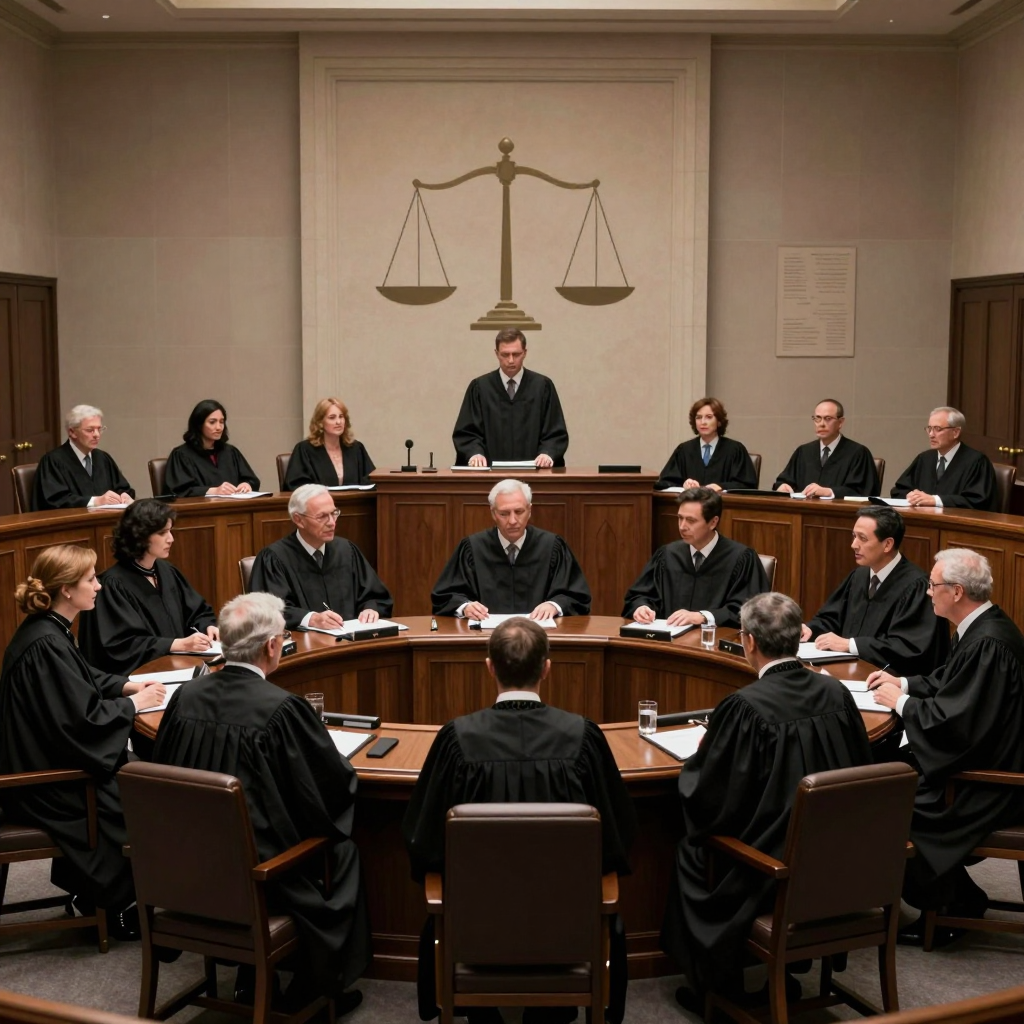
Judging by the name “Grand Bench,” one might assume that the Chief Justice and all 13 other Supreme Court Justices—in other words, all 14 members—must gather in one place before a decision can be made. In practice, however, the system works somewhat differently.
Under the Court Organization Act, the Grand Bench may exercise jurisdiction when at least two-thirds of the total number of Supreme Court Justices are present. Given that the full bench consists of 14 members, this means that, in principle, the Court can hear a case and reach a decision with 10 or more justices in attendance.
Although it is called the “Grand Bench,” its operation hinges not on the attendance of every member, but on meeting the legally required quorum.
This structure is designed to ensure that the Supreme Court’s function as the final arbiter does not come to a halt even in the event of vacant seats or circumstances such as a justice’s recusal or disqualification. This is also why the absence of some justices does not automatically delay every important case.
That said, the fewer the justices in attendance, the more intense public scrutiny inevitably becomes. This is especially true when the Grand Bench is considering a case that could overturn precedent or carries significant political or social sensitivity. In such cases, “who took part and who did not” is not merely a procedural issue—it can directly affect the persuasiveness and credibility of the ruling.
The final decision is also determined by a majority vote of the justices present. Justices who do not agree with the majority may include dissenting or separate opinions in the judgment. For that reason, a Grand Bench ruling is not simply a document presenting a single conclusion. It is also the published outcome of a public judicial debate, recording the competing legal principles and values within the Supreme Court.
Ultimately, the key question in understanding the Grand Bench is not simply whether “all 14 members were present.” We must also examine whether the statutory quorum was met, how the bench was composed, and what new standard the majority opinion established.
Supreme Court En Banc: What Kind of Case Opens the Door to the Nation’s Highest Court?
A case sent to the Supreme Court en banc does not determine the fate of just one person. When a case could overturn existing precedent or reset the legal standards for society as a whole, the Supreme Court closes the door on a regular panel and opens the door to its full bench.
If the Supreme Court’s regular panels handle ordinary cases by dividing them among themselves, the en banc court is the highest decision-making forum for setting the broader direction of legal interpretation. A referral, therefore, does not itself signal guilt or innocence, victory or defeat. It does, however, suggest that the case could become a “new point of reference” for Korean society.
When Precedent Needs to Change
The most common reason for referral is the need to revise existing Supreme Court precedent. When an earlier ruling no longer fits the changes of the times or newly emerging legal issues, it can be difficult for a regular panel alone to overturn the established doctrine.
At that point, the en banc court engages in wide-ranging deliberations among the Supreme Court justices to decide whether to preserve the existing standard or adopt a new interpretation. A single ruling can become the guiding standard for countless trials that follow.
When Courts Reach Conflicting Conclusions
Another important reason for referral arises when lower courts reach different conclusions on the same law. If outcomes vary by region or by panel, the public’s ability to predict how the law will be applied can be undermined.
The en banc court brings these divided interpretations together under a single principle. Put simply, it serves to announce the Supreme Court’s official standard: “From now on, this is how this issue will be decided.”
When a Case Has Broad Social Consequences
Cases involving labor, taxation, elections, criminal procedure, or large-scale collective disputes may also be sent to the en banc court. Although the parties to a case may be limited, the ruling’s effects can extend to countless people—including businesses, workers, voters, investigative agencies, and administrative bodies.
In politically sensitive cases especially, not only the need for referral but also the timing of the referral and the schedule for the ruling can become subjects of controversy. This is where the principle that the process exists to resolve legal questions collides with the reality that timing itself can ultimately affect the case.
The en banc court is more than a place that handles “important cases.” It is where the Supreme Court declares how the law will be applied—and what form it will take—in the future.
Ultimately, when the door to the en banc court opens, the Supreme Court is deciding more than the outcome of a single case. It is also shaping the direction of the law that society will follow after the ruling—in effect, drafting the outline of a new set of rules.
Vacancies on the Full Bench and the Politics of Time
What matters in judicial decisions is not only the conclusion. When that conclusion is reached can also change the substantive outcome of a case. This is especially true in criminal cases where the expiration of the detention period is approaching: the passage of time before a ruling can itself become a decisive factor in determining the defendant’s custody status and the course of the proceedings.
This is why the controversy surrounding the two vacancies on the Supreme Court and the referral of cases to the full bench has drawn attention. Under the Court Organization Act, the full bench may hear and decide a case as long as a required minimum number of justices is present, even if the Court’s full complement has not been filled. In practice, however, the proceedings and ruling schedule may be extended depending on the importance of the case, the composition of the bench, and the need to coordinate differing views.
When Waiting Becomes the Outcome
For a defendant in custody, time is not an abstract matter. Once the statutory detention period expires, the question of release may arise regardless of whether the defendant is ultimately found guilty or not guilty. Accordingly, if the ruling is delayed while the full bench hears the case, that delay is not merely an administrative scheduling issue; it can directly affect the individual’s liberty.
This is why politically sensitive cases inevitably raise questions such as:
- Was the referral to the full bench truly necessary to change precedent or clarify legal principles?
- To what extent did the vacancies on the Supreme Court affect the schedule for hearings and the ruling?
- Can a decision be reached before the detention period expires?
- What balance is needed between procedural caution and the right to a speedy trial?
A Vacancy Is More Than a Number
A vacancy on the Supreme Court is not simply a matter of having fewer judges. In a body such as the full bench, which establishes the Supreme Court’s authoritative position, the composition of the participating justices can itself affect the breadth of legal debate and the persuasiveness of the judgment.
Of course, the existence of vacancies does not automatically bring proceedings to a halt. Yet the more important the case, the greater the need for thorough review and careful coordination of views. In that process, delays in appointments can naturally become a question of time. That is why delays in appointing Supreme Court justices are not merely a gap in judicial administration; they also concern when the public can expect to receive a decision.
The moment a full-bench ruling is delayed, time ceases to be a neutral backdrop and becomes a variable capable of influencing the outcome of the case.
Ultimately, the issue is not simply speed, nor is it simply caution. The more open a case is to political interpretation, the more transparently the court must explain why the full bench is necessary, what procedures it will follow, and when it expects to reach a conclusion. Only then can “waiting” be understood as deliberation in the pursuit of justice, rather than viewed with suspicion as a delay intended to change the outcome.
The Supreme Court’s Grand Bench Could Become the Architect of a New Criminal Justice Order
The abolition of the Prosecutors’ Office, the establishment of a Public Prosecution Office and a Serious Crimes Investigation Agency, and police reform are not simply matters of changing the names of government institutions. They involve redesigning the very power structure of the criminal justice system—who investigates, who prosecutes, and who exercises control.
The real problems will begin once the new system takes effect. Where exactly will the boundary between investigation and prosecution lie? How will jurisdiction over cases be divided between the Serious Crimes Investigation Agency and the police? To what extent will the Public Prosecution Office be able to control illegality in the investigative process? Numerous conflicts are expected, and statutory provisions alone will have difficulty filling every gap.
Ultimately, such disputes will make their way to court, where they will await the Supreme Court’s final interpretation. In particular, when a case cannot be resolved under existing precedents or requires new standards for the nation’s criminal procedure, the Grand Bench is increasingly likely to step in.
The Grand Bench’s rulings will not merely determine the guilt or innocence of the parties in a single case. For example, decisions concerning the standards for excluding illegally obtained evidence, conflicts of authority among investigative agencies, and the scope of protections for suspects’ right to mount a defense will become substantive rules that investigative agencies and courts nationwide must follow thereafter.
If a system is created by statute, the way that system actually operates is ultimately completed through case law.
In this respect, the Grand Bench could serve not only as the “court of last resort” for the new criminal justice system, but also as the architect of the judicial order, coordinating the gaps and conflicts within the system. Going forward, what matters will not be limited to the speed of institutional reform. The answer to how citizens’ fundamental rights and the limits of state power should be balanced under the new system is likely to take concrete shape through the Grand Bench’s rulings.
Comments
Post a Comment